Mathematics notes, unit 1
Numbers up to 100
Textbook Mathematics Year 1 (DLP), Textbook Part 1 and Part 2, pages 1–54
What this chapter covers
- You can say which group has more and which has fewer, and match things one to one (1.1)
- You can count, say, read and write the numbers 0 to 100 in numerals and in words (1.2, 1.3)
- You can show how two numbers make a bigger number, such as 4 and 6 make 10 (1.4)
- You can say the place value and the digit value of a digit in a two-digit number (1.6)
- You can say which number is more or less, and use "1 more than" and "1 less than" (1.2)
- You can arrange numbers in ascending and descending order, and count on and back in ones, twos, fives and tens (1.5)
- You can finish simple number patterns (1.9)
- You can estimate with "about", "more than" and "less than", and round off to the nearest ten (1.7, 1.8)
- You can solve simple number problems (1.10)
1.1Many and few
We can compare two groups. Match the things one to one. The group with things left over has more. The other group is less.

If two groups match one to one with none left over, they are equal.
There are 6 cups and 6 plates. Are they equal or not equal?
Show answerHide answer
Equal. Each cup has one plate.
1.2Numbers 0 to 20
Count the things, then say the number. Zero (0) means none.
| 0 | 1 | 2 | 3 | 4 | 5 | 6 | 7 | 8 | 9 | 10 |
|---|---|---|---|---|---|---|---|---|---|---|
| zero | one | two | three | four | five | six | seven | eight | nine | ten |
| 11 | 12 | 13 | 14 | 15 | 16 | 17 | 18 | 19 | 20 |
|---|---|---|---|---|---|---|---|---|---|
| eleven | twelve | thirteen | fourteen | fifteen | sixteen | seventeen | eighteen | nineteen | twenty |
For 11 to 20, make a group of 10 first. Then count on. 10 and 3 is 13.
How do you write 16 in words? What is 10 and 8?
Show answerHide answer
sixteen. 10 and 8 is 18.
1.3Making numbers
Two small numbers can make a bigger number. This is a combination.


| Combinations of 10 |
|---|
| 0 and 10, 1 and 9, 2 and 8, 3 and 7, 4 and 6, 5 and 5 |
Order does not matter. 7 and 3 make 10, and 3 and 7 make 10 too.
6 and ___ make 10.
Show answerHide answer
4. 6 and 4 make 10.
1.4Numbers 21 to 100
Count in groups of ten. 3 groups of ten is 30. Then count on in ones: 30, 31, 32, 33, 34.
| 10 | 20 | 30 | 40 | 50 | 60 | 70 | 80 | 90 | 100 |
|---|---|---|---|---|---|---|---|---|---|
| ten | twenty | thirty | forty | fifty | sixty | seventy | eighty | ninety | one hundred |
Say and write 34 and 45
30 and 4 is 34: thirty-four.40 and 5 is 45: forty-five.
Watch the spelling. It is forty (no "u" in four), and fourteen keeps the "u".
10 tens make 100 (one hundred).
Write 72 in words.
Show answerHide answer
seventy-two.
1.5Place value and digit value
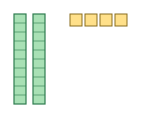
A digit is one of the numbers 0 to 9. The number 24 has two digits, 2 and 4.
Place value is the place of the digit: tens or ones.
Digit value is what the digit is worth. In 24, the 2 is worth 20 and the 4 is worth 4.
Place value is the place of the digit: tens or ones.
Digit value is what the digit is worth. In 24, the 2 is worth 20 and the 4 is worth 4.
| Number 58 | Digit 5 | Digit 8 |
|---|---|---|
| Place value | tens | ones |
| Digit value | 50 | 8 |
67 and 76 use the same digits, but they are different numbers. Look at which digit is in the tens place.
In 83, what is the digit value of 8?
Show answerHide answer
8 is in the tens place, so its digit value is 80.
1.6More than and less than
Which is less, 38 or 45?
Compare the tens first. 3 tens is less than 4 tens, so 38 is less than 45.If the tens are the same, compare the ones: 57 is more than 53.
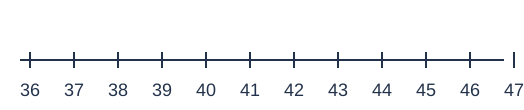
Say it in a sentence: "45 is more than 38. 38 is less than 45."
Which is more, 74 or 69?
Show answerHide answer
7 tens is more than 6 tens, so 74 is more.
1.7Arranging and counting
Ascending order: from the smallest to the biggest, like 1, 2, 3, 4, 5.
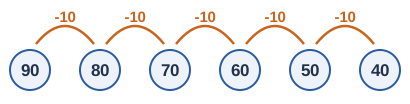
Descending order: from the biggest to the smallest, like 5, 4, 3, 2, 1.
Descending order: from the biggest to the smallest, like 5, 4, 3, 2, 1.
- 1 more than 38 is 39 (the number after).
- 1 less than 38 is 37 (the number before).
- The number between 38 and 40 is 39.
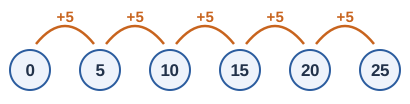
Arrange 25, 45 and 35 in ascending order.
Show answerHide answer
25, 35, 45.
1.8Number patterns
A number pattern repeats or follows a rule.

Counting patterns follow a rule too. 82, 84, 86, 88 goes up in twos. 100, 90, 80, 70 goes down in tens.
What comes next? 6, 1, 6, 1, 6, ___
Show answerHide answer
1. The numbers 6 and 1 take turns.
1.9Estimating and rounding off
To estimate is to make a good guess. Use the words about, more than and less than. A bigger box holds more things than a smaller box.
Round off to the nearest ten
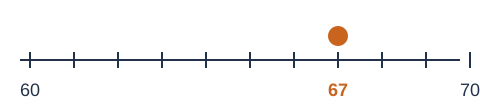
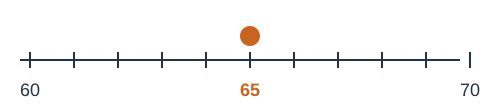
Look at the ones digit. 0, 1, 2, 3, 4: stay at the tens (22 becomes 20). 5, 6, 7, 8, 9: go up (28 becomes 30).
Round off 74 and 85 to the nearest ten.
Show answerHide answer
74 becomes 70. 85 becomes 90.
1.10Solving problems
Read the problem. Draw a picture or a number line. Then find the answer.
Ali has 45 marbles. Kumar has 5 fewer.
Kumar has 5 less than 45. Count back 5 from 45: 44, 43, 42, 41, 40.Kumar has 40 marbles.
Make numbers with cards 7 and 2
Put 7 in the tens place: 72. Put 2 in the tens place: 27. The biggest is 72.Use the cards 4 and 9. What is the biggest two-digit number you can make?
Show answerHide answer
94. Put the bigger digit in the tens place.
Summary
- Match one to one to find which group has more or less.
- Numbers up to 100 are made of tens and ones. Say and write them in words.
- Combinations: 4 and 6 make 10.
- Place value is tens or ones. Digit value is what the digit is worth (the 5 in 58 is 50).
- Compare the tens first, then the ones.
- Ascending is small to big. Descending is big to small.
- Estimate with "about", "more than" and "less than". Round off by looking at the ones digit.
Based on the Year 1 textbook, pages 1 to 54.