Length, Mass and Volume of Liquid
What this chapter covers
- You can use the units centimetre (cm) and metre (m), and know that 1 m = 100 cm (6.1.1)
- You can measure the length of objects with a ruler and draw straight lines (6.1.2)
- You can estimate lengths and say "more than" or "less than" (6.1.3)
- You can use the units gram (g) and kilogram (kg), and know that 1 kg = 1 000 g (6.2.1)
- You can read a weighing scale and estimate the mass of objects (6.2.2, 6.2.3)
- You can use the units millilitre (mℓ) and litre (ℓ), and know that 1 ℓ = 1 000 mℓ (6.3.1)
- You can measure and estimate the volume of liquid (6.3.2, 6.3.3)
- You can solve simple everyday problems about length, mass and volume of liquid (6.4.1)
In this unit we measure how long things are (length), how heavy they are (mass) and how much liquid they hold (volume of liquid). Each one has a small unit and a big unit.
| We measure | Small unit | Big unit | The big unit is |
|---|---|---|---|
| Length | centimetre (cm) | metre (m) | 1 m = 100 cm |
| Mass | gram (g) | kilogram (kg) | 1 kg = 1 000 g |
| Volume of liquid | millilitre (mℓ) | litre (ℓ) | 1 ℓ = 1 000 mℓ |
6.1Length: centimetres and metres
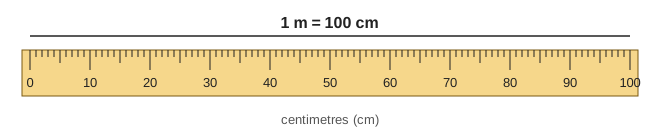
1 m = 100 cm
A pencil is about 15 cm. A door is about 2 m tall. The symbol for centimetre is cm and the symbol for metre is m.
Measure with a ruler
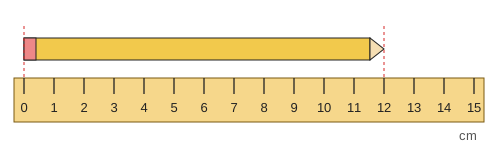
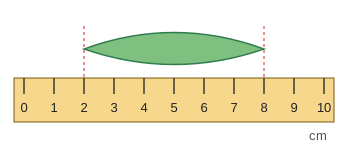
Each space on the ruler is 1 cm. Start from 0 and read the number where the object ends.
Estimate length
To estimate is to make a good guess. Use words like "about", "more than" and "less than". Then measure to check.
b) 1 m = ___ cm
c) A ribbon starts at 0 and ends at 7 on a ruler. How long is it?
Show answerHide answer
b) 100 cm
c) 7 cm
6.2Mass: grams and kilograms
1 kg = 1 000 g
A slice of bread is about 40 g. A bag of rice is 5 kg. The symbol for gram is g and the symbol for kilogram is kg.
Read a weighing scale
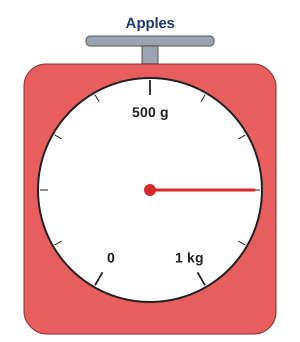
- Before you weigh, make sure the needle points to 0.
- Look at the graduation: how much is each small mark worth?
- Read where the needle stops.
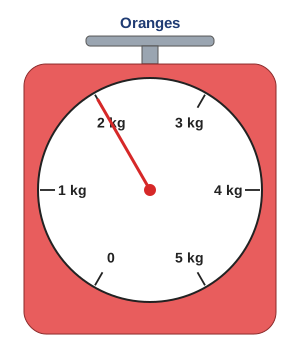
b) 1 kg = ___ g
c) A mango is about 300 g. About how much are 2 mangoes?
Show answerHide answer
b) 1 000 g
c) about 600 g (300 + 300)
6.3Volume of liquid: millilitres and litres
1 ℓ = 1 000 mℓ
A box of milk is 1 ℓ. A glass of juice is about 250 mℓ. A spoon of medicine is 5 mℓ. The symbols are mℓ and ℓ.
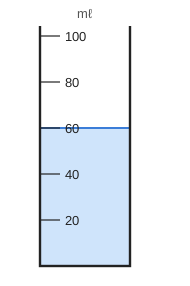
Measure liquid
- Use a beaker, a measuring cylinder or a measuring jug.
- Look at the graduation first.
- Look at the water level at eye level. Then read the volume.
Estimate volume
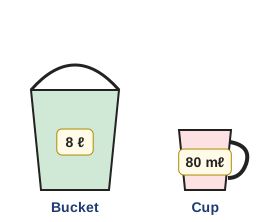
If a jug of juice is 1 ℓ, then a container that looks twice as big holds about 2 ℓ. Say "more than" or "less than" and then measure to check.
b) 1 ℓ = ___ mℓ
c) The beaker above shows 60 mℓ. How much more water to make 100 mℓ?
Show answerHide answer
b) 1 000 mℓ
c) 100 − 60 = 40 mℓ
6.4Solve everyday problems
Read the question slowly. Ask: What do I know? What must I find? Then pick the unit that fits.
10 cm is more than 8 cm. The blue thread is longer.
Show answerHide answer
Summary
- Length: cm for short things, m for long things. 1 m = 100 cm.
- Mass: g for light things, kg for heavy things. 1 kg = 1 000 g.
- Volume of liquid: mℓ for small amounts, ℓ for big amounts. 1 ℓ = 1 000 mℓ.
- Start measuring from 0, check the graduation and write the unit.
- Estimate with "about", "more than" and "less than", then measure to check.