Science notes, unit 7
Electricity
Textbook Science Year 2 (DLP), pages 73–86
What this chapter covers
- You can name a dry cell, a bulb, a switch and connecting wires (7.1.1)
- You can say what a dry cell, a bulb and a switch do (7.1.2)
- You can build a simple electric circuit that lights a bulb (7.1.3)
- You can tell a complete circuit from an incomplete circuit (7.1.3)
- You can give reasons why a bulb in a circuit does not light up (7.1.4)
- You can test objects and sort them into conductors and insulators (7.1.5, 7.1.6, 7.1.7)
Picture: Science Year 2 (DLP) textbook, p. 73.
7.1Electrical components
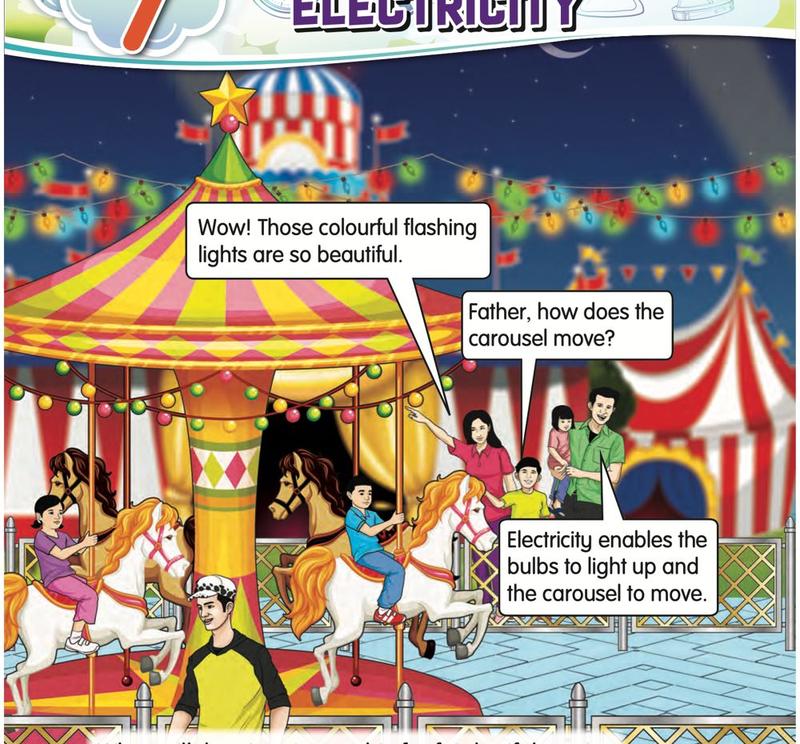
Electricity makes bulbs light up. We can build an electric circuit with a few parts. The parts are called electrical components.
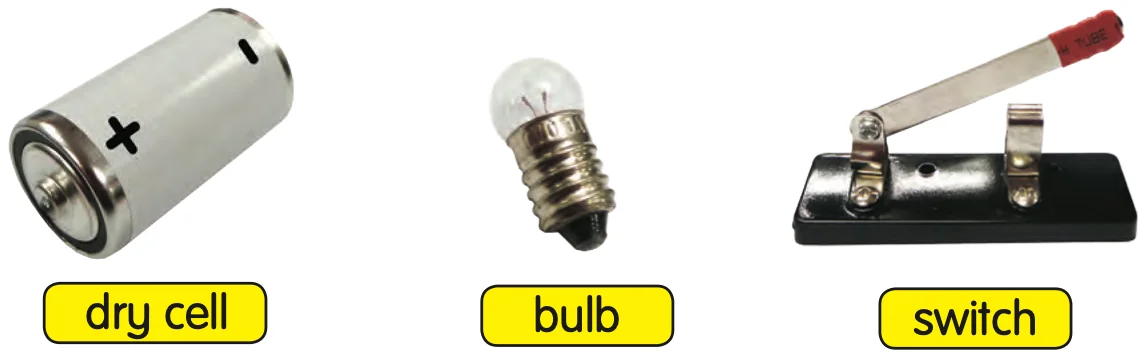
The three main electrical components are a dry cell, a bulb and a switch. We join them with connecting wires.
Picture: Science Year 2 (DLP) textbook, p. 74.
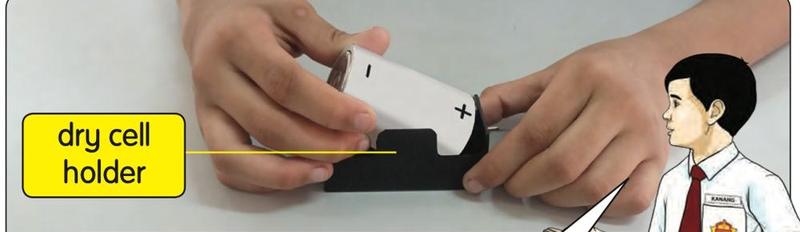
- Put the dry cell in a dry cell holder.
- Screw the bulb onto the bulb holder.
- Use wires to join every part.
Picture: Science Year 2 (DLP) textbook, p. 74.
What each part does
| Component | Function |
|---|---|
| Dry cell | Supplies electrical energy |
| Bulb | Produces light |
| Switch | Completes and breaks the circuit |
| Connecting wire | Joins the parts together |
Bulbs are made of glass. They break easily, so hold them gently.
Did you know? A buzzer can take the place of the bulb. A buzzer makes a sound.
Which component supplies electrical energy?
Show answerHide answer
The dry cell.
7.2Complete and incomplete circuits
Picture: Science Year 2 (DLP) textbook, p. 75.
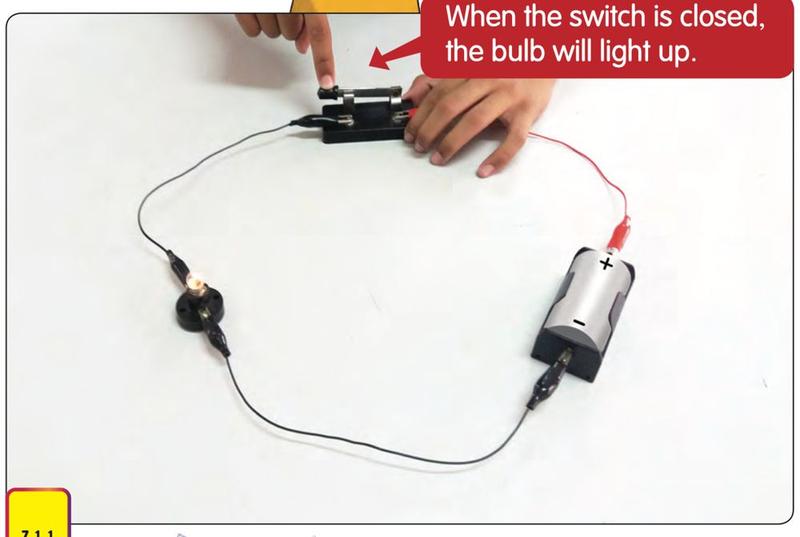
A complete circuit has no gaps, and the switch is closed. The bulb lights up.
An incomplete circuit has a gap, or the switch is opened. The bulb does not light up.
An incomplete circuit has a gap, or the switch is opened. The bulb does not light up.
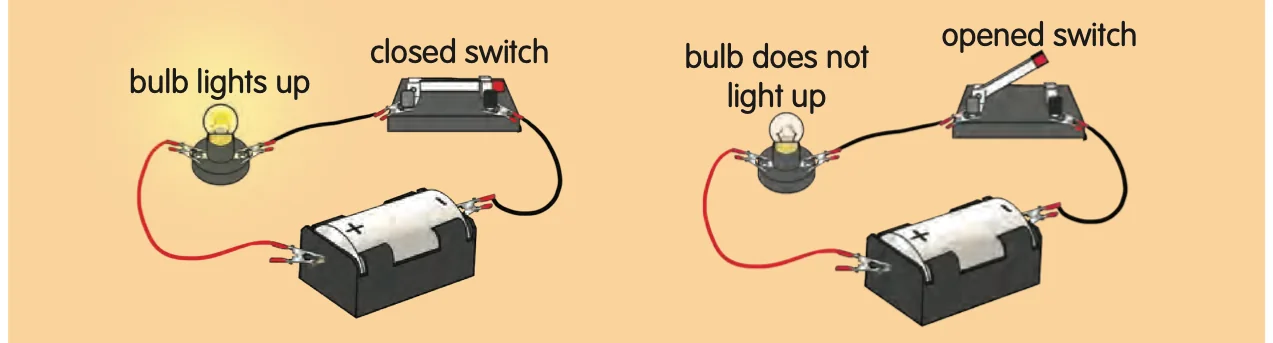
Picture: Science Year 2 (DLP) textbook, p. 85.
| Switch | Circuit | Bulb |
|---|---|---|
| Closed | Complete | Lights up |
| Opened | Incomplete | Does not light up |
The switch is opened. Does the bulb light up?
Show answerHide answer
No. The circuit is incomplete.
7.3Why does the bulb not light up?
The bulb is still dark. Check these things.
- The switch is opened, so the circuit is incomplete.
- The bulb is damaged.
- The dry cell has no more energy.
- The bulb is not fastened properly onto the bulb holder.
- A wire is not connected properly.
- The bulb holder, wire, dry cell holder or switch is faulty.
Change one thing at a time. Then you know which part was the problem.
Name two reasons why a bulb in a circuit does not light up.
Show answerHide answer
Any two: the switch is opened, the bulb is damaged, the dry cell has no energy, the bulb is loose, a wire is not connected.
7.4Conductors and insulators
We put different objects in a circuit in place of the switch. Some objects make the bulb light up. Some do not.
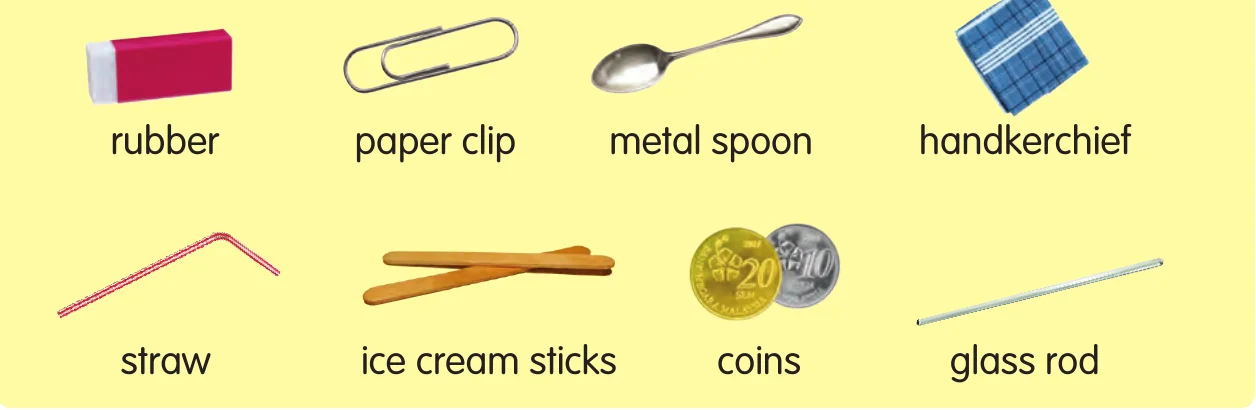
Picture: Science Year 2 (DLP) textbook, p. 81.
A conductor lets electric current flow through it. The bulb lights up.
An insulator does not let electric current flow through it. The bulb stays dark.
An insulator does not let electric current flow through it. The bulb stays dark.
| Conductors | Insulators |
|---|---|
| Paper clip, metal spoon, coin, nail, fork, screw | Rubber, plastic, cloth, straw, glass rod, ice cream stick, banknote, leaf, thread |
Most metals are conductors. Rubber, plastic and cloth are insulators.

Picture: Science Year 2 (DLP) textbook, p. 86.
Is a metal spoon a conductor or an insulator? How do you know?
Show answerHide answer
A conductor. The bulb lights up when it is in the circuit.