Practice paper, not an official KPM paper
Sains Tahun 3
Ujian Akhir Sesi AkademikEnd of Academic Session Test
SainsScience
Darjah 3, 1 jam / 1 hour, 40 marks
Nama / Name
Kelas / Class
Tarikh / Date
Markah / Marks: / 40
Instructions
- Jawab semua soalan.Answer all questions.
- Bahagian A: bulatkan satu jawapan yang betul.Section A: circle one correct answer.
- Bahagian B: tulis jawapan anda di ruang yang disediakan.Section B: write your answers in the spaces provided.
Answer schemes are in English (DLP).
Practice shows answers as you go. Exam times you and hides answers until you submit.
Bahagian ASection A
10 marksJawab semua soalan. Setiap soalan diikuti oleh empat pilihan jawapan, A, B, C dan D. Bulatkan satu jawapan yang betul.Answer all questions. Each question has four options, A, B, C and D. Circle one correct answer.
1
Question 1
Dinda menyusun manik mengikut satu corak, seperti dalam Rajah 1. Apakah warna manik yang seterusnya?Dinda threads beads in a pattern, as shown in Diagram 1. What is the colour of the next bead?

Show answerHide answer
C
The pattern is green, blue, red and then it repeats. The last bead shown is blue, so the next bead is red. Predicting means using a pattern to say what comes next (textbook p. 11).
2
Question 2
Mengapakah kita perlu membuka semua pintu dan tingkap bilik sains sebelum aktiviti bermula?Why must we open all the doors and windows of the Science Room before an activity starts?
Show answerHide answer
B
Open doors and windows let in light and fresh air. A closed room becomes hot, dark and stuffy (textbook p. 24).
3
Question 3
Sebahagian makanan yang kita makan tidak dapat dicerna. Apakah yang berlaku kepada makanan yang tidak dicerna itu?Some of the food we eat cannot be digested. What happens to the food that is not digested?
Show answerHide answer
A
Food that the body does not need, or cannot digest, leaves the body through the anus as faeces (textbook p. 52). Only digested nutrients are absorbed in the intestine.
4
Question 4
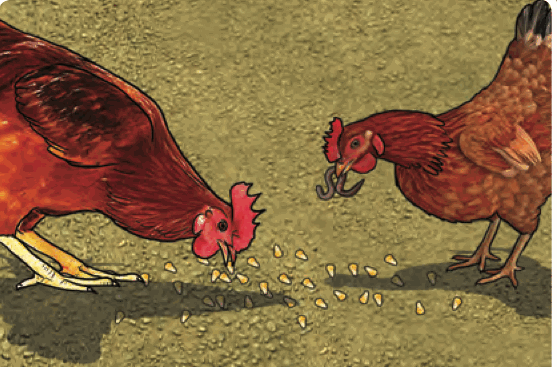
Rajah 2 menunjukkan ayam sedang makan biji-bijian dan cacing. Mengapakah ayam dikelaskan sebagai omnivor?Diagram 2 shows chickens eating seeds and a worm. Why is a chicken classified as an omnivore?
Show answerHide answer
C
Seeds come from plants and worms are animals. An animal that eats both plants and other animals is an omnivore.
5
Question 5
Tumbuhan manakah membiak melalui daun?Which plant reproduces through its leaves?
Show answerHide answer
D
Setawar and the snake plant grow new plants from their leaves (textbook p. 73). Hibiscus and tapioca use stem cuttings; the banana plant grows suckers.
6
Question 6
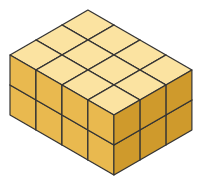
Rajah 4 menunjukkan sebuah kotak berongga yang dipenuhi dengan kubus. Isi padu setiap kubus ialah 1 cm³. Berapakah isi padu kotak itu?Diagram 4 shows a hollow box filled with cubes. The volume of each cube is 1 cm³. What is the volume of the box?
Show answerHide answer
C
One layer has 4 × 3 = 12 cubes and there are 2 layers, so 12 × 2 = 24 cubes. The volume is 24 cm³. 18 cm³ counts only the cubes we can see; six cubes are hidden inside.
7
Question 7
Sebatang kayu balak yang besar dan berat terapung di atas air. Sebiji klip kertas yang kecil dan ringan tenggelam. Mengapakah keadaan ini berlaku?A big, heavy log floats on water. A small, light paper clip sinks. Why does this happen?
Show answerHide answer
A
Floating and sinking depend on density, not on size or weight. A log is less dense than water, so it floats. A paper clip is more dense than water, so it sinks (textbook p. 99).
8
Question 8
Rani minum kopi tanpa gula. Kopi itu berasa pahit. Rani berkata kopi itu beralkali. Bagaimanakah Rani boleh menyemak sifat kopi itu dengan betul?Rani drinks coffee without sugar. The coffee tastes bitter. Rani says the coffee is alkaline. How can Rani check the property of the coffee correctly?
Show answerHide answer
D
Taste and touch are not scientific indicators. Coffee tastes bitter but it turns blue litmus paper red, so it is acidic (textbook p. 109). Litmus paper gives the true answer.
9
Question 9
Kebanyakan asteroid terdapat di antara dua buah planet. Antara pasangan planet berikut, yang manakah betul?Most asteroids are found between two planets. Which pair of planets is correct?
Show answerHide answer
B
Asteroids are big pieces of rock. Most of them are found between Mars and Jupiter (textbook p. 116).
10
Question 10
Sebuah kren menggunakan takal tetap dan takal alih bersama-sama. Apakah nama jenis takal ini?A crane uses a fixed pulley and a movable pulley together. What is the name of this type of pulley?
Show answerHide answer
D
A fixed pulley and a movable pulley used together make a compound pulley (textbook p. 135). Cranes at ports and construction sites use them.
Bahagian BSection B
30 marksJawab semua soalan. Tulis jawapan anda di ruang yang disediakan.Answer all questions. Write your answers in the spaces provided.
11
Question 11
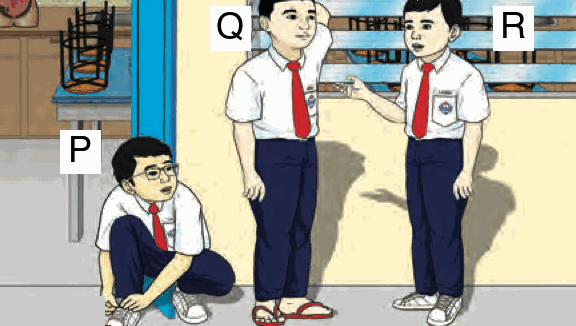
Rajah 6 menunjukkan tiga orang murid, P, Q dan R, di luar bilik sains sebelum aktiviti bermula.Diagram 6 shows three pupils, P, Q and R, outside the Science Room before an activity starts.
[1 mark]
(a)Murid manakah tidak mematuhi peraturan bilik sains?Which pupil does not follow the Science Room rules?
Show answerHide answer
Q
Q wears slippers. Shoes that cover the feet must be worn in the Science Room (textbook p. 24).
[1 mark]
(b)Mengapakah murid perlu memakai kasut yang menutup kaki di dalam bilik sains?Why must pupils wear shoes that cover their feet in the Science Room?
Show answerHide answer
Tick each point you got.
[1 mark]
(c)Nyatakan satu peraturan bilik sains yang perlu dipatuhi semasa aktiviti.State one Science Room rule that must be followed during an activity.
Show answerHide answer
Any 1 points
Any one rule for during an activity (textbook p. 25). Rules for before (line up, bags outside, shoes, open windows) and after (clean, switch off) do not score.
Tick each point you got.
12
Question 12
Jadual di bawah menunjukkan makanan tiga jenis haiwan, P, Q dan R.
The table above shows the food of three animals, P, Q and R.
| Haiwan / Animal | Makanan / Food |
|---|---|
| P: lembu / cow | Rumput dan daun / Grass and leaves |
| Q: kelawar / bat | Buah dan serangga / Fruit and insects |
| R: katak / frog | Serangga sahaja / Insects only |
[1 mark]
(a)Haiwan manakah ialah karnivor?Which animal is a carnivore?
Show answerHide answer
R
R eats other animals only (insects), so it is a carnivore.
[1 mark]
(b)Mengapakah Q dikelaskan sebagai omnivor?Why is Q classified as an omnivore?
Show answerHide answer
Tick each point you got.
[1 mark]
(c)Gigi manakah yang digunakan oleh P untuk mengisar rumput?Which teeth does P use to grind grass?
Show answerHide answer
Molars
Incisors cut, canines tear and molars grind (textbook p. 64). A herbivore has big molars to grind plants.
[1 mark]
(d)Kucing di rumah ialah karnivor tetapi boleh makan nasi bercampur ikan. Haiwan boleh mengubah tabiat pemakanannya apabila ______ haiwan itu berubah.A cat at home is a carnivore but it may eat rice mixed with fish. An animal may change its eating habit when its ______ changes.
Show answerHide answer
surroundings
Animals may change their eating habits when their surroundings change, for example when their usual food is hard to find (textbook p. 67).
13
Question 13
Pak Ali menanam beberapa jenis tumbuhan di kebunnya. Pilih cara setiap tumbuhan itu membiak.Pak Ali grows some plants in his garden. Choose the way each plant reproduces.
[1 mark]
(a)Halia membiak melaluiGinger reproduces through
Show answerHide answer
underground stems
Ginger, turmeric, onion and potato are underground stems (textbook p. 72).
[1 mark]
(b)Pokok bunga raya membiak melaluiHibiscus reproduces through
Show answerHide answer
stem cuttings
A piece of stem of a hibiscus plant can be planted and it grows into a new plant (textbook p. 73).
[1 mark]
(c)Rambutan membiak melaluiRambutan reproduces through
Show answerHide answer
seeds
Plants that make fruits, such as rambutan, reproduce through seeds (textbook p. 72).
[1 mark]
(d)Ubi keledek boleh membiak melalui keratan batang dan ______.Sweet potato can reproduce through stem cuttings and ______.
Show answerHide answer
underground stems
Sweet potato reproduces in two ways: stem cuttings and underground stems (textbook p. 76).
14
Question 14
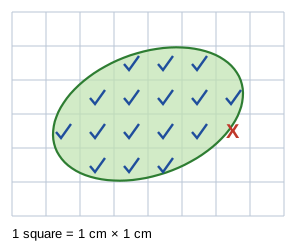
Mei meletakkan sehelai daun di atas kertas graf. Setiap petak ialah 1 cm × 1 cm. Dia melukis sekeliling daun itu dan menanda (✓) petak yang penuh dan petak yang separuh penuh atau lebih. Rajah 9 menunjukkan hasil kerjanya.Mei puts a leaf on graph paper. Each square is 1 cm × 1 cm. She draws around the leaf and ticks (✓) the squares that are full or half full or more. Diagram 9 shows her work.
[1 mark]
(a)Anggarkan luas daun itu. Tulis unitnya sekali.Estimate the area of the leaf. Write the unit too.
Show answerHide answer
Tick each point you got.
[1 mark]
(b)Mengapakah petak X tidak ditanda (✓)?Why is square X not ticked (✓)?
Show answerHide answer
Tick each point you got.
[1 mark]
(c)Mei mengukur isi padu air di dalam silinder penyukat. Matanya perlu beradaMei measures the volume of water in a measuring cylinder. Her eyes must be
Show answerHide answer
level with the bottom of the meniscus
Eyes too high give a reading that is too big; eyes too low give a reading that is too small (textbook p. 89).
[1 mark]
(d)Encik Tan mengukur luas dinding sebelum membeli cat. Mengapakah pengukuran itu penting?Mr Tan measures the area of a wall before he buys paint. Why is the measuring important?
Show answerHide answer
Measuring carefully helps us not to waste things (textbook p. 94).
Tick each point you got.
15
Question 15
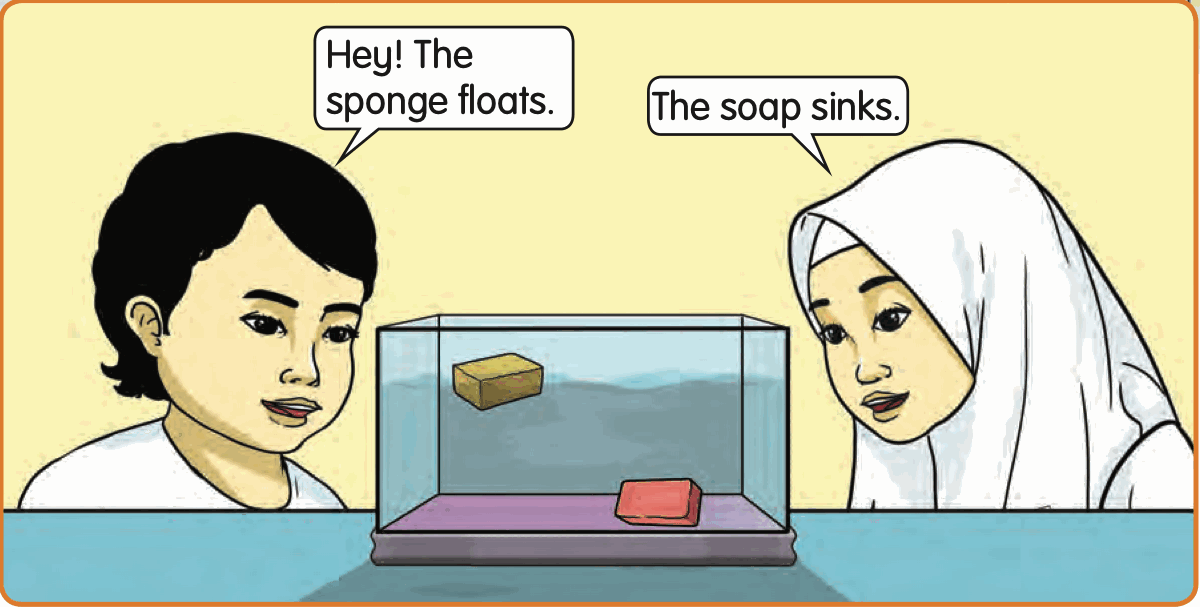
Rajah 10 menunjukkan sekeping span dan seketul sabun di dalam air. Span itu timbul dan sabun itu tenggelam.Diagram 10 shows a sponge and a bar of soap in water. The sponge floats and the soap sinks.
[1 mark]
(a)Mengapakah span itu timbul?Why does the sponge float?
Show answerHide answer
Tick each point you got.
[1 mark]
(b)Sabun itu tenggelam kerana sabun itu ______ daripada air.The soap sinks because it is ______ than water.
Show answerHide answer
more dense
Objects that are more dense than water sink.
[1 mark]
(c)Ketulan ais timbul di dalam segelas teh ais. Ais ______ daripada air.Ice cubes float in a glass of iced tea. Ice is ______ than water.
Show answerHide answer
less dense
Ice floats, so it is less dense than water (textbook p. 99).
16
Question 16
Mei menguji tiga bahan, P, Q dan R, dengan ekstrak kunyit yang berwarna kuning. Kemudian, dia menguji Q dan R dengan kertas litmus. Jadual di bawah menunjukkan keputusannya.
Mei tests three substances, P, Q and R, with yellow turmeric extract. Then she tests Q and R with litmus paper. The table above shows the results.
| Bahan / Substance | Ekstrak kunyit / Turmeric extract | Kertas litmus biru / Blue litmus paper | Kertas litmus merah / Red litmus paper |
|---|---|---|---|
| P | Bertukar menjadi merah keperangan / Turns reddish-brown | Tidak diuji / Not tested | Tidak diuji / Not tested |
| Q | Kekal kuning / Stays yellow | Bertukar menjadi merah / Turns red | Tiada perubahan / No change |
| R | Kekal kuning / Stays yellow | Tiada perubahan / No change | Tiada perubahan / No change |
[1 mark]
(a)Bahan P bersifatSubstance P is
Show answerHide answer
alkaline
Turmeric extract turns reddish-brown only with an alkaline substance (textbook p. 112).
[1 mark]
(b)Nyatakan sifat bahan Q.State the property of substance Q.
Show answerHide answer
Tick each point you got.
[1 mark]
(c)Mengapakah Mei menggunakan kertas litmus untuk menguji Q dan R selepas menggunakan ekstrak kunyit?Why did Mei use litmus paper to test Q and R after using turmeric extract?
Show answerHide answer
Both Q (acidic) and R (neutral) kept the yellow colour, so a second test with litmus paper was needed.
Tick each point you got.
[1 mark]
(d)Tanah di sebuah ladang terlalu berasid. Antara P, Q dan R, bahan manakah sesuai ditabur pada tanah itu? Terangkan.The soil on a farm is too acidic. Which substance, P, Q or R, is suitable to add to the soil? Explain.
Show answerHide answer
An acid and an alkali cancel each other out. Farmers add agricultural lime (alkaline) to acidic soil (textbook p. 111). Q is acidic and R is neutral, so neither would help.
Tick each point you got.
17
Question 17
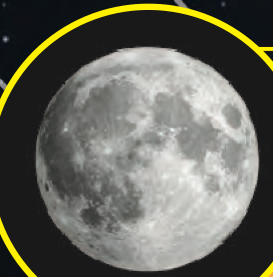
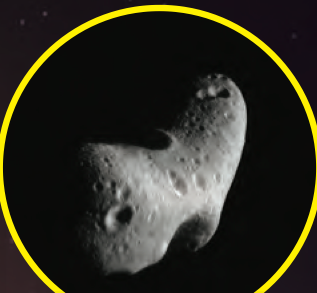
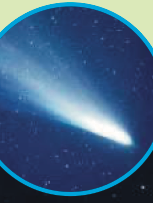
Rajah 11 menunjukkan tiga ahli Sistem Suria, P, Q dan R. Pilih nama yang betul bagi setiap ahli itu.Diagram 11 shows three members of the Solar System, P, Q and R. Choose the correct name of each member.
[1 mark]
(a)P ialahP is a
Show answerHide answer
natural satellite
P is the Moon. It moves around the Earth, so it is a natural satellite.
[1 mark]
(b)Q ialahQ is an
Show answerHide answer
asteroid
Q is a big piece of rock. Most asteroids are found between Mars and Jupiter.
[1 mark]
(c)R ialahR is a
Show answerHide answer
comet
R is a ball of ice and dust with a long, bright tail.
18
Question 18
Lim membuat model takal untuk menaikkan baldi air. Rajah 12 menunjukkan langkah A hingga F.Lim makes a pulley model to lift a bucket of water. Diagram 12 shows steps A to F.
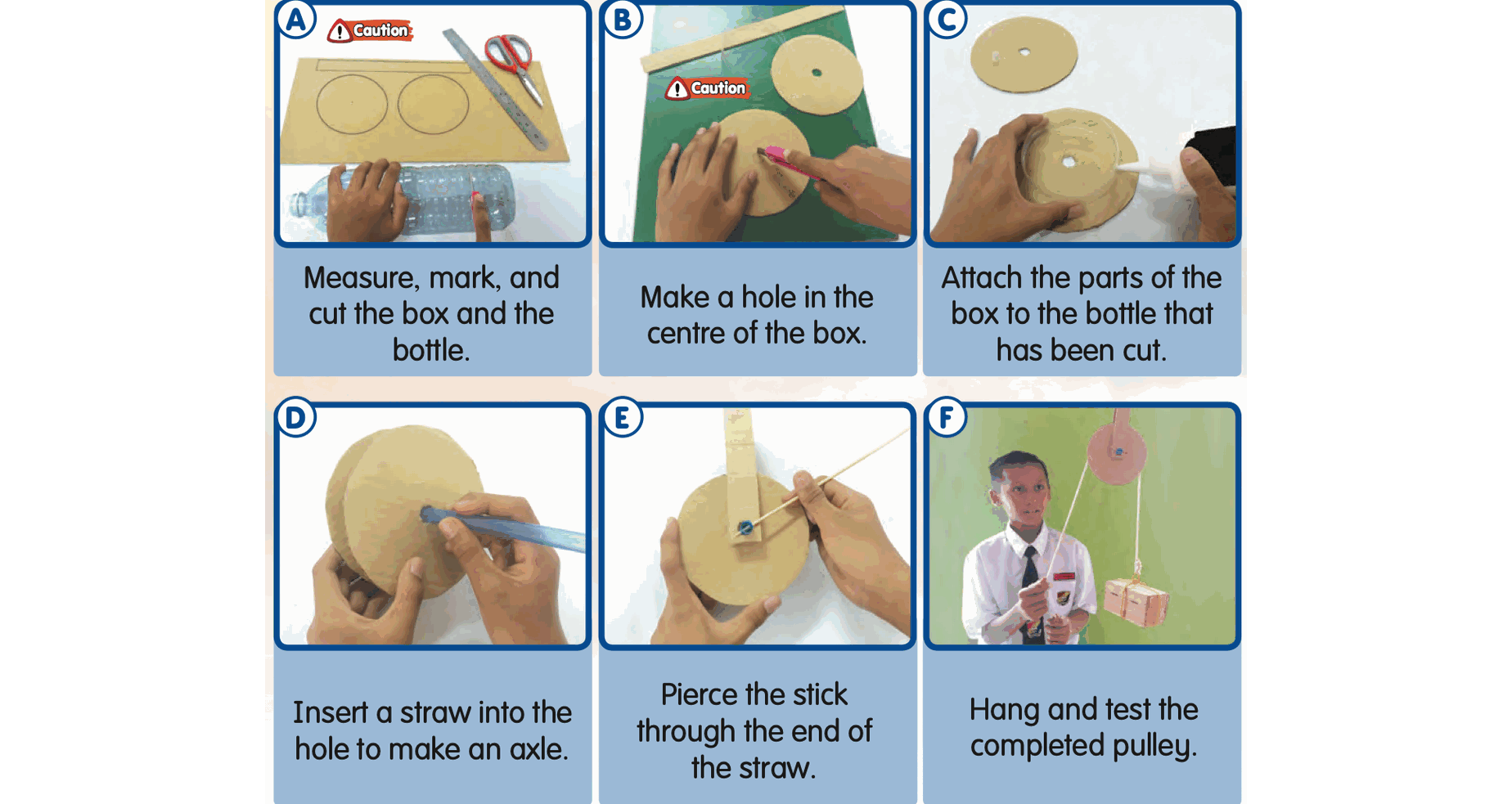
[1 mark]
(a)Apakah bahagian takal yang dibuat oleh straw dalam langkah D?Which part of the pulley is made by the straw in step D?
Show answerHide answer
axle
The straw is the axle; the wheel turns around it (textbook p. 134).
[1 mark]
(b)Lim perlu berhati-hati dalam langkah A dan B. Berikan sebab.Lim must be careful in steps A and B. Give a reason.
Show answerHide answer
Tick each point you got.
[1 mark]
(c)Mengapakah Lim melukis lakaran dahulu sebelum langkah A?Why does Lim draw a sketch before step A?
Show answerHide answer
Problem solving steps: find the problem, get an idea, sketch the idea, prepare materials, then build and test (textbook p. 133).
Tick each point you got.
[1 mark]
(d)Namakan satu bahan kitar semula untuk takal itu.Name one recycled material used.
Show answerHide answer
Any 1 points
Any one material seen in the steps (textbook p. 133-134).
Tick each point you got.
[1 mark]
(e)Bagaimanakah takal membantu menaikkan baldi air?How does the pulley help lift the bucket of water?
Show answerHide answer
Tick each point you got.
Test specification (JSU)
| Unit | Remembering | Understanding | Applying | Analysing | Evaluating | Creating | Items | marks |
|---|---|---|---|---|---|---|---|---|
| 1. Scientific skills | – | – | 1 (1) | – | – | – | 1 | 1 |
| 2. Science room rules | – | 1 (1) | 1 (3) | – | – | – | 2 | 4 |
| 3. Humans | 1 (1) | – | – | – | – | – | 1 | 1 |
| 4. Animals | – | 2 (5) | – | – | – | – | 2 | 5 |
| 5. Plants | 1 (1) | 1 (4) | – | – | – | – | 2 | 5 |
| 6. Measurement | – | – | 2 (5) | – | – | – | 2 | 5 |
| 7. Density | – | 1 (3) | – | 1 (1) | – | – | 2 | 4 |
| 8. Acid and alkali | – | – | 1 (1) | – | 1 (4) | – | 2 | 5 |
| 9. The solar system | 2 (4) | – | – | – | – | – | 2 | 4 |
| 10. Machine | 1 (1) | – | 1 (5) | – | – | – | 2 | 6 |
| Total | 5 (7) | 5 (13) | 6 (15) | 1 (1) | 1 (4) | 0 (0) | 18 | 40 |
Each cell shows items (marks).