Where are you from?
What this chapter covers
- I can say where people are from and what their nationality is, like "I'm from Mexico. I'm Mexican." (1.1)
- I can use country and nationality words, like the UK / British, Brazil / Brazilian, Korea / Korean, China / Chinese (1.1)
- I can talk about daily routines with always, usually, sometimes and never (1.2)
- I can say what people do with the present simple, including he / she plays and does he / she...? (1.2)
- I can tell the time with half past, a quarter past and a quarter to (1.2)
- I can ask and answer "What is he doing?" with the present continuous, like "He's reading." (1.3)
- I can read an e-mail to a pen pal and write one about myself, my family and my hobbies (1.4)
- I can read a story and talk about its characters and what they do (1.5)
- I can say the endings /s/, /z/ and /iz/ in words like paints, reads and washes (1.6)
Welcome to Module 1! You will meet Greg and Anna and their new friends from around the world. You will learn to say where people are from, talk about daily routines and hobbies, say what is happening now, and write an e-mail to a pen pal.
1.1Where are you from?

Get Smart Plus 4, p. 5.
We use a country name to say where a person is from. We use a nationality word to say what the person is.
| Country | Nationality |
|---|---|
| the UK | British |
| Brazil | Brazilian |
| Mexico | Mexican |
| the US | American |
| Korea | Korean |
| China | Chinese |
| Malaysia | Malaysian |
Get Smart Plus 4, pp. 5-7.
My friend's from the UK. Her name is Anastasia.
This is Paolo. He's from Brazil.
His friend's from the US. Her name is Jill.
Pattern: Where are you from?
| Question | Answer |
|---|---|
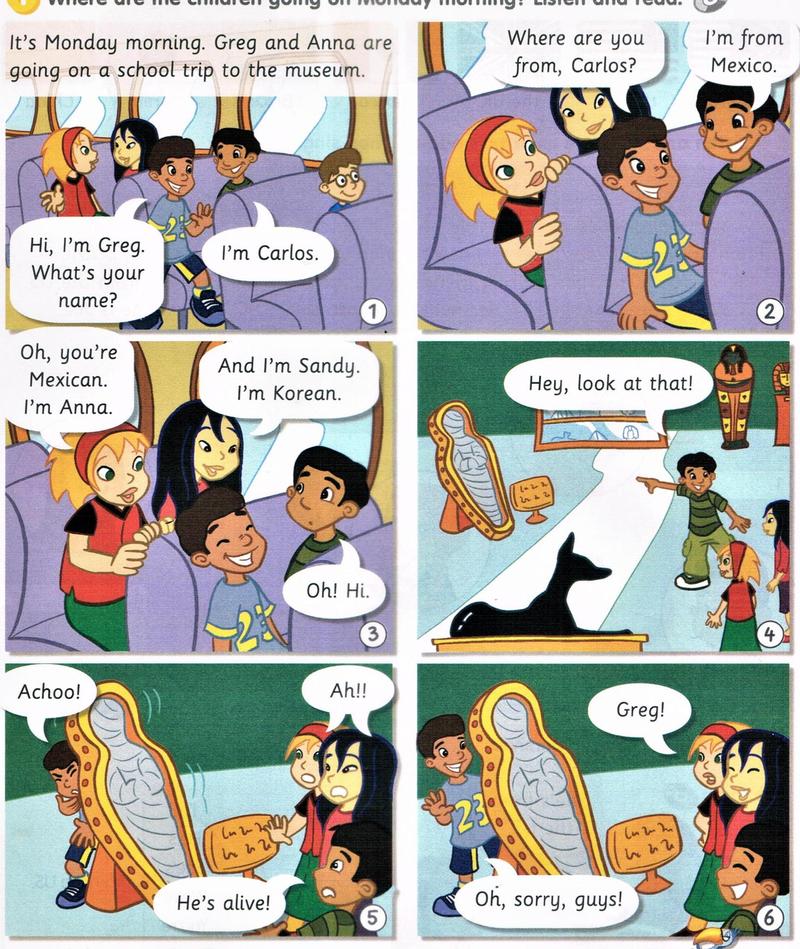
| Where are you from, Carlos? | I'm from Mexico. I'm Mexican. |
| Where is he / she from? | He's / She's from Korea. |
Use am / is / are with from: I'm, you're, he's, she's, we're, they're.
Get Smart Plus 4, p. 6.
The story: It is Monday morning. Greg and Anna are on a school trip to the museum. They meet Carlos, who is Mexican, and Sandy, who is Korean. At the museum they see an old mummy case. Greg hides behind it and sneezes ("Achoo!"), so the others think the mummy is alive. Then they see it is only Greg, and he says sorry.
Show answerHide answer
1.2Our world: daily routines
Get Smart Plus 4, p. 8.
Get Smart Plus 4, p. 8.
| Person | School | Home and bed |
|---|---|---|
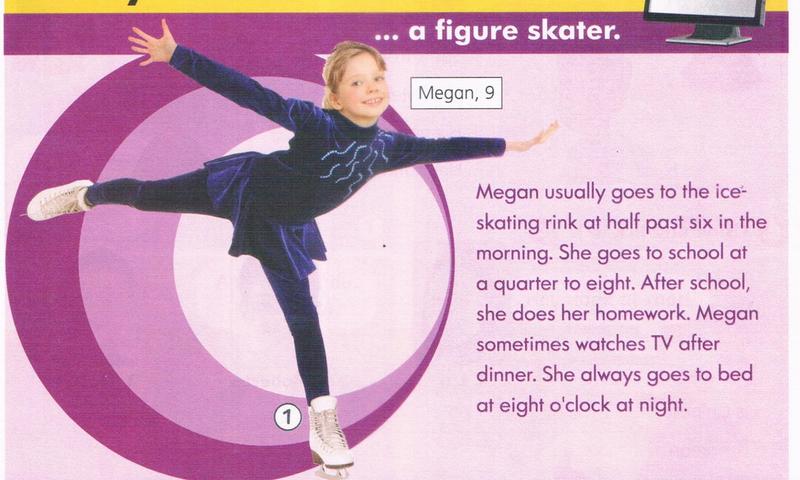
| Megan (9) | goes to school at a quarter to eight | does homework after school; always goes to bed at eight o'clock |
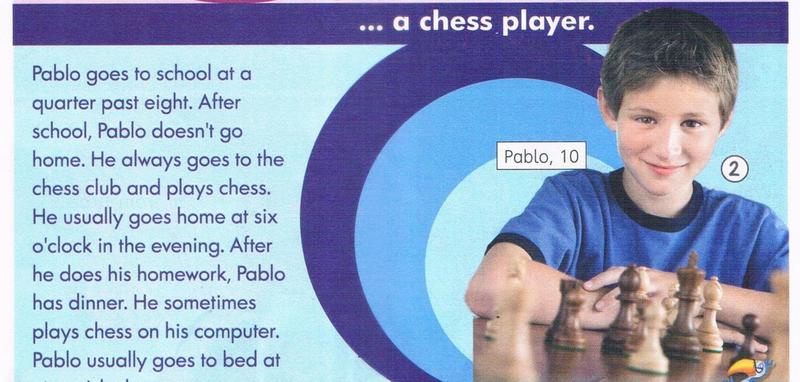
| Pablo (10) | goes to school at a quarter past eight | always goes to chess club after school; usually goes home at six o'clock; usually goes to bed at nine o'clock |
Telling the time
| Words | Digital time |
|---|---|
| six o'clock | 6:00 |
| half past six | 6:30 |
| a quarter past eight | 8:15 |
| a quarter to eight | 7:45 |
Adverbs of frequency
These words tell us how often something happens. From most often to never:
| Word | Meaning | Example (p. 9) |
|---|---|---|
| always | every time | I always skate before dinner. |
| usually | most times | You usually play baseball after school. |
| sometimes | not often | He sometimes plays chess. |
| never | not at any time | They never play volleyball. |
Get Smart Plus 4, p. 9.
The adverb goes before the main verb: "She always goes to bed at eight o'clock."
Present simple: he / she adds -s or -es
| Rule | Example |
|---|---|
| Most verbs take -s | speak, he speaks; play, he plays |
| Verbs ending in -ss, -ch, -x, -o take -es (also -sh) | watch, he watches; go, he goes; wash, he washes |
| Consonant + y: drop y, add -ies | study, he studies (but play, he plays) |
Get Smart Plus 4, p. 161 (Grammar reference).
| Sentence | Question | Short answers |
|---|---|---|
| I / you / we / they play. | Do you play? | Yes, I do. / No, I don't. |
| He / she plays. | Does he play? | Yes, he does. / No, he doesn't. |
Show answerHide answer
1.3Let's play: What is he doing?
We use the present continuous for what is happening now: am / is / are + verb-ing.
| Question | Answer |
|---|---|
| What is he / she doing? | He's / She's reading. |
| What are they doing? | They're swimming. |
| Where is he from? | He's from Korea. |
Get Smart Plus 4, p. 10.
Activities on p. 10: swimming, ice-skating, doing karate, playing badminton, exercising, playing football, playing computer games.
Show answerHide answer
1.4Project: an e-mail to a pen pal
I'm Kumar and I'm ten. I come from Malaysia and I live in Melaka. I've got a brother called Rama. Have you got any brothers or sisters?
My favourite sport is football, and in this picture I'm playing it. What's your favourite sport?
Please write back soon.
Bye for now,
Kumar
Get Smart Plus 4, p. 11.
| Fact | Kumar's e-mail |
|---|---|
| Name | Kumar |
| Age | ten |
| From | Malaysia |
| Lives in | Melaka |
| Family | a brother, Rama |
| Likes | football |
Show answerHide answer
1.5Story time: Charlie's birthday surprise 1
Get Smart Plus 4, p. 12.
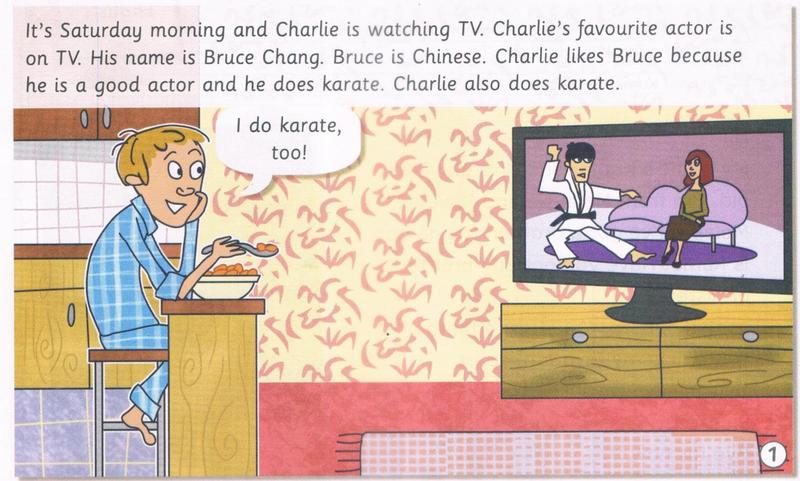
Summary: Charlie's favourite actor is Bruce Chang, who is Chinese. Bruce does karate every day after breakfast and also plays football. Charlie does karate and plays football too. Later Charlie tells his friends Reggie and Dean that he wants to meet Bruce. But Bruce lives in China, so they cannot go. They play football instead.
| Who | Fact |
|---|---|
| Charlie | does karate; plays football; rides his bike to the park |
| Bruce Chang | Chinese actor; does karate every day after breakfast; plays table tennis at the weekends |
| Reggie and Dean | Charlie's friends at the park |
Show answerHide answer
1.6Phonics: -s endings
When a verb ends in -s or -es, the ending has three different sounds.
| Sound | Words | Heard after |
|---|---|---|
| /s/ | paints, claps | sounds like p, t, k |
| /z/ | reads, swims, runs | sounds like d, m, n and vowels |
| /iz/ | teaches, washes | sounds like sh, ch |
Get Smart Plus 4, p. 119 (Phonics 1).
Chant "Busy Bob" uses these words: runs, stands, walks, reads, writes, talks, rides, flies, sits, watches, plays, swims, catches, eats.
Show answerHide answer
Summary
| Topic | Remember |
|---|---|
| Countries | the UK - British; Brazil - Brazilian; Mexico - Mexican; the US - American; Korea - Korean; China - Chinese; Malaysia - Malaysian. |
| Where from | Where are you from? I'm from Mexico. I'm Mexican. |
| Routines | always, usually, sometimes, never go before the main verb. |
| Present simple | He plays, she watches. Does he play? Yes, he does. No, he doesn't. |
| Time | o'clock, half past, a quarter past (:15), a quarter to (:45). |
| Now | What is he doing? He's reading. (is / are + verb-ing) |
| Hi! or Hello!, about you, family and hobbies, end with your name. | |
| Phonics | /s/ paints, /z/ reads, /iz/ washes. |
| Values | Respect other cultures. Embrace new friends. Engage in hobbies for a healthy mind and body. |