Numbers and Operations
What this chapter covers
- You can read and write numbers up to 100 000 in numerals and in words (1.1)
- You can state the place value and digit value of a digit, and partition numbers (1.1)
- You can compare numbers and arrange them in ascending and descending order (1.1)
- You can tell even numbers from odd numbers (1.2)
- You can estimate quantities and round off numbers to the nearest ten, hundred, thousand and ten thousand (1.3, 1.4)
- You can complete and state number patterns (1.5)
- You can add and subtract numbers up to 100 000 and check by estimating (1.6)
- You can multiply by 10, 100 and 1 000 and by two-digit numbers, and divide by 10, 100, 1 000 and two-digit numbers (1.6)
- You can solve mixed operations, find unknown values and solve problems (1.7, 1.8, 1.9)
1.1Reading, writing and comparing numbers
In Year 4 you work with numbers up to 100 000. A five-digit number is read in two groups: the thousands group first, then the last three digits. A football match can have 62 307 people watching it.
| Numeral | In words |
|---|---|
| 13 701 | thirteen thousand seven hundred and one |
| 47 293 | forty-seven thousand two hundred and ninety-three |
| 20 008 | twenty thousand and eight |
| 50 813 | fifty thousand eight hundred and thirteen |
Place value, digit value and partitioning
| Digit | 6 | 2 | 3 | 0 | 7 |
|---|---|---|---|---|---|
| Place value | ten thousands | thousands | hundreds | tens | ones |
| Digit value | 60 000 | 2 000 | 300 | 0 | 7 |
By digit value: 62 307 = 60 000 + 2 000 + 300 + 7. A 0 can be left out.
Show answerHide answer
Comparing and arranging
Compare from the left: ten thousands first, then thousands, hundreds, tens and ones. Stop at the first digit that is different.

Ascending order (smallest to largest): 13 719, 14 419, 15 202, 15 367.
Descending order (largest to smallest): 15 367, 15 202, 14 419, 13 719.
1.2Even and odd numbers
85 ÷ 2 = 42 remainder 1, so 85 is odd.
Only the ones digit matters: 50 204 and 76 000 are even; 16 783 and 90 909 are odd.
Show answerHide answer
1.3Estimating
1.4Rounding off

12 295 rounded off to the nearest thousand is 12 000.
Step 2. If it is 5, 6, 7, 8 or 9, add 1 to the ten thousands digit: 3 becomes 4.
Step 3. Replace the other digits with 0: 40 000.

| Round off to the nearest … | Look at this digit | Example: 46 195 |
|---|---|---|
| ten | ones | 46 200 |
| hundred | tens | 46 200 |
| thousand | hundreds | 46 000 |
| ten thousand | thousands | 50 000 |
Show answerHide answer
1.5Number patterns
A number pattern follows a rule. Find the rule by subtracting two numbers that are next to each other.
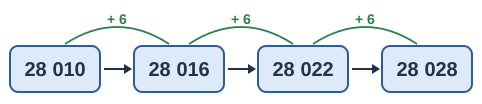
88 275, 87 275, ___, 85 275: each number is 1 000 less, so the missing number is 87 275 − 1 000 = 86 275.
Show answerHide answer
1.6Addition, subtraction, multiplication and division
Addition
Line up the digits by place value and start from the ones. Regroup when a place has 10 or more.
4 tens + 3 tens + 1 ten = 8 tens.
0 hundreds + 2 hundreds = 2 hundreds.
8 thousands + 7 thousands = 15 thousands: write 5, regroup 1 ten thousand.
1 + 1 = 2 ten thousands. Answer: 25 282.
Subtraction
26 467 − 1 295 = 25 172. Check with addition: 25 172 + 1 295 = 26 467.
Show answerHide answer
Multiplication
| Multiply by | Rule | Example |
|---|---|---|
| 10 | write one 0 at the end | 12 × 10 = 120 |
| 100 | write two 0s at the end | 420 × 100 = 42 000 |
| 1 000 | write three 0s at the end | 65 × 1 000 = 65 000 |
Step 2. Multiply by the tens: 49 × 70 = 3 430.
Step 3. Add the two products: 294 + 3 430 = 3 724.
Show answerHide answer
Division
Divide by 10, 100 or 1 000 by taking off 1, 2 or 3 zeros: 12 400 ÷ 10 = 1 240; 59 300 ÷ 100 = 593; 43 000 ÷ 1 000 = 43. Division is the inverse of multiplication, so 70 600 ÷ 100 = 706 because 706 × 100 = 70 600.
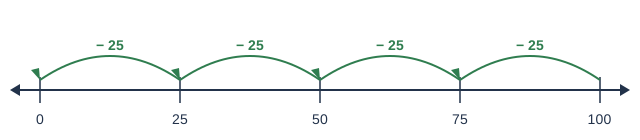
2 592 ÷ 12 = 216. Check: 216 × 12 = 2 592.
Show answerHide answer
1.7Mixed operations
Shortcut: 630 ÷ 30 = 21 first, then 21 × 15 = 315. Same answer, easier sums.
1.8Finding an unknown
k − 56 = 28, so k = 28 + 56 = 84.
92 − y = 73, so y = 92 − 73 = 19.
Check by putting the value back: 84 − 56 = 28.
1.9Solving problems
Follow four steps: understand the problem, plan a strategy (a diagram, a table, a number sentence), solve, then check.
Number sentence: 27 600 − 17 930 − 8 752 = 9 670 − 8 752 = 918.
Check: 918 + 8 752 + 17 930 = 27 600.
Show answerHide answer
Summary
- Numbers up to 100 000: read in groups; a 0 is not said but is written.
- Place value is the position; digit value is what the digit is worth (6 in 62 307 is 60 000).
- Compare from the left; ascending is smallest first, descending is largest first.
- Even numbers end in 0, 2, 4, 6, 8; odd numbers end in 1, 3, 5, 7, 9.
- Rounding off: look at the digit to the right of the place; 5 or more rounds up, and the middle value goes up.
- Find a number pattern's rule by subtracting neighbours.
- Add and subtract by place value; estimate to check; subtraction is checked by addition.
- To multiply by 10, 100, 1 000 add 1, 2, 3 zeros; to divide, take them off.
- Division is checked by multiplication (then add the remainder).
- For unknowns use the opposite operation. For problems: understand, plan, solve, check.