Starter unit
What this chapter covers
- I can talk about my hobbies and interests with key phrases like "I'm into ..." and "I'm good at ..." (1.1)
- I can use the verb be in affirmative and negative sentences, and use subject pronouns and possessive adjectives to introduce people (1.2)
- I can use prepositions (on, in, under, between, next to, near, opposite) to say where everyday objects are (1.3)
- I can use the possessive 's and s', and ask and answer be questions about where people and things are (1.4)
- I can describe things with basic adjectives and adverbs of degree such as very, really and quite (1.5)
- I can use this, that, these and those, and have got / has got in sentences, questions and short answers (1.6)
- I can say countries and nationalities, for example Spain and Spanish (1.7)
- I can ask Where, What and Who questions, join ideas with and, or and but, and write an email about myself (1.8)
Welcome to the Starter unit! This unit revises the English you need for Year 5. You will talk about your hobbies, use the verb be and have got, say where things are, describe things, name countries and nationalities, and write an email about yourself.
1.1Free time: hobbies and interests
These are the free-time words in the textbook. Each word matches a picture.
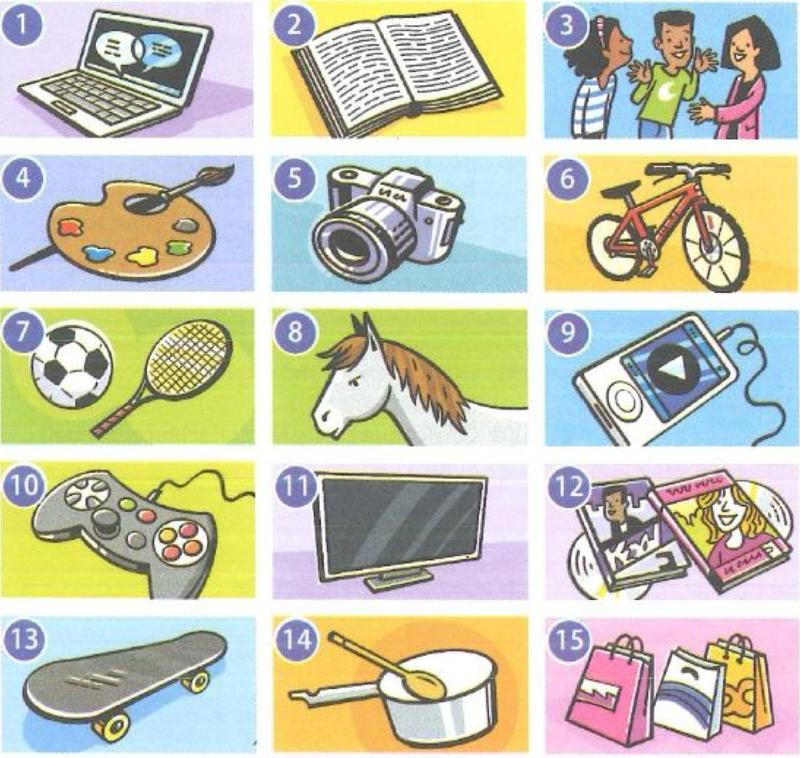
English Plus 1 Year 5, p. 4.
| Positive (+) | Negative (-) |
|---|---|
| I'm interested in photography. | I'm not interested in shopping. |
| I'm into sport. | I'm not into sport. |
| I like reading. | I don't like reading. |
| I'm good at basketball. | I'm not good at music. |
| My favourite ... is / are ... |
Show answerHide answer
1.2The verb be, pronouns and possessive adjectives
be: affirmative and negative
| Who | Affirmative | Negative |
|---|---|---|
| I | I'm from Oxford. | I'm not interested in shopping. |
| You | You're twelve. | You aren't very good. |
| He / She / It | She's into video games. | He isn't into sport. |
| We / You / They | They're students. | They aren't my friends. |
Subject pronouns and possessive adjectives
| Singular subject | Singular possessive | Plural subject | Plural possessive |
|---|---|---|---|
| I | my | we | our |
| you | your | you | your |
| he | his | they | their |
| she | her | ||
| it | its |
Jen and Ed are from the UK. They are from the UK.
Anya and I are friends. We are friends.
Introducing people
Jack: Not bad. And you?
Leila: Good, thanks. This is my friend Yasmin.
Jack: Oh, hi, Yasmin.
Leila: Yasmin is into skateboarding.
Jack: Really? That's cool.
Leila: See you later, Jack.
Key phrases: How are things? / How are you? This is ... (Yasmin) is into ... See you later.
Show answerHide answer
1.3Prepositions and everyday objects
A preposition tells us where something is.
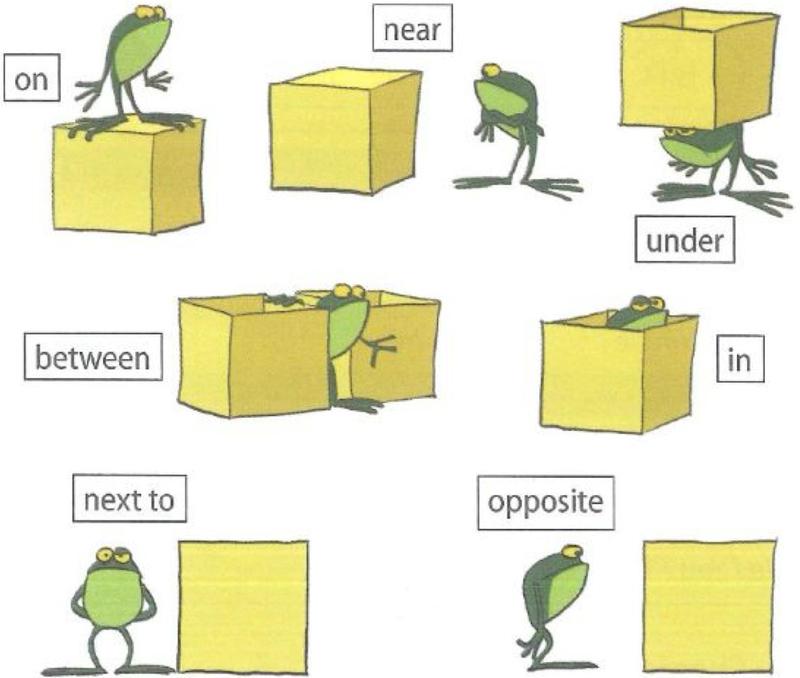
English Plus 1 Year 5, p. 6.
| Preposition | Meaning | Example |
|---|---|---|
| on | touching the top | The dictionaries are on the shelf. |
| in | inside | The mobile phone is in the drawer. |
| under | below | The bag is under the desk. |
| between | with one thing on each side | The laptop is between the speakers. |
| next to | at the side, very close | My desk is next to the window. |
| near | not far from | The poster is near the teacher's table. |
| opposite | on the other side, facing | The board is opposite the students' desks. |
The classroom picture shows the objects: table, drawer, mobile phone, poster, laptop, speaker, desk, coat, bag, chair, notebook, pen, shelf, board, dictionary, clock.
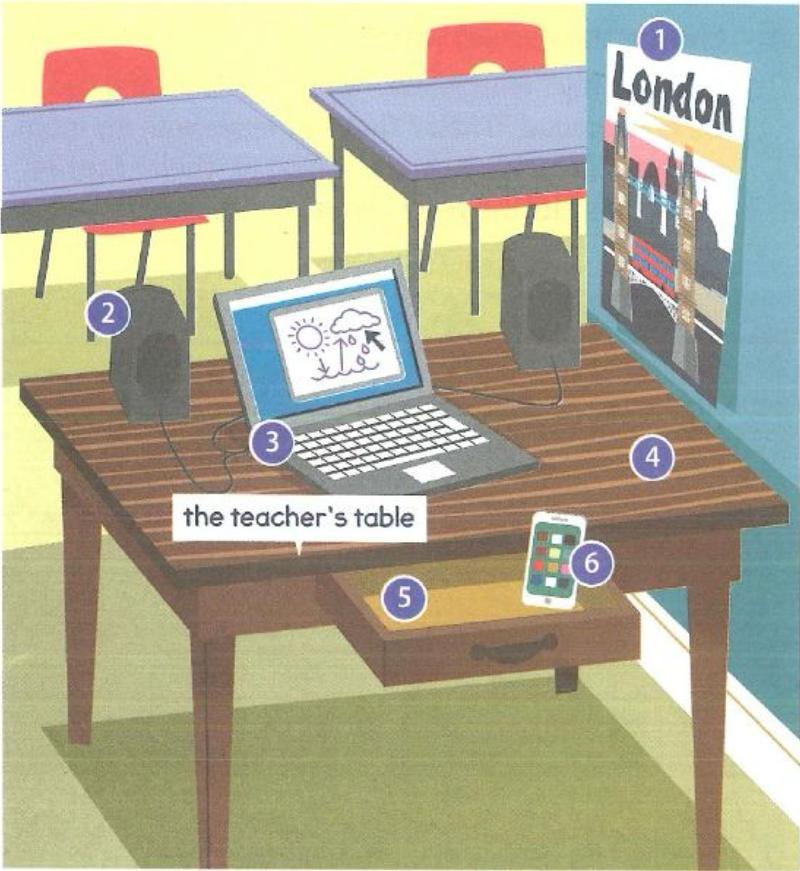
English Plus 1 Year 5, p. 6.
Show answerHide answer
1.4Possessive 's and be questions
Possessive 's
| Rule | Examples |
|---|---|
| Singular owner: add 's | the teacher's mobile, Harry's bag |
| Plural owner ending in s: add ' after the s | the students' chairs, the teachers' names |
| Two owners: add 's to the last name | Harry and Eva's desks |
be: questions and short answers
| Question | Yes | No |
|---|---|---|
| Am I late? | Yes, I am. | No, I'm not. |
| Are you at work? | Yes, I am. | No, I'm not. |
| Is he / she / it at home? | Yes, he / she / it is. | No, he / she / it isn't. |
| Are we / they in class? | Yes, we / they are. | No, we / they aren't. |
Use Where to ask about a place: "Where is my laptop?" "It's in the drawer."
Show answerHide answer
1.5Basic adjectives and adverbs of degree
An adjective describes a noun. Learn these adjectives with their opposites.
| Adjective | Opposite |
|---|---|
| popular | unpopular |
| good | bad |
| new | old |
| expensive | cheap |
| nice | horrible |
| interesting | boring |
| fast | slow |
| big | small |
Adverbs of degree
An adverb of degree says how strong an adjective is. It comes before the adjective.
| Weaker | Stronger | ||
|---|---|---|---|
| not very expensive | quite expensive | very expensive | really expensive |
Show answerHide answer
1.6this, that, these, those and have got
| Singular | Plural | |
|---|---|---|
| Near you | this pen | these books |
| Far from you | that desk | those students |
have got
| Form | I / you / we / they | he / she / it |
|---|---|---|
| Affirmative | I have got (I've got) a mobile. | She has got (She's got) a pet. |
| Negative | I haven't got a mobile. | He hasn't got a pet. |
| Question | Have you got a mobile? | Has he got a pet? |
| Short answers | Yes, I have. / No, I haven't. | Yes, he has. / No, he hasn't. |
Maria: Yes, I have. I've got this book about cooking.
Ben: That's nice. I haven't got a present.
Show answerHide answer
1.7Countries and nationalities
| Country | Nationality | Country | Nationality |
|---|---|---|---|
| Australia | Australian | Italy | Italian |
| Brazil | Brazilian | Japan | Japanese |
| China | Chinese | Mexico | Mexican |
| Egypt | Egyptian | Spain | Spanish |
| India | Indian | Turkey | Turkish |
| the UK (also called Britain) | British | the USA | American |
English Plus 1 Year 5, p. 10.
Show answerHide answer
1.8Question words, conjunctions and an email
Question words
| Word | Asks about | Example |
|---|---|---|
| Where | a place | Where's Neymar Junior from? |
| What | a thing | What's a taco? |
| Who | a person | Who's Usain Bolt? |
Key phrases for thinking of answers: I think he / she / it's ... And you? I'm not sure. Yes, that's right. I don't know.
Conjunctions: and, or, but
| Word | Use | Example |
|---|---|---|
| and | adds one idea to another | I'm into music and sport. |
| or | gives a choice | Email or message me. |
| but | joins ideas that are different | I speak a little Italian, but I'm not very good at it. |
Writing about yourself
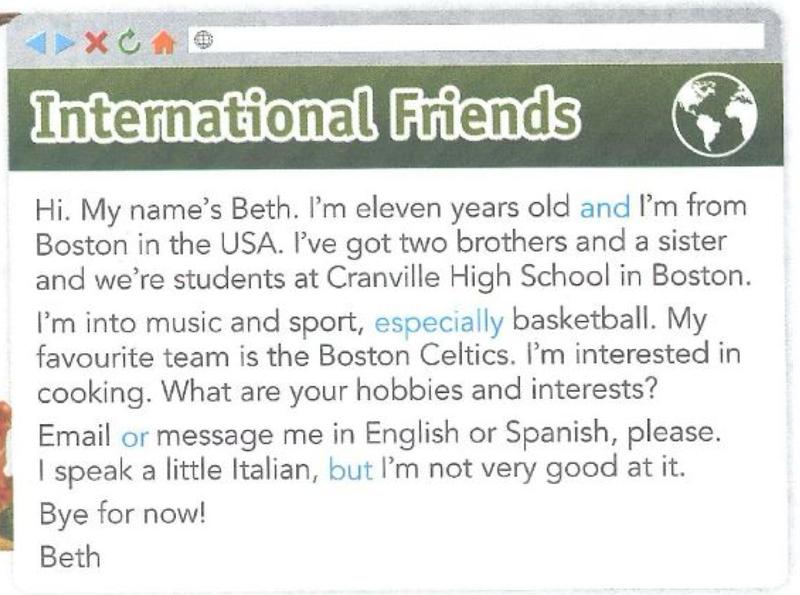
English Plus 1 Year 5, p. 11.
Key phrases: I'm a student at ... I'm into ..., especially ... Email or message me in ... I speak / study ... Bye for now!
Capital letters are used for names of people, places, schools and teams (Beth, Boston, the USA, Cranville High School, the Boston Celtics) and at the start of each sentence.
Show answerHide answer
Summary
| Topic | Remember |
|---|---|
| Hobbies | I'm into / interested in / good at ...; I like ...; My favourite ... is ... |
| be | I'm, you're, he's, we're; negative: I'm not, isn't, aren't. |
| Pronouns | I / my, you / your, he / his, she / her, it / its, we / our, they / their. |
| Prepositions | on, in, under, between, next to, near, opposite. |
| Possessive 's | Harry's bag (one owner); the students' chairs (many owners). |
| Adjectives | Opposites: new / old, cheap / expensive, boring / interesting, fast / slow. Very and really come before the adjective. |
| this, that | this / these (near), that / those (far). |
| have got | I have got; she has got; Have you got ...? Yes, I have. |
| Nationalities | Spain / Spanish, Japan / Japanese, the UK / British. Use a capital letter. |
| Question words | Where (place), What (thing), Who (person). |
| Conjunctions | and adds, or gives a choice, but shows a difference. |