Whole Numbers and Operations
What this chapter covers
- You can read and write numbers up to 1 000 000 in numerals and in words (1.1)
- You can state the place value and digit value of a digit, and partition numbers (1.1)
- You can compare numbers and arrange them in ascending and descending order (1.1)
- You can identify prime numbers (1.2)
- You can complete and state number patterns (1.5)
- You can estimate quantities and round off numbers to the nearest thousand, ten thousand and hundred thousand (1.3, 1.4)
- You can add, subtract, multiply and divide whole numbers up to 1 000 000 (1.6)
- You can solve mixed operations with brackets, find unknown numbers and solve problems (1.7, 1.8, 1.9)
1.1Reading and writing numbers up to 1 000 000
In Year 5 you work with six-digit numbers, all the way up to 1 000 000 (one million). You meet them in real data: the number of passengers at Langkawi International Airport in the first quarter of 2018 was 602 337.
| Numeral | In words |
|---|---|
| 602 337 | six hundred two thousand three hundred and thirty-seven |
| 200 339 | two hundred thousand three hundred and thirty-nine |
| 125 070 | one hundred twenty-five thousand and seventy |
| 542 000 | five hundred forty-two thousand |
| 900 017 | nine hundred thousand and seventeen |
| 1 000 000 | one million |
Show answerHide answer
1.2Place value, digit value and partitioning
Every digit sits in a place. Place value is the name of the place. Digit value is how much the digit is worth in that place.
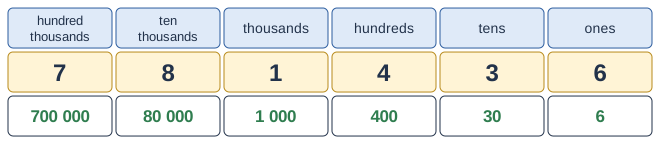
Step 2. By digit value: 781 436 = 700 000 + 80 000 + 1 000 + 400 + 30 + 6.
Step 3. 531 089 has a 0 in the hundreds place. By place value you must write it: 5 hundred thousands + 3 ten thousands + 1 thousand + 0 hundreds + 8 tens + 9 ones.
Step 4. By digit value you may leave the 0 out: 531 089 = 500 000 + 30 000 + 1 000 + 80 + 9.
Show answerHide answer
1.3Comparing and arranging numbers
A toy shop made four models: robot 118 200 blocks, building 320 915, house 120 290 and car 98 050 blocks.
Step 2. Same number of digits? Compare from the left: hundred thousands first.
Step 3. Equal? Compare the ten thousands, then thousands, hundreds, tens and ones.
Step 4. 118 200 and 120 290 both have 1 hundred thousand. Ten thousands: 2 is more than 1, so 120 290 > 118 200.
Descending order: from the largest to the smallest.
Ascending order of the four models: 98 050, 118 200, 120 290, 320 915. On a number line the larger number is always further to the right.

Show answerHide answer
1.4Prime numbers
2, 3 and 5 are prime. 4 can also be divided by 2, and 6 can be divided by 2 and 3, so 4 and 6 are not prime. 1 is not prime either, because it is not greater than 1.
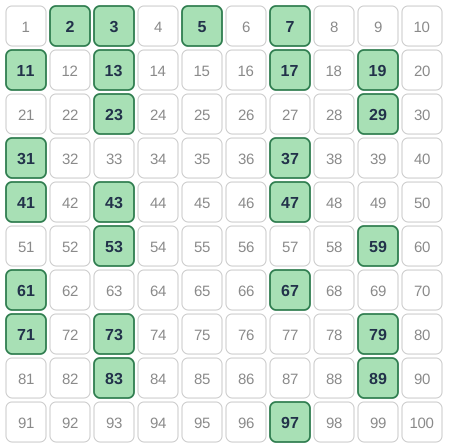
Step 2. 5 + 1 = 6, so 51 can be divided by 3: 51 = 3 × 17. It is not prime.
Step 3. 53 cannot be divided by 2, 3, 5 or 7. It is prime.
Show answerHide answer
1.5Number patterns
In a number pattern the same amount is added or subtracted each time. Say whether it is ascending (increasing) or descending (decreasing), and state the amount.

219 984, 219 980, 219 976, 219 972: each number is 4 less. The pattern is descending by fours (−4).
127 450, 126 450, 125 450, 124 450: the thousands digit goes down by 1. Descending by thousands (−1 000).
Show answerHide answer
1.6Estimating and rounding off
Estimating quantities
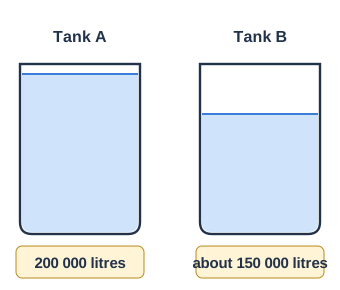
To estimate, compare with a quantity you know. Tank A is full with 200 000 litres. Tank B holds about three quarters as much.
Step 1. All of pallet A: about 2 × 370 = 740 kg.
Step 2. Pallet B is 2 times pallet A: about 2 × 740 = 1 480 kg.
Rounding off numbers
You can round off a six-digit number to the nearest thousand, ten thousand or hundred thousand. Look at the digit just to the right of the place you are rounding to.

264 405 to the nearest hundred thousand. The ten thousands digit is 6 (5 to 9), so 2 becomes 3. Answer: 300 000.
RM380 590 to the nearest hundred thousand ringgit. The ten thousands digit is 8, so 3 becomes 4. Answer: RM400 000.
| Round off to the nearest … | Look at this digit | Example: 573 862 |
|---|---|---|
| thousand | hundreds | 574 000 |
| ten thousand | thousands | 570 000 |
| hundred thousand | ten thousands | 600 000 |
Show answerHide answer
1.7Addition and subtraction
Addition
Line up the digits by place value. Add from the ones. Regroup when a column makes 10 or more.
Step 2. Tens: 8 + 1 + 1 = 10 tens. Write 0, regroup 1 hundred.
Step 3. Hundreds: 5 + 3 + 1 = 9. Thousands: 2 + 7 = 9.
Step 4. Ten thousands: 8 + 3 = 11. Write 1, regroup 1 hundred thousand. Hundred thousands: 1 + 2 + 1 = 4.
Answer: 182 587 + 237 317 = 419 904.
Show answerHide answer
Subtraction
Line up the digits. Subtract from the ones. If the top digit is smaller, regroup from the next place to the left.
Step 2. Thousands: 0 − 5 cannot be done. Regroup from the hundred thousands: 1 hundred thousand = 9 ten thousands + 10 thousands, so 10 − 5 = 5.
Step 3. Ten thousands: 9 − 0 = 9. Hundred thousands: 0.
Answer: 100 685 − 5 322 = 95 363.
Shortcut for 600 000 − 24 750: take 1 from both numbers. 599 999 − 24 749 gives the same difference and needs no regrouping.
Show answerHide answer
1.8Multiplication and division
Multiplication
By 10, 100 and 1 000
Each time, the digits move one place to the left. Write 1, 2 or 3 zeros after the number.
| Calculation | Answer |
|---|---|
| 35 215 × 10 | 352 150 |
| 8 493 × 100 | 849 300 |
| 764 × 1 000 | 764 000 |
By a 1-digit or 2-digit number
Step 2. Multiply by the tens: 2 604 × 40 = 104 160 (write a 0 in the ones place first).
Step 3. Add the two products: 7 812 + 104 160 = 111 972.
Show answerHide answer
Division
Division is sharing equally, or repeated subtraction. Start from the left, with the biggest place.
By 10, 100 and 1 000
Take away 1, 2 or 3 zeros: 165 090 ÷ 10 = 16 509; 734 000 ÷ 100 = 7 340; 802 000 ÷ 1 000 = 802. This shortcut is only for numbers that end in enough zeros. When there is a remainder you must do the long division: 632 590 ÷ 100 = 6 325 remainder 90.
Step 1. 87 ÷ 56 = 1, left 31. Bring down 1: 311 ÷ 56 = 5 (280), left 31. Bring down 9: 319 ÷ 56 = 5 (280), left 39.
Step 2. Bring down 7: 397 ÷ 56 = 7 (392), left 5. Bring down 6: 56 ÷ 56 = 1.
Answer: 871 976 ÷ 56 = 15 571.
Check by multiplying: 12 095 × 38 = 459 610, and 459 610 + 3 = 459 613.
Show answerHide answer
1.9Unknown numbers, mixed operations and problems
Unknown numbers
Use a letter or a box for the number you do not know. Then use the opposite operation.
| Number sentence | Opposite operation | Answer |
|---|---|---|
| k × 12 = 36 | k = 36 ÷ 12 | k = 3 |
| 15 × p = 60 000 | p = 60 000 ÷ 15 | p = 4 000 |
| 1 800 ÷ m = 18 | m = 1 800 ÷ 18 | m = 100 |
| s ÷ 24 = 3 190 | s = 3 190 × 24 | s = 76 560 |
Show answerHide answer
Mixed operations and brackets
1. Work inside the brackets first.
2. Then multiply or divide, from left to right.
3. Last, add or subtract, from left to right.
3 × (150 + 120): brackets first, 270, then 3 × 270 = 810.
48 − 2 × 4: 2 × 4 = 8, then 48 − 8 = 40.
2 + 12 ÷ 3: 12 ÷ 3 = 4, then 2 + 4 = 6.
RM100 ÷ 4 − RM5: RM25 − RM5 = RM20.
(4 594 − 178) ÷ (47 − 23) = 4 416 ÷ 24 = 184.
Show answerHide answer
Solving problems
Follow four steps: understand the problem (underline the important information), plan the strategy (draw a diagram or make a table), solve it, then check your answer (with the opposite operation, or an estimate).
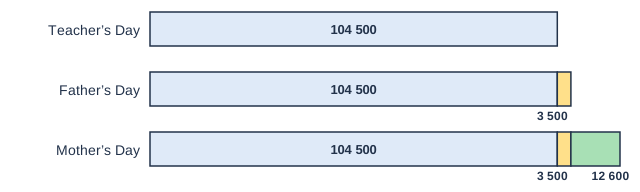
Given: 3 480 loaves a day. Asked for: loaves in 31 days. Number sentence: 31 × 3 480 = 107 880 loaves.
Check: 10 days is 34 800, so 31 days is 3 × 34 800 + 3 480 = 107 880.
Show answerHide answer
Summary
- Read six-digit numbers from the left: the thousands group, then the last three digits. A 0 is written but not said.
- Place value names the place; digit value is what the digit is worth (the 7 in 781 436 is worth 700 000).
- To compare, count the digits, then compare from the hundred thousands. Ascending = smallest first; descending = largest first.
- A prime number is greater than 1 and can only be divided by 1 and itself. 2 is the only even prime.
- Find a number pattern by subtracting neighbours: ascending or descending by the same amount.
- Rounding off: look at the digit to the right. 0 to 4 stays, 5 to 9 goes up; the digits after become 0.
- Add and subtract in columns by place value; estimate first, then check.
- Multiply by 10, 100, 1 000 by adding zeros; divide by removing zeros (only when there is no remainder). The remainder is always less than the divisor.
- Unknowns: use the opposite operation, then check.
- Order of operations: brackets, then multiply or divide, then add or subtract.
- Problems: understand, plan, solve, check.