It's an emergency!
What this chapter coversMatlamat bab ini
- I can talk about my family, subjects, free time and holidays, and name countryside, sports, jobs and shops from a picture (Welcome unit)
- I can read a newspaper article, find its headline, subheading, quote and caption, and understand facts and details (Reading)
- I can use the past continuous with the past simple, with when and while, to say what was happening when something interrupted it (Grammar)
- I can use emergency words such as alarm, fire drill, smoke, lifeboat and life jacket, and ask "What were you doing when the alarm rang?" (Language in use)
- I can listen for context clues to work out where people are and what the problem is (Listening)
- I can write a newspaper article from reporter's notes with a headline, an introduction, a main body and a conclusion, and write direct speech (Writing)
- I can choose between adjectives ending in -ing and -ed, such as terrifying and terrified, and tell a noun from a verb when one word is both (Working with words, Learning to learn)
- I can show how I feel when I speak, and analyse a problem to plan a rescue (Speaking, Think about it!)
- I can read the traditional story The trick and give a personal response to it (Reading time 1)
This chapter covers the Welcome unit (pp. 4-7), where you meet the Academy Stars and revise vocabulary, and Unit 1: It's an emergency! (pp. 8-17), which is about newspaper reports, power cuts, fires and rescues. It ends with the traditional story The trick (Reading time 1, pp. 18-21). The main grammar is the past continuous with the past simple.
W.1Welcome: meet the Academy Stars
On p. 4 four pupils introduce themselves: Alice loves reading, Oliver wants to discuss interesting topics, Kit wants to learn how to find and organise information, and Sophia (12) loves science and technology. Then they ask you: "What would you like to learn about this year?"
Academy Stars Year 6 Pupil's Book, p.4.
Lesson 1 (p. 5) is a listening task with a fact table. You listen and find the information that is not true.
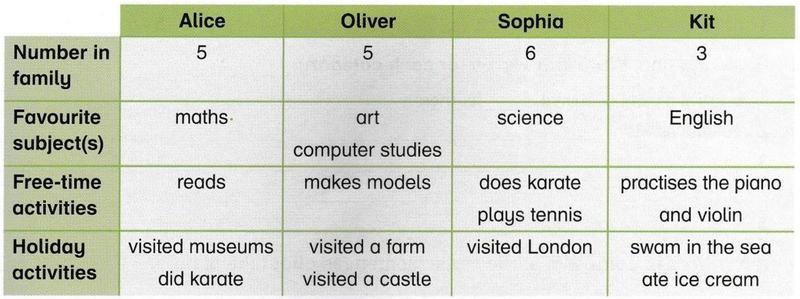
Textbook figure: Academy Stars Year 6 Pupil's Book, p.5.
Notice the two tenses in the table. Free-time activities use the present simple (reads, makes models, does karate). Holiday activities use the past simple (visited museums, swam in the sea, ate ice cream).
| To find out about | Ask |
|---|---|
| number in family | How many people are there in your family? |
| free time | What do you do in your free time? |
| holidays | What did you do during the holidays? |
Academy Stars Year 6 Pupil's Book, p.2 (scope and sequence) and p.5. The first question is the book's own example.
Show answerHide answer
W.2Welcome: vocabulary review (pp. 6-7)
The picture over pp. 6-7 shows a countryside and a small town. You find words that start with p, s, b, f and c (the book's example is photographer) and write four words for each of five categories: parts of a plant or animal (the book's example is feathers), outdoor sports, jobs, shops, and things in the countryside.
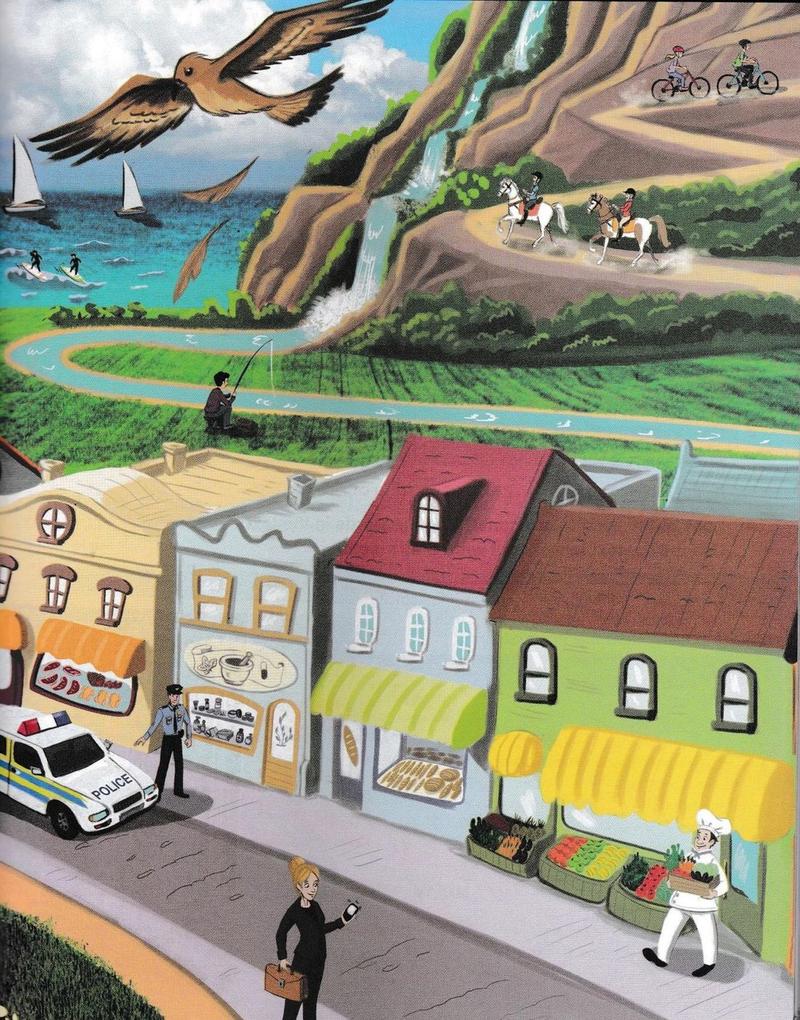
Textbook figure: Academy Stars Year 6 Pupil's Book, p.7.
| Category | Words you can find in the picture |
|---|---|
| parts of an animal | feathers, wings, tail |
| outdoor sports | sailing, surfing, horse riding, cycling, fishing |
| jobs | photographer, police officer, chef |
| shops | greengrocer's, bakery, pharmacy, butcher's |
| things in the countryside | waterfall, river, cliff, field, hillside |
Categories from Academy Stars Year 6 Pupil's Book, p.6; the word lists are my own, read from the picture on pp.6-7.
In activity 3 you work in pairs and say true or false sentences about the picture. The book's model: "A chef is coming out of the greengrocer's." (True) and "Some people are swimming in the sea." (False: they are surfing and sailing, not swimming).
Show answerHide answer
1.1Reading: a newspaper article (pp. 8-9)
Unit 1 opens by asking: What happens during a power cut? Who can you call for help? Then you work out where the text on p. 9 comes from (a book, a website or a newspaper) and how you know. The text is a newspaper article, "The day the lights went out", by Tony De Marchi, from New York Metro.
Academy Stars Year 6 Pupil's Book, pp.8-9.
headline: the big title that catches your eye (here "The day the lights went out").
subheading: a line under the headline that gives the main news ("Power cut hits millions, no light, no heat, no trains").
byline: who wrote it (By Tony De Marchi).
caption: the words under a photograph ("New York City in darkness").
quote: a person's exact words in quotation marks, sometimes shown in big type.
Summary of the article. A power cut hit New York State and parts of Canada at 7 pm. Thirty million people had no electricity for 13 hours. The article gives eyewitness accounts: pupils were rehearsing for a school concert, families were cooking dinner, a train stopped in the dark, traffic lights failed and there were road accidents, and an elephant escaped from New York Zoo when the lights went out while the keepers were feeding the animals and someone forgot to close the gate. The cause, said the power company, was a squirrel that jumped on the power lines.
Key sentences from the article (use them as models):
- "My train was leaving the station when the lights went out."
- "I was singing when suddenly all the lights went out."
- "The lights went out while we were feeding the animals."
Academy Stars Year 6 Pupil's Book, p.9.
The vocabulary panel (p. 8) lists accident, ambulance, cooker, electricity, embarrassed, heating, hit, million, power and rehearse (rehearsing). Work out the meaning from context:
| Word | Meaning here |
|---|---|
| power cut | a time when the electricity stops |
| hit | happened suddenly and affected a place (the power cut hit New York) |
| rehearse | practise something, such as a concert, before the real show |
| electricity / power | the energy that makes lights and machines work |
| cooker, heating | things that stopped working because they needed electricity |
| accident | something bad that happens by mistake (the squirrel's jump was an accident) |
| embarrassed | ashamed and uncomfortable (the power company was very embarrassed about the squirrel) |
Word list from Academy Stars Year 6 Pupil's Book, p.8; meanings are my own, taken from the context on p.9.
Show answerHide answer
1.2Reading comprehension and Learning to learn (p. 10)
You answer questions about facts and details: where the power cut was, how long it lasted (13 hours), why a woman screamed (the train went dark and stopped), why there were traffic accidents (the traffic lights stopped working), and why people left their cars in Times Square (it was too dark to drive; there was no moon). Then you decide who said each quote: a zookeeper, a mother, an ambulance driver, a worker at New York Power or a police officer.
Academy Stars Year 6 Pupil's Book, p.10 (questions) and p.9 (answers).
Some verbs change to form nouns. Compare "We couldn't cook dinner" (verb) with "The cooker isn't working" (noun), and "We couldn't heat soup" (verb) with "The heating isn't working" (noun).
Academy Stars Year 6 Pupil's Book, p.10.
Show answerHide answer
1.3Grammar: past continuous with past simple (p. 11)
The grammar box on p. 11 shows a zookeeper feeding an elephant. The elephant escapes in the second picture. The book uses colour blocks to show the two tenses.
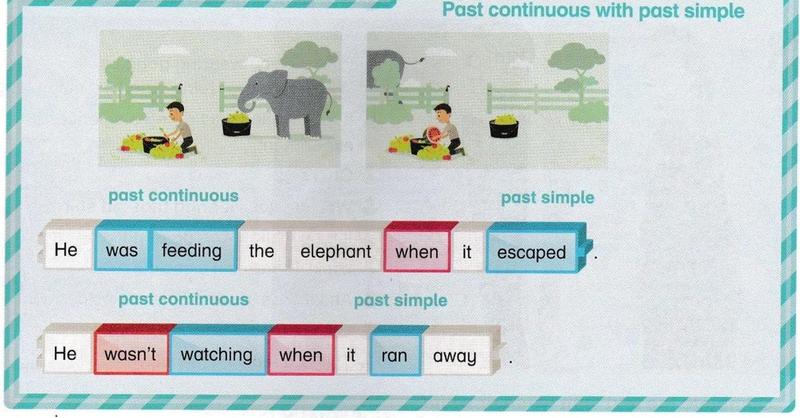
Textbook figure: Academy Stars Year 6 Pupil's Book, p.11.
Past simple: the short action that happened in the middle and interrupted it.
| Form | Example |
|---|---|
| positive | He was feeding the elephant when it escaped. (book) |
| negative | He wasn't watching when it ran away. (book) |
| with I, he, she, it | I was singing. She was cooking. |
| with we, you, they | They were rehearsing. We were feeding the animals. |
Academy Stars Year 6 Pupil's Book, p.11; the I/she and we/they lines are from the article on p.9.
Picture the action as a long line with a short stop on it:
Longer action (past continuous): He was feeding the elephant ...
Short action (past simple): ... when it escaped.
The book's practice shows a family on the night of a power cut: "I was doing my homework last night when I lost all my work." and "My brother was watching TV when all the lights went out."
Academy Stars Year 6 Pupil's Book, p.11 (activity 2).
Show answerHide answer
1.4Language in use: when and while (p. 12)
The emergency words for p. 12 are alarm, emergency, experiment, fire drill, smoke and fire engine. In the dialogue two pupils talk about a school fire drill. One wears goggles; the other wears an old shirt for art class.
Academy Stars Year 6 Pupil's Book, p.12.
past continuous + when + past simple
OR
past simple + while + past continuous
| Pattern | Example |
|---|---|
| past continuous + when + past simple | I was doing a science experiment when the alarm rang. (my example) |
| past simple + while + past continuous | The alarm rang while I was doing a science experiment. (the book's reply) |
Questions: "What were you doing when the alarm rang?" Answer: "It rang while I was painting in art class."
Academy Stars Year 6 Pupil's Book, p.12.
Show answerHide answer
1.5Listening: emergencies at school, in space and at sea (p. 13)
You match three pictures to the places at school, in space and at sea. The new words are lifeboat, life jacket and rescue boat. For each dialogue you answer: What's the problem? Do they need help? The audio is not printed in the book, so on this site we only describe the pictures.
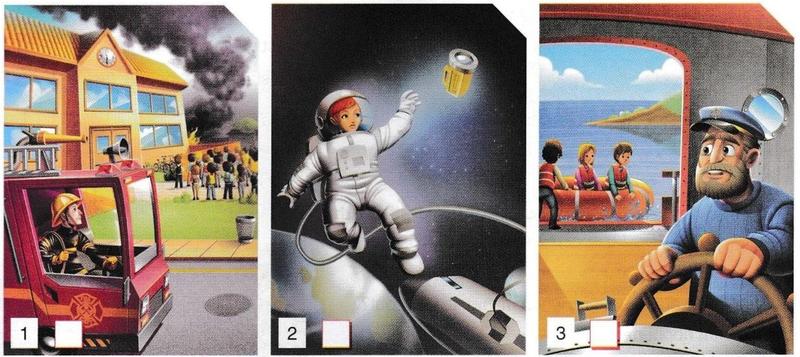
Textbook figure: Academy Stars Year 6 Pupil's Book, p.13.
- School: a fire engine, smoke, pupils waiting outside.
- Space: an astronaut who needs her torch (the questions on p. 13 ask what she sees and why she needs a torch).
- Sea: a captain, a lifeboat and children wearing life jackets.
Academy Stars Year 6 Pupil's Book, p.13.
The Values box asks: "What can you do to help in an emergency?" Sensible answers: stay calm, listen to adults, call the emergency number, do not run or push, help younger children.
Show answerHide answer
1.6Writing: a newspaper article from notes (pp. 14-15)
Direct speech means the exact words a person says. In the article, Natasha says: "My train was leaving the station when the lights went out." On p. 14 you answer: What are the actual words? How can you recognise direct speech? Why does the reporter use it? The book's reasons you tick include that it is accurate, dramatic and exciting, clear and shows how people feel.
1. Put the speaker's exact words in quotation marks (' ' or " ").
2. Add a reporting word such as said, shouted, explained.
3. Put a comma, question mark or exclamation mark before the closing mark.
Example (from the article, p.9): "I was cooking soup when the power went off," said Martha Miller.
Academy Stars Year 6 Pupil's Book, pp.9 and 14 (direct speech idea and Natasha's quote); the Martha Miller line is also from p.9.
Next, a reporter interviewed Mark Kapinski about the power cut, and you use the reporter's notes to write an article. The notes are in three parts:
| Part | What it answers | Notes (summary) |
|---|---|---|
| Introduction | Who? Where? What was he doing? | Mark Kapinski, Brooklyn, New York; walking home from football practice when the lights went out |
| Main body | What happened? How did he feel? | It went completely dark and he couldn't see or hear anything; he sat on a bench to look at the stars; he was not frightened but excited; it was a beautiful night |
| Conclusion | How did it end? What did people say? | Police and firefighters worked all night; the power cut lasted four hours; there were no accidents |
Academy Stars Year 6 Pupil's Book, p.14 (reporter's notes, summarised).
The model opening on p. 15 is: "A power cut hit New York last night. Mark Kapinski, from Brooklyn, New York, was walking home from football practice when ..." In your article remember to give a headline, organise it into an introduction, main body and conclusion, and use direct speech.
Academy Stars Year 6 Pupil's Book, p.15.
Show answerHide answer
1.7Working with words: adjectives ending in -ing or -ed (p. 15)
-ed adjective: describes the person and how they feel. "I was terrified!"
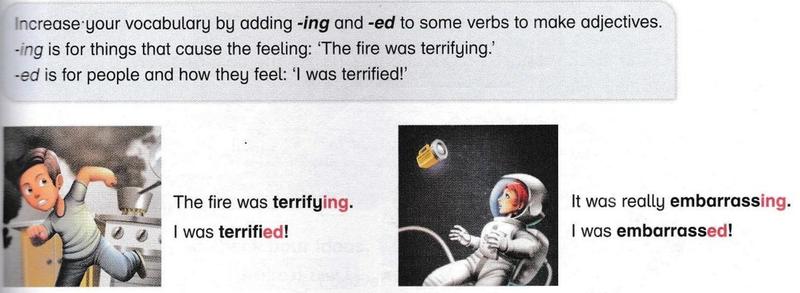
Textbook figure: Academy Stars Year 6 Pupil's Book, p.15.
| Cause (-ing) | Feeling (-ed) |
|---|---|
| terrifying | terrified |
| embarrassing | embarrassed |
| surprising | surprised |
| exciting | excited |
| worrying | worried |
| frightening | frightened |
Academy Stars Year 6 Pupil's Book, p.15 (the six pairs come from the practice paragraph about a train stopped in a tunnel).
Show answerHide answer
1.8Speaking: express feelings (p. 16)
A picture story shows a boat with smoke coming from the engine, the children putting on life jackets, a lifeboat and a rescue boat. You match speech to the pictures, for example "I'm frightened. Our boat is sinking.", "There's smoke coming from the engine.", "Everyone get into the lifeboat, please!" and "Look! It's the rescue boat!" Then you match the sentences to ways of speaking: shout, whisper, scream, explain.
Academy Stars Year 6 Pupil's Book, p.16.
| Way of speaking | When you do it |
|---|---|
| shout | to be heard from far away, or when you give an order |
| whisper | very quietly, so people nearby cannot hear |
| scream | very loudly in fear or pain |
| explain | calmly, to make something clear (the book's example: the captain explains about the smoke) |
Ways of speaking from Academy Stars Year 6 Pupil's Book, p.16; the explanations are my own.
A reporter then asks the three children how they felt. The book's answers include "I was terrified.", "Yes, I was really worried.", "I'm a bit cold and tired." and "I was surprised and excited." Use feeling words (terrified, worried, excited) and let your voice and face show the feeling too. In groups you act out the emergency; the captain says "There's smoke coming from the boat. Please send a rescue boat."
Academy Stars Year 6 Pupil's Book, p.16.
Show answerHide answer
1.9Think about it: plan a rescue (p. 17)
Thinking skills: analysis and problem-solving. The task: you are the director of a rescue team. It is four o'clock in the morning. Last night Mike Dobbs was climbing Misty Mountain when he fell and broke his leg. He needs a doctor immediately; then you must get him back to base camp as quickly as possible. One way to name the three parts of the problem (my reading of the task) is the injury (he needs a doctor), the location (a mountain) and the time (it is early morning and he must come back quickly).
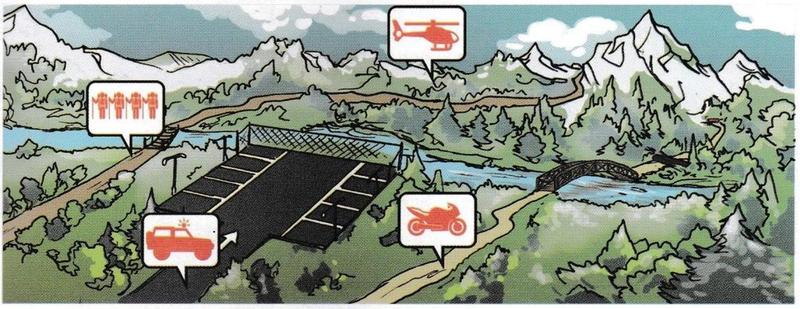
Textbook figure: Academy Stars Year 6 Pupil's Book, p.17.
| Transport | Possible good point / bad point (my own ideas to think about) |
|---|---|
| on foot (climbing team) | can walk all the way (the book's sample note) / very slow |
| ambulance | carries a doctor and equipment / may not drive on a mountain path |
| motorbike | fast and goes on narrow paths / cannot carry an injured person safely |
| helicopter | fast and flies over rivers and rocks / needs a landing place and good weather |
Task and first sample note from Academy Stars Year 6 Pupil's Book, p.17. The recording that gives the book's own notes is not printed.
The book then asks the group to decide the best way, using up to two forms of transport. Use this frame: "I think we should send ... first because ..." Give a reason, listen to others, and decide together.
Show answerHide answer
1.10Reading time 1: The trick (pp. 18-21)
This is a traditional story about two friends, Musa and Hakan, who live next door to each other in a small village. Here is the story in my own words, with a few quotes.
- Money is very important to Hakan, sometimes more important than his friends. His horse, Atik, is not well, so Hakan decides to sell him. His wife Pinar says it is not honest to sell a sick horse, and certainly not to a friend. Hakan says he is doing "a good thing" because he will give Musa a good price.
- Musa is watering plants next door and hears them through the open window. He decides "to teach my friend a lesson".
- The next day Musa asks Hakan if he knows of a horse for sale. Hakan says Atik is "the strongest and fastest horse in the village".
- That evening, while Hakan is having dinner, Musa breaks a chair against the wall, shouts for help and lies on the floor. Hakan runs to Musa's house.
- Musa says he fell from the chair and thinks he has broken his leg. The nearest hospital is thirty kilometres away. He says that Hakan can take him there on Atik, "the strongest and fastest horse", in three hours.
- Hakan knows this is an emergency and that Atik cannot carry his friend for three hours, so he tells Musa the truth. He offers to buy him the strongest and fastest horse in the country. Musa stands up and shows that his leg is not broken. Hakan laughs, hugs him, and promises never to trick him again. Atik gets better and Hakan gives the horse to Musa as a present.
Academy Stars Year 6 Pupil's Book, pp.18-20.
Grammar to notice in the story: past continuous with past simple: "Musa was watering the plants in his garden when he heard the last part of the conversation." "Musa and Hakan were drinking coffee together when Musa asked ..." "While Hakan was having dinner, Musa took a chair and broke it." Also used to: "he used to be stronger" (he was stronger in the past, but is not now).
Academy Stars Year 6 Pupil's Book, pp.18-19.
On p. 21 you answer questions about why Pinar was angry, why Hakan thought he was doing a good thing, and why Hakan decided to tell the truth. You tick the main themes, such as "You should be kind to friends or you will lose them", "It's important to be honest" and "It's important to say sorry when you hurt a friend". You also discuss which of the two tricks was wrong, and who was the better friend. The book asks you to give reasons for your answers, and to imagine a different ending.
Academy Stars Year 6 Pupil's Book, p.21.
Show answerHide answer
Summary
| Topic | Remember |
|---|---|
| Welcome questions | What do you do in your free time? What did you do during the holidays? How many people are there in your family? |
| Newspaper article | headline, subheading, byline, caption, quote; introduction, main body, conclusion |
| Past continuous + past simple | I was singing when the lights went out. (long action + interruption) |
| when / while | past continuous + when + past simple; past simple + while + past continuous |
| -ing or -ed | -ing = the thing that causes the feeling (terrifying); -ed = the person who feels it (terrified) |
| Nouns and verbs | scream, break, stop can be both; cook becomes cooker, heat becomes heating |
| Direct speech | exact words in quotation marks with said, shouted, explained |
| Emergency words | alarm, fire drill, fire engine, smoke, lifeboat, life jacket, rescue boat, ambulance |
| Reading time 1 | The trick: Hakan tricks Musa, Musa tricks him back, and both learn to be honest friends. |