Reading: A Window to the World
What this chapter covers
- I can name kinds of books (genres) such as horror, science fiction, adventure, poetry, autobiography and folklore, and say which I would choose and why (1.1.2)
- I can choose a book using the genre and the blurb or synopsis on the back cover (1.3.1)
- I can read a short story, answer questions about it and give my opinion with reasons (2.2.2)
- I can work out the meaning of difficult words and phrases, such as enormous, glanced and devastated, from the passage (2.3.1)
- I can use full stops, commas, question marks, capital letters, exclamation marks and quotation marks correctly (3.2.3)
- I can write a book report with title, author, genre, characters, synopsis, opinion and moral values (3.2.1)
- I can form and use compound nouns such as football, wallpaper and classmate, and stress the first noun (5.1.1)
- I can recognise words that sound the same but are spelt differently, such as night and knight (2.3.1)
- I can enjoy a poem, "Toes", and say what it means (4.1.1)
Welcome to Unit 1. You will talk about the books you like, choose a book to read, read a story and work out hard words, practise punctuation, write a book report, and learn about compound nouns.
1.1Kinds of books: genres
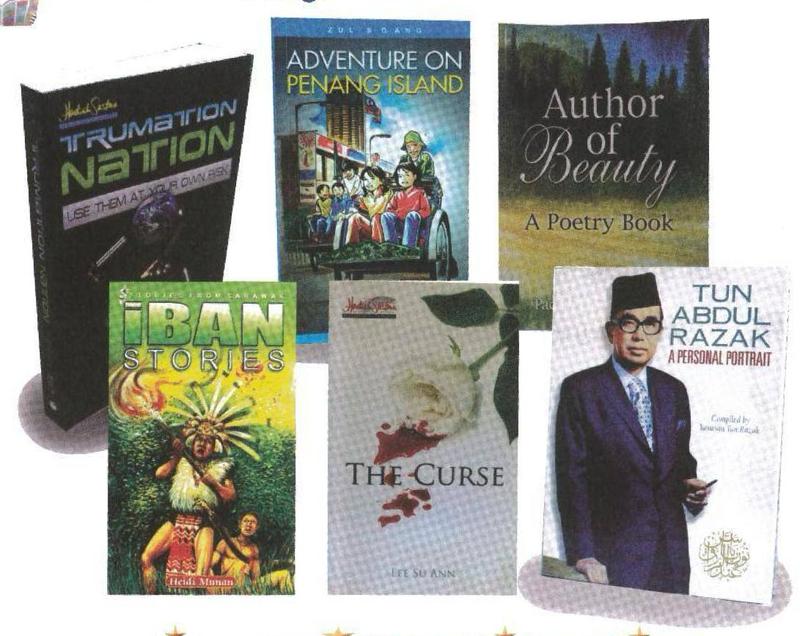
English Year 6 SK, p. 1.
| Genre | What it is about | Example from the page |
|---|---|---|
| horror | frightening, scary events | The Curse |
| science fiction | imagined science, technology and the future | Trumation Nation |
| adventure | exciting journeys and daring deeds | Adventure on Penang Island |
| poetry | poems with rhythm and feeling | Author of Beauty |
| autobiography / biography | the true story of a real person's life (an autobiography is written by the person) | Tun Abdul Razak: A Personal Portrait |
| folklore | traditional tales of a people | Iban Stories |
Show answerHide answer
1.2Choosing a book: blurb and synopsis
Kamini tells Idith how to pick an interesting book (p. 2):
- First, choose your favourite genre.
- Then read the synopsis (the gist of the story), which is on the back of the book.
- If it sounds interesting, buy it.
On p. 3 two blurbs are read aloud. Matilda is a clever girl, a bookworm and a Maths wizard, whose parents do not appreciate her; she goes to Cruncher Hall Primary School, run by the strict Miss Trunchball. Harry Potter lives a miserable (sad) life with his cruel aunt, uncle and cousin Dudley, until a messenger brings a mysterious letter that invites him to a wonderful place.
Show answerHide answer
1.3Reading a story: The Knight of the Night
Summary (p. 4): In the country of Peace Piece, children sleep only when the Knight of the Night sings to them. One Saturday he is late, and the mothers are angry. One mother goes to ask why. He explains that he was cleaning all day and still has to put the sun to sleep, wake the moon and polish the stars so that Sunday looks clean and pretty. She is confused and says he cannot do these things. He is angry and says he knows what he is doing. Through the window she sees the children already asleep, so she goes home and never learns whether he told the truth.
2. Read each question and find the line that answers it.
3. Answer in a full sentence, using words from the story.
4. For "Why do you think...?", give your own idea and a reason.
Homophones
Homophones sound the same but have different spelling and meaning. Peace and piece, knight and night, write and right are homophones.
| Pair | Meanings |
|---|---|
| peace / piece | calm and quiet / a part of something |
| knight / night | a brave soldier of old / the dark time of day |
| write / right | to put words on paper / correct, or the opposite of left |
Show answerHide answer
1.4Reading: The scarecrow, and word meanings
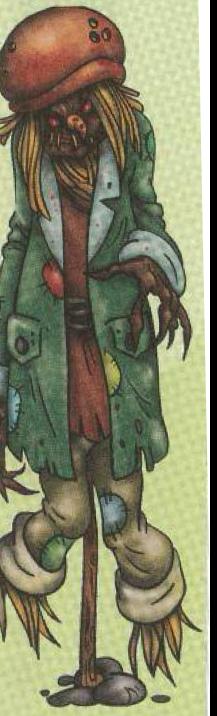
English Year 6 SK, p. 5.
Summary: Pak Johan grows organic vegetables, and his very scary scarecrow keeps the birds away. His jealous neighbours Man and Lan steal it, and Pak Johan's greens are eaten. At night the brothers cannot forget the scarecrow's face; Man smashes its head and buries it. At midnight the headless scarecrow rises, grabs Lan and chases Man. Man sees it has a new head, and the story stops there, so the reader decides how it ends.
| Word or phrase | Meaning |
|---|---|
| organic | made without artificial chemicals |
| enormous | extremely large |
| stretched out | put out a long arm |
| effective | producing a successful result |
| devastated | very shocked and sad |
| took out | removed from its place |
| rose up | moved upward |
| glanced | looked quickly at |
Show answerHide answer
1.5Writing: punctuation
| Mark | Use |
|---|---|
| Full stop (.) | end of a complete sentence |
| Comma (,) | separates phrases or items in a list |
| Question mark (?) | end of a question |
| Capital letter | start of a sentence, proper nouns, and the start of direct speech |
| Exclamation mark (!) | shows strong feeling |
| Quotation marks (" ") | show the words someone says |
Tan and his wife, Jenny, lived in a village by the seaside.
Show answerHide answer
1.6Writing: a book report
A book report says what you think about a book you read. Your opinion can be positive or negative. Idith's report on Little House on the Prairie (p. 7) has these parts:
| Part | Idith's report |
|---|---|
| Title | Little House on the Prairie |
| Author | Laura Ingalls Wilder |
| Genre | Classic |
| Characters | Laura, father, mother, Mary and Baby Carrie |
| Synopsis | A family moves to a new place, works hard to make it home and learns survival skills and family values. |
| Opinion | She likes it because it is exciting and interesting. |
| Moral values | Family values, honesty and hard work. |
Show answerHide answer
1.7Language: compound nouns
| Noun + noun | Compound noun |
|---|---|
| foot + ball | football |
| wall + paper | wallpaper |
| gold + fish | goldfish |
| cow + boy | cowboy |
| class + mate | classmate |
| ground + nuts | groundnuts |
| shop + keeper | shopkeeper |
| door + bell | doorbell |
| cup + cake | cupcake |
| air + port | airport |
English Year 6 SK, pp. 8 and 9 (pairs matched from the Grammar exercise).
Show answerHide answer
1.8Poem: Toes
"Toes" by Judith Nicholls praises toes. They are handy to wiggle, useful to kick, fun to tickle, and good to count on, walk on and run on. The poem ends by saying feet without toes would be much less fun, and a fine set of toes is "neat". Toes also help us balance.
Show answerHide answer
Summary
| Topic | Remember |
|---|---|
| Genres | horror, science fiction, adventure, poetry, autobiography, folklore. |
| Choosing a book | choose the genre, read the blurb or synopsis on the back. |
| Homophones | peace / piece, knight / night, write / right. |
| Word meanings | use the sentences around a word to guess its meaning. |
| Punctuation | full stop, comma, question mark, capital letter, exclamation mark, quotation marks. |
| Book report | title, author, genre, characters, synopsis, opinion, moral values. |
| Compound nouns | two nouns make one: football, classmate, airport. |