Reading short texts: notices, messages and signs
What this chapter covers
- I know what Paper 1 Part 1 looks like - 8 short texts, 3 options each, about 15 minutes (1.1)
- I can say what kind of text I am reading (sign, notice, label, advertisement, note, text message or email) and where I would see it (1.2, 1.3)
- I can work out who is writing to whom and why - to invite, remind, warn, say sorry, ask for help or change a plan (1.3, 1.4)
- I can find small details such as times, dates, prices, places and rules, and do simple sums with them (1.5)
- I can understand rule words such as must, only, before, until, except, free, postponed and out of order (1.2, 1.5)
- I can spot the common traps in the options - same words, wrong meaning; opposite; too strong; wrong person; true but not the answer (1.6)
- I can use a five-step method to answer a Part 1 question and check my answer (1.7)
In this unit you will learn to read the short texts in Paper 1 Part 1: signs, notices, labels, advertisements, notes, text messages and short emails. You will learn to find the main point, the purpose and the small details, and to avoid the traps the examiners put in the options.
1.1Paper 1 Part 1 at a glance
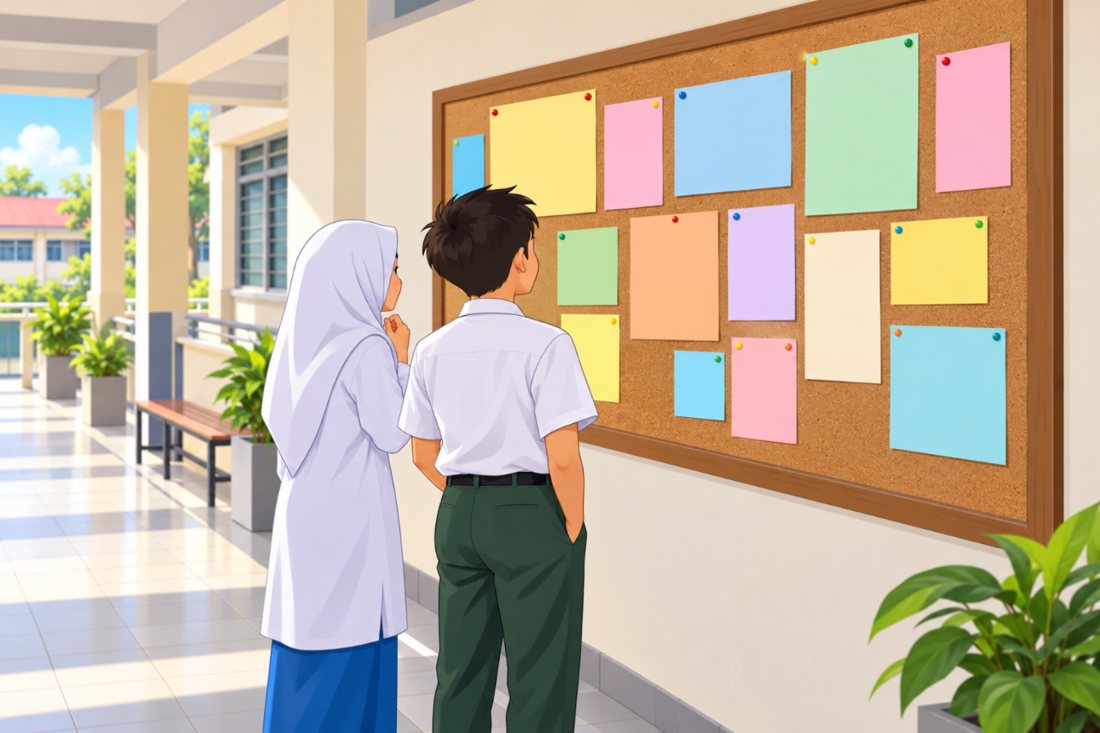
Paper 1 (Reading and Use of English) has five parts. Part 1 is the first and usually the easiest place to get marks.
| What | Details |
|---|---|
| Questions | 8 questions (questions 1 to 8), 1 mark each |
| Texts | 8 short texts, one for each question |
| Options | 3 options: A, B or C. Only one is correct. |
| Time | About 15 minutes, so a little less than 2 minutes for each question |
| Skills | Understand the main point of a text (LS 3.1.1) and find specific details (LS 3.1.2) |
| Text types | Signs, notices, labels, posters and advertisements, notes, text messages and chats, short emails, simple charts and short dialogues |
The question stem usually has one of these shapes. Learn them so that you know what to look for before you read.
| Question stem | What it asks | Look for |
|---|---|---|
| Rani writes to Mei Ling to ... The purpose of the message is to ... | Purpose (why) | The request or the main sentence, often near the start or the end |
| From the notice, we know that ... Which is correct about ...? | Main point or one true fact | Check every option against the text |
| A visitor who ... will ... Pupils who have paid ... | Detail for one group | Rules, conditions, numbers |
| Who will ...? Where should ...? | One detail | Names, places, times |
1.2Know your text: signs, notices, labels and advertisements
These texts are written for everybody who passes by. They are short, so every word matters. Most of them do one of four jobs.
| Job | Typical words | Example |
|---|---|---|
| Tell you a rule (you must / must not) | Do not ..., No ..., ... only, must, Please ... | No food or drinks in the lab. |
| Warn you about danger | Caution, Danger, Beware of ..., Mind the ... | Caution: wet floor. |
| Give information (time, place, change) | open, closed, until, from ... to ..., postponed, moved to | The canteen is closed until 10 a.m. |
| Sell or offer something | sale, % off, free, buy 1 get 1 free, discount, special offer | All bags 30% off this weekend. |
A sign
New grass is growing.
Please use the footpath.
Job: a rule. Meaning: do not walk on the grass; walk on the path.
A notice
Encik Rahim, Senior Assistant
Job: information about a change. The main point: the assembly moves from the hall to the canteen. A detail: pupils bring their own chairs.
A label
Keep refrigerated (below 4 °C).
Best before: 18 OCT 2026
Once opened, use within 3 days.
Job: instructions and information. If you open it on 10 October, you must finish it by 13 October, even though the date on the box is later.
An advertisement
School shoes: buy 1 pair, get the 2nd pair at half price!
Saturday and Sunday only
Jalan Pasar, Kuantan
Job: selling. Detail: the second pair costs 50% of the price. The offer is only on the weekend.
Words you must know in signs and notices
| Word or phrase | Meaning |
|---|---|
| Out of order | The machine is broken. You cannot use it. |
| Staff only / Authorised persons only | Only workers (or people with permission) may go in. |
| Admission free / Free of charge | You do not pay. |
| Sold out | There are no more. All have been sold. |
| Postponed | Moved to a later date. It will still happen. |
| Cancelled | It will not happen. |
| Until 5 p.m. | Up to 5 p.m., then it stops or changes. |
| Valid until 31 May | You can use it up to 31 May, not after. |
| Best before / Expiry date | Eat or use it before this date. |
| Fine RM300 | You must pay RM300 as a punishment. |
| Limited places | Only a small number of people can join. |
| Register / Sign up | Give your name to join. |
| Venue | The place where an event happens. |
- Fine on a sign is not "okay". "No littering. Fine RM500." means you will pay RM500 if you throw rubbish.
- Out of order does not mean "in the wrong order". It means "broken".
- Postponed and cancelled are different. A postponed trip still happens, later.
- Book now does not mean "read a book now". It means "reserve a place or a ticket now".
Show answerHide answer
1.3Messages: notes, text messages, chats and emails

A message is written by one person to another person (or a small group). Before anything else, find three things:
| Ask | Where to look |
|---|---|
| Who is writing? | The name at the end (note, email) or the name next to each bubble (chat) |
| Who is reading? | The name at the start: "Hi Arul", "Dear Puan Lim", "To: ..." |
| Why are they writing? | The request (Please ..., Can you ...?, Don't forget ...) or the subject line of an email |
A note
I've gone to the clinic with Atuk. Your lunch is in the fridge. Please feed the cat at 2 p.m. and don't forget to lock the back door.
Mama
Writer: Mama. Reader: Danish. Purpose: to tell Danish what to do while she is out (feed the cat, lock the door).
A text message chat
In a chat, read every bubble, and keep track of who says what. Aishah's purpose: to cancel tonight's plan and suggest another day.
An email
To: nurul.a@mail.com
Subject: Our History project
Hi Nurul,
I can't find the photos of A Famosa for our project. Could you send them to me tonight? I need to print them tomorrow morning before class.
Thanks,
Jia Hui
Writer: Jia Hui. Reader: Nurul. Purpose: to ask for help (send the photos). The subject line gives the topic, not always the purpose.
Purpose words
The options for a purpose question start with a verb. Match the verb to the clue in the text.
| Option verb | Clues in the text |
|---|---|
| to invite | Would you like to come ...? Please come to ... |
| to remind | Don't forget ... Remember to ... As planned ... |
| to ask for help / a favour | Can you ...? Could you ...? Please help me ... |
| to apologise (say sorry) | I'm sorry ... I didn't mean to ... |
| to thank | Thank you for ... It was very kind of you ... |
| to change a plan | ... instead, not ... but ..., Let's meet at ... instead |
| to warn | Be careful ... Don't ... because it is dangerous |
| to inform / tell | I just want to let you know ... The ... will be ... |
| to offer or sell | I can lend you ... Do you want to buy ...? |
Show answerHide answer
1.4Reading for gist and purpose
To find the gist, ask: "If I had to tell a friend about this text in one sentence, what would I say?" Small details do not go in that sentence.
Saturday, 8 a.m. Meet at the surau. We will clean the drains and the playground. Bring gloves. Drinks and nasi lemak will be served after the work. Everyone is welcome!
One sentence: "People in Taman Melati are invited to clean the area together on Saturday."
Gloves, the surau and nasi lemak are details. An option such as "to tell people about free nasi lemak" picks a detail, not the main point.
The football match is at 5 p.m., not 4 p.m., because the field is wet. Bring your boots. Coach says we will have a short meeting after the match.
Hakim
Hakim writes to Zul to
A ask him to buy new boots.
B tell him about a new time for the match.
C invite him to a meeting with the coach.
Answer: B. The main news is the new time (5 p.m., not 4 p.m.). A: "bring your boots" is not "buy new boots". C: the meeting is a detail and Hakim is not the one inviting.
Show answerHide answer
1.5Reading for detail: times, prices, rules and conditions
Many Part 1 questions test one small detail. The answer is usually not written in the same words as the option, so you must understand it.
Small words that change the meaning
| Word | Example | What it tells you |
|---|---|---|
| only | Form 2 pupils only. | Form 1 and Form 3 pupils cannot join. |
| except | Open every day except Monday. | Closed on Monday. |
| before | Pay before 15 May. | Pay on 14 May or earlier. 15 May is too late. |
| by | Pay by 15 May. | Pay on 15 May or earlier (by = not later than). |
| after | RM5 per hour after the first hour. | The first hour is different (often free). |
| until | Closed until 2 p.m. | It opens at 2 p.m. |
| instead of | Meet at 8 a.m. instead of 9 a.m. | The new time is 8 a.m.; 9 a.m. is the old time. |
| not ... but ... | The talk is not in the hall but in the library. | The place is the library. |
| if / unless | We will cycle unless it rains. | If it rains, we will not cycle. |
| must / need not | You need not bring food. | Bringing food is not necessary. |
Doing simple sums
Some texts give prices, times or dates and the option gives the result of a sum. Work it out on the question paper.
RM8 per game
Students: RM2 off each game (show your student card)
Shoe rental: RM3
Siva shows his student card and plays 2 games. He rents shoes. How much does he pay?
| Step | Working |
|---|---|
| Price of one game for a student | RM8 - RM2 = RM6 |
| Two games | 2 × RM6 = RM12 |
| Add shoes | RM12 + RM3 = RM15 |
Watch out for trap options: RM19 (2 × RM8 + RM3, forgot the student price) and RM12 (forgot the shoes).
"The bus leaves at 7.45 a.m. Please arrive 15 minutes early." When should you arrive? 7.45 - 15 minutes = 7.30 a.m.
- Reading "before 15 September" as "on 15 September". Before means the 14th or earlier.
- Picking the old time in "instead of" sentences. The new information comes first: "at 8 a.m. instead of 9 a.m." means 8 a.m.
- Forgetting a condition: "Free for children under 7" does not mean free for everyone.
Show answerHide answer
1.6Common traps in the options
All three options look possible. Two of them are wrong in a clever way. If you know the traps, you can cross them out quickly.
| Trap | What it does | Example (text, then wrong option) |
|---|---|---|
| Same words, wrong meaning | Copies words from the text but changes the idea | Text: "Bring your umbrella, it may rain." Wrong: "to ask him to buy an umbrella" |
| Opposite | Says the reverse of the text, often with not / no / open / closed | Text: "Do not refreeze." Wrong: "put it back in the freezer" |
| Too strong | Uses all, every, always, never when the text has a limit | Text: "Discount on weekdays." Wrong: "a discount every day" |
| Wrong person | Gives the action to the wrong person | Text: Ali asks Ben to bring the ball. Wrong: "Ben asks Ali to bring the ball" |
| True but not the answer | States a real detail, but the question asks for the purpose or the main point | Question: "Why does Lily write?" Wrong: "Her earphones are broken." (true, but not why she writes) |
| Wrong detail | Mixes up two numbers, days or places in the text | Text: "opens at 7.00 a.m. instead of 7.30 a.m." Wrong: "opens at 7.30 a.m." |
| Not in the text | Sounds sensible but the text never says it | Text: a notice about a school trip. Wrong: "pupils will get lunch at the zoo" |
Show answerHide answer
1.7The five-step method
| Step | What you do |
|---|---|
| 1. Read the question stem | Is it asking for the purpose, the main point or a detail? Underline the key words (for example "Jack sends Aiman a text message to ..."). |
| 2. Name the text | Sign, notice, label, advertisement, note, chat or email? Who writes, and to whom? |
| 3. Read the whole text | Underline the request, the rule, the change, and every number, day and place. |
| 4. Test each option | Compare A, B and C with the text one by one. Cross out the wrong ones and name the trap. |
| 5. Choose and check | Read your answer with the stem as one sentence. Does the text say this, maybe in other words? Then shade the answer. |
Place: Kuala Selangor Nature Park
Bus leaves school at 7.00 a.m.
Members: free. Non-members: RM15 (bus and lunch).
Wear old clothes and shoes. You will get muddy!
Give your name to Cikgu Faridah by 15 August.
Question: A pupil who is not a member of the club
A cannot join the trip.
B must pay RM15 to go.
C needs to bring lunch.
| Step | Thinking |
|---|---|
| 1 | The stem asks about one group: not a member. So it is a detail question. |
| 2 | It is a notice (a poster) from a club to pupils. |
| 3 | The line about this group: "Non-members: RM15 (bus and lunch)." |
| 4 | A: the notice gives non-members a price, so they can join. Opposite, so cross out. B: matches "Non-members: RM15". Keep. C: lunch is included in the RM15. Opposite of the text, so cross out. |
| 5 | "A pupil who is not a member of the club must pay RM15 to go." Yes. Answer: B. |
Show answerHide answer
Summary
- Part 1 has 8 short texts, each with one question and 3 options (A, B, C). Spend about 15 minutes.
- Signs and notices give rules, warnings, information or offers. Know the key words: out of order, staff only, free of charge, postponed, cancelled, until, valid, fine.
- For messages, find who writes, who reads and why. Purpose verbs: invite, remind, ask for help, apologise, thank, change a plan, warn, inform, offer.
- Gist = the one-sentence idea. Details = times, prices, places and rules. Watch small words: only, except, before, until, instead of, unless.
- Do the sums: prices, discounts, times and dates.
- Traps: same words with a wrong meaning, opposite, too strong, wrong person, true but not the answer, wrong detail, not in the text.
- Five steps: read the stem, name the text, read and underline, test each option, choose and check.