Prepositions, conjunctions and spotting errors
What this chapter covers
- I can use at, on and in correctly with times, days, dates, months and years (6.1)
- I can describe where things are with prepositions of place such as under, next to, between, opposite and in front of (6.2)
- I can use common verbs and adjectives with the right preposition, like listen to, wait for, good at and afraid of (6.3)
- I can join ideas with and, but, so, because, although, when and while (6.4)
- I can make the verb agree with its subject, like "My father drives" and "The students are" (6.5)
- I can find and correct the underlined error in a UASA Paper 1 Part 2 text, step by step (6.6)
Small words cause big mistakes. In this unit you will learn the little words that show time and place (prepositions), the words that join ideas (conjunctions), and how to make the verb agree with its subject. Then you will use all of it in UASA Paper 1 Part 2, where you read a text, find the underlined errors and write the correct word. Part 2 has 8 questions, worth 8 marks, and you should spend about 15 minutes on it.
6.1Prepositions of time: at, on, in
For time, three prepositions do most of the work. Think of them as going from small to big.
| Preposition | Use it with | Examples |
|---|---|---|
| at (a point) | clock times, meal times, short moments, night, the weekend | at 7.30 a.m., at noon, at lunchtime, at night, at the weekend, at the end of the lesson |
| on (a day) | days, dates, special days, a day + part of the day | on Monday, on Sundays, on 31 August, on Hari Raya, on my birthday, on Friday afternoon |
| in (a longer time) | parts of the day, months, years, seasons, centuries, long periods | in the morning, in the evening, in March, in 2026, in the school holidays, in the 21st century |
No preposition with these time words
Do not put at, on or in before last, next, this, every, today, tomorrow or yesterday.
| Wrong | Right |
|---|---|
| We went to Melaka | We went to Melaka last Saturday. |
| I will see you | I will see you tomorrow. |
| She swims | She swims every morning. |
Other useful time prepositions
| Preposition | Meaning | Example |
|---|---|---|
| before / after | earlier than / later than | Wash your hands before meals. We play futsal after school. |
| during | all through, or at some time in, an event | Do not talk during the test. |
| from ... to / until | the start and end of a period | The shop opens from 9.00 a.m. to 10.00 p.m. I waited until five o'clock. |
| for | how long (a period) | We stayed in Kuching for three days. |
| since | from a point in the past until now | Amir has lived in Johor Bahru since 2020. |
| by | not later than | Send your form by Friday. |
(a) The bus leaves ____ 6.45 a.m.
(b) We have a spelling test ____ Thursday.
(c) Merdeka Day is ____ August.
(d) I visited my grandmother ____ last week.
Show answerHide answer
6.2Prepositions of place and movement
Prepositions of place tell us where something is. Look at where the ball is in each picture.
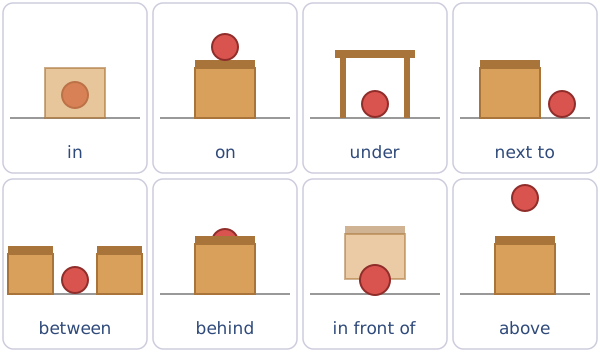
At, on, in for places
| Preposition | Use it for | Examples |
|---|---|---|
| at | a point or a place where something happens | at the bus stop, at the door, at school, at home, at the counter, at the end of the road |
| on | a surface, a line, a floor of a building | on the table, on the wall, on the board, on the second floor, on Jalan Ampang, on page 12 |
| in | inside a space, an area, a town or a country | in the box, in the classroom, in the canteen, in Ipoh, in Sabah, in Malaysia |
More prepositions of place
| Preposition | Example |
|---|---|
| under / below | The cat is sleeping under the car. |
| above / over | The clock is above the whiteboard. |
| next to / beside | Mei Ling sits next to Kavitha. |
| between (two things) | The bank is between the bakery and the post office. |
| opposite (facing) | The school is opposite the mosque. |
| in front of / behind | The flag pole is in front of the office. The field is behind the canteen. |
| near | We live near the night market. |
Prepositions of movement
| Preposition | Example |
|---|---|
| to (a place you go) | We went to Langkawi by ferry. |
| into / out of | He jumped into the pool. She took the books out of her bag. |
| across (from one side to the other) | Use the bridge to walk across the river. |
| along (following a line) | We cycled along the beach. |
| through (in one side and out the other) | The train went through a long tunnel. |
| up / down | Farah ran up the stairs. |
(a) Put your shoes (in / on) the rack outside the door.
(b) The surau is (between / opposite) the library and the hall.
(c) We arrived (in / at) Kota Kinabalu at night.
Show answerHide answer
6.3Verbs and adjectives with prepositions
Some verbs and adjectives always go with the same preposition. There is no rule; learn them as pairs, like one word.
Verb + preposition
| Pair | Example |
|---|---|
| listen to | Please listen to the announcement. |
| wait for | I am waiting for my father. |
| look at / look for | Look at the board. I am looking for my pencil case (trying to find it). |
| belong to | This bottle belongs to Hakim. |
| depend on | Our trip depends on the weather. |
| agree with (a person) | I agree with you. |
| talk about / talk to | We talked about the match. I talked to the teacher. |
| apologise for / thank someone for | He apologised for being late. Thank you for the gift. |
| take care of | My sister takes care of our cat. |
Adjective + preposition
| Pair | Example |
|---|---|
| good at / bad at | Aiman is good at badminton. |
| afraid of / scared of | My brother is afraid of the dark. |
| interested in | Are you interested in joining the Scouts? |
| proud of | We are proud of our school choir. |
| full of | The pasar malam was full of people. |
| kind to | Be kind to animals. |
| different from | Sabah food is different from Kelantan food. |
| famous for | Penang is famous for its street food. |
| worried about / excited about | Siti is worried about the test. |
"We
"She
"He
"Please
And "I
(a) Kumar is very good in Mathematics.
(b) We must discuss about the trip tomorrow.
(c) I am agree with Puan Zura.
Show answerHide answer
6.4Conjunctions: joining ideas
Each one has its own meaning, so choose it by asking: how are the two ideas connected?
| Conjunction | Meaning | Example |
|---|---|---|
| and | adds a similar idea | Hana likes reading and she writes poems too. |
| but | shows a contrast (the opposite idea) | The shoes are nice, but they are too expensive. |
| so | gives the result | It was raining, so we stayed indoors. |
| because | gives the reason | We stayed indoors because it was raining. |
| although | a surprising contrast in one sentence | Although he was tired, he finished his homework. |
| when | at the time something happens (often a short action) | When the bell rang, everyone stood up. |
| while | during a longer action | Mum cooked dinner while I was bathing my brother. |
Danial woke up late, so he missed the bus.
Danial missed the bus because he woke up late.
Danial woke up late, but he did not miss the bus. (a different story: contrast)
Although Danial woke up late, he did not miss the bus.
Commas
Put a comma before but and so when they join two full sentences. Put a comma after the first part when a sentence starts with although, when or because: When I reached home, I had a shower.
"
"
"I was tired,
(a) Mira studied hard. She passed the test. (so)
(b) We could not swim. The sea was rough. (because)
(c) The food was cheap. It was delicious. (although)
Show answerHide answer
(b) We could not swim because the sea was rough.
(c) Although the food was cheap, it was delicious. (or: The food was delicious although it was cheap.)
6.5Subject-verb agreement
In the present tense, the verb must agree with the subject: one person or thing (he, she, it, my father, the dog) takes a verb with -s; more than one (they, we, the boys) takes the verb with no -s.
| Subject | be | have | Other verbs |
|---|---|---|---|
| I | am | have | I play |
| He / She / It / one person or thing | is (past: was) | has | She plays, My father drives, The shop opens |
| You / We / They / more than one | are (past: were) | have | They play, The students walk |
Rules that catch people out
| Rule | Example |
|---|---|
| Two subjects joined by and are plural. | Ali and his sister are in the choir. |
| Each, every, everyone, everybody, nobody are singular. | Everyone is here. Each student has a locker. |
| One of + plural noun takes a singular verb. | One of my friends lives in Miri. |
| Find the real subject; ignore the words in between. | The boys in my class are noisy. The box of crayons is on the table. |
| There is + singular, There are + plural. | There is a cat. There are two cats. |
| After does, did, can, will, to: the base form, no -s. | Does she like durian? She can swim. He wants to go. |
(a) My uncle (sell / sells) fish at the market.
(b) The books on the shelf (is / are) new.
(c) Each of the girls (have / has) a badge.
Show answerHide answer
6.6Spotting and correcting errors (Paper 1 Part 2)
In Paper 1 Part 2 you read one text with eight underlined words (questions 9 to 16). Each underlined word is wrong. You write one correct word for each. There is always an example, (0), at the start.
The commonest error types
In real UASA Form 1 papers, the answer schemes name the grammar point of each error. These come up again and again:
| Error type | Wrong (underlined) | Correct | What to check |
|---|---|---|---|
| Tense | Yesterday we visit the zoo. | visited | Time words: yesterday, last week, ago → past |
| Subject-verb agreement | She always help her mother. | helps | Is the subject one or many? |
| After a modal or to | We should saved money. | save | can, should, must, will, to + base form |
| Pronoun | He lost he wallet. | his | Before a noun: my, his, her, our, their |
| Preposition | The match is in Saturday. | on | Time/place rules and fixed pairs (6.1 to 6.3) |
| Article | She is a honest girl. | an | a / an / the; an before a vowel sound |
| Conjunction | I was hungry, because I ate. | so | How are the two ideas connected? |
| Singular or plural noun | one of my friend | friends | one of / many / two + plural; a / another / each + singular |
| Word form | She sings beautiful. | beautifully | Describing a verb → adverb (-ly) |
The method: five steps
- Read the whole text once without stopping. Find out what it is about and whether it tells a past story (past tense) or gives facts and habits (present tense).
- Look at the example (0). It shows you how to answer: one word only.
- For each underlined word, ask "what kind of word is it?" A verb? Check tense and agreement. A pronoun? Check it fits the noun. A small word (at, on, but, so, a)? Check the rule.
- Look left and right. The clue is usually next to the error: the subject before a verb, the noun after a preposition, the time word in the sentence.
- Write one word, spelt correctly, then read the sentence again with your word in it. Does it sound right?
My brother Irfan (0) love football. Every evening he (9) play with (10) he friends at the field near our flat. Last Sunday, his team (11) win a match in Ipoh. He was very proud (12) with his team.
| No. | Thinking (steps 3 and 4) | Answer |
|---|---|---|
| 0 | Verb. Subject = my brother (one person), a habit → present with -s. | loves |
| 9 | Verb. Subject = he, every evening = habit → -s. | plays |
| 10 | Pronoun. It comes before a noun (friends), so we need the possessive form of he. | his |
| 11 | Verb. Last Sunday → past tense. Win is irregular. | won |
| 12 | Preposition after an adjective. The pair is proud of. | of |
Our school canteen is very clean. The canteen operator, Puan Salmah, (a) wash the tables every afternoon. Students must queue (b) at front of the counter. Last week, the canteen (c) win a prize for the cleanest canteen in the district. We were all happy (d) but proud.
Show answerHide answer
Summary
| Topic | Remember |
|---|---|
| Time | at 7.00, at night; on Monday, on 5 May; in May, in 2026, in the morning. No preposition before last, next, every, tomorrow. |
| Place | at a point (at the bus stop); on a surface (on the wall); in a space or town (in the hall, in Ipoh). Go home, not go to home. |
| Pairs | listen to, wait for, look at, belong to, depend on; good at, afraid of, interested in, proud of, full of. Discuss / enter / reach with no preposition. I agree, not I am agree. |
| Conjunctions | and (add), but (contrast), so (result), because (reason), although (surprising contrast), when (at that time), while (during a longer action). Never although ... but. |
| Agreement | He / she / it / one thing + verb-s; they / we / many + verb. Each, every, everyone = singular. Find the real subject. |
| Part 2 | Read all → look at (0) → what kind of word? → look left and right → write one word, spelt correctly, and reread. |