Reading charts, timetables and other non-linear texts
What this chapter covers
- I can say what Paper 1 Part 4 looks like and plan my 20 minutes (8.1)
- I can follow five steps to answer True/False and short-answer questions on a non-linear text (8.2)
- I can spot the trap words (only, every, all, free, except) that make a statement False (8.3)
- I can copy a short answer of no more than five words and/or a number exactly from the text (8.4)
- I can read rows and columns in a timetable and work out times and journeys (8.5)
- I can read bar charts, maps, keys and legends (8.6)
- I can read menus, price lists, brochures and posters, and work out simple prices and savings (8.7)
In this unit you learn to read non-linear texts: timetables, charts, menus, price lists, posters, brochures and maps. This is Paper 1 Part 4 of the UASA. The texts are short, but the questions test whether you read every detail, such as a small star (*) note at the bottom or the word "only".
8.1What is Part 4?
| Part 4 | What you get |
|---|---|
| Text | One non-linear text: a poster, brochure, timetable, menu, price list, chart or advertisement |
| Questions 25 to 28 | Four statements. Write True or False for each one. |
| Questions 29 to 32 | Four sentences with a gap. Fill each gap with no more than five words and/or a number from the text. |
| Marks | 8 marks, 1 mark for each answer (right or wrong, no half marks) |
| Time | About 20 minutes |
Words for the parts of a non-linear text
| Word | Meaning |
|---|---|
| heading / title | the big words at the top that say what the text is about |
| row | a line of boxes going across (left to right) in a table |
| column | a line of boxes going down (top to bottom) in a table |
| key / legend | a box that tells you what each symbol, colour or short form means |
| footnote (* note) | small words at the bottom, often after a star (*). They often give a rule or a condition. |
| bullet points | a short list, each line starting with a dot (•) |
Show answerHide answer
8.2The five-step method, with a worked example
| Step | What to do |
|---|---|
| 1. Skim | Look at the heading, pictures and boxes for 30 seconds. What is this text? Who is it for? |
| 2. Read the question | Underline the key words in the statement or gap sentence: names, numbers, days, ages, prices. |
| 3. Scan | Find the box, row or line in the text with the same idea. The words may be different (daily = every day). |
| 4. Compare | Read that part slowly, including any * note. Does it say exactly the same thing? |
| 5. Answer and check | Write True or False, or copy the words. Read the full sentence again with your answer in it. |
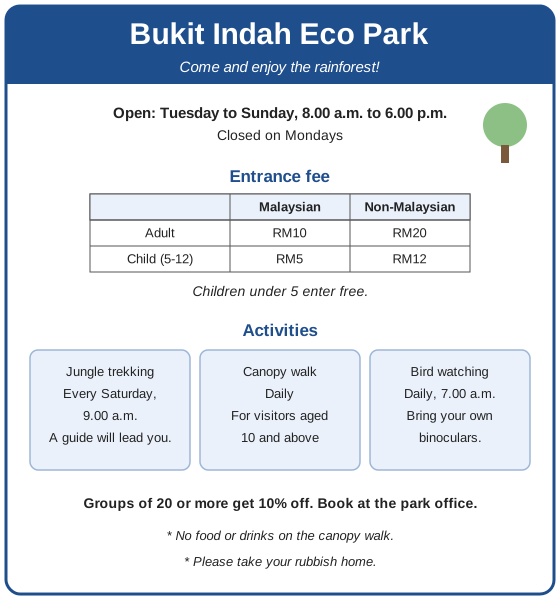
Key words: open, every day. Scan: "Open: Tuesday to Sunday … Closed on Mondays". Compare: every day would include Monday, but the park is closed on Monday.
Answer: False
2. A four-year-old child can enter the park for free.
Key words: four-year-old, free. Scan: "Children under 5 enter free." Four is under five.
Answer: True
3. An eight-year-old pupil can go on the canopy walk.
Key words: eight-year-old, canopy walk. Scan: "Canopy walk … For visitors aged 10 and above". Eight is below ten.
Answer: False
Scan the table: row Adult, column Malaysian. Answer: RM10
5. Visitors who want to watch birds must bring their own ______.
Scan the bird-watching box: "Bring your own binoculars." Answer: binoculars (one word, spelt exactly as in the text)
6. A school group of 25 pupils gets ______ off.
Scan: "Groups of 20 or more get 10% off." 25 is more than 20. Answer: 10%
Show answerHide answer
8.3True or false: watch for trap words
A statement is True only if the text says the same thing. If one small part is different, the whole statement is False. The UASA has no "Not given" answer: if the text does not support the statement, it is False.
| Trap | Text says | Statement | Answer |
|---|---|---|---|
| only | Open to all pupils. | The club is only for Form 1 pupils. | False |
| every / all / everyone | The first 50 visitors get a free bag. | Everyone gets a free bag. | False |
| free / discount | Members get 20% off. | Members get the book free. | False |
| except | Open daily except Fridays. | You can visit on Friday. | False |
| age limits | For children under 12. | A 12-year-old can join. | False (12 is not under 12) |
| same idea, new words | Open daily. | It is open every day. | True |
| inference | Foreigner: RM35. | A tourist from Japan pays RM35. | True (a tourist from Japan is a foreigner) |
Number words you must know
| Phrase | Includes the number? | Example |
|---|---|---|
| 12 years and above / 12 or older | Yes, 12 is included | 12, 13, 14 … |
| under 12 / below 12 / less than 12 | No, 12 is not included | … 9, 10, 11 |
| above 12 / over 12 / more than 12 | No, 12 is not included | 13, 14, 15 … |
| from 1 to 7 August | Yes, both days | 1, 2, 3, 4, 5, 6, 7 August |
Show answerHide answer
8.4Short answers: no more than five words and/or a number
For questions 29 to 32 you copy words from the text into the gap. The answer must:
- be words from the text, spelt exactly the same;
- have no more than five words, and/or a number (RM25, 7.00 a.m., 50%);
- fit the sentence: read the sentence again with your answer in the gap.
| Question | Good answer | Weak answer |
|---|---|---|
| The puppet show starts at ______. | 8.30 p.m. | "It starts at half past eight at night" (a full sentence, not from the text) |
| Every visitor gets a map, a drink and ______. | a free badge | "a map, a drink and a free badge" (repeats words that are already there) |
| You can find out more on ______. | our Facebook page | "our Facebok page" (wrong spelling) |
| Adults pay ______ for the boat ride. | RM12 | "12" (no RM: a number without its unit may lose the mark) |
- Writing six or more words. Count them before you move on.
- Copying the wrong row of a table. Use your two fingers (row and column).
- Changing the words: the text says sports shoes, you write sport shoe. Copy exactly.
- Forgetting the unit: RM, %, km, a.m. or p.m.
- Writing the words that are already in the sentence again.
Show answerHide answer
8.5Timetables and schedules
A timetable shows when things happen. Read the column headings (trips, days) and the row headings (stops, times, subjects) first.
| Route 23 bus | Trip 1 | Trip 2 | Trip 3 | Trip 4* |
|---|---|---|---|---|
| Taman Melati | 7.00 a.m. | 9.30 a.m. | 12.30 p.m. | 3.30 p.m. |
| Pasar Besar | 7.15 a.m. | 9.45 a.m. | 12.45 p.m. | 3.45 p.m. |
| Hospital | 7.35 a.m. | 10.05 a.m. | 1.05 p.m. | 4.05 p.m. |
| Bus station | 7.50 a.m. | 10.20 a.m. | 1.20 p.m. | 4.20 p.m. |
| Fare: RM1.50 for each trip. Students with a student card: RM0.50. * Trip 4 does not run on Sundays and public holidays. | ||||
Trip 1 leaves at 7.00 and arrives at 7.50: 50 minutes. (Check another trip: 9.30 to 10.20 is also 50 minutes.)
Puan Aminah must be at the hospital by 11.00 a.m. Which is the latest bus she can take from Taman Melati?
Look down the Hospital row: 10.05 a.m. is before 11.00, 1.05 p.m. is too late. So she takes Trip 2, at 9.30 a.m.
True or False: There are four buses to the bus station on Sundays.
The * note says Trip 4 does not run on Sundays. Only three buses run. False
Grammar: the present simple for timetables
We use the present simple for things fixed in a timetable, even when they happen in the future.
| Who | Pattern | Example |
|---|---|---|
| The bus, the train, the class, it | verb + s / es | The bus leaves at 7.00 a.m. The class finishes at 1.20 p.m. |
| The buses, the trains, they | verb (no s) | The trains arrive every 20 minutes. |
| Question | What time does … + verb? | What time does the ferry leave? |
Prepositions of time
| Preposition | Use with | Example |
|---|---|---|
| at | clock times | at 7.30 a.m., at noon |
| on | days and dates | on Monday, on 9 August, on weekdays |
| in | months, years, parts of the day | in July, in 2026, in the morning |
| from … to … | a start and an end | from 8.00 a.m. to 6.00 p.m. |
Show answerHide answer
8.6Charts, maps, keys and legends
Bar charts
Read the title, the label on each axis and the scale (what each line on the side stands for) before you read the bars.
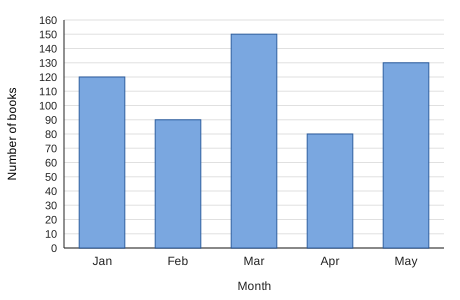
January 120, February 90, March 150, April 80, May 130.
Most books: March (the tallest bar). Fewest: April.
How many more books in March than in April? 150 − 80 = 70.
True or False: More books were borrowed in February than in January. 90 is less than 120. False
Maps and keys
A map uses symbols instead of words. The key (or legend) tells you what each symbol means. On most maps, north is at the top: look for the N arrow.
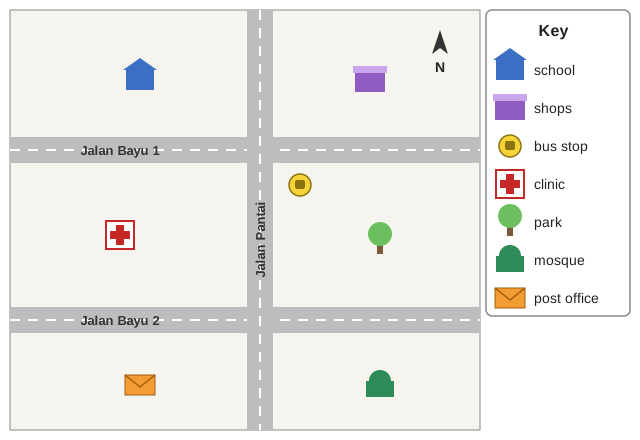
| Direction words | Meaning on the map |
|---|---|
| north / south of | above / below it |
| east / west of | to the right / to the left of it |
| opposite | on the other side of the road, facing it |
| between A and B | in the middle, with A on one side and B on the other |
| next to / beside | very near, on the same side |
What is south of the clinic, across Jalan Bayu 2? The envelope symbol: the post office.
Show answerHide answer
Keys in other texts
Keys are not only on maps. A class timetable may use short forms (BI = English, SN = Science), and a pictogram may say ● = 10 pupils. Always read the key first.
| Club members (● = 10 pupils, ◐ = 5 pupils) | Number | |
|---|---|---|
| Football | ● ● ● ● | 40 |
| Chess | ● ◐ | 15 |
| Scouts | ● ● ◐ | 25 |
Show answerHide answer
8.7Menus, price lists, brochures and posters
| Kantin Ceria: price list | |
|---|---|
| Nasi lemak | RM2.50 |
| Mee goreng | RM3.00 |
| Roti canai | RM1.20 |
| Chicken porridge (Mondays and Wednesdays only) | RM3.50 |
| Teh tarik | RM1.50 |
| Mineral water | RM1.00 |
| Set A: nasi lemak + teh tarik | RM3.50 |
| Open 7.00 a.m. to 2.30 p.m. on school days only. | |
2 × RM1.20 = RM2.40, + RM1.00 = RM3.40
How much do you save with Set A?
Separately: RM2.50 + RM1.50 = RM4.00. Set A: RM3.50. You save RM4.00 − RM3.50 = RM0.50
True or False: You can buy chicken porridge on Friday. The menu says Mondays and Wednesdays only. False
Words you meet on posters and brochures
| Word | Meaning |
|---|---|
| daily | every day |
| weekdays / weekends | Monday to Friday / Saturday and Sunday |
| entrance fee / admission | the money you pay to go in |
| per person / per month | for each person / for each month |
| free of charge | you do not pay |
| compulsory / optional | you must / you can choose |
| venue | the place where an event happens |
| closing date | the last day to send a form or register |
| while stocks last | only until there are no more |
| senior citizen | an older person, usually 60 or older |
| terms and conditions apply | there are rules; read the small print |
Show answerHide answer
Summary
- Part 4 has one non-linear text, four True/False statements and four short-answer gaps: 8 marks in about 20 minutes.
- Use the five steps: skim, read the question, scan, compare, answer and check.
- A statement is True only if every part matches the text. Trap words: only, every, all, everyone, free, except, and age or number limits.
- Short answers: copy no more than five words and/or a number exactly from the text, with RM, %, a.m. or p.m.
- Timetables: read the row and column headings, count the minutes, and check the * note for days a service does not run.
- Charts and maps: read the title, the scale and the key first; north is at the top.
- Menus and brochures: watch for "per person", "only" and the small print. Show your working for prices and savings.
- Grammar: the present simple for timetables (The bus leaves at 7.00), and at times, on days, in months.