Writing from notes: note expansion
What this chapter covers
- I can describe Paper 2 Part 2 of the UASA and how it is marked (11.1)
- I can read a writing task and its notes, and decide the text type, the reader and the tense (11.2)
- I can plan a text with one paragraph for each note and a word budget (11.3)
- I can expand a short note into full sentences by adding details, examples, reasons and feelings (11.4)
- I can link my sentences and paragraphs with linking words such as first, then, because, so, however and in the end (11.5)
- I can keep my tenses consistent and avoid common grammar mistakes (11.6)
- I can write an essay of about 90 words from notes, as the real paper asks, in about 40 minutes, and check it before I hand it in (11.7, 11.8)
In Paper 2 Part 2 you get a short task and a few notes. You turn the notes into a full text, usually an essay, in paragraphs. This is called note expansion: you expand (make bigger) each short note into good sentences. This unit gives you a method you can use for any topic, and shows you how the examiner gives the marks.
11.1What Part 2 looks like
| Paper 2 Part 2 at a glance | Details |
|---|---|
| Marks | 20 marks (half of Paper 2) |
| Time | about 40 minutes (Part 1, the email of about 80 words, takes about 20 minutes) |
| Task | write a text, usually an essay, about a topic from your English class |
| Notes | three (sometimes four) short notes, often in circles around the topic |
| Length | about 90 words: both UASA Form 1 papers of 2022/2023 say "In about 90 words, write an essay about ...". That is about 9 or 10 lines of handwriting, or about 30 words for each note. This unit practises the real length. (Some practice books ask for 120 to 150 words; if a question gives a different number, follow the number in the question.) |
| The rule | You must use all the notes. |
In about 90 words, write an essay about a school trip you enjoyed.
You must use the notes below to help you.
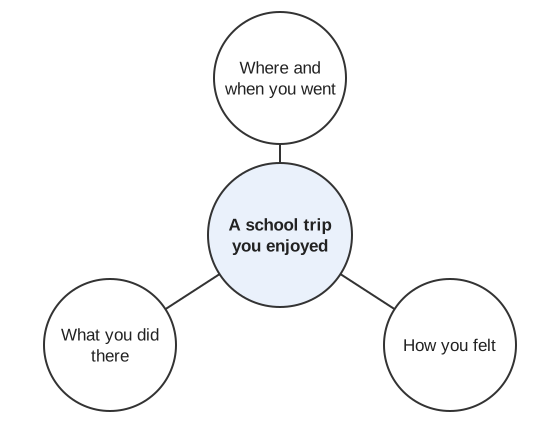
Each note is like a question you must answer. "Where and when you went" really means Where did you go? When did you go? If you leave out a note, you lose marks for content.
How the 20 marks are given
The examiner does not count mistakes one by one. They read your whole text and give a score from 0 to 5 for each of four areas, using the official rating scale.
| Area (5 marks each) | What the examiner asks | What gets 5 |
|---|---|---|
| Content | Did you write about every note? Is everything about the task? | All the notes are used, and the reader is fully informed. |
| Communicative achievement | Does it read like a real essay (or article, or story)? | Clear ideas, a good beginning and ending, a title if it is an essay. |
| Organisation | Is it in paragraphs? Are the sentences linked? | Paragraphs, and linking words such as first, then, because, so, however. |
| Language | Are the words and grammar correct? | Simple words used well, mostly correct grammar; small mistakes do not stop the meaning. |
Areas from the official UASA Form 1 Paper 2 rating scale (scores 5, 3 and 1 are described; 4 and 2 are in between).
Show answerHide answer
11.2Reading the task and the notes
Before you write a single sentence, read the task and ask yourself four questions.
| Ask | Look for | In the school trip task |
|---|---|---|
| 1. What is the topic? | the words after write an essay about | a school trip I enjoyed |
| 2. What type of text? | essay, article, story, report | an essay: title, beginning, middle, ending |
| 3. How many words? | In about ... words | about 90 words (about 30 for each note) |
| 4. Which tense? | Is it about the past, the present (habits, facts) or the future (plans)? | a trip that is finished, so mostly past simple |
Turn each note into questions
A note is very short. Change it into two or three wh- questions (who, what, where, when, why, how). Your answers become your sentences.
| Note | Questions to answer |
|---|---|
| Where and when you went | Where did you go? When? Who went with you? How did you get there? |
| What you did there | What did you do first? What did you see? What happened next? What was fun or funny? |
| How you felt | How did you feel? Why? Would you go again? |
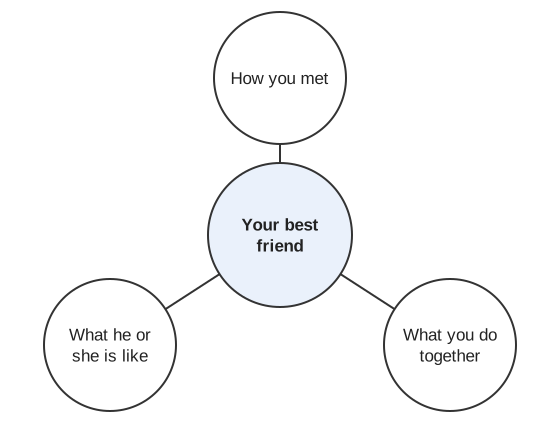
Show answerHide answer
What he or she is like: What does he or she look like? What kind of person is he or she? (present simple: She is kind and funny.)
What you do together: What do you do after school? What do you do at weekends? (present simple for habits: We often cycle to the park.)
Any sensible questions are fine. This task mixes tenses, and that is correct, because each note is about a different time.
11.3Planning your paragraphs
Spend about 5 minutes on a plan. It saves time later. The easiest plan gives one paragraph to each note, with a short title at the top.
| Part | What goes in it | Words (for about 90) |
|---|---|---|
| Title | a short name for your essay, e.g. My Trip to Zoo Negara | (not counted) |
| Paragraph 1 | Note 1, plus an opening sentence that tells the reader the topic | about 20 to 30 |
| Paragraph 2 | Note 2, with two or three details | about 30 to 40 |
| Paragraph 3 | Note 3, plus a closing sentence that ends the essay | about 25 to 30 |
With only about 90 words, there is no room for a separate introduction and conclusion. Put the opening sentence in paragraph 1 and the closing sentence in paragraph 3. What matters is that every note has its own place.
Each paragraph starts with a topic sentence: a sentence that tells the reader what the paragraph is about. The other sentences give supporting details.
P1 (where, when): Zoo Negara, Ulu Klang; last March; 40 students + 3 teachers; bus
P2 (what I did): elephants (one sprayed water); tigers, orang utans; after lunch, sea lion + ball
P3 (feelings): happy, excited, learnt a lot; tired; best trip
Three or four short points for each note are enough for about 90 words.
11.4Expanding a note into sentences
This is the main skill of Part 2. Take one note and build it up, step by step.
| Step | Add | Example |
|---|---|---|
| 1. Make a full sentence | a subject and a verb in the right tense | We visited the elephants. |
| 2. Add when or where | a time or a place | After lunch, we visited the elephants near the lake. |
| 3. Add a describing word | an adjective or an adverb | After lunch, we visited the huge elephants near the lake. |
| 4. Add a detail or example | what happened, such as, for example | ... One of them sprayed water at us. |
| 5. Add a reason or feeling | because, so, how you felt | ... so we all laughed. |
The note "visited elephants" (2 words) has become: After lunch, we visited the huge elephants near the lake. One of them sprayed water at us, so we all laughed. (21 words). Do this for every note and you will reach about 90 words. Choose your two or three best details for each note; you do not need to use every idea in your plan.
Ways to add details
| Add a ... | Useful words | Example |
|---|---|---|
| time | last March, on Saturday, in the morning, at 7.30 a.m., two weeks before | On Saturday morning, we left school at 7.30 a.m. |
| place | in, at, near, beside, around | We had lunch at a small stall near the jetty. |
| person | with my family, my cousin Farid, our teacher Cikgu Aina | I went with my cousin, Farid. |
| example | such as, for example, like | We bought souvenirs such as key chains and T-shirts. |
| reason | because, so, as | I was happy because our team won. |
| feeling | happy, proud, excited, nervous, tired, grateful, calm | I felt proud when the teacher praised us. |
| sense | see, hear, smell, taste | We could smell the satay from far away. |
Copying the note:
Adding ideas that are not about the task: a long story about the bus driver's car. Stay on the notes.
Repeating the same idea to reach the word count:
Writing far too much: 180 words with a long story about one note leaves less time to check, and the other notes get only one short sentence. Aim for about 90 words, shared out between the notes.
(a) went to Melaka – with family
(b) ate – Jonker Street
(c) felt tired – but happy
Show answerHide answer
(a) During the school holidays, I went to Melaka with my family. We drove there from Seremban in my father's car.
(b) In the evening, we ate at Jonker Street. I tried chicken rice balls and cendol, and both were delicious.
(c) At the end of the day, I felt tired but happy because I had learnt a lot about the history of Melaka.
Check: a full sentence with a subject and a past verb, plus a time, place, example or reason.
11.5Linking words
Linking words (connectors) join ideas so that your text flows. The rating scale gives marks for them under Organisation. Use a few different ones; you do not need many.
| Job | Linking words | Example |
|---|---|---|
| order (first to last) | first, then, next, after that, later, finally, in the end | First, we saw the tigers. After that, we had lunch. |
| adding | and, also, besides that, moreover | The food was cheap. It was also delicious. |
| contrast | but, however, although | It rained. However, we still enjoyed the trip. |
| reason | because, as | We went home early because it rained. |
| result | so, as a result | It rained, so we went home early. |
| example | for example, such as | We played games such as tug of war. |
| time | when, while, as soon as, before, after | As soon as we arrived, the guide met us. |
| ending | in the end, finally, all in all, in conclusion | All in all, it was a wonderful day. |
Punctuation with linking words
| Pattern | Example |
|---|---|
| Linking word + comma at the start of a sentence | However, the bus was late. / After that, we went home. |
| Comma before so and but joining two sentences | The bus was late, so we waited. |
| because in the middle, no comma | We waited because the bus was late. |
| Although at the start + comma in the middle | Although the bus was late, we arrived on time. |
(a) I was hungry. I bought a plate of mee goreng. (so)
(b) The hall was hot. We enjoyed the concert. (although)
(c) We left early. We wanted a good seat. (because)
Show answerHide answer
(b) Although the hall was hot, we enjoyed the concert.
(c) We left early because we wanted a good seat.
11.6Keeping your tenses consistent
Tense consistency means you stay in the same tense unless the time really changes. Choose the main tense from the task.
| The task is about | Main tense | Example |
|---|---|---|
| something that happened (a trip, a day, an event) | past simple | We went to Kuching. We visited the cat museum. |
| a habit, a person, a place, a festival every year | present simple | My cousin lives in Ipoh. We visit him every Raya. |
| a plan or a dream | will / would like to / going to | My dream room will have a big window. I would like to paint it blue. |
Changing tense is fine when the time changes: We met in Year 4 (past). Now she is in 1 Bestari with me (present). Next year we will join the Scouts together (future).
Past forms you will need
| Base | Past | Base | Past | Base | Past |
|---|---|---|---|---|---|
| go | went | see | saw | buy | bought |
| eat | ate | take | took | bring | brought |
| make | made | build | built | catch | caught |
| feel | felt | leave | left | teach | taught |
| swim | swam | win | won | learn | learnt (or learned) |
"Last Friday, our school held a sports day. I join the 100-metre race. When the race start, I run as fast as I could. In the end, I win a silver medal."
Show answerHide answer
11.7Worked example: from notes to essay
Here is the whole method on the school trip task in 11.1. Learn these six steps.
| Step | What you do | Time |
|---|---|---|
| 1. Read the task | topic, text type, number of words, tense | about 5 minutes |
| 2. Ask questions | turn each note into wh- questions | |
| 3. Plan | title + one paragraph for each note, in short notes | |
| 4. Write | a topic sentence, then two or three details for each note | about 25 minutes |
| 5. Link | linking words inside and between paragraphs | |
| 6. Check | all notes used? tenses, spelling, full stops, capital letters? count the words | about 5 to 10 minutes |
Steps 1 to 3 are in 11.2 and 11.3. Here is the essay written from the plan in 11.3.
My Trip to Zoo Negara
Last March, my class went on a school trip to Zoo Negara in Ulu Klang, Selangor. Forty students and three teachers travelled there by bus.
At the zoo, we saw many animals. First, we visited the elephants. One of them sprayed water at us, and we all laughed. Then we saw the tigers and the orang utans. After lunch, we watched a sea lion play with a ball.
I felt happy and excited because I learnt a lot about animals. However, I was tired when we reached school. It was the best trip of the year.
| Why it scores well | Where you can see it |
|---|---|
| Content: all three notes | P1 where and when; P2 what we did; P3 how I felt (with a reason) |
| Communicative achievement | a title, an opening sentence that gives the topic, a closing sentence |
| Organisation | three paragraphs; First, Then, After lunch, and, because, However |
| Language | past simple all the way (went, travelled, saw, visited, laughed, felt, learnt) |
| Length | 96 words: about 90, as the task asks, with about 30 words for each note |
A stronger writer can do more with the same notes and the same number of words. Compare the B1 answer below: sentences with which is, as soon as and had never been, and a feeling that changes.
An Unforgettable Day at Zoo Negara
Last March, my classmates and I went on a trip to Zoo Negara, which is in Ulu Klang, Selangor. Forty of us travelled by bus.
As soon as we arrived, our guide took us to the elephants. One of them sprayed water at us, so we screamed and laughed. After that, parrots flew above our heads in the bird park. Later, a sea lion caught a ball on its nose.
To be honest, I felt nervous before the trip because I had never been to a zoo. In the end, however, it was the most exciting day of the year.
11.8Checking your work
Keep 5 to 10 minutes at the end. Read your essay slowly and tick this list.
| Check | Ask yourself |
|---|---|
| Notes | Did I use every note? Did I give a reason for feelings or likes? |
| Paragraphs | Did I start a new paragraph for each note? Is there a title? |
| Linking | Did I use at least four different linking words? |
| Tense | Is every verb in the right tense? Past forms correct (went, bought, felt)? |
| Agreement | he goes, she has, they were: subject and verb match? |
| Small words | a / an / the in place? No extra words (discuss |
| Punctuation | a capital letter at the start of each sentence and for names; a full stop at the end; commas in lists |
| Length | About 90 words? Count one line and multiply by the number of lines. |
"In conclusion, I feel happy. Because we eat a lot of food."
Show answerHide answer
Better: All in all, I felt very happy because my whole family was together and we ate a lot of delicious food. I hope we can have another picnic soon.
Summary
- Paper 2 Part 2: "In about 90 words, write an essay about ..." from notes in circles; 20 marks; about 40 minutes. Part 1 is an email of about 80 words. About 90 words means about 30 words for each note.
- Marks: Content, Communicative achievement, Organisation and Language, 5 marks each. You must use all the notes.
- Read the task: topic, text type, word count, tense. Turn each note into wh- questions.
- Plan: a title and one paragraph for each note, each starting with a topic sentence.
- Expand each note: a full sentence, then a time or place, a describing word, a detail or example, and a reason or feeling.
- Link with first, then, after that, and, also, but, however, because, so, such as, in the end. Never "although ... but".
- Keep the tense: past for events, present for habits and descriptions, will for plans. Check past forms, was/were, articles and extra words.
- Check before you finish: notes, paragraphs, linking words, tenses, punctuation, length.