Practice paper, not an official KPM paper
Bahasa Perancis
Ujian Akhir Sesi Akademik
Bahasa Perancis (French)
Tingkatan 1, 1 jam 30 minit / 1 hour 30 minutes, 75 marks
Nama / Name
Kelas / Class
Tarikh / Date
Markah / Marks: / 75
Instructions
- Document du candidat, épreuves collectives. This paper has three parts: Partie 1 Grammaire et vocabulaire (25 points), Partie 2 Compréhension écrite (25 points) and Partie 3 Production écrite (25 points).
- Répondez à toutes les questions. Answer all questions.
- Écrivez vos réponses en français, avec les accents. Write your answers in French, with the accents.
Practice shows answers as you go. Exam times you and hides answers until you submit.
Partie 1 : grammaire et vocabulaire
25 marks1
Question 1
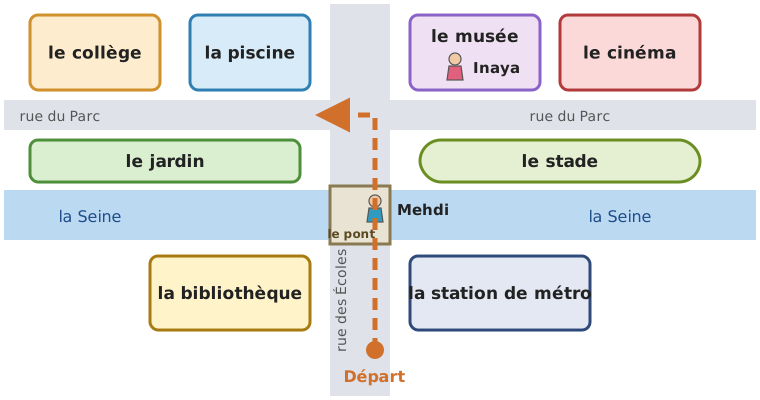
Regardez le plan du quartier. Vous êtes à la station de métro (« Départ ») et vous marchez vers le haut de la page. Complétez à l’aide des mots suivants. Utilisez chaque mot une fois. Look at the plan of the neighbourhood. You are at the metro station (“Départ”) and you walk up the page. Complete the sentences with the words below. Use each word once. Left and right are as you see them on the plan.
près dutournesà droitedansloin dutout droità gauchesurprès de latraverses
[1 mark]
(a)Du départ, tu ________________ le pont.
Show answerHide answer
Tick each point you got.
[1 mark]
(b)Après le pont, tu continues ________________.
Show answerHide answer
Tick each point you got.
[1 mark]
(c)Dans la rue du Parc, tu ________________ à gauche.
Show answerHide answer
Tick each point you got.
[1 mark]
(d)La piscine est ________________ jardin.
Show answerHide answer
Tick each point you got.
[1 mark]
(e)La bibliothèque est ________________ station de métro.
Show answerHide answer
Tick each point you got.
[1 mark]
(f)Le collège est ________________ stade.
Show answerHide answer
Tick each point you got.
[1 mark]
(g)Inaya est ________________ le musée.
Show answerHide answer
Tick each point you got.
[1 mark]
(h)Mehdi est ________________ le pont.
Show answerHide answer
Tick each point you got.
[1 mark]
(i)Le cinéma est ________________ du musée.
Show answerHide answer
Tick each point you got.
[1 mark]
(j)Le collège est ________________ de la piscine.
Show answerHide answer
Read the plan first. Verbs go with tu (tu traverses, tu tournes); près de / loin de join with the article (le jardin → près du jardin, la station → près de la station); dans = inside, sur = on top of. Left and right are as you see them on the plan.
Tick each point you got.
2
Question 2
Écrivez les nombres en lettres. Write down the numbers in letters.
QUATRE-VINGT-HUIT DOUZE CENT QUARANTE-DEUX QUATRE-VINGT-DIX VINGT ET UN QUATRE-VINGT-QUATORZE TRENTE-SIX SOIXANTE-SEIZE CENT QUARANTE-SEPT
[1 mark]
(a)36 :
Show answerHide answer
Tick each point you got.
[1 mark]
(b)100 :
Show answerHide answer
Tick each point you got.
[1 mark]
(c)21 :
Show answerHide answer
Tick each point you got.
[1 mark]
(d)76 :
Show answerHide answer
Tick each point you got.
[1 mark]
(e)12 :
Show answerHide answer
Tick each point you got.
[1 mark]
(f)94 :
Show answerHide answer
Tick each point you got.
[1 mark]
(g)47 :
Show answerHide answer
Tick each point you got.
[1 mark]
(h)90 :
Show answerHide answer
Tick each point you got.
[1 mark]
(i)142 :
Show answerHide answer
Tick each point you got.
[1 mark]
(j)88 :
Show answerHide answer
Small or capital letters both get the mark. Adosphère 1 writes et un with no hyphens (vingt et un); the 2025 UASA paper prints the 1990 form (TRENTE-ET-UN), so both are correct. French has no single word for 70 or 90: 76 is 60 + 16, 90 is 80 + 10 and 94 is 80 + 14.
Tick each point you got.
3
Question 3
Complétez les phrases suivantes avec le verbe « venir ». Complete the sentences with the verb venir (to come).
a) Exemple : Je viens à la fête à six heures.
[1 mark]
(b)Mes copains ________________ chez moi samedi.
Show answerHide answer
Tick each point you got.
[1 mark]
(c)Nous ________________ au collège en métro.
Show answerHide answer
Tick each point you got.
[1 mark]
(d)Tu ________________ à ma fête d’anniversaire ?
Show answerHide answer
Tick each point you got.
[1 mark]
(e)Ma cousine ________________ de Lyon en train.
Show answerHide answer
Tick each point you got.
[1 mark]
(f)Vous ________________ à quelle heure ?
Show answerHide answer
Venir is irregular: je viens, tu viens, il / elle vient, nous venons, vous venez, ils / elles viennent (conjugaison, p. 125). Not ils vienent.
Tick each point you got.
Partie 2 : compréhension écrite
25 marks4
Question 4
Lisez le texte ci-dessous et répondez « Vrai » ou « Faux ». Read the text below and answer True or False.
Je m’appelle Sofia Marin. J’ai douze ans et j’habite à Lille, 14 rue des Roses. Mon collège est loin de chez moi : je vais au collège en bus. Dans mon quartier, il y a une bibliothèque et un cinéma. Le soir, je regarde la télé et je me couche à dix heures.
1. Exemple : Sofia habite à Paris. → Faux
[1 mark]
(2)Sofia a douze ans.
Show answerHide answer
Vrai
[1 mark]
(3)Son collège est près de chez elle.
Show answerHide answer
Faux
Mon collège est loin de chez moi. Loin de = far from.
[1 mark]
(4)Elle va au collège en bus.
Show answerHide answer
Vrai
[1 mark]
(5)Dans son quartier, il y a un cinéma.
Show answerHide answer
Vrai
Dans mon quartier, il y a une bibliothèque et un cinéma.
[1 mark]
(6)Elle se couche à neuf heures.
Show answerHide answer
Faux
She goes to bed at dix heures (10 o’clock), not nine.
5
Question 5
Lisez le texte et répondez aux questions. Read the text and answer the questions.
Le message de Maëlle
Salut ! Je m’appelle Maëlle Roche. J’ai treize ans et j’habite à Toulouse, avec ma mère et mon frère Enzo. Le matin, je me lève à sept heures moins le quart. Je vais au collège en bus : je prends le bus à sept heures et demie. Le midi, je déjeune à la cantine. Le mercredi après-midi, je vais à la piscine avec ma copine Clémence. Le soir, je regarde la télé et je me couche à neuf heures et demie.
[2 marks]
(a)Où habite Maëlle ?
Elle habite à ______________________
Elle habite à ______________________
Show answerHide answer
Tick each point you got.
[2 marks]
(b)À quelle heure est-ce qu’elle se lève ?
Elle se lève à ______________________
Elle se lève à ______________________
Show answerHide answer
Tick each point you got.
[2 marks]
(c)Comment est-ce qu’elle va au collège ?
Elle va au collège ______________________
Elle va au collège ______________________
Show answerHide answer
Tick each point you got.
[2 marks]
(d)Où est-ce qu’elle déjeune ?
Elle déjeune ______________________
Elle déjeune ______________________
Show answerHide answer
Tick each point you got.
[2 marks]
(e)Qu’est-ce qu’elle fait le mercredi après-midi ?
Elle ______________________
Elle ______________________
Show answerHide answer
Each answer: 1 point for the right information from the text, 1 point for finishing the sentence correctly (verb, preposition, article, spelling). Watching TV (le soir) is in the evening, so it does not answer (e).
Tick each point you got.
6
Question 6
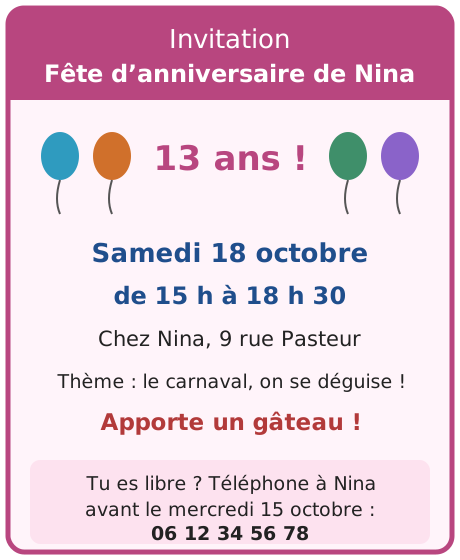
Vous êtes en France et vous recevez cette invitation. Lisez ce document et répondez aux questions. You are in France and you receive this invitation. Read it and answer the questions.
[1 mark]
(1)Quelle est la date de la fête ?
Show answerHide answer
Tick each point you got.
[1 mark]
(2)La fête finit…
Show answerHide answer
à 18 h 30.
De 15 h à 18 h 30: from 3 p.m. to 6.30 p.m. 15 h is the start.
[1 mark]
(3)La fête est…
Show answerHide answer
chez Nina.
Chez Nina, 9 rue Pasteur. Chez + a name = at that person’s home.
[1 mark]
(4)Pour la fête, on apporte…
 un gâteau
Show answerHide answer
un gâteauApporte un gâteau ! This is the imperative of apporter: no tu, no -s.
[1 mark]
(5)Pour répondre, on téléphone à Nina avant…
Show answerHide answer
le mercredi 15 octobre.
Téléphone à Nina avant le mercredi 15 octobre. The 18th is the day of the party.
7
Question 7
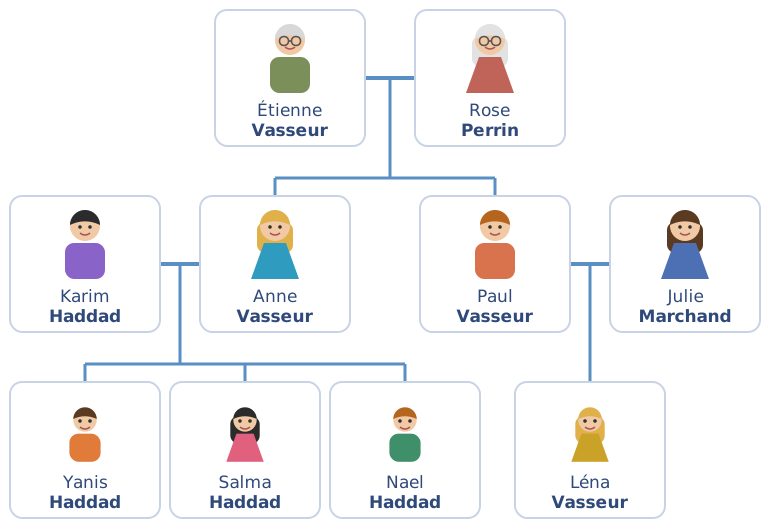
Regardez l’arbre généalogique de la famille Vasseur et cochez la bonne case, « Vrai » ou « Faux ». Look at the Vasseur family tree and tick the correct box, True or False.
a) Exemple : La grand-mère de Yanis s’appelle Julie Marchand. → Faux
[1 mark]
(b)L’oncle de Salma s’appelle Paul Vasseur.
Show answerHide answer
Vrai
Paul is the brother of Salma’s mother, Anne: he is l’oncle of Salma.
[1 mark]
(c)Léna est la sœur de Salma.
Show answerHide answer
Faux
Léna’s father Paul is the brother of Salma’s mother Anne, so Léna is la cousine of Salma.
[1 mark]
(d)Karim Haddad est le frère de Paul Vasseur.
Show answerHide answer
Faux
Karim is the husband of Paul’s sister Anne: he is le beau-frère of Paul, not his brother.
[1 mark]
(e)Julie Marchand est la belle-sœur d’Anne Vasseur.
Show answerHide answer
Vrai
Julie is the wife of Anne’s brother, Paul: la belle-sœur.
[1 mark]
(f)Étienne Vasseur est le grand-père de Léna.
Show answerHide answer
Vrai
Étienne is the father of Léna’s father, Paul.
Partie 3 : production écrite
25 marks8
Question 8
Votre collège organise un échange avec un collège de Toulouse. Remplissez cette fiche de présentation. Your school is organising an exchange with a school in Toulouse. Fill in this introduction form.
COLLÈGE JEAN-JAURÈS, TOULOUSE
Échange scolaire : fiche de présentation
Échange scolaire : fiche de présentation
[1 mark]
(a)Nom :
Show answerHide answer
Tick each point you got.
[1 mark]
(b)Prénom :
Show answerHide answer
Tick each point you got.
[1 mark]
(c)Date de naissance :
Show answerHide answer
Tick each point you got.
[1 mark]
(d)Adresse (numéro et rue) :
Show answerHide answer
Tick each point you got.
[1 mark]
(e)Ville et pays :
Show answerHide answer
Tick each point you got.
[1 mark]
(f)Nationalité :
Show answerHide answer
Tick each point you got.
[1 mark]
(g)Pour aller au collège, vous allez… :
Show answerHide answer
Tick each point you got.
[1 mark]
(h)Vous vous levez à quelle heure ?
Show answerHide answer
Tick each point you got.
[1 mark]
(i)Dans votre quartier, il y a… :
Show answerHide answer
Tick each point you got.
[1 mark]
(j)Quel jour de la semaine êtes-vous libre ?
Show answerHide answer
Model form: Nom : RAHMAN · Prénom : Hakim · Date de naissance : le 14 août 2013 · Adresse : 22 rue des Fleurs · Ville et pays : Ipoh, Malaisie · Nationalité : malaisien · Pour aller au collège : à vélo · Heure du lever : à six heures · Dans mon quartier : une bibliothèque · Jour libre : le samedi
1 point per field: the information must answer the label and be in French. In Nationalité, a girl writes malaisienne.
Tick each point you got.
9
Question 9
Vous écrivez à votre correspondant(e) français(e). Vous parlez de votre quartier et de votre journée (60 à 80 mots). You are writing to your French penfriend. Talk about your neighbourhood and your day (60 to 80 words).
- Vous vous présentez : prénom, âge, nationalité. Introduce yourself: first name, age, nationality.
- Vous présentez votre quartier : où vous habitez, deux lieux dans votre quartier, un lieu près de chez vous ou loin de chez vous. Describe your neighbourhood: where you live, two places in your area, one place near or far from your home.
- Vous parlez de votre journée : l’heure du lever, comment vous allez au collège, une activité le soir ou l’heure du coucher. Talk about your day: the time you get up, how you go to school, an evening activity or the time you go to bed.
[15 marks]
Show answerHide answer
Salut Alice !
Je m’appelle Farid, j’ai douze ans et je suis malaisien. J’habite à Ipoh, en Malaisie. Dans mon quartier, il y a un parc et une piscine. La piscine est loin de chez moi.
Le matin, je me lève à six heures et je vais au collège à vélo. Le soir, je regarde la télé et je me couche à neuf heures et demie.
Et toi, tu te lèves à quelle heure ?
À bientôt !
Farid (about 75 words)
Je m’appelle Farid, j’ai douze ans et je suis malaisien. J’habite à Ipoh, en Malaisie. Dans mon quartier, il y a un parc et une piscine. La piscine est loin de chez moi.
Le matin, je me lève à six heures et je vais au collège à vélo. Le soir, je regarde la télé et je me couche à neuf heures et demie.
Et toi, tu te lèves à quelle heure ?
À bientôt !
Farid (about 75 words)
Content 9 points (one tick per element; the two places count 1 each) and language 6 points in three cumulative bands (2 + 2 + 2). Common mistakes that cost language points: « Je suis 13 ans » (write J’ai 13 ans), « Je lève à six heures » (write Je me lève), « en pied » (write à pied), « près du bibliothèque » (write près de la bibliothèque), « J’habite à Malaisie » (write en Malaisie).
Tick each point you got.
Test specification (JSU)
| Module | Remembering | Understanding | Applying | Analysing | Evaluating | Creating | Items | marks |
|---|---|---|---|---|---|---|---|---|
| 5. La ville : où j'habite et mon chemin | – | 1 (5) | 2 (20) | – | – | – | 3 | 25 |
| 6. L'heure et ma journée | – | 2 (15) | 1 (5) | – | – | 1 (15) | 4 | 35 |
| 7. La famille, les pays et les transports | – | – | – | 1 (5) | – | – | 1 | 5 |
| 8. Les vacances et les animaux | 1 (10) | – | – | – | – | – | 1 | 10 |
| Total | 1 (10) | 3 (20) | 3 (25) | 1 (5) | 0 (0) | 1 (15) | 9 | 75 |
Each cell shows items (marks).