Linear equations
What this chapter covers
- Identify linear equations in one variable and describe their characteristics (6.1)
- Form linear equations in one variable from a statement or a situation, and write a situation for an equation (6.1)
- Solve linear equations in one variable by trial and improvement, the equality concept and backtracking (6.1)
- Solve problems involving linear equations in one variable (6.1)
- Identify linear equations in two variables and write them in the general form ax + by = c (6.2)
- Form linear equations in two variables from a statement or a situation, and vice versa (6.2)
- Find possible solutions of a linear equation in two variables and draw its straight line graph (6.2)
- Form simultaneous linear equations from daily situations, draw their graphs and state the type of solution (6.3)
- Solve simultaneous linear equations by the graphical, substitution and elimination methods (6.3)
- Solve problems involving simultaneous linear equations in two variables (6.3)
A class of 30 students is to be split into groups. There are 6 more boys than girls. How many girls are there? If we let the number of girls be x, the boys are x + 6 and so x + (x + 6) = 30. This is a linear equation. Solving it gives x = 12 girls and 18 boys. In this chapter you will learn how to form equations like this from a situation and how to solve them.
| English | Bahasa Melayu |
|---|---|
| linear equation | persamaan linear |
| variable | pemboleh ubah |
| solution, root of an equation | penyelesaian, punca persamaan |
| trial and improvement | cuba jaya |
| backtracking (working backwards) | pematahbalikan |
| simultaneous linear equations | persamaan linear serentak |
| substitution, elimination | penggantian, penghapusan |
6.1Linear equations in one variable
What is an equation?
- only one variable (one letter), and
- the power of the variable is 1 (no x², no 1x, no xy).
Example 1: is it a linear equation in one variable? (textbook p. 125)
| Equation | Answer | Reason |
|---|---|---|
| 3x + 2 = 5 | Yes | One variable, x, and its power is 1 |
| p − 4q = 6 | No | Two variables, p and q |
| 2(k − 7) = k | Yes | One variable, k, and its power is 1 (the brackets do not matter) |
| y² + 3y = 1 | No | The highest power of y is 2 |
Show answerHide answer
Forming linear equations
Choose a letter for the unknown, then turn the words into a mathematical sentence.
| Words | Maths |
|---|---|
| sum of, more than, added to, increased by | + |
| difference, less than, subtract … from, reduced by | − |
| times, twice, thrice, product of | × |
| quotient of, shared equally, half of | ÷ |
| is, the result is, gives, equals | = |
Example 2 (textbook p. 126)
- Subtract 8 from a number, the remainder is 2. Let the number be x: x − 8 = 2
- Peck Chin bought five pens at y sen each and an exercise book for RM3. She paid RM7 in total.
Change everything to sen: RM3 = 300 sen, RM7 = 700 sen. 5y + 300 = 700
Example 3: from an equation to a situation (textbook p. 126)
- 2x + 5 = 19, where x is a number: "Twice a number added to 5 gives 19."
- y − 2 = 8, where y is Rajes's age now: "Rajes was 8 years old 2 years ago."
Show answerHide answer
b) 5y = 40
c) 3x + 200 = 500 (in sen). Solving gives x = 100, so each pen costs 100 sen = RM1.
Solving linear equations in one variable
Two blocks of x kg and 6 kg are on a scale that reads 10 kg, so x + 6 = 10. A 4 kg block makes the scale read 10 kg, so x = 4 satisfies the equation.
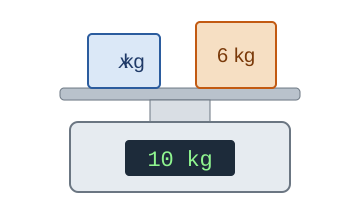
There are three methods. Example 4 solves 2x + 1 = 7 with each one.
Example 4: solve 2x + 1 = 7 (textbook pp. 127–128)
(a) Trial and improvement. Try a value, check the left hand side, then improve the guess.
| Try x = | 2x + 1 | Compare with 7 |
|---|---|---|
| 1 | 2(1) + 1 = 3 | 3 is less than 7. Try a bigger value. |
| 2 | 2(2) + 1 = 5 | 5 is closer, still less than 7. |
| 3 | 2(3) + 1 = 7 | Equal to 7. x = 3 |
(b) Equality concept. An equation is like a balance. Whatever you do to one side, do the same to the other side and it stays level.
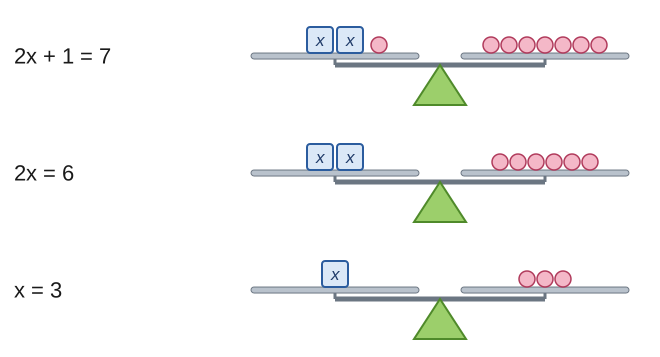
2x + 1 − 1 = 7 − 1 → 2x = 6 → 2x2 = 62 → x = 3
(c) Backtracking. List what happens to x, then undo the operations in reverse order starting from the answer.
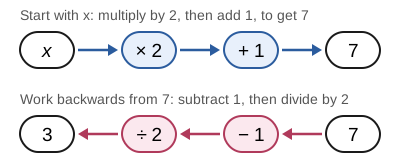
Harder equations: fractions, brackets and x on both sides
Use the equality concept. Write a short reason for each step.
Example 5 (textbook p. 129)
(a) 2x + 135 = 7
- Multiply both sides by 5: 2x + 13 = 35
- Subtract 13 from both sides: 2x = 22
- Divide both sides by 2: x = 11
(b) 5(x − 4) = x + 16
- Expand the brackets: 5x − 20 = x + 16
- Add 20 to both sides: 5x = x + 36
- Subtract x from both sides: 4x = 36
- Divide both sides by 4: x = 9
Check: 5(9 − 4) = 25 and 9 + 16 = 25 ✓
Show answerHide answer
b) 4x = 8, x = 2
c) x6 = 2, x = 12
d) x + 8 = 18, x = 10
e) 3x + 6 = 5x, 6 = 2x, x = 3
Solving problems
Four steps: understand the problem, let a letter stand for the unknown, form and solve the equation, then check the answer in the story.
Example 6: Jalil's age (textbook p. 130)
After 10 years, Jalil's age will be three times his age this year. How old is Jalil?
- Let Jalil's age now be x years. After 10 years he is x + 10.
- x + 10 = 3x
- Subtract x from both sides: 10 = 2x
- x = 5. Jalil is 5 years old.
Check: 5 + 10 = 15 = 3 × 5 ✓
Example 7: a rectangle (textbook p. 130)
The perimeter of the rectangle is 66 cm. Find its area.
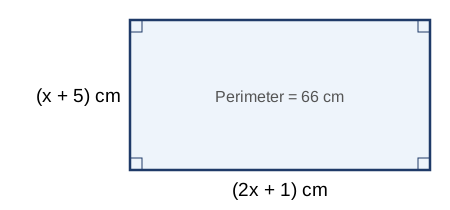
- Perimeter = 2(length + width): 2[(2x + 1) + (x + 5)] = 66
- 2(3x + 6) = 66 → 6x + 12 = 66 → 6x = 54 → x = 9
- Length = 2(9) + 1 = 19 cm, width = 9 + 5 = 14 cm
- Area = 19 × 14 = 266 cm²
Show answerHide answer
b) Let Yazid's score be y. y + (y + 17) + 2y = 161, 4y + 17 = 161, 4y = 144, y = 36. Azmah = 36 + 17 = 53.
6.2Linear equations in two variables
What is a linear equation in two variables?
Example 8 (textbook p. 132)
| Equation | Two variables, linear? | Reason |
|---|---|---|
| 3p − q = 6 | Yes | Variables p and q, each with power 1 |
| 7x² + 5y = 9 | No | The power of x is 2 |
| 2(k + 8) = 5k | No | Only one variable |
| y6 + 4 = −2x | Yes | Variables x and y, each with power 1 |
Forming linear equations in two variables
Example 9 (textbook p. 133)
- The difference between two numbers is 18: p − q = 18
- Ahmad saved RMx and Norita saved RMy. Together they saved RM600: x + y = 600
- A bus holds m passengers and a van holds n. Two buses and five vans carry 100 passengers: 2m + 5n = 100
- Going the other way: 4x + 5y = 35, where x and y are the prices in RM of a plate of nasi lemak and a plate of fried noodles: "4 plates of nasi lemak and 5 plates of fried noodles cost RM35."
Show answerHide answer
b) x + 2y = 40
Possible solutions
Example 10: three solutions of 2x + y = 6 (textbook p. 134)
| Choose | Substitute | Solve | Ordered pair |
|---|---|---|---|
| x = 0 | 2(0) + y = 6 | y = 6 | (0, 6) |
| x = 1 | 2(1) + y = 6 | y = 4 | (1, 4) |
| x = 2 | 2(2) + y = 6 | y = 2 | (2, 2) |
Example 11: Osman's jerseys (textbook p. 135)
Osman bought 5 jerseys for Harimau Team (x) and Kancil Team (y): x + y = 5. The possible pairs are (1, 4), (2, 3), (3, 2) and (4, 1). In a real situation, only whole numbers make sense: you cannot buy 2.5 jerseys.
Show answerHide answer
b) Gold + bronze = 4: (1 gold, 3 bronze), (2, 2), (3, 1).
Graphs of linear equations in two variables
Make a table of values, plot the ordered pairs on a grid and join them. The points always lie on a straight line, which is why these equations are called linear.
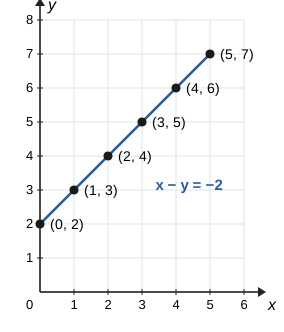
Example 12: draw the graph of x − y = −2 (textbook p. 136)
Rewrite as y = x + 2, then fill in the table.
| x | 0 | 1 | 2 | 3 | 4 | 5 |
|---|---|---|---|---|---|---|
| y | 2 | 3 | 4 | 5 | 6 | 7 |
Show answerHide answer
b) x = 2 − y2: x = −4, −3, −2, −1, 0, 1
6.3Simultaneous linear equations in two variables
Forming simultaneous linear equations
Faizah rears 7 chickens and ducks. A chicken costs RM2 a week and a duck RM1. The total cost is RM12 a week. Let x = number of chickens and y = number of ducks.
x + y = 7 (number of animals) 2x + y = 12 (cost)
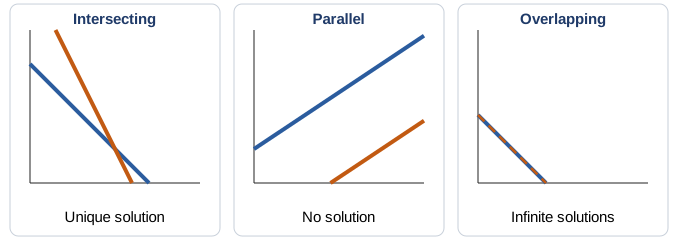
| The two straight lines | Type of solution | Example |
|---|---|---|
| Intersect at one point | Unique solution | x + y = 7 and 2x + y = 12 |
| Are parallel | No solution | 2x − 3y = −6 and 4x − 6y = 18 |
| Overlap (the same line) | Infinite solutions | x + y = 4 and 5x + 5y = 20 |
Method 1: graphical method
Example 13: x + y = 6 and 2x + y = 8 (textbook p. 140)
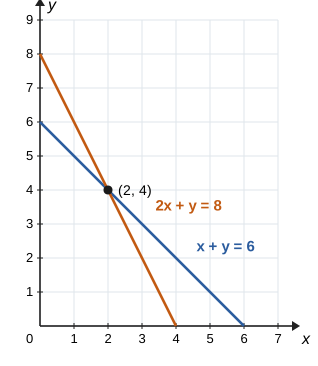
Draw both lines on the same axes. They meet at (2, 4), so x = 2, y = 4.
Method 2: substitution method
Example 14: x − 3y = 7 and 5x + 2y = 1 (textbook p. 140)
x − 3y = 7 …… ① 5x + 2y = 1 …… ②
- From ①, write x in terms of y: x = 7 + 3y …… ③
- Substitute ③ into ②: 5(7 + 3y) + 2y = 1
- 35 + 15y + 2y = 1 → 17y = −34 → y = −2
- Substitute y = −2 into ③: x = 7 + 3(−2) = 1
x = 1, y = −2. Check in ②: 5(1) + 2(−2) = 1 ✓
Method 3: elimination method
Make the coefficients of one variable the same, then add (if the signs are different) or subtract (if the signs are the same) to remove it.
Example 15 (textbook p. 141)
(a) x + 2y = 9 …… ① 3x − 2y = 15 …… ②
- +2y and −2y have different signs, so add: ① + ②: 4x = 24 → x = 6
- Substitute into ①: 6 + 2y = 9 → 2y = 3 → y = 32
(b) 2x + 5y = 14 …… ① 3x + 4y = 7 …… ②
- The LCM of 2 and 3 is 6. ① × 3: 6x + 15y = 42 …… ③
- ② × 2: 6x + 8y = 14 …… ④
- Same signs, so subtract: ③ − ④: 7y = 28 → y = 4
- Substitute into ①: 2x + 20 = 14 → 2x = −6 → x = −3
x = −3, y = 4
Show answerHide answer
b) Add: 3x = 27, x = 9, y = 5 − 9 = −4
c) Add: 5x = 10, x = 2; 4(2) + 3y = 8, y = 0
Solving problems
Example 16: Zoo Negara tickets (textbook p. 142)
2 adults and 3 children paid RM97. 4 adults and 1 child paid RM139. Find the price of each ticket.
- Let an adult ticket be RMx and a child ticket be RMy.
- 2x + 3y = 97 …… ① 4x + y = 139 …… ②
- ① × 2: 4x + 6y = 194 …… ③
- ③ − ②: 5y = 55 → y = 11
- Substitute into ①: 2x + 33 = 97 → 2x = 64 → x = 32
An adult ticket costs RM32 and a child ticket costs RM11. Check: 2(32) + 3(11) = 97 ✓, 4(32) + 11 = 139 ✓
Show answerHide answer
b) p = 2q and 2p + 2q = 150. Substitute: 4q + 2q = 150, 6q = 150, q = 25, p = 50.
Summary
| Linear equation in one variable | Linear equation in two variables | Simultaneous linear equations | |
|---|---|---|---|
| Form | ax + b = c | ax + by = c | Two equations in the same x and y |
| Example | 2x + 1 = 7 | x + y = 7 | x + y = 7 and 2x + y = 12 |
| Solutions | Only one (x = 3) | Many pairs; they form a straight line | Unique, none (parallel) or infinite (overlapping) |
| Methods | Trial and improvement, equality concept, backtracking | Choose x, substitute, solve for y | Graphical, substitution, elimination |
| Remember | Key fact |
|---|---|
| Balance rule | Do the same thing to both sides |
| Brackets | Multiply every term inside: 3(x − 2) = 3x − 6 |
| Units | Change RM and sen (or m and cm) to the same unit before forming the equation |
| Backtracking | Undo the operations in reverse order |
| Elimination | Different signs: add. Same signs: subtract. |
| Check | Substitute your answer into the original equation(s) |