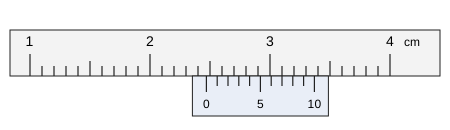
Diagram 3 shows the scale of a pair of vernier calipers. What is the reading?
Diagram 3
Show answerHide answer
D
Main scale just before the vernier zero = 2.4 cm. Vernier line 7 lines up with a main-scale line → 0.07 cm. Reading = 2.4 + 0.07 = 2.47 cm.
ApplyingMedium1.4Textbook p. 22
9
Which instrument is the most suitable for measuring the diameter of a strand of hair?
Show answerHide answer
D
The micrometer screw gauge is the most sensitive (smallest reading 0.01 mm), so it can measure very small diameters.
UnderstandingLow1.4Textbook p. 23
10
Which of the following is an example of a random error?
Show answerHide answer
A
Random errors are caused by the observer, e.g. parallax error. The other three are systematic errors from the instrument.
UnderstandingMedium1.4Textbook p. 26
11
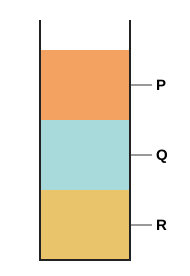
Diagram 4 shows three liquids, P, Q and R, that do not mix, in a measuring cylinder. Which statement is correct?
Diagram 4
Show answerHide answer
C
The densest liquid sinks to the bottom. R is at the bottom, so R is the densest; P (top) is the least dense.
AnalysingMedium1.5Textbook p. 30
12
A student has identified a problem and constructed a hypothesis. What is the next step in a scientific investigation?
Show answerHide answer
B
Order: identify problem → construct hypothesis → control variables → plan → conduct → collect data → analyse → conclude → report.
UnderstandingLow1.6Textbook p. 34
Section B: structured questions
31 marks
Answer all questions. Write your answers in the spaces provided.
13
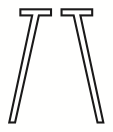
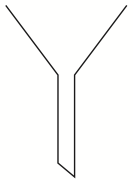
Diagram 5 shows three pieces of apparatus, P, Q and R. Choose the function of each.
[1 mark](a)Apparatus PPShow answerHide answer
Supports apparatus during heating
P is a tripod stand.
[1 mark](b)Apparatus QQShow answerHide answer
Separates insoluble solids from a mixture
Q is a filter funnel.
[1 mark](c)Apparatus RRShow answerHide answer
Evaporates excess solvent
R is an evaporating dish.
RememberingLow1.2Textbook p. 10
14
Convert the following.
[1 mark](a)1.5 kg = ______ g
Show answerHide answer
1500 g1
Tick each point you got.
[1 mark](b)3 minutes = ______ s
Show answerHide answer
180 s1
Tick each point you got.
[1 mark](c)250 mm = ______ m
Show answerHide answer
0.25 m1
Tick each point you got.
ApplyingLow1.3Textbook p. 16
15
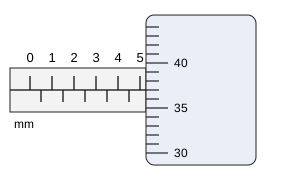
Diagram 6 shows a micrometer screw gauge being used to measure the diameter of a wire.
Diagram 6
[1 mark](a)What is the reading of the micrometer screw gauge?
Show answerHide answer
5.37 mm1
Sleeve 5.0 mm + thimble 37 × 0.01 = 0.37 mm.
Tick each point you got.
[1 mark](b)The micrometer screw gauge has a zero error of +0.02 mm. Calculate the actual diameter of the wire.
Show answerHide answer
5.37 − 0.02 = 5.35 mm1
Actual reading = reading − zero error.
Tick each point you got.
[1 mark](c)Why is a micrometer screw gauge used instead of a ruler to measure the diameter of the wire?
Show answerHide answer
It is more sensitive / more accurate — its smallest reading is 0.01 mm (a ruler reads only to 1 mm)1
Tick each point you got.
ApplyingMedium1.4Textbook p. 23
16
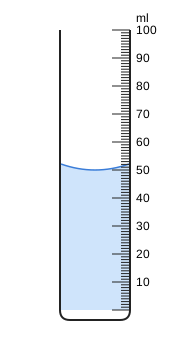
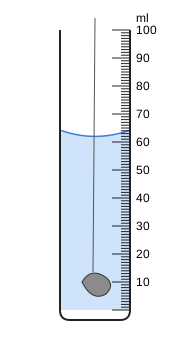
A stone of mass 30 g is lowered into a measuring cylinder of water. Diagram 7 shows the water level before and after.
Before
After
[1 mark](a)What is the volume of the stone?
Show answerHide answer
62 − 50 = 12 cm³1
Tick each point you got.
[2 marks](b)Calculate the density of the stone.
Show answerHide answer
Density = 30 ÷ 12 (correct substitution)1
= 2.5 g cm⁻³ (answer with unit)1
Tick each point you got.
[2 marks](c)Will the stone float or sink in water? Explain your answer.
Show answerHide answer
Sinks1
Its density (2.5 g cm⁻³) is greater than the density of water (1.00 g cm⁻³)1
Tick each point you got.
[1 mark](d)Name the method used to find the volume of the stone.
Show answerHide answer
Water displacement method1
Tick each point you got.
AnalysingMedium1.5Textbook p. 31
17
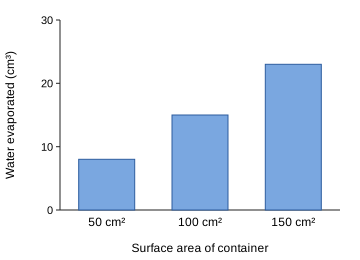
Siti poured 100 cm³ of water into each of three containers with different surface areas. She left them in the sun for 3 hours and then measured how much water had evaporated. Diagram 8 shows her results.
Diagram 8
[1 mark](a)State the manipulated variable.
Show answerHide answer
Surface area of the container1
Tick each point you got.
[1 mark](b)State the responding variable.
Show answerHide answer
Volume of water evaporated1
Tick each point you got.
[1 mark](c)State one constant variable.
Show answerHide answer
Any 1 points
Initial volume of water (100 cm³)1
Time left in the sun (3 hours)1
Location / temperature of surroundings1
Tick each point you got.
[1 mark](d)Construct a hypothesis for this investigation.
Show answerHide answer
The larger the surface area of the container, the larger the volume of water evaporated1
Tick each point you got.
[1 mark](e)Based on Diagram 8, state one conclusion.
Show answerHide answer
The larger the surface area, the more water evaporates — the hypothesis is accepted1
Tick each point you got.
[1 mark](f)State one scientific attitude Siti must practise when recording her results.
Show answerHide answer
Honest and accurate when recording data1
Tick each point you got.
AnalysingHigh1.6Textbook p. 34
18
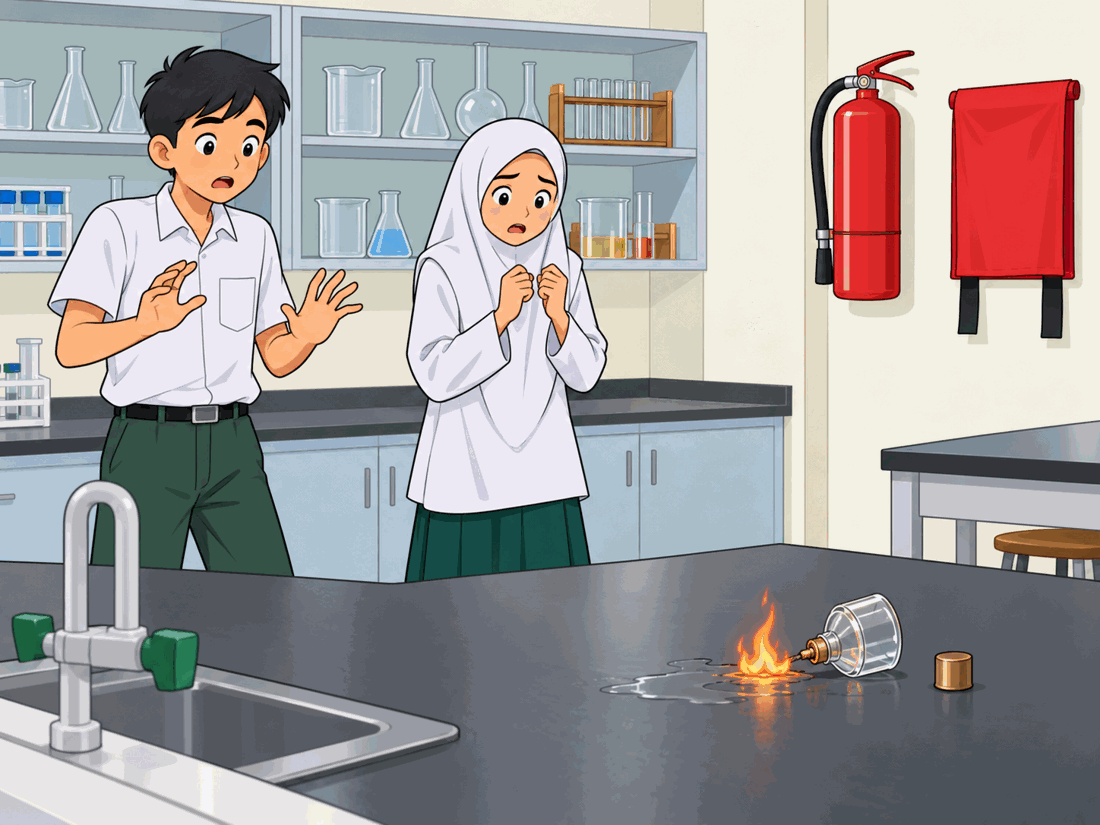
Diagram 9 shows a situation in a science laboratory.
Diagram 9
[2 marks](a)State two actions the students should take immediately.
Show answerHide answer
Any 2 points
Do not panic / move away from the fire1
Inform the teacher immediately1
Switch off the electricity / gas supply1
Use the fire blanket or fire extinguisher (if trained / under the teacher's instruction)1
Tick each point you got.
[1 mark](b)The spirit lamp contains alcohol. Which hazard symbol should be on the alcohol bottle?Show answerHide answer
Flammable
Alcohol vaporises easily and catches fire.
[1 mark](c)Suggest one laboratory rule that could have prevented this accident.
Show answerHide answer
Any 1 points
Keep flammable chemicals away from flames / heat sources1
Do not leave a lit spirit lamp unattended1
Handle apparatus carefully and keep the bench tidy1
Tick each point you got.
EvaluatingHigh1.2Textbook p. 14
19
Pak Wan wants to sell a three-layer drink. The table shows the densities of three liquids he has.
Liquid
Density (g cm⁻³)
Rose syrup
1.30
Orange juice
1.05
Milk foam
0.60
[1 mark](a)State the order of the layers from the bottom to the top of the glass.
Show answerHide answer
Rose syrup (bottom) → orange juice → milk foam (top)1
Tick each point you got.
[2 marks](b)Explain how Pak Wan should prepare the drink so that the layers stay separate.
Show answerHide answer
Any 2 points
Pour the densest liquid (rose syrup) first, then orange juice, then milk foam1
Pour slowly (e.g. over the back of a spoon) so the layers do not mix1
Less dense liquids float on denser liquids1
Tick each point you got.
CreatingHigh1.5Textbook p. 32
20
Choose the correct term for each description.
[1 mark](a)A digital thermometer can detect a change of 0.1 °C.Show answerHide answer
Sensitivity
[1 mark](b)Three measurements of the same pencil are 4.52 cm, 4.52 cm and 4.52 cm.Show answerHide answer
Consistency
[1 mark](c)The reading obtained is very close to the actual value.Show answerHide answer