Science questions, chapter 2
Cell as the Basic Unit of Life
43 marks. Use Practice to check each answer as you go, or Exam to answer everything against the clock first.
Section A: objective questions
12 marksChoose the best answer for each question.
1
In 1665, a scientist looked at a thin piece of cork through a microscope and named the small box-shaped structures he saw "cells". Who was he?
Show answerHide answer
B
Robert Hooke observed cork cells in 1665. Antonie van Leeuwenhoek observed moving microorganisms in rain water in 1674.
2
Which solution is used to stain cheek cells so that they can be seen clearly under a microscope?
Show answerHide answer
C
Methylene blue is used for cheek (animal) cells. Iodine solution is used for onion (plant) cells.
3
When preparing a slide, the cover glass is lowered slowly onto the specimen using a mounting needle. Why?
Show answerHide answer
A
Lowering the cover glass slowly from one side pushes the air out, so no air bubbles are trapped over the cells. Filter paper absorbs excess stain.
4
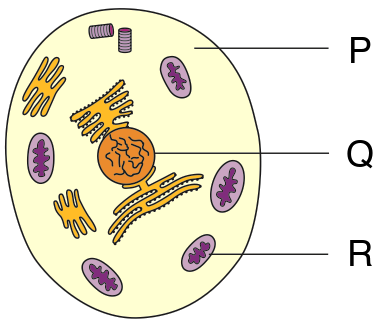
Diagram 1 shows an animal cell. What is the function of structure Q?
Show answerHide answer
D
Q is the nucleus, which controls all activities in the cell. P is the cytoplasm and R is a mitochondrion.
5
Which structures are found in both animal cells and plant cells?
Show answerHide answer
D
Both cells have a nucleus, cell membrane, cytoplasm and mitochondria. The cell wall, chloroplast and large vacuole are found only in plant cells.
6
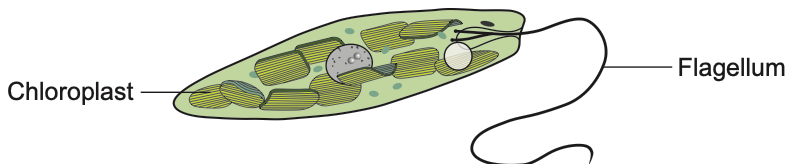
Diagram 2 shows an organism found in a drop of pond water. Which statement about it is correct?
Show answerHide answer
B
This is Euglena, a unicellular organism. Its chloroplasts let it make food using sunlight like a plant, and its flagellum lets it move like an animal.
7
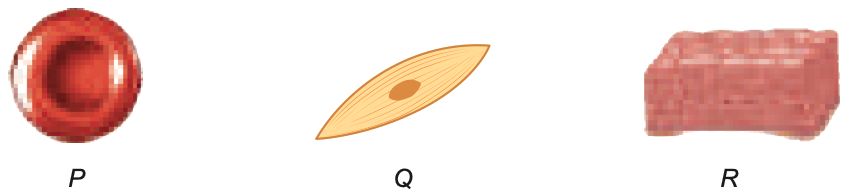
Diagram 3 shows three types of cells, P, Q and R. Which cell helps the heart muscle to contract and relax?
Show answerHide answer
A
Q is a muscle cell; muscle cells contract and relax to enable movement. P is a red blood cell and R is epithelium (a protective layer).
8
Which feature helps a red blood cell to transport oxygen?
Show answerHide answer
C
Haemoglobin carries oxygen, and the biconcave disc shape increases the surface area. Long fibres belong to nerve cells; changing shape to surround germs is what white blood cells do.
9
Which sequence shows the correct order of cell organisation in a multicellular organism?
Show answerHide answer
D
Cells with the same function form a tissue; different tissues form an organ; related organs form a system; all systems form an organism.
10
Which word equation represents cell respiration?
Show answerHide answer
A
Cell respiration uses glucose and oxygen and produces carbon dioxide, water and energy. Option B is photosynthesis.
11
In the test for starch, why is the leaf placed in a boiling tube of ethanol?
Show answerHide answer
C
Ethanol removes the chlorophyll so the colour change of the iodine can be seen clearly. Boiling water breaks the cell walls; iodine (not ethanol) shows starch.
12
Which statement is correct about a green plant at night, when there is no light?
Show answerHide answer
B
Photosynthesis occurs only in the presence of light, but cell respiration occurs at all times. So at night the plant only respires.
Section B: structured questions
31 marksAnswer all questions. Write your answers in the spaces provided.
13
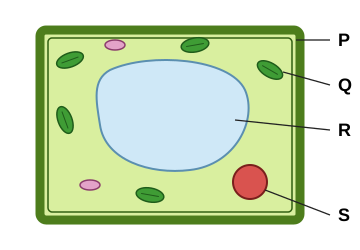
Diagram 4 shows a plant cell.
[1 mark]
(a)Name structure P.
Show answerHide answer
- Cell wall1
Tick each point you got.
[1 mark]
(b)State the function of structure Q.
Show answerHide answer
- Absorbs light energy for photosynthesis / contains chlorophyll that absorbs light1
Q is a chloroplast.
Tick each point you got.
[2 marks]
(c)Name structure R and state its function.
Show answerHide answer
- Vacuole1
- Provides support to the cell when it is filled with cell sap1
Tick each point you got.
[1 mark]
(d)Structure S controls all the activities in the cell. What is S?
Show answerHide answer
Nucleus
The nucleus controls all activities in the cell and contains the chromosomes (DNA).
14
Aina wants to observe onion cells and cheek cells under a microscope.
[1 mark]
(a)Which solution should she use to stain the onion cells?
Show answerHide answer
Iodine solution
Iodine is used for onion (plant) cells; methylene blue for cheek (animal) cells.
[1 mark]
(b)Why must the cells be stained?
Show answerHide answer
- Cells are almost colourless, so staining makes the structures (e.g. nucleus) clearly visible1
Tick each point you got.
[1 mark]
(c)State one difference between the onion cells and the cheek cells that she will see.
Show answerHide answer
Any 1 points
- Onion cells have a fixed (box-like) shape but cheek cells have no fixed shape1
- Onion cells have a cell wall but cheek cells do not1
Tick each point you got.
15
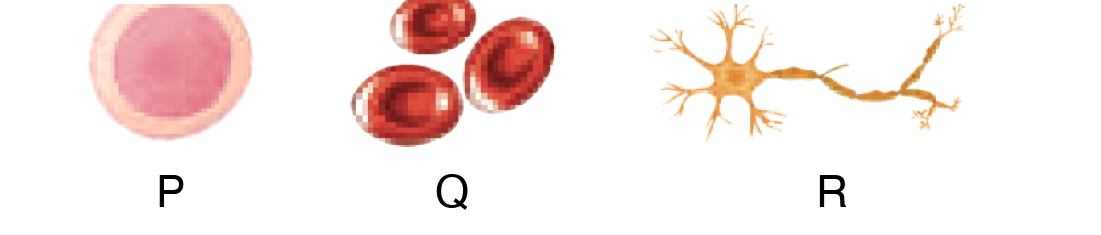
Diagram 5 shows three types of human cells, P, Q and R. Choose the name of each cell.
[1 mark]
(a)Cell P
Show answerHide answer
Ovum
The ovum is a large round cell that carries female genetic material.
[1 mark]
(b)Cell Q
Show answerHide answer
Red blood cells
Red blood cells are biconcave discs with no nucleus.
[1 mark]
(c)Cell R
Show answerHide answer
Nerve cell
A nerve cell has long fibres that carry impulses.
16
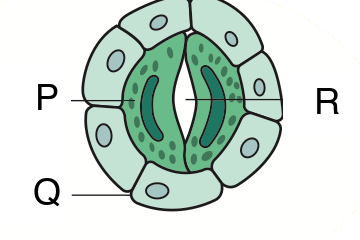
Diagram 6 shows part of the lower surface of a leaf, seen under a microscope.
[1 mark]
(a)Name cell P.
Show answerHide answer
Guard cell
[1 mark]
(b)Name the pore R.
Show answerHide answer
- Stoma1
Tick each point you got.
[1 mark]
(c)On a very hot day, pore R closes. Explain why this is useful to the plant.
Show answerHide answer
- It reduces water loss from the plant (so the plant does not wilt)1
Tick each point you got.
17
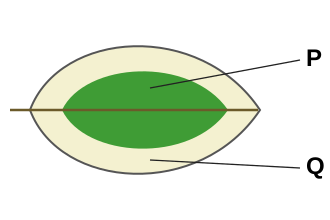
A variegated leaf was plucked from a plant that had been in sunlight for a few hours. Diagram 7 shows the leaf before the test. Part P is green and part Q is white. The leaf was then tested for starch with iodine solution.
[1 mark]
(a)State the manipulated variable in this experiment.
Show answerHide answer
- The presence of chlorophyll1
Tick each point you got.
[1 mark]
(b)Which part of the leaf turned dark blue?
Show answerHide answer
P
[2 marks]
(c)Explain your answer in (b).
Show answerHide answer
Any 2 points
- Part P has chlorophyll (is green), so photosynthesis took place there1
- Starch was made in P, and starch turns iodine dark blue1
- Part Q has no chlorophyll, so no photosynthesis / no starch, and iodine stays brown1
Tick each point you got.
[1 mark]
(d)Before iodine solution is added, the leaf is placed in ethanol. Why?
Show answerHide answer
- To remove the chlorophyll so the colour change of iodine can be seen clearly1
Tick each point you got.
18
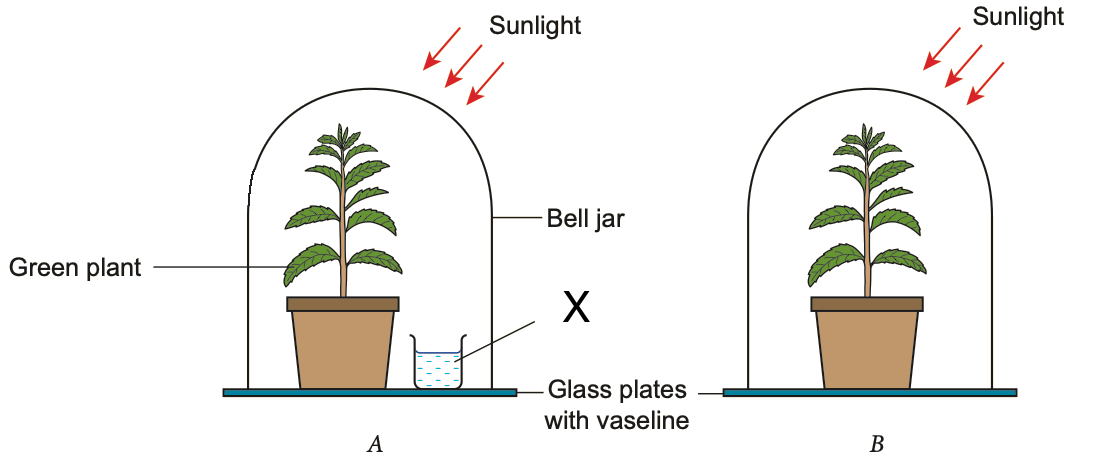
Diagram 8 shows an experiment. Two similar plants were kept in the dark for two days and then placed in sealed bell jars A and B under sunlight for four days. Jar A contains a beaker of solution X.
[2 marks]
(a)Name solution X and state its function.
Show answerHide answer
- Potassium hydroxide solution1
- Absorbs carbon dioxide from the air in the jar1
Tick each point you got.
[1 mark]
(b)A leaf from each plant is tested with iodine solution. What colour will the leaf from jar A be?
Show answerHide answer
Brown (iodine does not change colour)
No carbon dioxide in jar A → no photosynthesis → no starch.
[2 marks]
(c)Ali says, "This experiment shows that plants need light for photosynthesis." Do you agree? Justify your answer.
Show answerHide answer
Any 2 points
- Disagree1
- Both plants received sunlight / light was kept the same (not changed)1
- Only the presence of carbon dioxide was changed, so it shows that plants need carbon dioxide for photosynthesis1
Tick each point you got.
19
Diagram 9 shows how blood cells are organised in the human body.
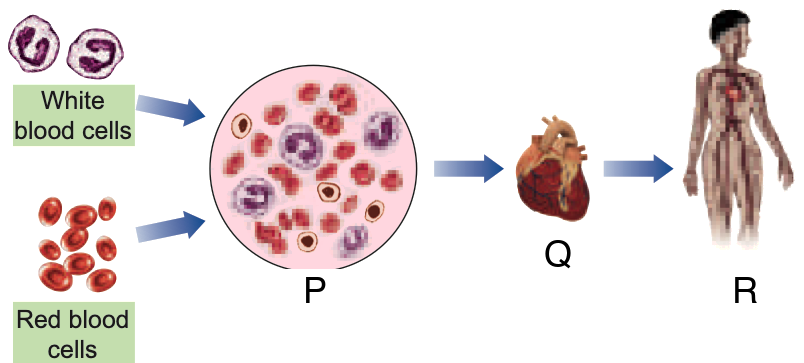
[1 mark]
(a)What is the level of organisation of Q (the heart)?
Show answerHide answer
Organ
[1 mark]
(b)Name system R.
Show answerHide answer
- Blood circulatory system1
Tick each point you got.
[1 mark]
(c)State one function of system R.
Show answerHide answer
- Carries oxygen, nutrients and hormones to all parts of the body1
Tick each point you got.
[1 mark]
(d)Explain why the skin is an organ and not a tissue.
Show answerHide answer
- The skin is made of different types of tissues that work together to carry out a specific function1
Tick each point you got.
20
Your class wants to build a sealed glass jar with water, a small water plant and a snail, so that both can stay alive for many weeks without opening the jar.
[2 marks]
(a)Using your knowledge of photosynthesis and cell respiration, explain how the plant and the snail help each other to survive in the jar.
Show answerHide answer
- The plant carries out photosynthesis and produces oxygen (and glucose/food) which the snail uses for cell respiration1
- The snail (and plant) carry out cell respiration and produce carbon dioxide (and water) which the plant uses for photosynthesis1
Tick each point you got.
[1 mark]
(b)Suggest where the jar should be placed. Give a reason.
Show answerHide answer
- Near a window / in a bright place, because the plant needs light energy for photosynthesis1
Tick each point you got.