Science questions, chapter 9
Earth
44 marks. Use Practice to check each answer as you go, or Exam to answer everything against the clock first.
Section A: objective questions
12 marksChoose the best answer for each question.
1
Which component of the Earth system is the life zone, made up of humans, animals, plants and microorganisms?
Show answerHide answer
B
The biosphere is the life zone. The geosphere is rock and soil, the hydrosphere is water and the atmosphere is air.
2
In which layer of the atmosphere is the ozone layer found?
Show answerHide answer
D
The ozone layer is in the stratosphere (13 – 50 km). It absorbs harmful ultraviolet rays from sunlight.
3
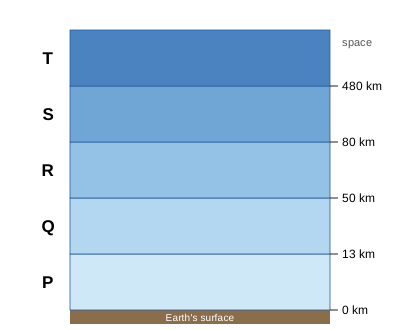
Diagram 1 shows the layers of the atmosphere. In which layer do meteorites burn up and get destroyed?
Show answerHide answer
A
Meteorites burn up in the mesosphere (50 – 80 km), which is layer R. Q is the stratosphere, S the thermosphere and T the exosphere.
4
Why is it difficult for plants to live in the midnight zone of the ocean?
Show answerHide answer
C
Plants need light. The midnight zone has little or no light. Only the surface zone receives enough light for plants.
5
Earth is the only planet in our Solar System that is suitable for life. Which statement explains this?
Show answerHide answer
D
Earth is not too near and not too far from the Sun, so its temperature is suitable. It also has water and oxygen.
6
A rock has many layers and contains fossils. What type of rock is it most likely to be?
Show answerHide answer
B
Sedimentary rocks form from compressed layers of deposited material, so they are layered and may contain fossils. Igneous rocks form from hot magma and have no fossils.
7
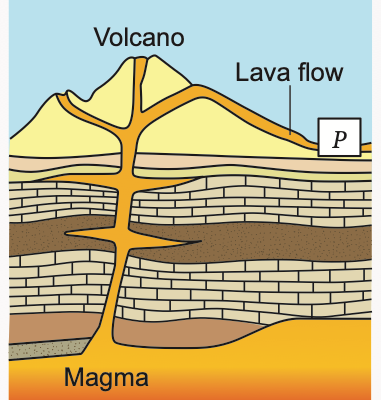
Diagram 2 shows lava flowing out of a volcano. What type of rock will form at P?
Show answerHide answer
A
When lava cools and freezes it forms igneous rock (textbook Summative Practice 9, Q5).
8
Which of the following is an endogenic process?
Show answerHide answer
C
Endogenic processes are caused by forces from within the Earth, e.g. mantle convection, magma activity and plate tectonics. The other three happen on the surface (exogenic).
9
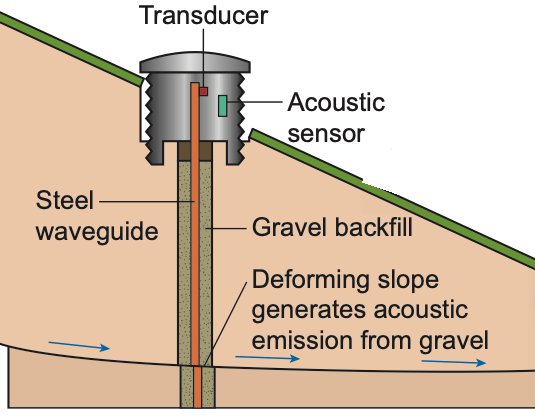
Diagram 3 shows a device placed on the slope of a hill. It has an acoustic sensor. What does it give an early warning of?
Show answerHide answer
B
This is the landslide detector. When the slope moves, the gravel makes sound that the acoustic sensor detects. A different device, placed at the shoreline, gives tsunami warnings via satellite.
10
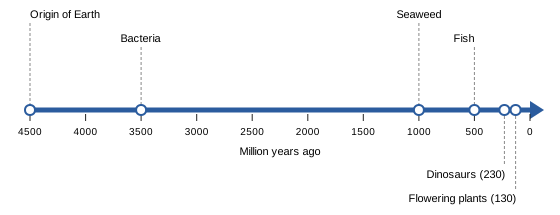
Diagram 4 shows when some organisms first appeared on Earth. How many million years after the Earth was formed did seaweed first appear?
Show answerHide answer
D
Earth formed 4500 million years ago and seaweed appeared 1000 million years ago: 4500 − 1000 = 3500 million years later.
11
Which of the following is a metallic mineral?
Show answerHide answer
A
Iron ore, tin and gold are metallic minerals. Coal and petroleum are non-metallic minerals.
12
The water at the hot spring in Sungai Klah, Perak is hot even at night. Which statement explains this?
Show answerHide answer
C
This is the hydrothermal process: underground water (an aquifer) is heated by heat from the Earth (magma).
Section B: structured questions
32 marksAnswer all questions. Write your answers in the spaces provided.
13
Diagram 5 shows the layers of the Earth. Name the layers P, Q, R and S.
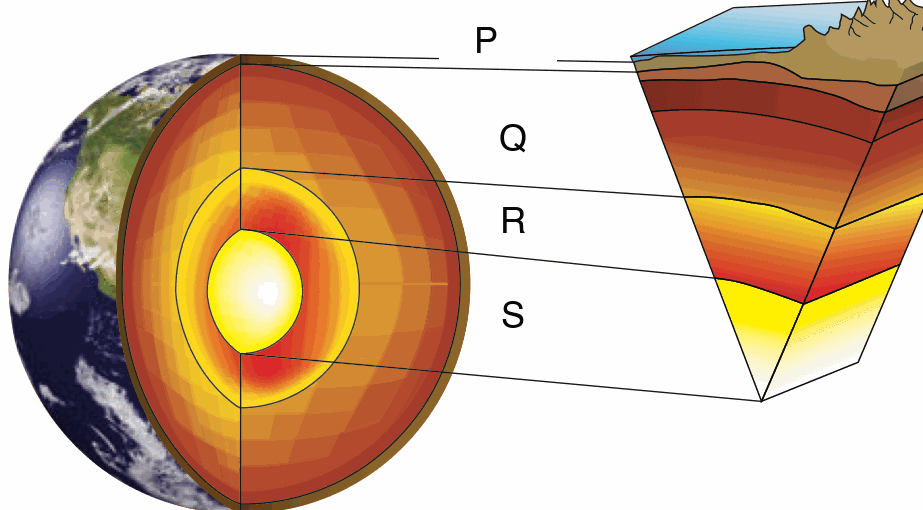
[1 mark]
(a)Layer P
Show answerHide answer
Crust
P is the thin outermost layer.
[1 mark]
(b)Layer Q
Show answerHide answer
Mantle
Q is the thick layer under the crust.
[1 mark]
(c)Layer R
Show answerHide answer
Outer core
[1 mark]
(d)Layer S
Show answerHide answer
Inner core
S is at the centre of the Earth.
14
Diagram 6 shows the layers of the atmosphere.
[1 mark]
(a)In which layer does the aurora occur?
Show answerHide answer
S
The aurora occurs in the thermosphere (80 – 480 km).
[1 mark]
(b)Communication satellites orbit the Earth in which layer?
Show answerHide answer
T
Satellites orbit in the exosphere (480 km and above).
[2 marks]
(c)Layer Q contains the ozone layer. Explain why the ozone layer is important to living things.
Show answerHide answer
- The ozone layer absorbs (harmful) ultraviolet rays from sunlight1
- So less ultraviolet rays reach living things / protects living things from the harmful effects of UV rays1
Tick each point you got.
15
Diagram 7 shows the air pressure at different altitudes.
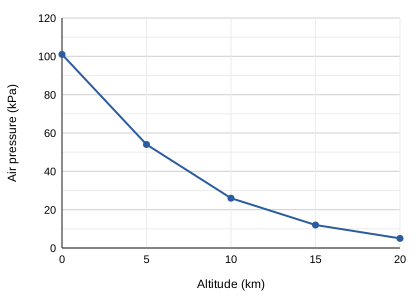
[1 mark]
(a)What is the air pressure at an altitude of 10 km?
Show answerHide answer
- 26 kPa (accept 25 – 27 kPa)1
Tick each point you got.
[1 mark]
(b)Describe the relationship between altitude and air pressure.
Show answerHide answer
- The higher the altitude, the lower the air pressure1
Tick each point you got.
[1 mark]
(c)Calculate the fall in air pressure from sea level (0 km) to 5 km.
Show answerHide answer
- Readings about 101 kPa and 54 kPa; fall = 101 − 54 = 47 kPa (accept 45 – 48 kPa from the student's readings)1
Tick each point you got.
[1 mark]
(d)Explain why mountain climbers find it difficult to breathe near the top of a high mountain.
Show answerHide answer
- Air pressure is low / air is thinner at high altitude, so there is less oxygen in each breath1
Tick each point you got.
16
Diagram 8 shows the rock cycle. Some labels have been replaced by X and Y.
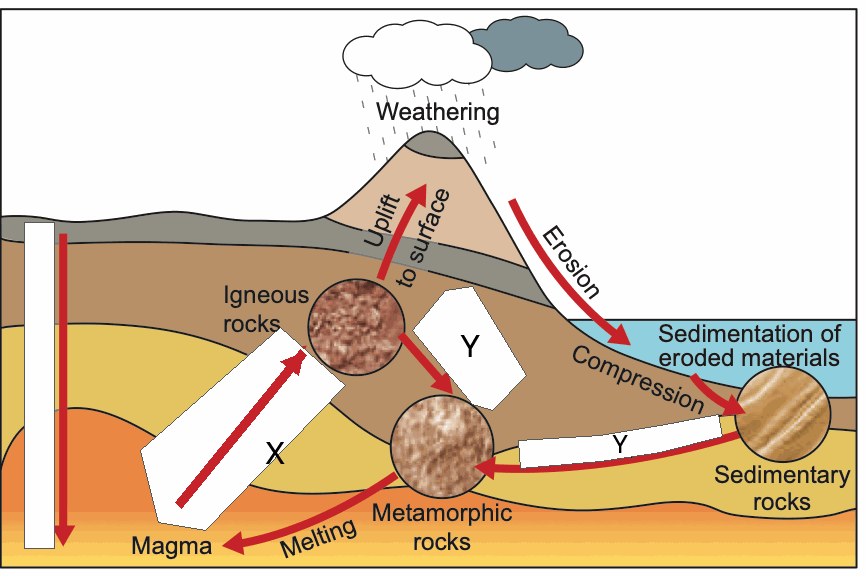
[1 mark]
(a)Name process X, which changes magma into igneous rock.
Show answerHide answer
- Cooling and freezing (of magma / lava)1
Tick each point you got.
[2 marks]
(b)Process Y changes sedimentary rock into metamorphic rock. State two factors needed for process Y.
Show answerHide answer
- (Very) high pressure1
- (Very) high temperature / heat1
Tick each point you got.
[1 mark]
(c)Salina found a rock at the mouth of a river. It is hollow, layered and contains fossils. What type of rock is it?
Show answerHide answer
Sedimentary rock
Layers, hollows and fossils are features of sedimentary rock (textbook Summative Practice 9, Q6).
17
Classify each process as exogenic or endogenic.
[1 mark]
(a)Rocks break up because of changes in temperature and rainwater.
Show answerHide answer
Exogenic
Weathering happens on the surface.
[1 mark]
(b)Two plates of the Earth's crust move apart.
Show answerHide answer
Endogenic
Plate tectonics is caused by forces inside the Earth.
[1 mark]
(c)Soil moves down a slope because of gravity.
Show answerHide answer
Exogenic
Mass and land depletion happens on the surface.
[1 mark]
(d)Name two agents that cause erosion.
Show answerHide answer
- Any two: water, wind, waves [both needed for 1 mark]1
Tick each point you got.
18
Diagram 9 shows when some organisms first appeared on Earth.
[1 mark]
(a)When did fish first appear on Earth?
Show answerHide answer
- 500 million years ago1
Tick each point you got.
[1 mark]
(b)How many million years after the first fish did flowering plants appear?
Show answerHide answer
- 500 − 130 = 370 million years1
Tick each point you got.
[1 mark]
(c)The age of the Earth is about 4.5 billion years. What did scientists use to estimate this?
Show answerHide answer
- Meteorites1
Tick each point you got.
[1 mark]
(d)State one importance of fossils to scientists today.
Show answerHide answer
Any 1 points
- Show how plant and animal species have evolved over millions of years1
- Give information about species that have become extinct1
Tick each point you got.
19
Read the news report.
Bauxite pollution in Kuantan
Residents complain about bauxite pollution near Bukit Goh, Gebeng and Kuantan Port. Uncontrolled mining has dirtied the main road, bauxite dust pollutes the air and the river is polluted. Bauxite is red soil rich in aluminium.
Residents complain about bauxite pollution near Bukit Goh, Gebeng and Kuantan Port. Uncontrolled mining has dirtied the main road, bauxite dust pollutes the air and the river is polluted. Bauxite is red soil rich in aluminium.
[3 marks]
(a)A company says the mining should continue without any control because aluminium is valuable to the economy. Do you agree? Give your opinion and two reasons.
Show answerHide answer
Any 3 points
- Opinion: disagree — mining should continue only if it is controlled / planned [1 mark, must have a reason to score]1
- Bauxite dust pollutes the air and causes health problems (e.g. breathing problems)1
- Rivers are polluted, harming aquatic life and the water supply1
- Soil is exposed, causing erosion / flash floods / dirty roads1
- Mineral supply is limited, so it must be used wisely1
Tick each point you got.
[1 mark]
(b)Uncle Yatim is a farmer. His son advises him not to spray pesticides excessively. Why?
Show answerHide answer
- Excess pesticide pollutes surface water (rivers) / leaches into underground water and pollutes it1
Tick each point you got.
20
Cameron Highlands often has landslides on its steep hill slopes. Diagram 10 shows a slope after a landslide.
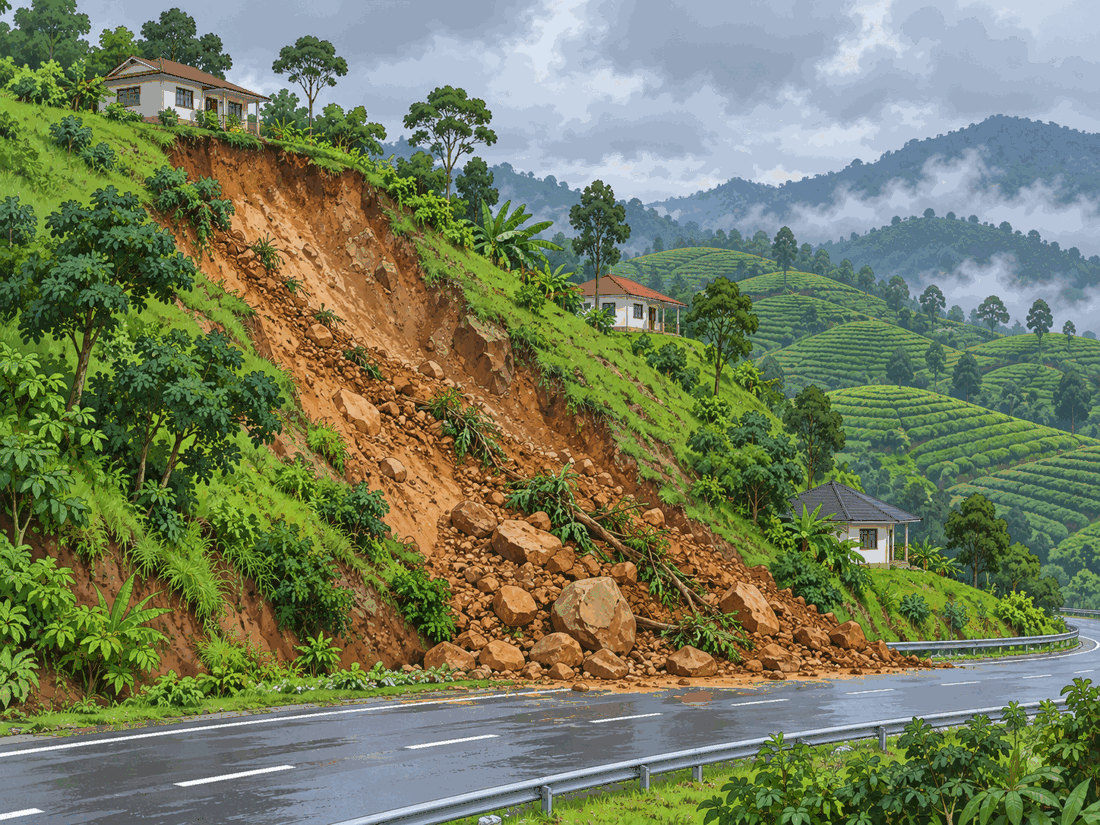
[3 marks]
(a)Suggest a device that could warn the villagers before a landslide happens. Explain how it works and where it should be placed.
Show answerHide answer
Any 3 points
- Device: landslide detector with an acoustic sensor (or a tilt / movement sensor, or a rain gauge linked to an alarm)1
- Placement: buried in / on the slope of the hill above the houses or road1
- How it works: when the slope starts to move, the gravel rubs and makes sound / movement that the sensor detects1
- It sends a signal / sounds an alarm or SMS so people can move away early1
Tick each point you got.
[1 mark]
(b)Suggest one other step (not a device) to reduce the risk of landslides on the slope.
Show answerHide answer
- Plant trees / grass on the slope; avoid clearing forest on steep slopes; build retaining walls or proper drains1
Tick each point you got.