Practice paper, not an official KPM paper
55
Ujian Akhir Sesi AkademikEnd of Academic Session Test
SainsScience
Tingkatan 1, 2 jam / 2 hours, 100 marks
Nama / Name
Kelas / Class
- Kertas soalan ini mengandungi tiga bahagian: Bahagian A, Bahagian B dan Bahagian C.This question paper consists of three sections: Section A, Section B and Section C.
- Jawab semua soalan.Answer all questions.
- Bahagian A: pilih satu jawapan bagi setiap soalan.Section A: choose one answer for each question.
- Bahagian B dan C: tulis jawapan anda di ruang yang disediakan. Tunjukkan jalan kerja jika perlu.Sections B and C: write your answers in the spaces provided. Show your working where it helps.
- Rajah yang mengiringi soalan tidak dilukis mengikut skala kecuali dinyatakan.The diagrams in this paper are not drawn to scale unless stated.
- Anda dibenarkan menggunakan kalkulator saintifik.You may use a scientific calculator.
Bahagian ASection A
20 marks[20 markah] Jawab semua soalan. Setiap soalan diikuti oleh empat pilihan jawapan, A, B, C dan D. Pilih satu jawapan yang terbaik.[20 marks] Answer all questions. Each question is followed by four options, A, B, C and D. Choose the best answer.
1
Pembantu makmal sekolah menyediakan sebotol asid hidroklorik pekat. Simbol bahaya yang manakah perlu dilekatkan pada label botol itu?The school laboratory assistant prepares a bottle of concentrated hydrochloric acid. Which hazard symbol should be on the label of the bottle?
Show answerHide answer
B
Concentrated acids and alkalis are corrosive: they burn the skin (textbook Figure 1.7). Option B is the corrosive symbol. A is flammable, C is poison/toxic and D is explosive.
2
Antara pasangan kuantiti asas dan unit S.I. berikut, yang manakah betul?Which pair of base quantity and S.I. unit is correct?
Show answerHide answer
D
The S.I. units are: mass – kilogram, length – metre, temperature – kelvin, electric current – ampere (Table 1.2).
3
Hana ingin mengukur diameter dalam sebuah bikar kecil dengan tepat. Alat pengukur yang manakah paling sesuai?Hana wants to measure the inner diameter of a small beaker accurately. Which measuring instrument is the most suitable?
Show answerHide answer
B
Vernier calipers can measure the outer diameter, the inner diameter and the depth of an object, to 0.01 cm. A micrometer screw gauge cannot reach inside a beaker, and a ruler or tape is not accurate enough.
4
Struktur yang manakah terdapat dalam sel tumbuhan tetapi tidak terdapat dalam sel haiwan?Which structure is found in a plant cell but not in an animal cell?
Show answerHide answer
D
Plant cells have a cell wall, chloroplasts and a large vacuole; animal cells do not have chloroplasts. Nucleus, cell membrane and mitochondria are in both.
5
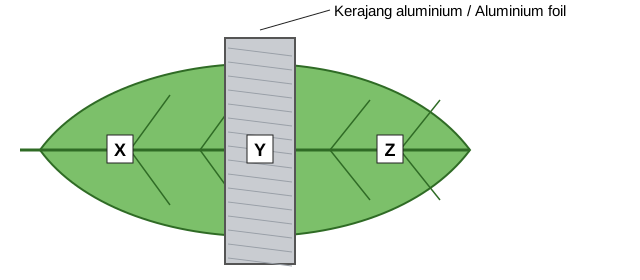
Sepasu pokok keembung di makmal sekolah disimpan di tempat gelap selama dua hari. Sehelai daunnya kemudian ditutup dengan kerajang aluminium seperti dalam Rajah 1, dan pokok itu diletakkan di bawah cahaya matahari selama sehari. Daun itu kemudian diuji dengan larutan iodin. Bahagian manakah yang bertukar menjadi biru tua?A potted balsam plant in the school laboratory is kept in a dark place for two days. One of its leaves is then covered with aluminium foil as shown in Diagram 1, and the plant is placed in sunlight for a day. The leaf is then tested with iodine solution. Which parts turn dark blue?
Show answerHide answer
C
Keeping the plant in the dark removes the starch. Only parts X and Z received light, so only they photosynthesised and made starch, which turns iodine dark blue. Y, under the foil, stays brown.
6
Sistem manakah yang terlibat dalam kawal atur kandungan air dalam badan manusia?Which systems are involved in regulating the water content of the human body?
Show answerHide answer
A
Water content is regulated by the excretory system (kidneys) and the endocrine system (the brain stimulates the secretion of a hormone).
7
Selepas larian merentas desa sekolah, suhu badan Hakim meningkat. Antara berikut, yang manakah mekanisme pembetulan yang berlaku dalam badannya?
I Salur darah mengembang
II Bulu roma menegak
III Lebih banyak peluh dirembeskan
IV Otot rangka mengecut dan mengendur sehingga menggigilAfter the school cross-country run, Hakim's body temperature rises. Which corrective mechanisms take place in his body?
I Blood vessels dilate
II Hairs stand erect
III More sweat is produced
IV Skeletal muscles contract and relax, causing shivering
I Salur darah mengembang
II Bulu roma menegak
III Lebih banyak peluh dirembeskan
IV Otot rangka mengecut dan mengendur sehingga menggigilAfter the school cross-country run, Hakim's body temperature rises. Which corrective mechanisms take place in his body?
I Blood vessels dilate
II Hairs stand erect
III More sweat is produced
IV Skeletal muscles contract and relax, causing shivering
Show answerHide answer
B
When body temperature rises, blood vessels dilate and sweating increases so that more heat is lost. Erect hairs and shivering happen when the body is too cold.
8
Bahagian manakah dalam sistem pembiakan lelaki yang menghasilkan sperma?Which part of the male reproductive system produces sperms?
Show answerHide answer
A
The testis produces the male gametes (sperms) and male sex hormones. The sperm duct carries sperms to the urethra; the seminal vesicle secretes nutritional fluid.
9
Seekor lebah membawa butir debunga dari sekuntum bunga raya di kebun sekolah ke stigma bunga raya pada pokok yang lain. Apakah proses ini?A bee carries pollen grains from a hibiscus flower in the school garden to the stigma of a hibiscus flower on another plant. What is this process?
Show answerHide answer
C
Pollen is transferred to the stigma of a flower on a different plant of the same species, so this is cross-pollination. Fertilisation happens later, when the male gamete fuses with the ovum.
10
Jadual menunjukkan ciri-ciri empat jenis bunga, P, Q, R dan S, yang diperhatikan oleh Kelab Sains di sekitar sekolah.
Bunga manakah yang didebungakan oleh angin?The table shows the characteristics of four flowers, P, Q, R and S, observed by the Science Club around the school.
Which flowers are pollinated by wind?
| Bunga | Ciri-ciri |
|---|---|
| P | Kelopak besar dan berwarna-warni, mempunyai nektar |
| Q | Kelopak pucat, stigma panjang dan berbulu, butir debunga kecil, licin dan ringan |
| R | Kelopak putih dan kecil, filamen panjang, banyak butir debunga yang ringan |
| S | Kelopak merah terang, berbau harum, butir debunga kasar dan melekit |
| Flower | Characteristics |
|---|---|
| P | Big, colourful petals; has nectar |
| Q | Pale petals; long, furry stigma; small, smooth and light pollen grains |
| R | Small white petals; long filaments; plenty of light pollen grains |
| S | Bright red petals; sweet smell; rough and sticky pollen grains |
Show answerHide answer
C
Wind-pollinated flowers have white or pale petals, a long furry stigma, a long filament and style, and plenty of small, smooth, light pollen grains (Q and R). Big colourful petals, nectar, smell and sticky pollen (P and S) attract insects and animals.
11
Air di dalam sebuah bikar dipanaskan dengan penunu Bunsen. Apakah yang berlaku kepada zarah-zarah air itu?Water in a beaker is heated with a Bunsen burner. What happens to the water particles?
Show answerHide answer
A
By the kinetic theory of matter, when heat is supplied the particles gain kinetic energy and move faster. The particles do not change size or number.
12
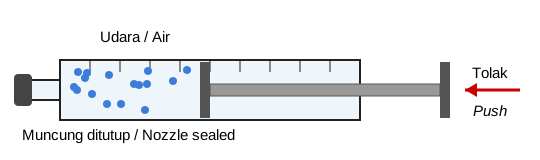
Rajah 2 menunjukkan sebuah picagari berisi udara yang muncungnya ditutup. Omboh picagari itu masih boleh ditolak ke dalam. Mengapa?Diagram 2 shows a syringe of air with its nozzle sealed. The plunger can still be pushed in. Why?
Show answerHide answer
D
Gas particles are arranged very loosely with large spaces between them, so a gas can be compressed. The particles do not shrink or disappear, and air has mass.
13
Zarah subatom manakah yang terdapat di dalam nukleus sesuatu atom?Which subatomic particles are found in the nucleus of an atom?
Show answerHide answer
B
Protons and neutrons are inside the nucleus; electrons move around the nucleus.
14
Antara pasangan campuran dan kaedah pengasingan berikut, yang manakah betul?Which pair of mixture and separation method is correct?
Show answerHide answer
C
Water and alcohol mix completely but have different boiling points, so they are separated by distillation. Dyes in ink need chromatography, oil and water a separating funnel (floatation), and iron nails a magnet.
15
Dalam kitar oksigen, proses manakah yang membebaskan oksigen ke udara?In the oxygen cycle, which process releases oxygen into the air?
Show answerHide answer
D
Green plants release oxygen during photosynthesis. Respiration, combustion and rusting all use oxygen.
16
Setiap pagi, banyak kenderaan beratur di pintu pagar sekolah. Asap ekzos kenderaan membebaskan sulfur dioksida dan nitrogen dioksida. Apakah kesan utama gas-gas ini kepada alam sekitar?Every morning, many vehicles queue at the school gate. The exhaust releases sulphur dioxide and nitrogen dioxide. What is the main effect of these gases on the environment?
Show answerHide answer
A
Sulphur dioxide and nitrogen dioxide cause acid rain. CFCs thin the ozone layer and asbestos particles cause lung cancer.
17
Semasa perhimpunan pagi di padang sekolah, bayang-bayang murid terbentuk di atas tanah. Sifat cahaya manakah yang menerangkan pembentukan bayang-bayang ini?During the morning assembly on the school field, the pupils' shadows form on the ground. Which property of light explains the formation of the shadows?
Show answerHide answer
C
Sunlight travels in straight lines. A pupil's body is opaque, so the light is blocked and a shadow forms behind the pupil.
18
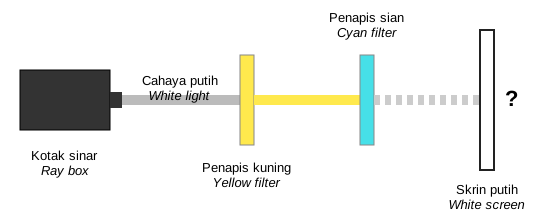
Rajah 3 menunjukkan cahaya putih dari kotak sinar melalui penapis kuning dan kemudian penapis sian sebelum sampai ke skrin putih dalam bilik gelap. Apakah warna cahaya yang kelihatan pada skrin?Diagram 3 shows white light from a ray box passing through a yellow filter and then a cyan filter before reaching a white screen in a dark room. What colour of light is seen on the screen?
Show answerHide answer
B
The yellow filter lets red and green light through and absorbs blue. The cyan filter lets green and blue through and absorbs red. Only green passes both filters.
19
Murid-murid menerbangkan layang-layang di padang sekolah. Dalam lapisan atmosfera manakah angin bertiup serta awan dan hujan terbentuk?Pupils fly kites on the school field. In which layer of the atmosphere does the wind blow and do clouds and rain form?
Show answerHide answer
A
The troposphere (0 – 13 km) is the layer where living organisms breathe, the wind blows and clouds, rain and snow form.
20
Sebuah sekolah terletak berhampiran ladang sayur. Ujian makmal menunjukkan air perigi sekolah itu mengandungi bahan kimia. Apakah punca yang paling mungkin?A school is next to a vegetable farm. Laboratory tests show that the school's well water contains chemicals. What is the most likely cause?
Show answerHide answer
D
Leaching of chemical fertilisers and pesticides from agriculture puts underground water (aquifers), and so well water, at risk of pollution.
Bahagian BSection B
20 marks[20 markah] Jawab semua soalan.[20 marks] Answer all questions.
21
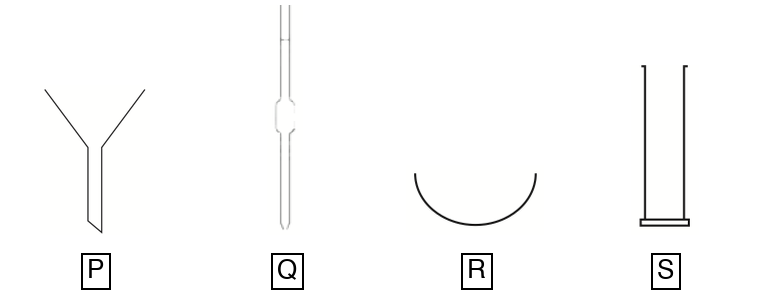
Rajah 4 menunjukkan empat radas, P, Q, R dan S, di dalam makmal sains sekolah.Diagram 4 shows four pieces of apparatus, P, Q, R and S, in the school science laboratory.
[1 mark]
(a)Aina perlu memindahkan tepat 25.0 ml larutan kuprum(II) sulfat ke dalam sebuah kelalang kon. Pilih radas yang perlu digunakan.Aina needs to transfer exactly 25.0 ml of copper(II) sulphate solution into a conical flask. Choose the apparatus she should use.
Show answerHide answer
Q
Q is a pipette, used to measure a fixed volume of liquid (Table 1.1).
[1 mark]
(b)Kumar ingin mendapatkan hablur garam daripada larutan garam dengan menyejatkan pelarut yang berlebihan. Pilih radas yang perlu digunakan.Kumar wants to obtain salt crystals from salt solution by evaporating the excess solvent. Choose the apparatus he should use.
Show answerHide answer
R
R is an evaporating dish, used to evaporate excess solvent.
[1 mark]
(c)Tandakan BENAR atau PALSU: Murid boleh makan dan minum di dalam makmal selepas eksperimen tamat.Mark TRUE or FALSE: Pupils may eat and drink in the laboratory after the experiment has ended.
Show answerHide answer
False
Eating, drinking and playing are prohibited in the laboratory at all times (laboratory rules, page 13).
[1 mark]
(d)Tandakan BENAR atau PALSU: Gunakan gogal keselamatan semasa mencampur atau memanaskan bahan kimia.Mark TRUE or FALSE: Wear safety goggles when mixing or heating chemicals.
Show answerHide answer
True
This is one of the safety measures when using chemicals and apparatus (page 13).
22
Murid Tingkatan 1 memerhatikan epidermis bawah daun dari kebun sekolah di bawah mikroskop pada dua masa yang berbeza. Rajah 5 menunjukkan pemerhatian mereka.Form 1 pupils observe the lower epidermis of a leaf from the school garden under a microscope at two different times. Diagram 5 shows their observations.
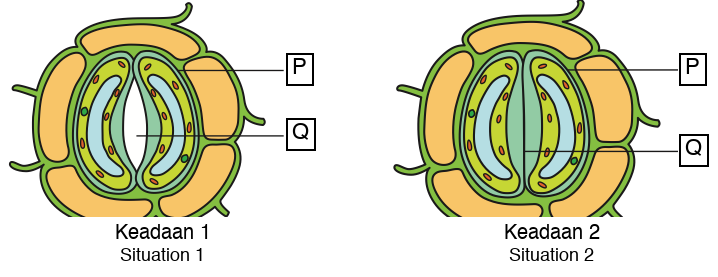
[1 mark]
(a)Pilih nama sel P.Choose the name of cell P.
Show answerHide answer
Guard cell
Guard cells control the opening and closing of the stoma.
[1 mark]
(b)Bilakah Keadaan 2 berlaku?When does Situation 2 happen?
Show answerHide answer
When the temperature is too high
During the day the stoma opens for gaseous exchange; when the temperature is too high it closes to reduce water loss (Figure 3.6).
[1 mark]
(c)Tandakan BENAR atau PALSU: Tumbuhan kehilangan air dalam bentuk wap air melalui Q. Proses ini dikenali sebagai transpirasi.Mark TRUE or FALSE: Plants lose water as water vapour through Q. This process is called transpiration.
Show answerHide answer
True
Transpiration is the loss of water vapour from the leaves through the stoma.
[1 mark]
(d)Tandakan BENAR atau PALSU: Transpirasi tidak penting kepada tumbuhan kerana air yang hilang tidak dapat diganti.Mark TRUE or FALSE: Transpiration is not important to plants because the water lost cannot be replaced.
Show answerHide answer
False
Transpiration produces a pull that helps the roots absorb water and minerals and carry them to all parts of the plant; it also cools the plant on hot days.
23
Pilih proses perubahan keadaan jirim yang berlaku dalam setiap situasi di sekolah berikut.Choose the process of change in the state of matter that takes place in each of the following situations at school.
[1 mark]
(a)Titisan air terbentuk pada permukaan luar bikar yang berisi ketulan ais.Water droplets form on the outer surface of a beaker of ice cubes.
Show answerHide answer
Condensation
Water vapour in the air touches the cold beaker, releases heat and turns into liquid.
[1 mark]
(b)Lilin cair yang menitis ke atas meja makmal menjadi keras.Molten candle wax that drips onto the laboratory bench becomes hard.
Show answerHide answer
Freezing
The liquid wax releases heat to the surroundings and turns into a solid.
[1 mark]
(c)Pewangi pepejal di dalam tandas sekolah menjadi semakin kecil selepas beberapa minggu tanpa menghasilkan sebarang cecair.A solid air freshener in the school toilet gets smaller after a few weeks without forming any liquid.
Show answerHide answer
Sublimation
The solid changes directly into a gas, like moth balls in a cupboard.
[1 mark]
(d)Lantai makmal yang basah menjadi kering selepas dimop.The wet laboratory floor becomes dry after it is mopped.
Show answerHide answer
Evaporation
The water absorbs heat from the surroundings and slowly turns into water vapour at room temperature.
24
Rajah 6 menunjukkan segi tiga api yang dipamerkan semasa latihan kebakaran di sekolah.Diagram 6 shows the fire triangle displayed during a fire drill at school.
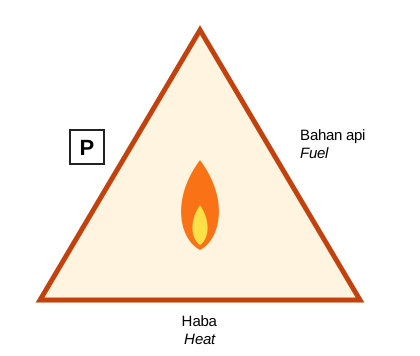
[1 mark]
(a)Pilih P.Choose P.
Show answerHide answer
Oxygen
Combustion needs fuel, heat and oxygen.
[1 mark]
(b)Tandakan BENAR atau PALSU: Selimut api memadamkan kebakaran dengan menghalang oksigen sampai kepada bahan yang terbakar.Mark TRUE or FALSE: A fire blanket puts out a fire by stopping oxygen from reaching the burning material.
Show answerHide answer
True
A fire blanket covers the fire and prevents oxygen from seeping below it.
[1 mark]
(c)Tandakan BENAR atau PALSU: Air sesuai digunakan untuk memadamkan kebakaran minyak masak di kantin sekolah.Mark TRUE or FALSE: Water is suitable for putting out a cooking-oil fire in the school canteen.
Show answerHide answer
False
Water is denser than oil and sinks below it, so the fire is not put out. Foam, dry powder or carbon dioxide is used for burning oil (Table 7.1).
[1 mark]
(d)Apabila dapur gas di kantin terbakar, pekerja kantin segera menutup injap tong gas. Pilih teknik memadamkan kebakaran yang digunakan.When the gas stove in the canteen catches fire, the canteen worker quickly closes the valve of the gas tank. Choose the fire-fighting technique used.
Show answerHide answer
Cutting off the source of fuel
Closing the valve cuts off the source of fuel (gas), so one condition of combustion is removed.
25
Rajah 7 menunjukkan tiga sampel batuan, P, Q dan R, di sudut sains sekolah. Maklumat tentang setiap batuan diberikan di bawah.
- P: terdiri daripada banyak lapisan pasir dan lumpur yang dimampatkan; terdapat fosil cengkerang di dalamnya.
- Q: terbentuk apabila lava daripada gunung berapi menyejuk dan membeku; mengandungi pelbagai mineral.
- R: terbentuk apabila batuan P terdedah kepada tekanan dan suhu yang sangat tinggi; lebih keras daripada P.
- P: made of many layers of sand and mud pressed together; a shell fossil is found in it.
- Q: formed when lava from a volcano cools and freezes; contains various minerals.
- R: formed when rock P is exposed to very high pressure and temperature; harder than P.
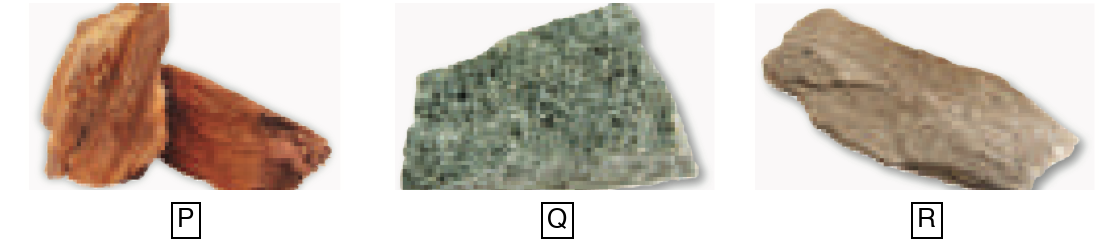
[1 mark]
(a)Pilih jenis batuan P.Choose the type of rock P.
Show answerHide answer
Sedimentary rock
Sedimentary rock forms from compressed deposited materials, has many layers and can contain fossils.
[1 mark]
(b)Pilih jenis batuan Q.Choose the type of rock Q.
Show answerHide answer
Igneous rock
Igneous rock forms from cooling and freezing of magma or lava and contains various minerals.
[1 mark]
(c)Pilih jenis batuan R.Choose the type of rock R.
Show answerHide answer
Metamorphic rock
Metamorphic rock forms when igneous or sedimentary rock is exposed to very high pressure and temperature; it is usually harder than the original rock.
[1 mark]
(d)Tandakan BENAR atau PALSU: Fosil biasanya dijumpai dalam batuan seperti Q.Mark TRUE or FALSE: Fossils are usually found in rocks like Q.
Show answerHide answer
False
Q is igneous rock, formed from very hot magma or lava, so the remains of living things are not preserved in it. Fossils are found in sedimentary rock.
Bahagian CSection C
60 marks[60 markah] Jawab semua soalan.[60 marks] Answer all questions.
26
Murid-murid Tingkatan 1 Bestari menyediakan slaid sel pipi dan sel epidermis bawang di makmal sekolah. Rajah 8 menunjukkan sel X dan sel Y yang dilihat di bawah mikroskop.Pupils of Form 1 Bestari prepare slides of cheek cells and onion epidermal cells in the school laboratory. Diagram 8 shows cell X and cells Y seen under a microscope.
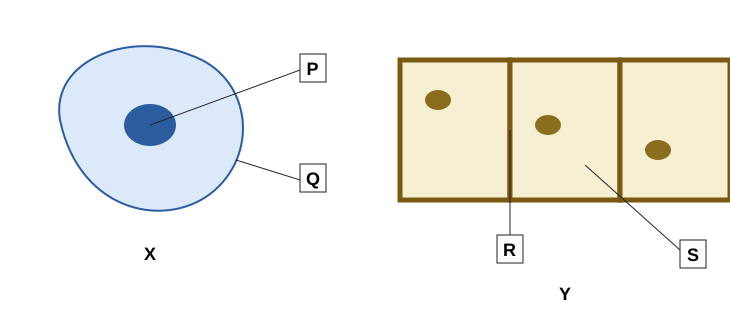
[2 marks]
(a)Namakan struktur P dan R.Name structures P and R.
Show answerHide answer
- P: nucleus1
- R: cell wall1
Tick each point you got.
[1 mark]
(b)Nyatakan fungsi P.State the function of P.
Show answerHide answer
Any 1 points
- Controls all activities in the cell1
- Contains chromosomes / DNA that carries genetic information1
Tick each point you got.
[1 mark]
(c)Nyatakan satu perbezaan antara sel X dengan sel Y yang dapat dilihat dalam Rajah 8.State one difference between cell X and cell Y that can be seen in Diagram 8.
Show answerHide answer
Any 1 points
- X has no cell wall but Y has a cell wall1
- X has no fixed shape but Y has a fixed shape1
Tick each point you got.
[2 marks]
(d)Sel X berasal daripada organisma multisel. Lengkapkan urutan organisasi sel berikut.
Sel → ............ → Organ → ............ → OrganismaCell X comes from a multicellular organism. Complete the following order of cell organisation.
Cell → ............ → Organ → ............ → Organism
Sel → ............ → Organ → ............ → OrganismaCell X comes from a multicellular organism. Complete the following order of cell organisation.
Cell → ............ → Organ → ............ → Organism
Show answerHide answer
- Tissue (after cell)1
- System (after organ)1
Tick each point you got.
[2 marks]
(e)Sel X dan sel Y menjalankan respirasi sel. Tuliskan persamaan perkataan bagi respirasi sel.Cells X and Y carry out cell respiration. Write the word equation for cell respiration.
Show answerHide answer
Glucose + oxygen → carbon dioxide + water + energy
- Reactants: glucose + oxygen1
- Products: carbon dioxide + water + energy1
Tick each point you got.
27
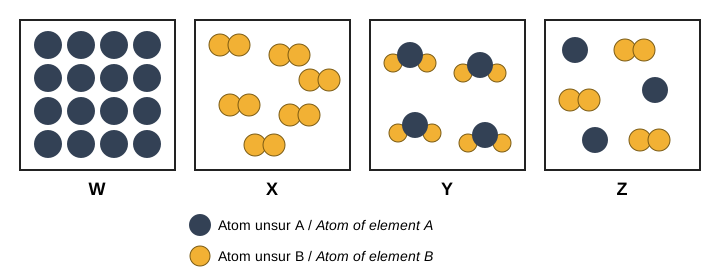
Rajah 9 menunjukkan susunan zarah dalam empat bahan, W, X, Y dan Z, yang dilukis oleh Kelab Sains untuk papan kenyataan makmal.Diagram 9 shows the particles in four substances, W, X, Y and Z, drawn by the Science Club for the laboratory notice board.
[1 mark]
(a)Bahan manakah ialah suatu sebatian?Which substance is a compound?
Show answerHide answer
Y
In Y each particle is made of atoms of two different elements combined chemically.
[1 mark]
(b)Bahan manakah ialah suatu campuran?Which substance is a mixture?
Show answerHide answer
Z
Z contains particles of element A and molecules of element B that are mixed but not combined chemically.
[1 mark]
(c)X terdiri daripada molekul tetapi X masih dikelaskan sebagai unsur. Terangkan mengapa.X is made of molecules, but X is still classified as an element. Explain why.
Show answerHide answer
- All the atoms in X are of the same type (only element B)1
Tick each point you got.
[2 marks]
(d)Guru sains mengalirkan arus elektrik melalui air yang dicampur sedikit asid sulfurik. Gas terhasil di kedua-dua elektrod.
(i) Namakan kaedah ini.
(ii) Namakan gas yang terhasil di katod.The science teacher passes an electric current through water mixed with a little sulphuric acid. Gas is produced at both electrodes.
(i) Name this method.
(ii) Name the gas produced at the cathode.
(i) Namakan kaedah ini.
(ii) Namakan gas yang terhasil di katod.The science teacher passes an electric current through water mixed with a little sulphuric acid. Gas is produced at both electrodes.
(i) Name this method.
(ii) Name the gas produced at the cathode.
Show answerHide answer
- (i) Electrolysis1
- (ii) Hydrogen1
Tick each point you got.
[1 mark]
(e)Mengapakah air tidak boleh diasingkan kepada unsur-unsurnya dengan kaedah fizikal seperti penyulingan?Why can water not be separated into its elements by a physical method such as distillation?
Show answerHide answer
- Water is a compound: hydrogen and oxygen are bonded chemically, so it can only be separated chemically (by electrolysis)1
Tick each point you got.
[2 marks]
(f)Jadual menunjukkan keputusan ujian ke atas dua rod, J dan K, di makmal.
(i) Kelaskan J dan K sebagai logam atau bukan logam.
(ii) Nyatakan satu lagi perbezaan ciri fizikal antara J dengan K.The table shows the results of tests on two rods, J and K, in the laboratory.
(i) Classify J and K as metal or non-metal.
(ii) State one other difference in physical characteristics between J and K.
| Rod | Rupa | Mentol menyala apabila disambung dalam litar? |
|---|---|---|
| J | Berkilau | Ya |
| K | Pudar | Tidak |
(ii) Nyatakan satu lagi perbezaan ciri fizikal antara J dengan K.The table shows the results of tests on two rods, J and K, in the laboratory.
| Rod | Appearance | Bulb lights up when connected in a circuit? |
|---|---|---|
| J | Shiny | Yes |
| K | Dull | No |
(ii) State one other difference in physical characteristics between J and K.
Show answerHide answer
- (i) J: metal and K: non-metal (both correct)1
- (ii) J is ductile/malleable but K is brittle; or J conducts heat well but K does not; or J has a higher density / melting point than K1
Tick each point you got.
28
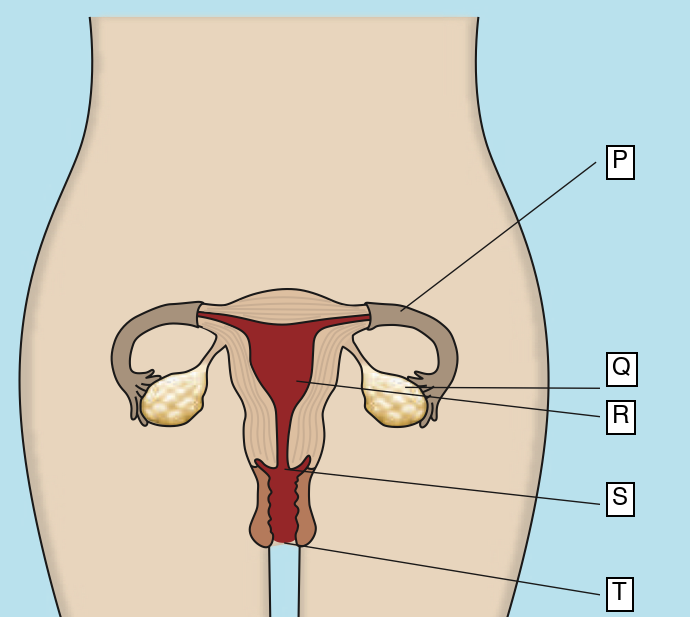
Semasa ceramah kesihatan di sekolah, seorang jururawat menunjukkan Rajah 10.1, iaitu sistem pembiakan perempuan, dan Rajah 10.2, iaitu kitar haid 28 hari.During a health talk at school, a nurse shows Diagram 10.1, the female reproductive system, and Diagram 10.2, a 28-day menstrual cycle.

[2 marks]
(a)Namakan struktur Q dan S.Name structures Q and S.
Show answerHide answer
- Q: ovary1
- S: cervix1
Tick each point you got.
[1 mark]
(b)Di manakah persenyawaan berlaku?Where does fertilisation take place?
Show answerHide answer
P
P is the Fallopian tube, where the sperm fuses with the ovum.
[2 marks]
(c)Berdasarkan Rajah 10.2:
(i) namakan fasa Y;
(ii) pada hari ke berapakah ovum dibebaskan dari ovari?Based on Diagram 10.2:
(i) name phase Y;
(ii) on which day is the ovum released from the ovary?
(i) namakan fasa Y;
(ii) pada hari ke berapakah ovum dibebaskan dari ovari?Based on Diagram 10.2:
(i) name phase Y;
(ii) on which day is the ovum released from the ovary?
Show answerHide answer
- (i) Fertile phase1
- (ii) Day 14 (ovulation)1
Tick each point you got.
[1 mark]
(d)Huraikan apa yang berlaku kepada lapisan dinding uterus dalam fasa W.Describe what happens to the uterine lining during phase W.
Show answerHide answer
- The uterine lining breaks down and is discharged together with blood, the unfertilised ovum and mucus (menstruation)1
Tick each point you got.
[1 mark]
(e)Mengapakah kebersihan diri penting semasa haid?Why is personal hygiene important during menstruation?
Show answerHide answer
- To prevent the reproductive system from being infected by microorganisms such as bacteria, viruses and fungi1
Tick each point you got.
[2 marks]
(f)Jururawat itu menasihati murid supaya tidak merokok. Nyatakan dua kesan kepada bayi jika seorang ibu hamil merokok.The nurse advises the pupils not to smoke. State two effects on the baby if a pregnant mother smokes.
Show answerHide answer
Any 2 points
- Low birth weight1
- Born premature1
- Miscarriage of the foetus1
- Higher mortality rate1
- Retarded / physical disabilities1
Tick each point you got.
[1 mark]
(g)Kedua-dua tiub Falopio seorang wanita tersumbat. Terangkan mengapa dia tidak boleh hamil.Both Fallopian tubes of a woman are blocked. Explain why she cannot become pregnant.
Show answerHide answer
- Sperms cannot reach / meet the ovum, so fertilisation cannot take place1
Tick each point you got.
29
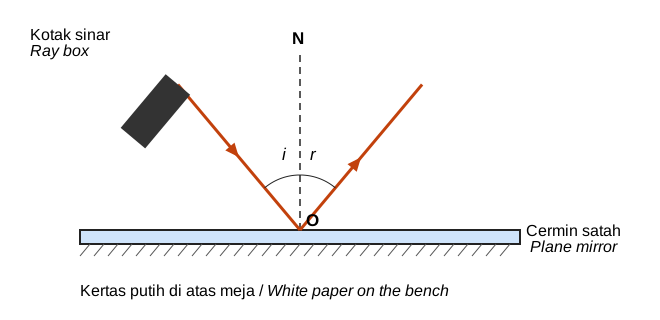
Sekumpulan murid menjalankan eksperimen di makmal untuk mengkaji hubungan antara sudut tuju, i, dengan sudut pantulan, r. Rajah 11 menunjukkan susunan radas dan jadual menunjukkan keputusan mereka.
A group of pupils carries out an experiment in the laboratory to study the relationship between the angle of incidence, i, and the angle of reflection, r. Diagram 11 shows the set-up and the table shows their results.
| Sudut tuju, i (°) | 20 | 30 | 40 | 50 | 60 |
|---|---|---|---|---|---|
| Sudut pantulan, r (°) | 20 | 30 | 40 | 50 | 60 |
| Angle of incidence, i (°) | 20 | 30 | 40 | 50 | 60 |
|---|---|---|---|---|---|
| Angle of reflection, r (°) | 20 | 30 | 40 | 50 | 60 |
[1 mark]
(a)Namakan garis putus-putus ON.Name the dashed line ON.
Show answerHide answer
- Normal (line)1
Tick each point you got.
[2 marks]
(b)Nyatakan
(i) pemboleh ubah dimanipulasikan;
(ii) pemboleh ubah bergerak balas.State
(i) the manipulated variable;
(ii) the responding variable.
(i) pemboleh ubah dimanipulasikan;
(ii) pemboleh ubah bergerak balas.State
(i) the manipulated variable;
(ii) the responding variable.
Show answerHide answer
- (i) Angle of incidence, i1
- (ii) Angle of reflection, r1
Tick each point you got.
[1 mark]
(c)Nyatakan hubungan antara i dengan r.State the relationship between i and r.
Show answerHide answer
- The angle of incidence is equal to the angle of reflection (i = r)1
Tick each point you got.
[1 mark]
(d)Dalam satu bacaan lain, sudut antara sinar tuju dengan sinar pantulan ialah 70°. Berapakah sudut tuju?In another reading, the angle between the incident ray and the reflected ray is 70°. What is the angle of incidence?
Show answerHide answer
- 35° (i = r and i + r = 70°, so i = 70° ÷ 2)1
Tick each point you got.
[3 marks]
(e)Farah berdiri 1.2 m di hadapan sebuah cermin satah di bilik tarian sekolah. Kemudian, dia berjalan 0.5 m ke arah cermin itu.
(i) Berapakah jarak antara Farah dengan imejnya sekarang?
(ii) Selain jaraknya dari cermin, nyatakan dua ciri imej yang terbentuk.Farah stands 1.2 m in front of a plane mirror in the school dance room. She then walks 0.5 m towards the mirror.
(i) What is the distance between Farah and her image now?
(ii) Apart from its distance from the mirror, state two characteristics of the image formed.
(i) Berapakah jarak antara Farah dengan imejnya sekarang?
(ii) Selain jaraknya dari cermin, nyatakan dua ciri imej yang terbentuk.Farah stands 1.2 m in front of a plane mirror in the school dance room. She then walks 0.5 m towards the mirror.
(i) What is the distance between Farah and her image now?
(ii) Apart from its distance from the mirror, state two characteristics of the image formed.
Show answerHide answer
Any 3 points
- (i) 1.4 m (she is now 0.7 m from the mirror and the image is 0.7 m behind it)1
- (ii) Upright1
- (ii) Same size as the object1
- (ii) Laterally inverted1
- (ii) Virtual1
One mark for (i) and one mark each for any two characteristics in (ii).
Tick each point you got.
[2 marks]
(f)Perkataan “AMBULANS” ditulis secara songsang di hadapan sebuah ambulans. Terangkan mengapa.The word “AMBULANS” is written in reverse on the front of an ambulance. Explain why.
Show answerHide answer
- Drivers in front see the ambulance in their rear-view (plane) mirror1
- The mirror image is laterally inverted, so the reversed word appears the right way round and can be read easily / they can give way quickly1
Tick each point you got.
30
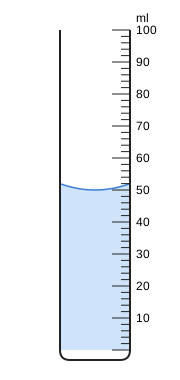
Kumpulan Hafiz memotong lima ketul plastisin, P, Q, R, S dan T, yang berlainan saiz. Mereka menimbang jisim setiap ketul, kemudian menentukan isi padunya dengan kaedah sesaran air menggunakan silinder penyukat yang berisi 50 ml air. Jadual menunjukkan keputusan mereka. Rajah 12 menunjukkan bacaan silinder penyukat sebelum dan selepas ketul R dimasukkan.
Hafiz's group cuts five pieces of plasticine, P, Q, R, S and T, of different sizes. They weigh each piece, then find its volume by the water displacement method using a measuring cylinder containing 50 ml of water. The table shows their results. Diagram 12 shows the measuring cylinder readings before and after piece R is put in.
| Ketul plastisin | P | Q | R | S | T |
|---|---|---|---|---|---|
| Jisim (g) | 6.0 | 12.0 | 18.0 | 24.0 | 30.0 |
| Bacaan akhir (ml) | 54 | 58 | 66 | 70 | |
| Isi padu (cm³) | 4 | 8 | 16 | 20 |
| Piece of plasticine | P | Q | R | S | T |
|---|---|---|---|---|---|
| Mass (g) | 6.0 | 12.0 | 18.0 | 24.0 | 30.0 |
| Final reading (ml) | 54 | 58 | 66 | 70 | |
| Volume (cm³) | 4 | 8 | 16 | 20 |
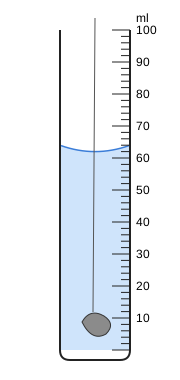
[2 marks]
(a)Berdasarkan Rajah 12, nyatakan
(i) bacaan akhir bagi ketul R;
(ii) isi padu ketul R.Based on Diagram 12, state
(i) the final reading for piece R;
(ii) the volume of piece R.
(i) bacaan akhir bagi ketul R;
(ii) isi padu ketul R.Based on Diagram 12, state
(i) the final reading for piece R;
(ii) the volume of piece R.
Show answerHide answer
- (i) 62 ml1
- (ii) 62 − 50 = 12 cm³1
Tick each point you got.
[3 marks]
(b)Nyatakan pemboleh ubah berikut dalam eksperimen ini.
(i) Pemboleh ubah dimanipulasikan
(ii) Pemboleh ubah bergerak balas
(iii) Pemboleh ubah dimalarkanState the following variables in this experiment.
(i) Manipulated variable
(ii) Responding variable
(iii) Constant variable
(i) Pemboleh ubah dimanipulasikan
(ii) Pemboleh ubah bergerak balas
(iii) Pemboleh ubah dimalarkanState the following variables in this experiment.
(i) Manipulated variable
(ii) Responding variable
(iii) Constant variable
Show answerHide answer
- (i) Volume / size of the piece of plasticine1
- (ii) Mass of the piece of plasticine1
- (iii) Type of plasticine / initial volume of water (50 ml)1
Accept (i) mass and (ii) volume the other way round if the pair is consistent.
Tick each point you got.
[1 mark]
(c)Nyatakan satu hipotesis bagi eksperimen ini.State a hypothesis for this experiment.
Show answerHide answer
- The larger the volume of the plasticine, the larger its mass (accept: the larger the mass, the larger the volume)1
Tick each point you got.
[2 marks]
(d)Hitung ketumpatan ketul T. Tunjukkan jalan kerja anda.Calculate the density of piece T. Show your working.
Show answerHide answer
- Density = mass ÷ volume = 30.0 g ÷ 20 cm³1
- = 1.5 g cm⁻³1
Tick each point you got.
[1 mark]
(e)Kumpulan Hafiz mendapati bahawa ketumpatan setiap ketul plastisin adalah sama dengan ketumpatan ketul T. Apakah kesimpulan yang boleh dibuat tentang ketumpatan plastisin?Hafiz's group finds that every piece of plasticine has the same density as piece T. What conclusion can be made about the density of plasticine?
Show answerHide answer
- The density of plasticine stays the same (1.5 g cm⁻³) whatever the size of the piece1
Tick each point you got.
[1 mark]
(f)Ramalkan isi padu seketul plastisin yang sama jenis dengan jisim 45.0 g.Predict the volume of a piece of the same plasticine with a mass of 45.0 g.
Show answerHide answer
- 30 cm³ (45.0 ÷ 1.5)1
Tick each point you got.
[2 marks]
(g)Mei berkata: “Ketul plastisin yang sangat kecil akan terapung di atas air kerana ia ringan.” Adakah anda bersetuju? Wajarkan jawapan anda. (Ketumpatan air = 1.00 g cm⁻³)Mei says: “A very small piece of plasticine will float on water because it is light.” Do you agree? Justify your answer. (Density of water = 1.00 g cm⁻³)
Show answerHide answer
- Disagree1
- The density of plasticine (1.5 g cm⁻³) is higher than the density of water (1.00 g cm⁻³) whatever its size, so even a small piece sinks1
Tick each point you got.
31
Aiman menjalankan eksperimen untuk mengkaji kesan suhu air terhadap kadar resapan. Dia memasukkan satu spatula hablur kuprum(II) sulfat ke dalam empat bikar yang berisi 100 ml air suling pada suhu berbeza, seperti dalam Rajah 13.1. Dia merekodkan masa yang diambil oleh warna biru untuk tersebar ke seluruh air. Rajah 13.2 menunjukkan graf keputusannya.Aiman carries out an experiment to study the effect of the temperature of water on the rate of diffusion. He puts one spatula of copper(II) sulphate crystals into each of four beakers containing 100 ml of distilled water at different temperatures, as in Diagram 13.1. He records the time taken for the blue colour to spread through all the water. Diagram 13.2 shows a graph of his results.
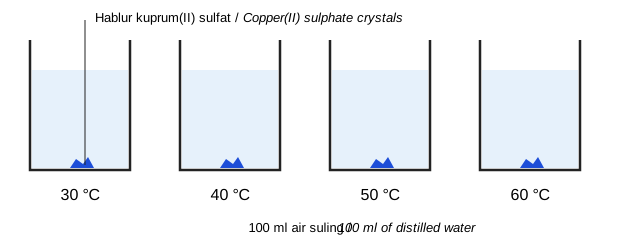
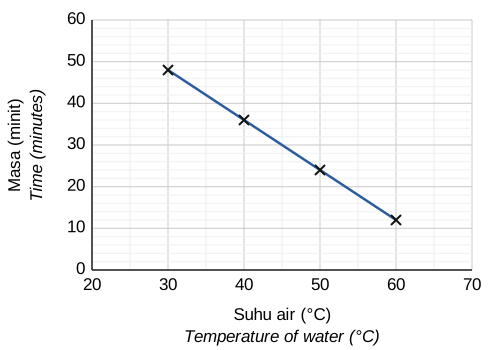
[2 marks]
(a)Nyatakan
(i) pemboleh ubah dimanipulasikan;
(ii) pemboleh ubah bergerak balas.State
(i) the manipulated variable;
(ii) the responding variable.
(i) pemboleh ubah dimanipulasikan;
(ii) pemboleh ubah bergerak balas.State
(i) the manipulated variable;
(ii) the responding variable.
Show answerHide answer
- (i) Temperature of the water1
- (ii) Time taken for the blue colour to spread through all the water / rate of diffusion1
Tick each point you got.
[1 mark]
(b)Nyatakan satu pemboleh ubah dimalarkan.State one constant variable.
Show answerHide answer
Any 1 points
- Volume of distilled water (100 ml)1
- Amount of copper(II) sulphate crystals (one spatula)1
- Size of beaker1
Tick each point you got.
[1 mark]
(c)Nyatakan satu hipotesis bagi eksperimen ini.State a hypothesis for this experiment.
Show answerHide answer
- The higher the temperature of the water, the shorter the time taken for the colour to spread / the higher the rate of diffusion1
Tick each point you got.
[1 mark]
(d)Berdasarkan Rajah 13.2, berapakah masa yang diambil jika suhu air ialah 45 °C?Based on Diagram 13.2, what is the time taken if the temperature of the water is 45 °C?
Show answerHide answer
- 30 minutes1
Tick each point you got.
[2 marks]
(e)Terangkan keputusan eksperimen ini berdasarkan teori kinetik jirim.Explain the result of this experiment using the kinetic theory of matter.
Show answerHide answer
- At a higher temperature the particles absorb more heat / gain more kinetic energy1
- so the particles move faster and the copper(II) sulphate particles spread (diffuse) among the water particles faster1
Tick each point you got.
[2 marks]
(f)Aiman mengulangi eksperimen pada suhu 30 °C tetapi menggunakan agar-agar tidak berwarna sebagai ganti air. Ramalkan pemerhatiannya dan berikan sebab.Aiman repeats the experiment at 30 °C but uses colourless gel instead of water. Predict his observation and give a reason.
Show answerHide answer
- The blue colour takes much longer to spread (a few days) / diffusion is slower1
- Particles in a solid are packed very closely and only vibrate in fixed positions, so the rate of diffusion in a solid is the lowest1
Tick each point you got.
[3 marks]
(g)Adik Aiman tidak percaya bahawa teh lebih cepat meresap dalam air panas. Dengan menggunakan dua uncang teh yang sama, air panas, air sejuk, dua gelas yang sama dan sebuah jam randik, rancang satu aktiviti mudah untuk membuktikannya. Huraikan langkah-langkah dan pemerhatian yang dijangka.Aiman's younger brother does not believe that tea diffuses faster in hot water. Using two identical tea bags, hot water, cold water, two identical glasses and a stopwatch, plan a simple activity to prove it. Describe the steps and the expected observation.
Show answerHide answer
Any 3 points
- Pour the same volume of hot water into one glass and cold water into the other1
- Put one tea bag gently into each glass at the same time (without stirring) and start the stopwatch1
- Record the time taken for the colour of the tea to spread through the whole glass1
- Expected: the colour spreads faster in the hot water1
Any three points. A fair test keeps the volume of water, the type of tea bag and the glass the same; only the temperature changes.
Tick each point you got.
Test specification (JSU)
| Chapter | Remembering | Understanding | Applying | Analysing | Evaluating | Creating | marks | |
|---|---|---|---|---|---|---|---|---|
| 1. Introduction to Scientific Investigation | 2 (2) | – | 2 (5) | – | 1 (12) | – | 19 | |
| 2. Cell as the Basic Unit of Life | 1 (1) | 1 (8) | 1 (1) | – | – | – | 10 | |
| 3. Coordination and Response | 1 (1) | 1 (4) | 1 (1) | – | – | – | 6 | |
| 4. Reproduction | 1 (1) | 1 (1) | 1 (10) | 1 (1) | – | – | 13 | |
| 5. Matter | – | 1 (1) | 2 (5) | – | – | 1 (12) | 18 | |
| 6. Periodic Table | 1 (1) | 1 (1) | 1 (8) | – | – | – | 10 | |
| 7. Air | 2 (5) | 1 (1) | – | – | – | – | 6 | |
| 8. Light and Optics | – | 1 (1) | – | 2 (11) | – | – | 12 | |
| 9. Earth | 1 (1) | 1 (4) | 1 (1) | – | – | – | 6 | |
| Total | 9 (12) | 8 (21) | 9 (31) | 3 (12) | 1 (12) | 1 (12) | 100 |
Each cell shows items (marks).