English
Instructions
- This model paper has Paper 1 (Reading and Use of English, 40 marks) and Paper 2 (Writing, 40 marks). In the real test the two papers are taken separately.
- Answer all questions.
- Paper 1: choose or write the answer for each question.
- Paper 2: write your answers in the spaces provided.
Practice shows answers as you go. Exam times you and hides answers until you submit.
Paper 1 Part 1
8 marksQuestion 1
Children 6 to 12 years: one spoonful (5 ml), three times a day after meals.
Do not take more than three spoonfuls in 24 hours.
Shake well before use. Keep out of reach of children.
Show answerHide answer
Question 2
Ravi: Oh no! Rest and drink some warm water. I'll tell Coach for you.
Dina: Thanks! I hope I feel better by tomorrow.
Show answerHide answer
Question 3
School hall, Wednesday, 8.30 a.m. to 12.30 p.m.
Open to teachers, staff, parents and students aged 17 and above.
Donors must weigh at least 45 kg, be in good health and have had a meal.
Please bring your identity card.
Show answerHide answer
Question 4
The sun is strongest between 10 a.m. and 4 p.m. Stay in the shade at these hours.
Put on sunscreen 20 minutes before you go out. Put it on again every two hours.
Wear a hat and sunglasses. Drink water often.
Show answerHide answer
Question 5
Subject: Trip to the National Science Centre
Dear parents,
Form 2 students will visit the National Science Centre on Thursday, 24 October. The bus leaves school at 7.30 a.m. and returns at 4.00 p.m. Students must bring a packed lunch and a water bottle. Any student with an allergy should tell me by Monday so that the centre can prepare.
Thank you.
Mr Tan
Show answerHide answer
Question 6
Join now for only RM30 a month (usual price RM50).
First class free. Open 6.00 a.m. to 10.00 p.m.
For students under 18 only: show your school identity card at the counter.
Show answerHide answer
Question 7
Hamid: But I'm nearly finished with my project, Mum.
Mum: Your eyes are red. Look away from the screen for five minutes, then you can carry on.
Show answerHide answer
Question 8
Outside shoes are not allowed beyond this line.
Please change into clean sports shoes.
Water bottles only: no food and no fizzy drinks.
Keep the hall clean for everyone.
Show answerHide answer
Paper 1 Part 2
8 marksQuestion 9
My Healthy Lifestyle Challenge
by Farhana, 2 Dedikasi
Last month I (0) decided to change my lifestyle. At that time I ate a lot of fast food and drank fizzy drinks every day. When I visited the doctor, she asked me, "How (9) ______ water do you drink in a day?" My answer was embarrassing: hardly any.
So I asked my classmate Zaki to join me in a Healthy Lifestyle Challenge. (10) ______ agreed at once because he wanted to be fitter for the school football team. We made three rules. First, we eat breakfast every day. Second, we eat (11) ______, chewing each mouthful carefully, instead of rushing. Third, for snacks we choose fruit, such as (12) ______ apple or a handful of grapes.
We have followed the rules (13) ______ five weeks, and the difference is clear. I (14) ______ never been a sporty person, but now I run three times a week, and I feel much (15) ______ than before. Next month, Zaki and I (16) ______ run in our first 5 km fun run!
Show answerHide answer
Question 10
Show answerHide answer
Question 11
Show answerHide answer
Question 12
Show answerHide answer
Question 13
Show answerHide answer
Question 14
Show answerHide answer
Question 15
Show answerHide answer
Question 16
Show answerHide answer
Paper 1 Part 3
8 marksQuestion 17
HEALTH WEEK TALK: EATING WELL, STUDYING WELL
Good morning, everyone. I am Puan Salmah Osman, a dietitian at Klinik Kesihatan Seksyen 7. Welcome to Health Week. My talk today is called "Eating Well, Studying Well".
First, breakfast. Many teenagers skip it because they wake up late, but your brain needs energy in the morning. A simple breakfast of two boiled eggs, a slice of wholemeal bread and a glass of milk is enough.
Next, sugar. A can of fizzy drink has about nine teaspoons of sugar, but your body needs only about six teaspoons for a whole day. So please choose plain water.
Third, think about your plate. Half of it should be vegetables and fruit. Rice takes a quarter, and the last quarter is for fish, chicken or beans.
Finally, our free health check. It was planned for the canteen, but because the roof is being repaired, it will now be held in the school hall at 10.00 a.m. on Wednesday. The class that eats the most fruit and vegetables during the week will win a fruit basket. Thank you.
| Notes: Health Week talk | |
|---|---|
| Speaker | Puan Salmah Osman, a (17) ____________ |
| Title of the talk | Eating Well, (18) ____________ Well |
| A simple breakfast | boiled eggs, wholemeal bread and a glass of (19) ____________ |
| Sugar in a can of fizzy drink | about (20) ____________ teaspoons |
| Sugar the body needs in a day | about (21) ____________ teaspoons |
| Half of the plate | vegetables and (22) ____________ |
| Venue of the health check | (23) ____________ |
| Prize | a fruit basket for the (24) ____________ that eats the most fruit and vegetables |
Show answerHide answer
Question 18
Show answerHide answer
Question 19
Show answerHide answer
Question 20
Show answerHide answer
Question 21
Show answerHide answer
Question 22
Show answerHide answer
Question 23
Show answerHide answer
Question 24
Show answerHide answer
Paper 1 Part 4
10 marksQuestion 25
BACK ON THE COURT
A young badminton player returns after an injury
Fourteen-year-old Danish Irfan from Seremban loves badminton. Last March he was playing in the district tournament when he landed badly after a jump smash. "I heard a small pop and felt a sharp pain in my ankle," he said. His coach, Cikgu Hasnah, rushed to help him at once.
At the clinic, the doctor said that Danish had a sprained ankle. His ankle was swollen, and a dark bruise appeared the next day. The doctor wrapped it in a bandage and told him to rest. For the first week Danish moved around on crutches, and he put ice on the ankle for fifteen minutes, three times a day.
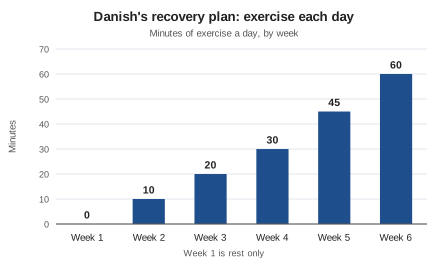
Danish was upset because the state trials were only two months away. However, his physiotherapist, Encik Lau, gave him a plan to recover step by step, shown in the chart. "The most important thing is to be patient," said Encik Lau. "Many teenagers return too early and hurt themselves again."
Two months later, Danish was back on the court and won second place at the state trials. He now warms up for twenty minutes before every game. "My injury taught me to look after my body," he says.
| Meaning | Word |
|---|---|
| to become well again (example) | recover |
| a long strip of cloth that is wrapped around an injury to protect it | (33) ____________ |
| a person who helps injured people to move and exercise again | (34) ____________ |
Show answerHide answer
Question 26
Show answerHide answer
Question 27
Show answerHide answer
Question 28
Show answerHide answer
Question 29
Show answerHide answer
Question 30
Show answerHide answer
Question 31
Show answerHide answer
Question 32
Show answerHide answer
Question 33
Show answerHide answer
Question 34
Show answerHide answer
Paper 1 Part 5
6 marksQuestion 35
OUR SCHOOL GOES GREEN
by Aina Sofea, 2 Cerdas
Our school used to have a big rubbish problem. The recycling bins near the canteen were always almost empty, while the rubbish bins were overflowing by lunch time. (35) ______ This was the first thing the Environment Club wanted to change.
In January, the club members carried out a survey of the canteen rubbish. (36) ______ Puan Rohani, the club advisor, said that this was a good reason to act.
Next, the club put up posters and painted the bins in three colours. (37) ______ These colours are easy to remember, even for the Form 1 students.
The project soon began to work. (38) ______ This was enough to fill a small lorry.
The club sold the paper and plastic to a recycling centre and used the money wisely. (39) ______ Now students can fill their bottles for free instead of buying drinks in plastic bottles.
The Green Bin Project has changed how we think about rubbish. (40) ______ After all, looking after the environment is everyone's job.
Sentences for 35 to 40 (two of the sentences are extra and are not needed):
| A | The result surprised everyone: almost half of it was paper and plastic that could have been recycled. |
| B | Blue is for paper, orange is for plastic and green is for food waste. |
| C | Most students did not know which bin to use, so they threw everything into the same one. |
| D | In just three months, the students collected more than 300 kg of paper and plastic. |
| E | With RM400, the school bought a water cooler for the canteen. |
| F | We hope that other schools in our district will start a project like ours. |
| G | Last year, the Environment Club had only five members. |
| H | Parents may bring old newspapers to the school gate on Saturdays. |
Show answerHide answer
Question 36
Show answerHide answer
Question 37
Show answerHide answer
Question 38
Show answerHide answer
Question 39
Show answerHide answer
Question 40
Show answerHide answer
Paper 2 Part 1
20 marksQuestion 41
To: Raj From: ______________
Show answerHide answer
Hi Raj,
Thanks for your message! My healthy habit is drinking a glass of warm water and doing ten minutes of stretching every morning. I do it because it wakes my body up, so I feel fresh in class. It also helps me to concentrate better.
You can start with something small, too. Put your phone away one hour before bedtime, and then go to sleep early. I'm sure you will feel less tired soon!
Good luck, and tell me how it goes.
Hana
Plan before you write: Raj asks three things, so answer all three: (1) your healthy habit, (2) why you do it, (3) how he can start. Give a detail for each (what, when, how long). Greet Raj, answer in a friendly tone and end with a closing sentence.
Official rating scale (Paper 2 Parts 1 and 2), 0 to 5 marks for each of the four areas:
| Scale | Content | Communicative achievement | Organisation | Language |
|---|---|---|---|---|
| 5 | All content is relevant to the task. Target reader is fully informed. | Produces a text that communicates straightforward ideas using the conventions of the communicative task reasonably well. | Uses simple connectors and a limited number of cohesive devices appropriately. | Uses basic vocabulary appropriately. Uses simple grammatical forms with a good degree of control. While errors are noticeable, meaning can still be determined. |
| 4 | Performance shares features of scores 3 and 5. | |||
| 3 | Minor irrelevances and/or omissions may be present. Target reader is on the whole informed. | Produces a text that communicates simple ideas in simple ways. | Text is connected using basic, high-frequency connectors. | Uses basic vocabulary reasonably. Uses simple grammatical forms with some degree of control. Errors may impede meaning at times. |
| 2 | Performance shares features of scores 1 and 3. | |||
| 1 | Irrelevances and/or misinterpretation of task may be present. Target reader is minimally informed. | Produces isolated short units about simple and concrete matters, not always communicating successfully. | Production unlikely to be connected, though punctuation and simple connectors (i.e. and) may on occasion be used. | Produces basic vocabulary of isolated words and phrases. Produces few simple grammatical forms with only limited control. |
| 0 | Content is totally irrelevant. Target reader is not informed. | Performance below band 1. | ||
The tick points above give the same 20 marks: five for each area. Tick honestly, then check that your total matches the band you would give each area.
Paper 2 Part 2
20 marksQuestion 42
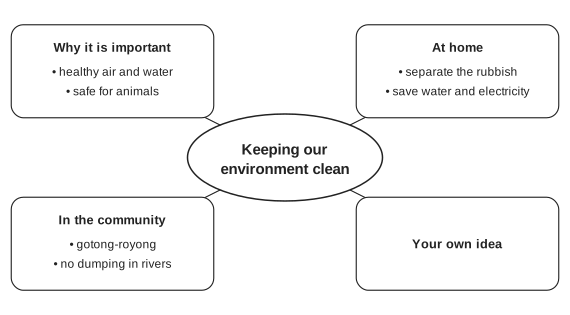
In about 110 words, write an essay about how we can keep our environment clean.
You must use the notes below to help you.
Show answerHide answer
Keeping our environment clean is very important. Clean air and water keep us healthy, and they are also safe for animals.
At home, we should separate the rubbish into paper, plastic and food waste. We can also save water and electricity by turning off taps and lights.
In the community, residents can join gotong-royong to clean drains and parks. Besides that, nobody should dump rubbish in rivers, because it pollutes the water and can cause floods.
Another idea is to bring our own shopping bags, because this reduces plastic waste.
In conclusion, if everyone does a small part, our environment will be cleaner and healthier for all of us.
Turn each box into one paragraph. Write each note as a full sentence, then add one more sentence with a detail, an example or a reason. Do not just copy the notes as a list. Your own idea counts as content too, so give it its own short paragraph. Keep to about 110 words.
This part is marked with the same official rating scale as Part 1: Content, Communicative achievement, Organisation and Language, 0 to 5 marks each (see the table under Paper 2 Part 1). Band 5 for Content means every note is covered and relevant; a missing note or no own idea drops Content to about 3.
Test specification (JSU)
| Unit | Remembering | Understanding | Applying | Analysing | Evaluating | Creating | Items | marks |
|---|---|---|---|---|---|---|---|---|
| 1. Reading short texts: messages, notices, leaflets and online posts | – | 3 (3) | 3 (3) | – | – | – | 6 | 6 |
| 2. Grammar: present perfect, past simple and the tense review | – | – | 1 (1) | – | – | – | 1 | 1 |
| 3. Grammar: nouns, pronouns, articles and quantifiers | – | – | 3 (3) | – | – | – | 3 | 3 |
| 4. Grammar: adjectives, adverbs, comparison and intensifiers | – | – | 2 (2) | – | – | – | 2 | 2 |
| 5. Grammar: the future, modals and obligation (will, be going to, would like, should, must) | – | – | 1 (1) | – | – | – | 1 | 1 |
| 6. Prepositions, conjunctions, time expressions and spotting errors | – | – | 1 (1) | – | – | – | 1 | 1 |
| 7. Information transfer from a text | 3 (3) | 6 (6) | – | – | – | – | 9 | 9 |
| 8. Reading charts, timetables, leaflets and other non-linear texts | 1 (1) | 3 (3) | 1 (1) | 1 (1) | – | – | 6 | 6 |
| 9. Gapped texts and how texts hold together | – | 1 (1) | – | 4 (4) | 1 (1) | – | 6 | 6 |
| 10. Writing short messages: emails, blog posts and instant messages | – | – | – | – | – | 1 (20) | 1 | 20 |
| 11. Writing from notes: note expansion and extended writing | – | – | – | – | – | 1 (20) | 1 | 20 |
| 12. Vocabulary: money, transport, sport and luck, health and personal issues | 1 (1) | 4 (4) | – | – | – | – | 5 | 5 |
| Total | 5 (5) | 17 (17) | 12 (12) | 5 (5) | 1 (1) | 2 (40) | 42 | 80 |