Reading short texts: messages, notices, leaflets and online posts
What this chapter covers
- I know what the short texts in Paper 1 Part 1 look like at Form 2 level - messages, notices, leaflets, timetables and online posts (1.1)
- I can read an online message board and say who gives which tip and why (1.2)
- I can read a leaflet or advice text and match each tip to the right problem (1.3)
- I can find facts in a timetable, a ticket list or a pie chart, and work out times, prices and fractions (1.4)
- I can understand what a short dialogue is doing - asking for a favour, asking for travel information, making arrangements, talking about health (1.5)
- I can find the main idea of a short article and say what a word such as them or it refers to (1.6)
- I can spot the traps in the options and use the five-step method (1.7)
In this unit you will practise the reading skills that Paper 1 Part 1 tests, using the kinds of short texts in Pulse 2 Units 6 to 9: online posts, leaflets, timetables, charts, articles and short dialogues. At Form 2 the texts are a little longer and the questions ask you to compare, work out and infer, not just to find one word.
1.1What is different at Form 2?
You still have 3 options (A, B, C) and about 2 minutes for each short text. What changes is the text and the thinking.
| Text type (Pulse 2) | Where | What the question usually asks |
|---|---|---|
| Online message board | Unit 6, p.63 | Who says what; which tip fits which person |
| Magazine article and pie chart | Unit 6, p.68 | A percentage or fraction; true or false statements |
| Metrolink map and ticket information | Unit 7, p.80 | Which ticket is best; who pays what |
| Leisure centre timetable and note | Unit 8, p.90 | Which day or time fits; what equipment is needed |
| Magazine article on superstition | Unit 8, p.85 | Main idea; reference words; reasons for a habit |
| Information leaflet on cyberbullying | Unit 9, p.95 | The right advice for a situation |
| First aid advice for holidays | Unit 9, p.100 | What to use for which problem |
1.2Online posts and message boards (p.63)
On a message board one person asks a question and others reply. Each post has a username, a date and time and the message. Replies begin with "Re:" or "RE:".
I'm 14 and I want to buy a smartphone. It's expensive! Any tips for making and saving money?
Re: Tips (Cinderella, 17/08)
My parents sometimes pay me to do chores, like washing the car or the ironing.
Re: Tips (TrendyGirl, 20/08)
Instead of earning money, why not spend less? Buy clothes in second-hand shops.
This is a short version of the board in the book. The first post says why the writer posts (needs money). Each reply gives one tip. Notice the two kinds of tips: earn more (chores, babysitting, pet sitting, selling things online) and spend less (second-hand clothes).
| Look for | Example from the board |
|---|---|
| Advice phrases | Why don't you ...? / How about ...? / Maybe you could ... / Instead of ..., why not ...? |
| Plans | I'm going to work in a hotel. I'm going to apply for a babysitting job. |
| A reason | ... so I'll have enough money to go on holiday |
- Mixing up the people. Check the username above the post, not the person who is mentioned inside it.
- Choosing a tip that was only asked. "Has anyone got any tips?" is a question, not a tip.
- Treating a suggestion as a fact. "Maybe you could try babysitting" is advice; it does not mean the writer babysits.
Show answerHide answer
1.3Leaflets and advice texts (pp.95 and 100)
A leaflet gives advice in a list. Each tip has a short heading or a number, then an explanation. Modal verbs tell you how strong the advice is.
| Modal | Strength | Example from the leaflets |
|---|---|---|
| must / mustn't | Strong: this is necessary | You mustn't try to deal with the problem on your own. |
| should / shouldn't | Advice: a good idea | You should always put sun cream on your skin before you go out. |
| don't + verb | Direct instruction | Don't reply. Don't encourage cyberbullies. |
Cyberbullying leaflet (p.95): five tips
| Tip | In other words |
|---|---|
| 1 Don't reply | Bullies want a reaction, so give them none. |
| 2 Block the messages | Use filters or avoid electronic communication so the bully cannot reach you. |
| 3 Talk to someone | Ask a parent, a teacher or a trusted adult for help. Do not wait: the sooner the better. |
| 4 Save the evidence | Keep or print the messages and show them to someone who can act. |
| 5 Help the victims | Do not encourage the bullies; report them if they carry on. |
First aid advice (p.100)
| Problem | What to do or take |
|---|---|
| A blister on the foot | Plasters |
| A cut | Antiseptic cream |
| A snake bite on an arm or leg | Wrap a bandage tightly around the bite |
| Sunburn | Sun cream before going out in the sun |
| Mosquito bites at night | Insect repellent sprayed on the skin |
| A headache | One or two aspirins with a glass of water |
| Feeling sick when travelling | Eat a mint |
Show answerHide answer
1.4Timetables, ticket lists and charts (pp.68, 80, 90)
Reading a timetable
Timetables use short forms: am = morning, pm = afternoon or evening, per = for each. Read across a row for the day, down a column for the time.
| Day | 10-11 am | 5-6 pm | 6-7 pm | 7-8 pm |
|---|---|---|---|---|
| Monday | table tennis | trampolining | archery | |
| Tuesday | archery | yoga | table tennis | fencing |
| Wednesday | fencing | archery | taekwondo | |
| Thursday | table tennis | taekwondo | trampolining | fencing |
| Friday | archery | yoga | table tennis | |
| Saturday | rollerblading | table tennis | trampolining | taekwondo |
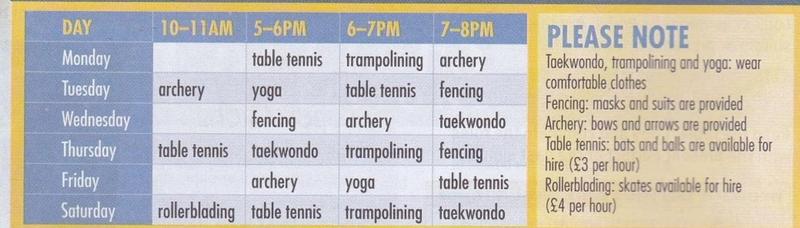
Based on the Hopfield Leisure Centre timetable, Pulse 2 p.90. Notes: taekwondo, trampolining and yoga need comfortable clothes; fencing masks and suits and archery bows and arrows are provided; table tennis bats and balls and rollerblading skates can be hired (table tennis 3 pounds per hour, rollerblading 4 pounds per hour).
Reading ticket information (p.80)
- The price depends on the length of the journey and when you travel.
- Children aged 5 to 16 pay about half the adult fare. Children under five travel free.
- If you make more than five return journeys a week, a season ticket (week, month or year) saves money.
A person who travels by tram every day makes more than five return journeys, so the season ticket is the best choice. A child of 4 pays nothing; a child of 10 pays about half.
Reading a pie chart (p.68)
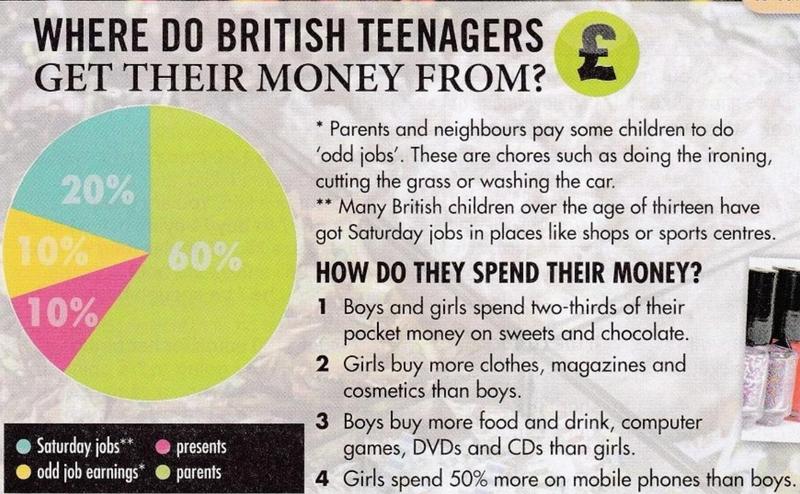
Textbook figure: Pulse 2 Student's Book, p.68.
The chart shows where British teenagers get their money: 60% from parents, 20% from Saturday jobs, 10% from odd jobs and 10% from presents. The parts add up to 100%.
| Percentage | Fraction in words |
|---|---|
| 10% | a tenth |
| 25% | a quarter |
| 33.3% | a third |
| 50% | (a) half |
| 75% | three-quarters |
| 100% | all |
- Reading the wrong column: 5-6 pm is not 6-7 pm. Put a finger on the row and column.
- Forgetting that a blank box means no class.
- "Under five" does not include five. A five-year-old pays about half.
Show answerHide answer
1.5Short dialogues and what they are for (pp.69, 81, 91, 101)
Every Integrated skills lesson includes a short dialogue. The question often asks what the speakers are doing (their function). Learn the phrases in each Communication kit.
| Function | Phrases | Example |
|---|---|---|
| Asking for a favour (p.69) | Can I ask you a favour? Could you lend me ...? Would you mind helping me with ...? | Lucy asks her dad to lend her money. He suggests she earns it by doing a chore. |
| Asking for travel information (p.81) | Could you tell me how to get to ...? Where do I change? How much is it? What time does it leave? | Nina asks how to get to Shudehill. She changes at Piccadilly Gardens. |
| Making arrangements (p.91) | Shall we go to ...? Let's go ... Where shall we meet? Do you want a lift? | Chris and Lucy meet at the leisure centre at quarter to ten. |
| Talking about health (p.101) | What's the matter? How do you feel? I think you should ... Hope you feel better soon! | A pharmacist tells Nina to use cream on the bites. |
Show answerHide answer
1.6Articles: the main idea and reference words (p.85)
The article on superstition in sport says that many sportspeople have lucky habits (Rafa Nadal's two identical bottles of water, Tiger Woods's red clothes on the last day, Michael Jordan's old college shorts). It then gives reasons: a routine makes people feel safe and helps them relax.
The main idea is what the whole text is about, in one sentence: "Sports champions (and many other people) follow superstitious routines because they feel lucky and safe."
Example: "many sports champions believe they bring them luck" - they = the superstitions; them = the sports champions.
- Choosing a detail as the main idea. Jordan's shorts are an example, not the main idea.
- Picking the nearest noun as the reference. Test it: replace the word and read the sentence.
- "a bit superstitious" is not "not superstitious". The writer admits to one habit (the same coffee cup).
Show answerHide answer
1.7Traps and the five-step method
| Trap | What it does |
|---|---|
| Same words, wrong meaning | Uses words from the text in a false statement. |
| Opposite | Says the reverse (block / don't block). |
| Too strong | Uses all, always, only, never when the text has a limit. |
| Wrong person | Gives one writer's idea to another. |
| True but not the answer | A real detail that does not answer this question. |
| Wrong number or time | Uses a figure from another row, day or column. |
| Step | What you do |
|---|---|
| 1 | Read the question. What kind of answer: who, when, how much, why? |
| 2 | Name the text: post, leaflet, timetable, chart, dialogue or article. |
| 3 | Find the part of the text with the answer. Underline it. |
| 4 | Test each option and name the trap for the wrong ones. |
| 5 | Check the answer in the sentence. Do the sum again if there is one. |
Step 1: how much. Step 3: aged 5-16 = half. Step 4: A is the adult fare; C is for under fives. Step 5: half of 6 = 3. Answer: B.
Show answerHide answer
Summary
- Form 2 short texts include message boards, leaflets, timetables, charts, articles and dialogues.
- On a message board, check the username before the tip. Tips are about earning or spending less.
- Leaflets give advice with must, should and don't; match the problem word to the tip.
- In timetables read the row and column; do the sums for prices, fractions and percentages.
- Dialogues have a function: asking for a favour, asking for travel information, making arrangements, talking about health.
- For an article, find the main idea and test reference words by substitution.
- Traps: same words, opposite, too strong, wrong person, true but not the answer, wrong number.