English
Instructions
- This model paper has Paper 1 (Reading and Use of English, 40 marks) and Paper 2 (Writing, 40 marks). In the real test the two papers are taken separately.
- Answer all questions.
- Paper 1: choose or write the answer for each question.
- Paper 2: write your answers in the spaces provided.
Practice shows answers as you go. Exam times you and hides answers until you submit.
Paper 1 Part 1
8 marksQuestion 1
BOOK AMNESTY WEEK
Monday 9 June to Friday 13 June
Overdue books returned this week will not be fined.
After 13 June, the fine is RM0.20 a day for every book.
Please return books to the library counter only.
Open 7.30 a.m. to 4.00 p.m.
Show answerHide answer
Question 2
First hour RM8 | Each extra hour RM5
Helmet is free.
Deposit RM50 (given back when the bicycle is returned).
Students: 20% off with a school card.
Closed on Mondays.
Show answerHide answer
Question 3
I took Grandma to the clinic for her check-up. The rice is in the cooker and the curry is in the fridge. Heat the curry for two minutes only. It looks like rain, so please bring in the washing before you do anything else. I will be home by 5.00 p.m. Do your homework first; don't wait for me.
Mum
Show answerHide answer
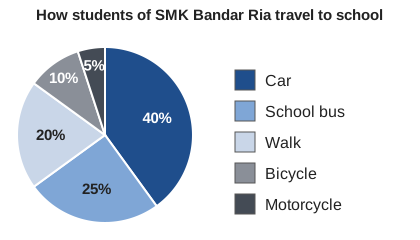
Question 4
Show answerHide answer
Question 5
To: All Science Club members
Subject: Change of date
Dear members,
The visit to the National Science Centre will not be on Saturday 12 July as planned. The centre is holding a school exhibition that day, so we will go on Saturday 19 July instead. The bus will still leave at 7.00 a.m. Please bring RM10 for the bus fare and return your consent form by this Friday.
Mr Tan
Show answerHide answer
Question 6
Posted by Syafiqah, Form 3 Dahlia
On Sunday I finished my first fun run! I had trained for six weeks, but at the 3 km sign my legs felt like stone and I wanted to stop. Then a lady at the side of the road read my name on my number and shouted, "Come on, Syafiqah, you can do it!" I could not let her down, so I kept going. My time was not fast, but I was so proud. Next goal: 10 km!
Show answerHide answer
Question 7
Attention, all students. Because the air quality is very poor today, all outdoor activities, including Physical Education, are cancelled. Uniformed units will meet in their classrooms at the usual time. Classes will end at the normal time, and students who walk home are advised to wear a mask.
Show answerHide answer
Question 8
Hanis: I would love to, but donors must be at least 17, and I am only 15.
Wei Jie: I know. But we still need helpers to give out drinks and biscuits to the donors afterwards.
Hanis: That sounds fun. What time should I be there?
Wei Jie: Eight o'clock. Wear your PE shirt.
Show answerHide answer
Paper 1 Part 2
8 marksQuestion 9
Our School Health Day
posted by Haikal, 3 Cekap, on the school blog
Last Sunday, our school (0) hold a Health Day for the residents of Taman Murni. By the time the first visitors arrived at 8.00 a.m., the committee members (9) set up twelve booths in the school hall. I was handing out leaflets when an old man (10) was fainting near my booth. A nurse ran to help him, and he was fine after a few minutes.
The main speaker was Dr Aminah, (11) that runs the clinic near our school. She gave the visitors (12) an advice on how to keep their hearts healthy: eat less salt, walk for thirty minutes every day and stop smoking. The nurses worked (13) hardly all morning, checking blood pressure and sugar levels. The queue was long, but nobody complained.
Every visitor was (14) gave a free bag of fruit before leaving. The headmaster said that he (15) is very proud of us, and he promised more events like this. If more residents (16) will come next year, we will need a bigger hall!
Show answerHide answer
Question 10
Show answerHide answer
Question 11
Show answerHide answer
Question 12
Show answerHide answer
Question 13
Show answerHide answer
Question 14
Show answerHide answer
Question 15
Show answerHide answer
Question 16
Show answerHide answer
Paper 1 Part 3
8 marksQuestion 17
Sleep: the Secret Power of Teenagers
Many teenagers say that they feel tired all the time, and the reason is simple: they do not sleep enough. Doctors say that people aged 13 to 18 need between eight and ten hours of sleep every night. However, a survey of 1,200 students found that more than half of them slept for less than seven hours on school nights.
Part of the problem is biology. During the teenage years, the body makes a hormone called melatonin about two hours later than it does in children and adults. Melatonin is the chemical that makes us feel sleepy, so a teenager who goes to bed at 9.00 p.m. often lies awake. Phones and tablets make things worse, because their bright screens keep the brain active.
The effects of too little sleep are serious. Students who are short of sleep find it hard to concentrate in class, and they get angry more easily. Their memory also becomes weaker, so they forget what they have just studied. Surprisingly, lack of sleep can make people hungrier, which is why tired students often choose sugary snacks.
Some schools have tried to help. In one school trial, the first lesson was moved from 7.50 a.m. to 8.45 a.m. Within two years, students were sleeping 34 minutes longer each night and their grades had improved. In most schools, though, lesson times cannot change easily, so students must change their own habits.
Experts offer three simple tips. First, go to bed at the same time every night, even at weekends. Second, switch off all screens an hour before bedtime. Third, keep your bedroom dark and cool.
| Notes: Teenagers and sleep | |
|---|---|
| Hours of sleep a teenager needs | (17) ____________ |
| Chemical that makes us sleepy | (18) ____________ |
| Melatonin comes later in teenagers by about | (19) ____________ |
| Effect of too little sleep on memory | becomes (20) ____________ |
| Food that tired students often choose | (21) ____________ |
| Time the first lesson was moved to in the trial | (22) ____________ |
| Extra sleep the students got each night | (23) ____________ |
| Tip: switch off screens ______ before bedtime | (24) ____________ |
Show answerHide answer
Question 18
Show answerHide answer
Question 19
Show answerHide answer
Question 20
Show answerHide answer
Question 21
Show answerHide answer
Question 22
Show answerHide answer
Question 23
Show answerHide answer
Question 24
Show answerHide answer
Paper 1 Part 4
10 marksQuestion 25
TEEN VOLUNTEER OF THE MONTH
Aiman Zulkifli, 15, runs a Saturday reading club for children in his neighbourhood
Interviewer: Aiman, how did the club begin?
Aiman: Two years ago I noticed that the children in my taman spent every afternoon on their phones. My neighbour, Puan Rohani, let me use her garage for free. On the first Saturday only three children came, but now we have thirty-two.
Interviewer: What do you do at the club?
Aiman: We read stories aloud, play word games and let the children act out scenes. Some of the children cannot read well, so older members sit with them one by one. Our rule is that no child is left behind.
Interviewer: Was it hard to start?
Aiman: Money was the biggest problem, because we had hardly any books. I wrote to a bookshop, and they donated forty second-hand books. Then my schoolmates held a book drive and collected over two hundred more.
Interviewer: Has the club changed you?
Aiman: Definitely. I am shy by nature, and I used to blush whenever I spoke in class. Standing in front of the children changed that. They are honest, too. If a story is dull, they just yawn!
Interviewer: What is next?
Aiman: A Family Reading Day at the community hall. Parents are coming, and a local author will read from her book. The details are on the poster.
Saturday 22 November
10.00 a.m. to 12.00 noon | Balai Raya Taman Murni
Guest reader: Puan Latifah Hashim
Free entry. Every family brings one book for the club's shelf.
Show answerHide answer
Question 26
Show answerHide answer
Question 27
Show answerHide answer
Question 28
Show answerHide answer
Question 29
Show answerHide answer
Question 30
Show answerHide answer
Question 31
Show answerHide answer
Question 32
Show answerHide answer
Question 33
Show answerHide answer
Question 34
Show answerHide answer
Paper 1 Part 5
6 marksQuestion 35
THE WALLET AT THE BUS STOP
Last Friday, Kamal waited at the bus stop near his school after extra class. It had rained all afternoon, and the road was full of puddles. (35) ______ He picked it up and opened it. Inside were RM150, a bank card and an identity card in the name of Mr Lim Kok Seng.
Kamal's heart beat fast. He had been saving for new football boots for months, and the money would have paid for them. (36) ______ He knew that the owner must be very worried.
There was no phone number in the wallet, but Kamal found a small card from a clinic. (37) ______ Kamal looked at his watch. It was 5.30 p.m., and the clinic was only two stops away.
He ran all the way to the clinic. (38) ______ Kamal held out the wallet and asked, "Is this yours, Uncle?" Mr Lim's eyes filled with tears. (39) ______ Kamal politely refused and said that he had only done what anyone would do.
(40) ______ Kamal still thinks that the best reward was the look on Mr Lim's face.
Sentences:
| A | Weeks later, the clinic sent a letter of thanks to the school, and the principal praised Kamal at the assembly. |
| B | Just as he sat down, he noticed a brown leather wallet lying under the bench. |
| C | He counted the money, took out a RM50 note and offered it to Kamal as a reward. |
| D | It showed that Mr Lim had an appointment there at 6.00 p.m. that evening. |
| E | However, he remembered his father's saying that honesty is worth more than money. |
| F | At the counter, a worried old man was telling the nurse that he had lost his wallet. |
| G | The bus arrived a few minutes later, and most of the students got on. |
| H | The wallet had been stolen from Mr Lim's car two days earlier. |
Show answerHide answer
Question 36
Show answerHide answer
Question 37
Show answerHide answer
Question 38
Show answerHide answer
Question 39
Show answerHide answer
Question 40
Show answerHide answer
Paper 2 Part 1
20 marksQuestion 41
I am really stressed out! My exams start in two weeks and I have not even started revising. I stay up late playing games on my phone and then I cannot concentrate in class. How can I plan my revision? And how can I get a better night's sleep?
Please help!
Zack
From: ______________ To: zack@email.com
Show answerHide answer
Hi Zack,
I'm sorry to hear that you feel so stressed. I felt the same before my last exam, so I understand you. Please don't worry too much.
First, make a revision timetable and study one subject at a time. Don't leave everything until the last night.
To sleep better, you should put your phone away an hour before bed. Also, go for a walk or listen to music to relax.
I'm sure you will do well. Good luck!
Best wishes,
Aina
Plan before you write: Zack asks two questions, so answer both: (1) how can he plan his revision, (2) how can he sleep better. Begin by showing that you understand how he feels, then give one or two pieces of advice for each question, each with a short reason, and end with encouragement.
Official rating scale (Paper 2 Parts 1 and 2), 0 to 5 marks for each of the four areas:
| Scale | Content | Communicative achievement | Organisation | Language |
|---|---|---|---|---|
| 5 | All content is relevant to the task. Target reader is fully informed. | Uses the conventions of the communicative task to hold the target reader's attention and communicate straightforward and some complex ideas, as appropriate. | Text is generally well organised and coherent, using a variety of linking words and cohesive devices. | Uses a range of everyday vocabulary appropriately, with occasional inappropriate use of less common lexis. Uses a range of simple and some complex grammatical forms with a good degree of control. Errors do not impede communication. |
| 4 | Performance shares features of scores 3 and 5. | |||
| 3 | Minor irrelevances and/or omissions may be present. Target reader is on the whole informed. | Uses the conventions of the communicative task in generally appropriate ways to communicate straightforward ideas. | Text is connected and coherent, using basic linking words and a limited number of cohesive devices. | Uses everyday vocabulary generally appropriately, while occasionally overusing certain lexis. Uses simple grammatical forms with a good degree of control. While errors are noticeable, meaning can still be determined. |
| 2 | Performance shares features of scores 1 and 3. | |||
| 1 | Irrelevances and misinterpretation of task may be present. Target reader is minimally informed. | Produces text that communicates simple ideas in simple ways. | Production is unlikely to be connected, though punctuation and simple connectors (and, but) may be used. | Produces basic vocabulary of isolated words and phrases. Produces few simple grammatical forms with only limited control. |
| 0 | Content is totally irrelevant. Target reader is not informed. | Performance below band 1. | ||
The tick points above give the same 20 marks: five for each area. Tick honestly, then check that your total matches the band you would give each area.
Paper 2 Part 2
20 marksQuestion 42
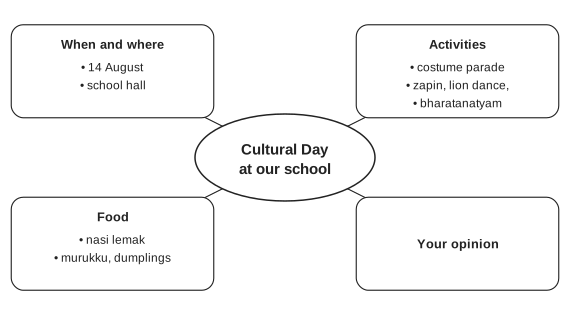
In about 100 words, write a report of the event for the magazine.
You must use the notes below to help you.
Show answerHide answer
Cultural Day at Our School
Our school held its Cultural Day on 14 August in the school hall. Students and parents came to celebrate the different cultures in Malaysia.
The programme began with a parade of traditional costumes. Then students performed the zapin, the lion dance and the bharatanatyam on the stage, and the audience clapped loudly.
After that, everyone enjoyed food from the stalls, such as nasi lemak, murukku and dumplings. Many people queued for more.
In my opinion, the event was a great success because it taught us to respect one another's culture. I hope our school will hold it again next year.
A report tells what happened, in the past tense, in order. Give it a title, turn each box into a short paragraph and add one detail to every note. The last box is your own opinion: say what you thought of the day and give one reason. Keep to about 100 words.
This part is marked with the same official rating scale as Part 1: Content, Communicative achievement, Organisation and Language, 0 to 5 marks each (see the table under Paper 2 Part 1). Band 5 for Content means every note is covered and relevant; a missing note or no opinion drops Content to about 3.
Test specification (JSU)
| Unit | Remembering | Understanding | Applying | Analysing | Evaluating | Creating | Items | marks |
|---|---|---|---|---|---|---|---|---|
| 1. Reading short texts: notices, messages and signs | – | 5 (5) | 1 (1) | 1 (1) | – | – | 7 | 7 |
| 2. Grammar: present, past and perfect tenses | – | – | 2 (2) | – | – | – | 2 | 2 |
| 3. Grammar: nouns, articles, quantifiers and relative clauses | – | – | 2 (2) | – | – | – | 2 | 2 |
| 4. Grammar: adjectives, adverbs and comparison | – | – | 1 (1) | – | – | – | 1 | 1 |
| 5. Grammar: modals, the future and conditionals | – | – | 1 (1) | – | – | – | 1 | 1 |
| 6. Passive, reported speech, causative and spotting errors | – | – | 1 (1) | 1 (1) | – | – | 2 | 2 |
| 7. Information transfer from a text | 3 (3) | 5 (5) | – | – | – | – | 8 | 8 |
| 8. Reading charts, timetables and other non-linear texts | – | 3 (3) | – | 1 (1) | – | – | 4 | 4 |
| 9. Gapped texts and how texts hold together | 2 (2) | 2 (2) | – | 6 (6) | 1 (1) | – | 11 | 11 |
| 10. Writing short messages: emails, notes and letters | – | – | – | – | – | 1 (20) | 1 | 20 |
| 11. Writing from notes: stories, reviews and reports | – | – | – | – | – | 1 (20) | 1 | 20 |
| 12. Vocabulary for everyday topics | – | 2 (2) | – | – | – | – | 2 | 2 |
| Total | 5 (5) | 17 (17) | 8 (8) | 9 (9) | 1 (1) | 2 (40) | 42 | 80 |