Practice paper, not an official KPM paper
Bahasa Perancis
Ujian Akhir Sesi Akademik
Bahasa Perancis (French)
Tingkatan 3, 1 jam 30 minit / 1 hour 30 minutes, 75 marks
Nama / Name
Kelas / Class
Tarikh / Date
Markah / Marks: / 75
Instructions
- Document du candidat, épreuves collectives. This paper has three parts: Partie 1 Grammaire et vocabulaire (25 points), Partie 2 Compréhension écrite (25 points) and Partie 3 Production écrite (25 points).
- Répondez à toutes les questions. Answer all questions.
- Écrivez vos réponses en français, avec les accents. Write your answers in French, with the accents.
Practice shows answers as you go. Exam times you and hides answers until you submit.
Partie 1 : grammaire et vocabulaire
25 marks1
Question 1
Conjuguez le verbe « devoir » au présent. Conjugate the verb devoir (must, to have to) in the present tense.
Exemple : il / elle → doit
[1 mark]
(a)je →
Show answerHide answer
Tick each point you got.
[1 mark]
(b)tu →
Show answerHide answer
Tick each point you got.
[1 mark]
(c)nous →
Show answerHide answer
Tick each point you got.
[1 mark]
(d)vous →
Show answerHide answer
Tick each point you got.
[1 mark]
(e)ils / elles →
Show answerHide answer
devoir follows the same pattern as pouvoir and vouloir (book p. 87): je dois, tu dois, il doit, nous devons, vous devez, ils doivent. The mark needs the exact spelling.
Tick each point you got.
2
Question 2
Conjuguez les verbes entre parenthèses au temps qui convient. Regardez les mots du temps (hier, ce soir, demain…). Put the verbs in brackets into the tense that fits. Look at the time words (yesterday, this evening, tomorrow…).
Exemple : Hier, je (manger) une crêpe. → ai mangé
[1 mark]
(a)Hier soir, nous (regarder) ______________ un documentaire sur la mer.
Show answerHide answer
Tick each point you got.
[1 mark]
(b)Samedi dernier, Inès (partir) ______________ en vacances à Nice.
Show answerHide answer
Tick each point you got.
[1 mark]
(c)Ce soir, mes cousins (aller) ______________ visiter le musée.
Show answerHide answer
Tick each point you got.
[1 mark]
(d)Demain, vous (prendre) ______________ un taxi pour l’aéroport.
Show answerHide answer
Tick each point you got.
[1 mark]
(e)Dans dix ans, mes parents (visiter) ______________ Tokyo.
Show answerHide answer
Choose the tense from the time word: hier, samedi dernier = past (passé composé); ce soir + an infinitive = futur proche; demain, dans dix ans = futur simple (infinitive + -ai, -as, -a, -ons, -ez, -ont; book p. 101).
Tick each point you got.
3
Question 3
Remettez les mots en ordre pour former une phrase correcte. Put the words in order to make a correct sentence.
Exemple : tu / aimes / le cinéma / ? → Tu aimes le cinéma ?
[1 mark]
(a)
êtresportif.il fautPour être nageur,
Show answerHide answer
Tick each point you got.
[1 mark]
(b)
faire ?Quelvoulez-vousmétier
Show answerHide answer
Tick each point you got.
[1 mark]
(c)
beaucoupà LondresIlpleuten automne.
Show answerHide answer
Tick each point you got.
[1 mark]
(d)
estLinadevenueactriceà Paris.
Show answerHide answer
Tick each point you got.
[1 mark]
(e)
visiterUn jour,jeMars.pourrai
Show answerHide answer
Start with the word that has the capital letter and finish with the one that carries the full stop or question mark. One mark per correct sentence; do not lose the hyphen in voulez-vous.
Tick each point you got.
4
Question 4
Conjuguez les verbes entre parenthèses. Les cinq premières phrases sont au présent, les cinq dernières au futur simple. Conjugate the verbs in brackets. The first five sentences are in the present, the last five in the futur simple.
[1 mark]
(a)Tu (pouvoir) ______________ m’expliquer ce mot ?
Show answerHide answer
Tick each point you got.
[1 mark]
(b)Les infirmiers (devoir) ______________ être très patients.
Show answerHide answer
Tick each point you got.
[1 mark]
(c)Nous (vouloir) ______________ un jour devenir ingénieurs.
Show answerHide answer
Tick each point you got.
[1 mark]
(d)Vous (pouvoir) ______________ poser trois questions au réalisateur.
Show answerHide answer
Tick each point you got.
[1 mark]
(e)Je (devoir) ______________ finir mon dossier avant midi.
Show answerHide answer
Tick each point you got.
[1 mark]
(f)Cet hiver, nous (aller) ______________ à la montagne.
Show answerHide answer
Tick each point you got.
[1 mark]
(g)En 2040, je (être) ______________ astronaute.
Show answerHide answer
Tick each point you got.
[1 mark]
(h)Dimanche, il (faire) ______________ beau et chaud.
Show answerHide answer
Tick each point you got.
[1 mark]
(i)Plus tard, tu (avoir) ______________ un métier passionnant.
Show answerHide answer
Tick each point you got.
[1 mark]
(j)Les villes (devoir) ______________ construire plus de pistes cyclables.
Show answerHide answer
Present: je peux / dois, tu peux, nous pouvons / voulons, vous pouvez, ils doivent. Futur simple of irregular verbs: the stem changes (ir-, ser-, fer-, aur-, devr-, pourr-) but the endings are the same as for regular verbs (book p. 101). Spelling counts: irons not iront for nous.
Tick each point you got.
Partie 2 : compréhension écrite
25 marks5
Question 5
Vous cherchez un stage. Vous lisez cette annonce. Lisez le document et répondez aux questions. You are looking for a work placement. You read this advertisement. Read the document and answer the questions.
Le candidat doit être créatif et organisé. Il faut aimer dessiner et savoir travailler en équipe.
Horaires : de 9 h à 17 h, du lundi au vendredi.
Le stage n’est pas payé, mais le déjeuner est offert.
Envoyez votre CV avant le 20 février à : stage@studioaquarelle.fr
Offre de stage : assistant(e) d’animation
Le studio Aquarelle, à Bordeaux, cherche un assistant ou une assistante d’animation pour un stage de deux semaines, du 3 au 14 mars.Le candidat doit être créatif et organisé. Il faut aimer dessiner et savoir travailler en équipe.
Horaires : de 9 h à 17 h, du lundi au vendredi.
Le stage n’est pas payé, mais le déjeuner est offert.
Envoyez votre CV avant le 20 février à : stage@studioaquarelle.fr
[2 marks]
(a)Où est le studio et combien de temps dure le stage ?
Le studio est ______________ et le stage dure ______________.
Le studio est ______________ et le stage dure ______________.
Show answerHide answer
Tick each point you got.
[2 marks]
(b)Citez les deux qualités (adjectifs) demandées au candidat.
Show answerHide answer
The two adjectives are créatif and organisé. Liking drawing and teamwork are skills, not qualities.
Tick each point you got.
[2 marks]
(c)Quels sont les horaires du stage ? (heures et jours)
Show answerHide answer
Tick each point you got.
[2 marks]
(d)Le stage est-il payé ? Qu’est-ce qu’on offre au stagiaire ?
Show answerHide answer
Tick each point you got.
[2 marks]
(e)Jusqu’à quand peut-on envoyer son CV et à quelle adresse ?
Show answerHide answer
Each question is worth 2 points: one for each piece of information, found in the text. Answers may be copied from the document; they do not have to be full sentences.
Tick each point you got.
6
Question 6
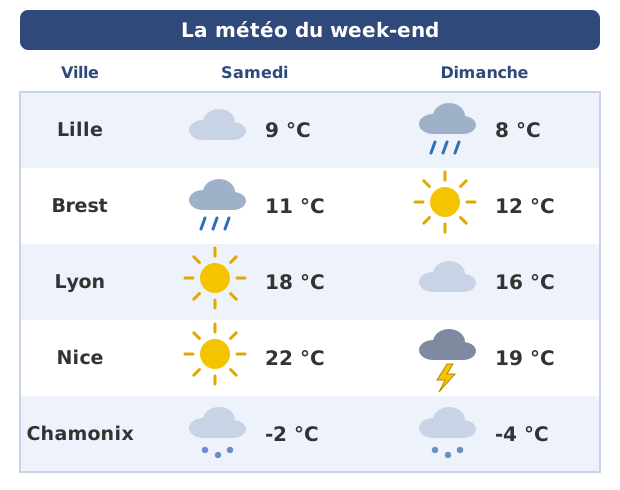
Vous êtes en France. Vous regardez la météo du week-end. Lisez le document et répondez aux questions. You are in France. You look at the weekend weather forecast. Read the document and answer the questions.
[2 marks]
(1)Samedi, où fait-il le plus chaud ? Combien de degrés ?
Il fait le plus chaud à ______________ : ______________ degrés.
Il fait le plus chaud à ______________ : ______________ degrés.
Show answerHide answer
Tick each point you got.
[2 marks]
(2)Quel temps fait-il à Chamonix dimanche ?
Il ______________ et il fait ______________ degrés.
Il ______________ et il fait ______________ degrés.
Show answerHide answer
The snow symbol means il neige; the temperature is -4 °C: moins quatre degrés.
Tick each point you got.
[2 marks]
(3)Dimanche, où est-ce qu’il pleut ? Combien de degrés y a-t-il ?
Show answerHide answer
On Sunday it rains only in Lille (8 °C). It rained in Brest on Saturday, which is a different day.
Tick each point you got.
[2 marks]
(4)Complétez avec « plus » ou « moins », puis avec la forme correcte de « que ».
Samedi, il fait ______________ chaud à Nice ______________ à Lyon.
Samedi, il fait ______________ chaud à Nice ______________ à Lyon.
Show answerHide answer
Nice 22 °C is warmer than Lyon 18 °C: plus chaud … que. Before à Lyon the word que becomes qu’: plus chaud qu’à Lyon.
Tick each point you got.
[2 marks]
(5)Il y a aussi une information pour les skieurs : « À Chamonix, l’hiver commence en décembre et la saison de ski finit en avril. » Quelle activité est possible à Chamonix et en quelle saison ?
Show answerHide answer
The season takes en before a vowel: en hiver, not au hiver.
Tick each point you got.
7
Question 7
Lisez les trois messages et répondez aux questions. Read the three messages and answer the questions.
Message 1
Salut Hugo ! Je suis arrivée à Québec hier. Il neige et il fait -10 degrés ! Demain, nous allons faire du patin à glace. Bisous, InèsMessage 2
Coucou Léa ! Nous avons visité Dakar. Il fait très chaud : 34 degrés ! Samedi, je vais aller à Paris en avion. À bientôt, KarimMessage 3
Chers parents, la sortie à la plage est jeudi, et pas mercredi, parce qu’il y aura de l’orage mercredi. Merci de préparer des baskets et un pull. M. Dupuis
[1 mark]
(1)Où est Inès ?
Show answerHide answer
Tick each point you got.
[1 mark]
(2)Quel temps fait-il à Dakar ?
Show answerHide answer
Tick each point you got.
[1 mark]
(3)Qu’est-ce qu’Inès va faire demain ?
Show answerHide answer
Tick each point you got.
[1 mark]
(4)Comment Karim va-t-il aller à Paris ?
Show answerHide answer
Tick each point you got.
[1 mark]
(5)Quand est la sortie à la plage ?
Show answerHide answer
Message 3 says jeudi, et pas mercredi, because there will be a storm on Wednesday.
Tick each point you got.
Partie 3 : production écrite
25 marks8
Question 8
Vous voulez faire un stage au studio Aquarelle. Remplissez cette fiche de candidature. You want to do a work placement at studio Aquarelle. Fill in this application form.
STUDIO AQUARELLE · BORDEAUX
Fiche de candidature pour un stage
Fiche de candidature pour un stage
[1 mark]
(a)Nom :
Show answerHide answer
Tick each point you got.
[1 mark]
(b)Prénom :
Show answerHide answer
Tick each point you got.
[1 mark]
(c)Âge :
Show answerHide answer
Tick each point you got.
[1 mark]
(d)Nationalité :
Show answerHide answer
Tick each point you got.
[1 mark]
(e)Ville et pays :
Show answerHide answer
Tick each point you got.
[1 mark]
(f)Adresse mail :
Show answerHide answer
Tick each point you got.
[1 mark]
(g)Métier choisi (Je voudrais être…) :
Show answerHide answer
Tick each point you got.
[1 mark]
(h)Deux qualités :
Show answerHide answer
Tick each point you got.
[1 mark]
(i)Pour ce métier, il faut… :
Show answerHide answer
Tick each point you got.
[1 mark]
(j)Langues parlées :
Show answerHide answer
Nom : HASSAN · Prénom : Nurin · Âge : 15 ans · Nationalité : malaisienne · Ville et pays : Kuching, Malaisie · Adresse mail : nurin.hassan@gmail.com · Métier choisi : infirmière · Deux qualités : patiente, sociable · Pour ce métier, il faut : savoir écouter les gens · Langues : le malais, l’anglais
1 point per field: the information must answer the label and be in French, with correct agreement (malaisienne, patiente).
Tick each point you got.
9
Question 9
Vous écrivez un message au studio Aquarelle pour présenter votre candidature (50 à 70 mots). You write a message to the studio Aquarelle to present your application (50 to 70 words).
- Vous vous présentez : prénom, âge, nationalité. Introduce yourself: first name, age, nationality.
- Vous dites quel métier vous voulez faire plus tard et pourquoi. Say which job you want to do later, and why.
- Vous donnez deux qualités et vous dites ce qu’il faut faire pour ce métier. Give two qualities and say what is necessary for this job.
- Vous parlez de vos projets : où vous habiterez ou ce que vous ferez dans dix ans. Talk about your plans: where you will live or what you will do in ten years.
[15 marks]
Show answerHide answer
Bonjour,
Je m’appelle Nurin, j’ai quinze ans et je suis malaisienne. Je voudrais être infirmière parce que j’aime aider les gens. Je suis patiente et sociable. Pour ce métier, il faut étudier longtemps et savoir écouter les malades. Dans dix ans, je travaillerai dans un hôpital à Kuching.
Cordialement,
Nurin Hassan
Je m’appelle Nurin, j’ai quinze ans et je suis malaisienne. Je voudrais être infirmière parce que j’aime aider les gens. Je suis patiente et sociable. Pour ce métier, il faut étudier longtemps et savoir écouter les malades. Dans dix ans, je travaillerai dans un hôpital à Kuching.
Cordialement,
Nurin Hassan
Content 9 points (one tick per element; the two qualities count 1 each) and language 6 points in three cumulative bands (2 + 2 + 2). Common mistakes that cost language points: « Je suis 15 ans » (write J’ai 15 ans), « Je serai étudier » (write Je dois étudier or Il faut étudier), « un infirmière », and « j’allerai » (write j’irai). Marks for content go to ideas, not to length: 50 to 70 words is a guide.
Tick each point you got.
Test specification (JSU)
| Module | Remembering | Understanding | Applying | Analysing | Evaluating | Creating | Items | marks |
|---|---|---|---|---|---|---|---|---|
| 3. Wassim : les métiers, les qualités et la nécessité | 1 (5) | 1 (10) | 3 (25) | – | – | 1 (15) | 6 | 55 |
| 4. Jeanne : la météo, les saisons et l'avenir | – | 2 (15) | 1 (5) | – | – | – | 3 | 20 |
| Total | 1 (5) | 3 (25) | 4 (30) | 0 (0) | 0 (0) | 1 (15) | 9 | 75 |
Each cell shows items (marks).