Consumer Mathematics: Savings and Investments, Credit and Debt
What this chapter covers
- Recognise savings accounts, fixed deposit and current accounts, and shares, unit trusts and real estate as types of savings and investments (3.1)
- Calculate simple interest and compound interest for savings, and explain the effect of the period, rate and compounding frequency on the future value (3.1)
- Calculate return on investment for unit trusts, shares and real estate, and compare risk, return and liquidity (3.1)
- Calculate the average cost per share using the ringgit cost averaging strategy and explain its benefits (3.1)
- Explain credit and debt, use credit cards wisely and calculate minimum payment, finance charge and late payment charge (3.2)
- Calculate loan repayment and instalment under flat interest and interest on balance, and compare loan offers (3.2)
3.1Savings and investments
Three ways to save in a bank
| Account | Interest | Taking money out | Other features |
|---|---|---|---|
| Savings account | Paid on the amount and the length of saving. Lower rate than a fixed deposit. | At any time, with a debit card or at an ATM. | Save any amount you can afford. |
| Fixed deposit account | A more competitive (higher) rate. | Not before the maturity date. If you do, the interest is reduced or cancelled. | Money is kept for a fixed term such as 3 months, 9 months or 1 year. A savings certificate is issued. |
| Current account | Normally none, and service charges apply. | By cheque, debit card, internet or telephone banking. | For personal or business payments. Allows an overdraft (taking out more than the balance, with interest charges). Needs a referee who already holds an account. |
Types of investment and their returns
| Investment | What it is | Return comes from |
|---|---|---|
| Shares | You buy part of a company, which uses the money to raise capital. You become a part-owner. | Dividends and capital gains |
| Unit trust | Many investors pool money. A qualified fund manager invests it in many companies. | Dividends, bonus shares and capital gains |
| Real estate | Immovable property: houses, shops, land. | Rent and capital gains |
Simple interest
I = Prt where I is the interest, P the principal, r the yearly rate (as a decimal or r100) and t the time in years.
t = 812 year
I = Prt = 9 000 × 4100 × 812 = RM240
Total savings = RM9 000 + RM240 = RM9 240
What changes the interest? With the same principal, a longer period or a higher rate gives more interest.
| Principal | Rate | Period | Interest | Total savings |
|---|---|---|---|---|
| RM8 000 | 3% | 2 years | RM480 | RM8 480 |
| RM8 000 | 3% | 3 years | RM720 | RM8 720 |
| RM5 000 | 5% | 1 year | RM250 | RM5 250 |
| RM5 000 | 6% | 1 year | RM300 | RM5 300 |
Rows from Examples 4 and 5, textbook pp. 56–57.
Show answerHide answer
(a) I = 2 500 × 0.03 × 2.5 = RM187.50
(b) Total = 2 500 + 187.50 = RM2 687.50
Compound interest
RM8 000 at 3% per annum, compounded once a year (textbook p. 57):
- Year 1: interest = 8 000 × 0.03 = RM240. Savings = RM8 240.
- Year 2: interest = 8 240 × 0.03 = RM247.20 (not RM240). Savings = RM8 487.20.
MV = matured value (principal + interest), P = principal, r = yearly rate as a decimal, n = number of times interest is compounded per year, t = time in years.
| Compounded | n | Rate per period | Number of periods in t years |
|---|---|---|---|
| Once a year | 1 | r | t |
| Every 6 months (half-yearly) | 2 | r ÷ 2 | 2t |
| Every 4 months | 3 | r ÷ 3 | 3t |
| Every 3 months (quarterly) | 4 | r ÷ 4 | 4t |
| Every month | 12 | r ÷ 12 | 12t |
P = 5 000, r = 0.06, n = 2, t = 2
MV = 5 000 (1 + 0.062)2 × 2 = 5 000 (1.03)4 = RM5 627.54
Interest = 5 627.54 − 5 000 = RM627.54 (simple interest would give only RM600)
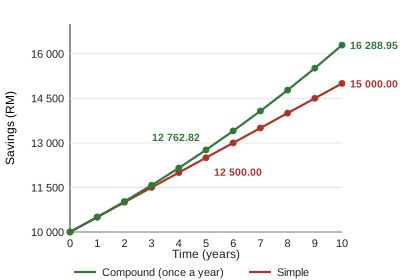
Compounding frequency. The more often interest is added, the more the savings grow (textbook p. 59, Example 7: RM10 000 at 5% per annum for 1 year).
| Compounded | n | Matured value |
|---|---|---|
| Once a year | 1 | RM10 500.00 |
| Quarterly | 4 | RM10 509.45 |
| Monthly | 12 | RM10 511.62 |
Show answerHide answer
2) MV = 5 000 (1.04)2 = RM5 408.00, so interest = RM408.00
Islamic banking
Malaysia has a dual banking system: conventional and Islamic. Islamic banking follows syarak, shares profit, and avoids usury (riba). It does not state a fixed rate of return at the start; the real return is known on maturity.
Under wadiah, the bank keeps the customer's deposit safely and is responsible for it. The bank may give a hibah (gift), which is not fixed. Percentage of hibah = HibahDeposit × 100%.
Hibah = 15 360 − 15 000 = RM360
Percentage of hibah = 36015 000 × 100% = 2.4% (a reference only, not a fixed rate)
Return on investment (ROI)
ROI = Total returnValue of initial investment × 100%
Total return = current income (rent, dividends) + capital gain. An investment is profitable when the return is more than the amount invested.
Initial investment = 5 000 × RM1.00 = RM5 000
Dividend = 6% × RM5 000 = RM300
Capital gain = (RM1.08 − RM1.00) × 5 000 = RM400
Total return = RM300 + RM400 = RM700
ROI = 7005 000 × 100% = 14%
Real estate
For property, the total return is the rent collected plus the capital gain. The capital gain is the selling price minus everything paid out: the down payment, the loan repaid to the bank, stamp duty, legal fees and the agent's commission.
Capital gain = 600 000 − 30 000 − 475 000 − 4 000 − 2 000 − 4 000 = RM85 000
Total return = 60 000 + 85 000 = RM145 000
ROI = 145 000300 000 × 100% = 48.33% over 20 years. This is above the 30% that was expected.
What affects the return from real estate? The economic situation (a strong economy raises demand and prices), the location (near a developed city centre is worth more than rural areas) and the political situation (stability raises demand, instability lowers it).
Risk, return and liquidity
Before investing, compare three things: the risk (the chance of losing money), the level of return and the liquidity (how quickly it can be turned into cash).
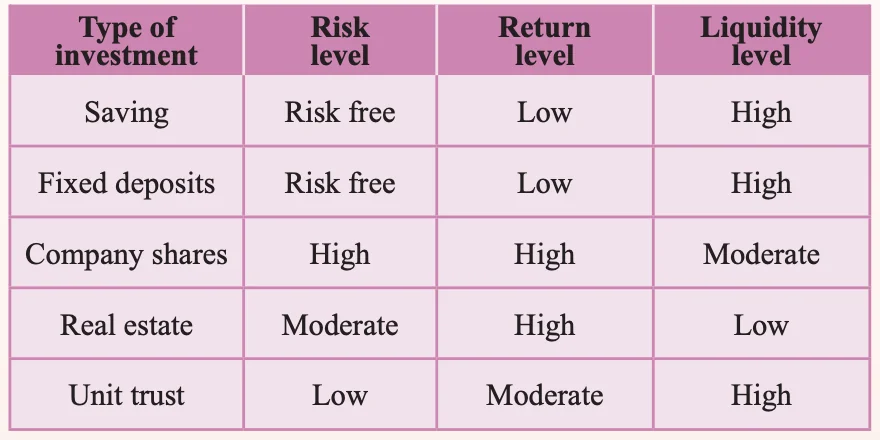
- Higher risk, higher possible return. Company shares carry the highest risk, with a high possible return. A savings account is risk free but pays little.
- Real estate is a good earner but has low liquidity: it takes time to sell.
- To lower risk, diversify: spread money over different investments (a portfolio) so that a loss in one is offset by the others.
Cost averaging strategy
Average cost per unit = Total amount investedTotal number of units owned
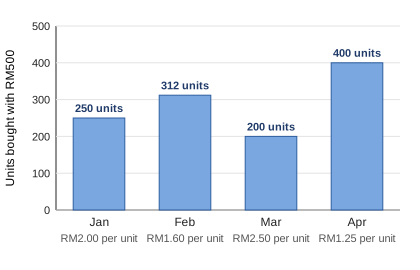
Total units = 250 + 312 + 200 + 400 = 1 162
Average cost = 2 0001 162 = RM1.72 per unit
The average of the four prices is RM1.84, so the strategy gave a lower cost.
Benefits for the investor: takes advantage of price changes (more units when cheap), avoids decisions driven by emotion, and lowers the risk of loss compared with putting everything in at one time. Textbook Example 13 (p. 68): RM20 000 in five equal purchases gave 10 626 units at RM1.88, against 10 000 units at RM2.00 for a lump sum.
Show answerHide answer
Total invested = RM900
Average cost = 900 ÷ 900 = RM1.00 per unit
Comparing investments
To decide who made the wisest investment, follow these steps.
- Find each return (interest, rent, dividend, capital gain).
- Find the ROI as a percentage of the same capital.
- Compare the ROI, then comment on the risk and liquidity.
Textbook Example 14 (pp. 70–71): three retirees each have RM400 000.
| Investor | Investment | Return in 1 year | ROI | Risk |
|---|---|---|---|---|
| Encik Zaidi | Apartment RM150 000 (rent RM800 a month), RM250 000 fixed deposit at 4% | 9 600 + 10 000 = RM19 600 | 4.9% | Low |
| Mr Leong | Shares worth RM400 000, 8% dividend | RM32 000 | 8% | High |
| Mr Navin | RM200 000 savings at 1%, RM200 000 fixed deposit at 4% | 2 000 + 8 000 = RM10 000 | 2.5% | Low |
Mr Leong has the highest ROI, but the highest risk. A "wise" choice depends on how much risk the person can accept.
3.2Credit and debt management
A personal budget is a plan of estimated income and spending for a period. It helps you plan spending carefully, avoid overspending and save.
Managing credit and debt wisely
- Pay the full balance within the interest-free period.
- Pay the outstanding balance shown on the statement, not only the minimum.
- Pay within the cash discount period when one is given.
- Avoid unlicensed moneylenders: they charge very high interest and lend on their own terms.
Credit cards
| Advantages | Disadvantages |
|---|---|
| Rewards such as cash rebates or points Do not need to carry a lot of cash Easy and efficient payment, also online | Charges: annual fee, finance charges (interest), cash advance interest and late payment charges Easy to overspend Some shops do not accept cards |
To apply, a person must be at least 21 years old, have a minimum income of RM24 000 a year and show a salary slip or supporting documents. Never give card details to strangers, never write the PIN on the card and check each statement.
Minimum payment and late payment
Interest-free period: normally 20 days from the statement date. Pay the full balance in that time and there is no interest.
Minimum payment: 5% of the statement balance, or RM50 if that is more.
Finance charge on the unpaid balance: yearly rate (15% to 18%) × days ÷ 365.
Late payment charge: at least RM10, or 1% of the total outstanding balance when that is more.
Minimum payment = 5% × 2 400 = RM120 (more than RM50)
Pays only the minimum: unpaid balance = 2 400 − 120 = RM2 280
Interest = 2 280 × 0.18 × 20365 = RM22.49, so the new balance = RM2 302.49
Pays nothing: interest = 2 400 × 0.18 × 20365 = RM23.67
Late charge = 1% × (2 400 + 23.67) = RM24.24
New balance = 2 400 + 23.67 + 24.24 = RM2 447.91
Buying from abroad with a card
Handbag = 250 ÷ 0.34 = RM735.29; delivery = 50 ÷ 0.34 = RM147.06; bank charge = 1% × 735.29 = RM7.35
Total = RM889.70, which is RM90.70 more than the local price of RM799.
The cheaper advertised price is not the cheapest once delivery and charges are added.
Loans: repayment and instalment
Total repayment A = P + Prt (P = loan after the down payment) and monthly instalment = A ÷ number of months.
Loan = 80 000 − 8 000 = RM72 000
Interest = 72 000 × 4100 × 6 = RM17 280
Total repayment = 72 000 + 17 280 = RM89 280
Monthly instalment = 89 280 ÷ 72 = RM1 240
| Month | Balance at start | Interest = balance × 0.06 ÷ 12 | Balance at end = start + interest − 150 |
|---|---|---|---|
| 1 | RM10 000.00 | RM50.00 | RM9 900.00 |
| 2 | RM9 900.00 | RM49.50 | RM9 799.50 |
| 3 | RM9 799.50 | RM49.00 | RM9 698.50 |
Show answerHide answer
(b) Month 1: 8 000 × 0.09 ÷ 12 = RM60.00. Balance = 8 060 − 400 = RM7 660.
Month 2: 7 660 × 0.09 ÷ 12 = RM57.45
Why take a vehicle loan?
Textbook Example 21 (p. 80): repaying in monthly instalments lets you own the car without paying a lump sum. The costs are that the car can be repossessed if instalments are missed, and the total repayment is high because of the interest.
Choosing a loan
Compare the monthly instalment, the total repaid and the total interest, and whether a guarantor is needed. Textbook Example 22 (pp. 80–81): Mr Vincent, income RM2 800, borrows RM40 000.
| Bank A | Bank B | |
|---|---|---|
| Rate (flat) | 4.5% | 5% |
| Period | 9 years | 6 years |
| Total repaid | RM56 200 | RM52 000 |
| Monthly instalment | RM520.37 | RM722.22 |
| Guarantor | Not required | Required |
Bank A has the lower instalment, which suits his income, but he pays RM4 200 more interest overall. Bank B costs less in total. The best choice depends on what he can afford each month.
Notes and worked examples follow Mathematics Form 3 (DLP) textbook, Chapter 3, pp. 52–83. The table image is from p. 66.