Additional Mathematics notes, chapter 1
Functions
Textbook Additional Mathematics Form 4 KSSM (DLP), pages 1–33
What this chapter covers
- Explain functions using graphs and notation, and determine whether a relation or graph is a function (1.1.1)
- Determine the domain, codomain and range of a function, including absolute value functions (1.1.2)
- Find the image of a function when the object is given and the object when the image is given (1.1.3)
- Describe and determine composite functions, find their images and objects, and find a function from a composite function (1.2.1–1.2.4)
- Solve problems involving composite functions (1.2.5)
- Describe the inverse of a function, use the horizontal line test and find inverse functions and their graphs (1.3.1–1.3.3)
1.1Functions
A function is a special relation from set X to set Y in which each element of X is mapped to one and only one element of Y. Example: the pay for a cashier at RM80 a day depends on the number of days worked.
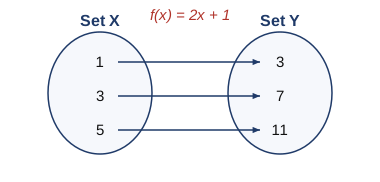
| Notation | How to read it |
|---|---|
| f : x → 2x + 1 | "f maps x to 2x + 1" |
| f(x) = 2x + 1 | "2x + 1 is the image of x under f" or "f of x equals 2x + 1" |
| f(1) = 3 | 1 is the object, 3 is its image |
A relation is not a function if an object has two images (one-to-many) or if an object has no image. An element in set Y with no object is allowed.
Function means one-to-one or many-to-one. One-to-many is never a function.
Vertical line test (graphs)
Draw a vertical line across the graph. If it cuts the graph at only one point, the graph is a function. If it cuts at no point or at two or more points, it is not a function.
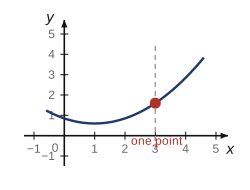
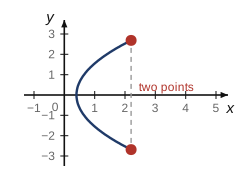
Test described in textbook p. 4.
Absolute value function
|x| is the numerical value of x: |x| = x when x ≥ 0 and |x| = −x when x < 0. The graph of f(x) = |x| is a V with its vertex at (0, 0).
Example 5 (textbook p. 8): f : x → |2x − 1| for −1 ≤ x ≤ 2
| x | −1 | 0 | 12 | 1 | 2 |
|---|---|---|---|---|---|
| f(x) | 3 | 1 | 0 | 1 | 3 |
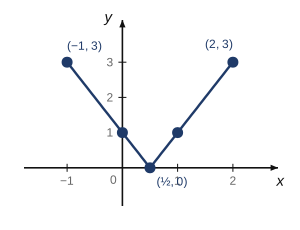
Domain, codomain and range
| Term | Meaning |
|---|---|
| Domain | the set of objects x that can be put into f |
| Codomain | the whole set Y that the images may come from |
| Range | the images that are actually obtained; the range is a part of the codomain |
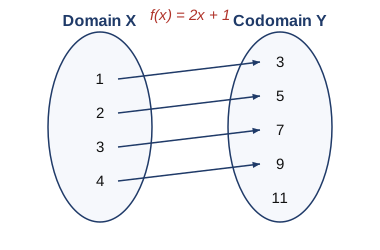
A discrete function has separate points (domain is a list of values). A continuous function is a line or curve over an interval, for example 1 ≤ x ≤ 4.
Do not put every element of the codomain into the range. 11 is in the codomain but no object maps to it.
The function f(x) = 3x − 1 has domain {0, 1, 2}. State the range.
Show answerHide answer
f(0) = −1, f(1) = 2, f(2) = 5. Range = {−1, 2, 5}
Finding the image or the object
Put the object into the formula to find the image. To find the object, put the image equal to f(x) and solve.
Example 6 (textbook p. 9): f : x → 3x + 5x, x ≠ 0
f(5) = 3(5) + 55 = 16.Find x when f(x) = 8: 3x + 5x = 8, so 3x² − 8x + 5 = 0, (3x − 5)(x − 1) = 0, x = 53 or x = 1.
Example 7 (textbook p. 10): absolute value equations
f(x) = |2x − 3|.f(x) = 5: 2x − 3 = 5 or 2x − 3 = −5, so x = 4 or x = −1.
f(x) < 1: −1 < 2x − 3 < 1, so 1 < x < 2.
f(x) > 3: 2x − 3 > 3 or 2x − 3 < −3, so x > 3 or x < 0.
|expression| < k gives one "sandwich" inequality (−k < … < k). |expression| > k gives two separate parts.
If f(x) = |x − 4|, find the values of x such that f(x) = 6.
Show answerHide answer
x − 4 = 6 or x − 4 = −6, so x = 10 or x = −2
1.2Composite functions
A composite function is made by putting one function inside another. fg(x) = f[g(x)]: do g first, then f. Also f²(x) = f[f(x)].
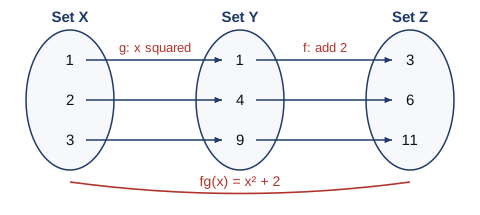
Example 8 (textbook p. 14): f : x → 2x and g : x → x² − 5
fg(x) = f(x² − 5) = 2(x² − 5) = 2x² − 10gf(x) = g(2x) = (2x)² − 5 = 4x² − 5
f²(x) = f(2x) = 4x
g²(x) = g(x² − 5) = (x² − 5)² − 5 = x⁴ − 10x² + 20
fg is not the same as gf, and fg is not f × g. The function nearest to x is done first.
Image, object and the missing function
Example 9 (textbook p. 15): f : x → x − 1, g : x → x² − 3x + 4
g(2) = 2² − 3(2) + 4 = 2, then f(2) = 1, so fg(2) = 1.fg(x) = x² − 3x + 3. If fg(x) = 7 then x² − 3x − 4 = 0, (x + 1)(x − 4) = 0, x = −1 or x = 4.
Example 10 (textbook p. 16): f : x → x − 2, given fg : x → 8x − 7
f[g(x)] = g(x) − 2 = 8x − 7, so g(x) = 8x − 5.If gf(x) is given instead, let y = x − 2 so x = y + 2, rewrite in y, then change y back to x.
Order matters. To find f, substitute into g first. When the outer function is known, write g(x) − 2 = result and solve for g(x).
f(x) = 2x + 1 and g(x) = x². Find (a) fg(x) (b) gf(3)
Show answerHide answer
(a) fg(x) = f(x²) = 2x² + 1
(b) f(3) = 7, g(7) = 49
(b) f(3) = 7, g(7) = 49
Problems with composite functions
In a word problem, name the functions, decide which one is applied first, then form the composite function and substitute.
Example 12 (textbook p. 17), idea only
Production q depends on workers n, and revenue r depends on q. Revenue as a function of n is r[q(n)], the composite function rq(n). Substitute n to get the revenue.Repeated functions (Example 11, textbook p. 16)
If f(x) = 1/x² = x−2, then f²(x) = f[f(x)] = x4, f³(x) = x−8 and f⁴(x) = x16. The power is (−2)n: positive for even n and negative for odd n. Hence f²²(x) = x2²² and f³³(x) = x−2³³.1.3Inverse functions
The inverse function f⁻¹ undoes f: f : x → y ⇔ f⁻¹ : y → x. f⁻¹ is read "f inverse". It does not mean the reciprocal 1f(x).
| Property | Meaning |
|---|---|
| Only a one-to-one function has an inverse | each image has exactly one object |
| ff⁻¹(x) = f⁻¹f(x) = x | use this to verify that two functions are inverses |
| Domain of f⁻¹ = range of f | and range of f⁻¹ = domain of f |
| (a, b) on f ⇒ (b, a) on f⁻¹ | graph of f⁻¹ is the reflection of the graph of f in y = x |
Horizontal line test
If every horizontal line cuts the graph of f at no more than one point, f is one-to-one and has an inverse. If a horizontal line cuts at two or more points, f has no inverse.
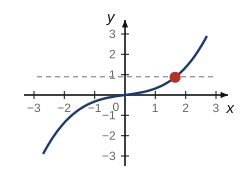
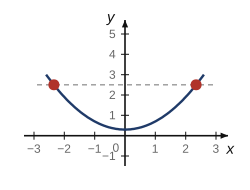
Finding f⁻¹ algebraically
- Write y = f(x).
- Make x the subject.
- Write x as f⁻¹(y), then replace y with x.
Example 19 (textbook p. 28): f : x → 5x + 2
y = 5x + 2, so x = y − 25. Hence f⁻¹(x) = x − 25 and f⁻¹(7) = 7 − 25 = 1.Finding f⁻¹(3) without the formula (Example 14, textbook p. 21)
f(x) = xx − 4, x ≠ 4. Let a = f⁻¹(3), so f(a) = 3: a = 3(a − 4), a = 6. Hence f⁻¹(3) = 6.f⁻¹(k) is the object whose image is k. Solve f(x) = k. It is often quicker than finding the whole formula.
Example 17 (textbook p. 26): f : x → x² − 6, 0 ≤ x ≤ 4
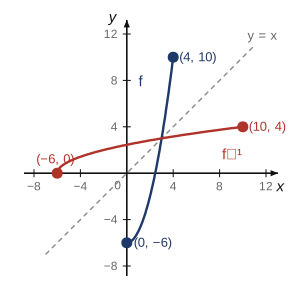
Check the domain. f(x) = x² − 6 for all real x has no inverse. A restricted domain such as 0 ≤ x ≤ 4 makes it one-to-one.
f(x) = x + 43. Find f⁻¹(x).
Show answerHide answer
y = x + 43, so x = 3y − 4. Hence f⁻¹(x) = 3x − 4