Ready for anything
What this chapter covers
- I can talk about extreme activities and risk using adjectives of feeling such as thrilled, anxious, terrified and fearless (2.1)
- I can choose the right quantifier (much, many, a few, a little, plenty of, enough, any, some) with countable and uncountable nouns (2.2)
- I can use defining and non-defining relative clauses with who, which, that, whose and where, and put commas in the right places (2.3)
- I can use the past simple and the past continuous together to narrate events, and I know the story linking words for time, result and emphasis (2.4, 2.6)
- I can use personality adjectives, prepositional phrases with in and out of, and phrasal verbs and expressions with keep (2.5)
- I can plan and write a description of a person I admire with an introduction, two main paragraphs and a conclusion (2.7)
- I can plan and write a story that ends or begins with a given sentence, and summarise an extract from a novel in my own words (2.6, 2.8)
In this unit you will talk about risk and extreme activities, practise quantifiers, relative clauses and the past simple and past continuous, build vocabulary for feelings and personality, and learn how to write a description of a person, a story and a summary of a novel extract. These are skills for SPM English Paper 1 (reading and use of English) and Paper 2 (writing).
2.1Risk, feelings and the texts in this unit
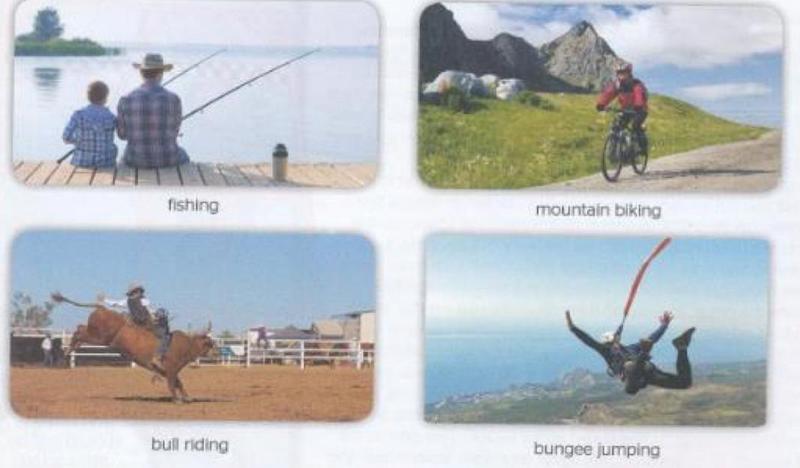
Photos: Full Blast Plus 4 Student's Book, p.21.
The unit opens with a question: is taking risks exciting, scary or just dangerous? Use adjectives to describe both the activity and the person's feeling.
| Describing the activity | Describing how a person feels |
|---|---|
| enjoyable, tempting, unforgettable (positive) | thrilled, fearless (positive or brave) |
| stressful, terrifying, risky (worrying) | terrified, anxious, uneasy (afraid or worried) |
| monotonous (boring, always the same) | relieved (happy that danger or worry has gone) |
The reading texts in this unit are good models for your own writing: a magazine article about people who do unusual things for charity (p.22), an extract from a Sherlock Holmes story (p.28), and an extract from Twenty Thousand Leagues Under the Sea (p.34-35).
Show answerHide answer
2.2Countable and uncountable nouns, and quantifiers
A countable noun has a plural and can take a number (one orange, four cats). An uncountable noun has no plural and is not counted with numbers (money, light, homework, advice, equipment).
| Quantifier | Countable (plural) | Uncountable | Note |
|---|---|---|---|
| many | many websites | no | usually in questions and negatives |
| much | no | much money | usually in questions and negatives; "so much", "too much" |
| a lot of / lots of / plenty of | yes | yes | for both; normal in positive sentences |
| a few | a few oranges | no | a small number, enough: positive |
| few | few people | no | almost none: negative |
| a little | no | a little time | a small amount, enough: positive |
| little | no | little time left | almost none: negative |
| some / any | yes | yes | some in positive sentences; any in negatives and questions |
- Some nouns are uncountable in English: "money", "homework", "equipment", "light" (as in brightness). Say "much money", not "many moneys".
- The same word can change meaning. "There is not enough light" (brightness, uncountable) but "Turn on the lights" (lamps, countable).
- Do not write "a lot money". Use "a lot of money".
"Rodney always gives ______ money to charities. I want to give some too, but there are so ______ that I don't know which one to choose." Money is uncountable, so a little fits (the book's choice is between "a little" and "a lot", and "a lot money" is wrong without of). "Charities" is plural countable, so many fits: "so many".
Show answerHide answer
2.3Relative clauses
A relative clause gives information about a noun. It starts with a relative pronoun or adverb.
| Word | Used for | Example |
|---|---|---|
| who / that | people | The guy who was talking to me is a ski instructor. |
| which / that | things, ideas | UNICEF is an organisation which helps children. |
| whose | belonging to a person | Dave, whose mum works at the supermarket, is my friend. |
| where | places | The campsite where we are staying has a restaurant. |
Defining and non-defining
| Defining | Non-defining | |
|---|---|---|
| Job | Tells which person or thing we mean. Without it the sentence is not clear. | Adds extra information. The sentence is clear without it. |
| Commas | No commas | Commas before and after the clause (one comma only if the clause ends the sentence) |
| that | who / which can be replaced by that; the pronoun can be left out when it is the object | that is not used |
| Example | I want to buy the phone which I showed you. | My father, who is a businessman, started work at fifteen. |
Show answerHide answer
2.4Past simple and past continuous
| Tense | Form | Job |
|---|---|---|
| Past simple | verb + -ed, or an irregular form (saw, went) | a finished action; a sequence of events in a story |
| Past continuous | was / were + verb-ing | an action in progress at a past moment; background; a longer action interrupted by a shorter one |
While the detective was looking around the room, he noticed a footprint on the carpet.
We were driving down the road when the police stopped us.
The longer background action (looking, driving) is in the past continuous; the short event that interrupted it (noticed, stopped) is in the past simple.
Show answerHide answer
2.5Vocabulary: personality, in / out of, keep, and words that are both verbs and nouns
Personality adjectives
| Adjective | Meaning |
|---|---|
| dedicated | gives a lot of time and effort because the work matters to you |
| ambitious | really wants to become successful |
| courageous | brave |
| responsible / reliable | can be trusted to make good decisions and to help when needed |
| strict | makes sure rules about behaviour are followed |
| patient | can stay calm for a long time |
| sociable | enjoys meeting and talking to people, outgoing |
| unselfish | cares more about the needs of others than your own |
| intelligent | clever, good at thinking and learning |
Phrases with in and out of
| in | out of | in or out of |
|---|---|---|
| in a hurry, in a good / bad mood, in common, in case of, in particular, in general, in need | out of breath, out of the question, out of one's mind, out of date, out of the ordinary, out of (one's) reach | in / out of danger, sight, control, trouble, order, use, shape |
Phrasal verbs and expressions with keep
| Expression | Meaning |
|---|---|
| keep someone company | stay with someone so they are not alone |
| keep off (the grass) | do not step on |
| keep up with | go or progress at the same speed as |
| keep an eye on | watch carefully, look after |
| keep still | do not move |
| keep your fingers crossed | hope for good luck |
| keep in mind | remember |
| keep a promise | do what you said you would do |
| keep something to yourself | do not tell anyone, keep it secret |
| keep + -ing | continue to do it: "If you keep eating like that, you'll gain weight." |
Words that are both verbs and nouns
Some words have the same spelling as a verb and a noun: help, support, harm, need, experience, stay, start. "We should help raise money" (verb) but "Thanks for your help" (noun). Check the sentence: after a, the or your expect a noun; after to or a subject expect a verb.
Words that are easily confused
| Pair | Difference |
|---|---|
| fee / tip / donation | a fee is a price to enter or use something; a tip is a small thank-you amount for service; a donation is money given freely to a cause |
| raise / gain / earn | raise money (collect it for a cause); gain experience; earn money by working |
| manage / succeed | manage to do something; succeed in doing something |
| elderly / old / ancient / mature | elderly is a polite word for old people; ancient is very old history; mature is grown-up in behaviour |
| ground / land | the ground is the surface to sit on; land is the dry part of the Earth, as opposed to the sea (sailors are glad to see land) |
Show answerHide answer
2.6Writing a story
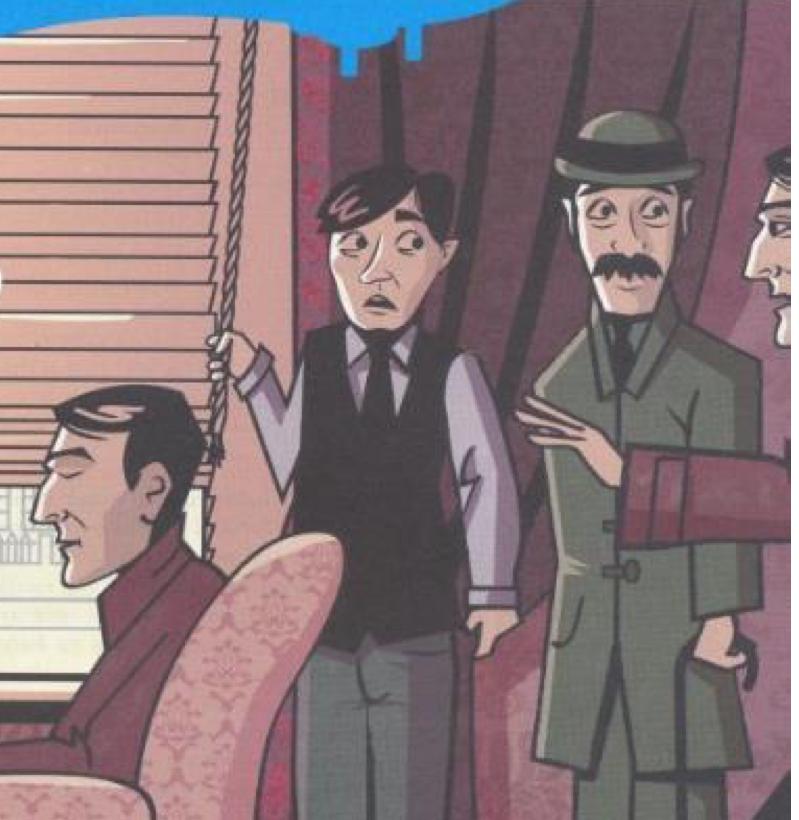
Illustration: Full Blast Plus 4 Student's Book, p.28.
In an SPM-style task the story often has to begin or end with a sentence you are given, for example "They were lucky to be alive." or "Susan will never forget what happened that day." Never change the given sentence.
| Part | What to include |
|---|---|
| Introduction | The setting (time, place, weather) and the main character(s) |
| Main part (2 to 3 paragraphs) | What happened, what the characters did, saw, heard and said, and how they felt |
| Conclusion | What happened in the end and a short comment |
Linking words and phrases
| Use | Words |
|---|---|
| Time | before, when, as soon as, while, as, during, after that, after a while, later, soon, then, at first, finally, by the time, at that moment, since, just as, in the meantime, until, immediately |
| Result or consequence | so ... that, such ... that, so, therefore, for this reason, as a consequence, as a result |
| Cause or reason | because, because of + noun, as |
| Emphasis | in fact, actually, as a matter of fact |
- while / during: "while" is followed by a clause (while the sun was going down); "during" is followed by a noun (during the night).
- so / such: "so heavy" (so + adjective) but "such heavy rocks" (such + adjective + noun).
- because / because of: because + clause; because of + noun.
Two brothers, Terry and Phil, are in a mountain cabin and a polar bear is outside. Terry sees there are two bears. He remembers the fireworks in his bag, lights one and throws it outside. The bangs and flashes scare the bears away and locals take the boys to safety. The story ends with the given sentence: "They were lucky to be alive." Notice the order: setting, problem, idea, result, given ending.
Show answerHide answer
2.7Writing a description of a person
Task: describe a person you admire, say why you admire him or her and how he or she has influenced you. First underline the key words in the task, then plan.
| Part | Content |
|---|---|
| Introduction | General information: the name, relationship to you, job |
| Main part, paragraph 1 | The person's personality, with examples to support each quality |
| Main part, paragraph 2 | The influence he or she has had on you or other people |
| Conclusion | A general comment and how you feel about the person |
Quality: My uncle is the most courageous person I know.
Example: He risks his life every day to save others as a firefighter.
Quality: Few people are as kind and unselfish as he is.
Example: He offers to help others even when he is not working.
Show answerHide answer
2.8Reading extracts and summarising a novel extract
The Let's Read pages (p.34-36) give an extract from Twenty Thousand Leagues Under the Sea by Jules Verne. The narrator, a marine biologist, is in the submarine Nautilus. Giant squid attack; Captain Nemo and the crew fight them with hatchets, a sailor is carried away, and Nemo weeps for the loss.
Guessing the meaning of new words
- Look at the context: the sentences before and after the word.
- Look at the word itself: its root, prefix and ending. Is it like a word you know?
- Decide the part of speech, whether the meaning is positive or negative, and the general topic.
Plan for a summary paragraph
| Sentences | What to write |
|---|---|
| First one or two | The main characters (who) and the setting (where, when) |
| Next two or three | The main theme and the main events |
| Following two or three | Details that support the theme: how and why characters react |
| Final sentence | The message or moral, if there is one |
Show answerHide answer
Summary
- -ing adjectives describe the cause (terrifying), -ed adjectives describe the feeling (terrified).
- Many / few / a few go with countable nouns; much / little / a little go with uncountable nouns; a lot of, plenty of, some and any go with both.
- Defining relative clauses have no commas and can use that; non-defining clauses add extra information, use commas and never use that. Use who for people, which for things, whose for belonging, where for places.
- Past continuous = the action in progress; past simple = the short event or a sequence of events.
- Learn the personality adjectives, in / out of phrases and the expressions with keep.
- A story has setting, events and ending; keep the given sentence unchanged, use past tenses, linkers and direct speech.
- A description of a person has an introduction, qualities with examples, influence and a conclusion.
- A summary uses your own words, mostly present tense, and names the title and author.