Practice paper, not an official KPM paper
4551
Ujian Akhir Sesi AkademikEnd of Academic Session Test
BiologiBiology
Tingkatan 4, 2 jam 30 minit / 2 hours 30 minutes, 100 marks
Nama / Name
Kelas / Class
Tarikh / Date
Markah / Marks: / 100
Instructions
- Kertas soalan ini mengandungi tiga bahagian: Bahagian A, Bahagian B dan Bahagian C.This question paper consists of three sections: Section A, Section B and Section C.
- Jawab semua soalan.Answer all questions.
- Bahagian A: pilih satu jawapan bagi setiap soalan.Section A: choose one answer for each question.
- Bahagian B dan C: tulis jawapan anda di ruang yang disediakan. Kerja mengira mesti ditunjukkan.Sections B and C: write your answers in the spaces provided. Working must be shown for calculations.
- Rajah yang mengiringi soalan tidak dilukis mengikut skala kecuali dinyatakan.The diagrams in this paper are not drawn to scale unless stated.
- Kalkulator saintifik yang tidak boleh diprogramkan dibenarkan.A non-programmable scientific calculator is allowed.
Answer schemes are in English (DLP).
Practice shows answers as you go. Exam times you and hides answers until you submit.
Bahagian ASection A
20 marksJawab semua soalan. Setiap soalan diikuti oleh empat pilihan jawapan, A, B, C dan D. Pilih satu jawapan sahaja.Answer all questions. Each question is followed by four options, A, B, C and D. Choose one answer only.
1
Question 1
Selepas satu eksperimen osmosis, seorang murid mempunyai beberapa cecair yang tidak diperlukan lagi. Cecair yang manakah boleh dibuang terus ke dalam singki?After an osmosis experiment, a student has several liquids that are no longer needed. Which liquid may be poured straight into the sink?
Show answerHide answer
B
Only harmless, low-concentration solutions with a pH of 5 to 9, such as sucrose solution, may go down the sink. Organic solvents (acetone) and heavy metals (mercury) may not, and a broth culture must first be decontaminated by autoclaving.
2
Question 2
Sel kelenjar pankreas menghasilkan enzim pencernaan yang dirembeskan keluar daripada sel. Organel yang manakah memproses, mengubah suai dan membungkus enzim itu ke dalam vesikel rembesan?A cell of the pancreas makes digestive enzymes that are secreted out of the cell. Which organelle processes, modifies and packs the enzymes into secretory vesicles?
Show answerHide answer
A
The Golgi apparatus processes, modifies, packs and transports proteins. Ribosomes make the protein; lysosomes digest; mitochondria release energy; smooth ER makes lipids.
3
Question 3
Dalam satu mikrograf elektron, palang skala yang mewakili 20 µm berukuran 40 mm. Berapakah pembesaran mikrograf itu?In an electron micrograph, a scale bar that represents 20 µm measures 40 mm. What is the magnification of the micrograph?
Show answerHide answer
C
Convert to the same unit: 40 mm = 40 000 µm. Magnification = image size ÷ actual size = 40 000 ÷ 20 = × 2 000.
4
Question 4
Pernyataan yang manakah menerangkan resapan berbantu?Which statement describes facilitated diffusion?
Show answerHide answer
C
Facilitated diffusion is passive transport of ions, glucose and amino acids down the concentration gradient through channel or carrier proteins, with no energy. A is active transport, B is osmosis and D is simple diffusion.
5
Question 5
Jadual 1 menunjukkan perubahan jisim bagi empat silinder ubi kentang yang sama jisimnya yang direndam dalam larutan sukrosa selama 1 jam. Anggarkan kepekatan larutan sukrosa yang isotonik dengan sap sel ubi kentang itu.
Table 1 shows the change in mass of four potato cylinders of equal starting mass that were soaked in sucrose solutions for 1 hour. Estimate the concentration of the sucrose solution that is isotonic to the cell sap of the potato.
| Kepekatan sukrosa / Sucrose concentration (mol dm⁻³) | 0.10 | 0.20 | 0.30 | 0.40 |
|---|---|---|---|---|
| Perubahan jisim / Change in mass (g) | +0.6 | +0.2 | −0.2 | −0.6 |
Show answerHide answer
B
The mass change is +0.2 g at 0.20 mol dm⁻³ and −0.2 g at 0.30 mol dm⁻³, so it is 0 g half way between, at 0.25 mol dm⁻³. There is no net movement of water at this concentration, so it is isotonic to the cell sap.
6
Question 6
Disakarida yang manakah terbentuk apabila satu molekul glukosa bergabung dengan satu molekul galaktosa melalui kondensasi?Which disaccharide is formed when one glucose molecule joins with one galactose molecule by condensation?
Show answerHide answer
D
Glucose + galactose → lactose + water. Maltose is glucose + glucose, sucrose is glucose + fructose, and starch is a polysaccharide, not a disaccharide.
7
Question 7
Laktase memangkinkan penghidrolisisan laktosa tetapi tidak memangkinkan penghidrolisisan maltosa. Mengapakah?Lactase catalyses the hydrolysis of lactose but does not catalyse the hydrolysis of maltose. Why?
Show answerHide answer
C
Enzymes are specific: only a substrate whose shape fits the active site can bind (lock and key hypothesis). Maltose is a disaccharide, and enzymes are not used up.
8
Question 8
Sebuah kilang menggunakan enzim tersekat gerak dalam proses pembuatan sirap fruktosa. Apakah kelebihan menggunakan enzim tersekat gerak?A factory uses immobilised enzymes to make fructose syrup. What is the advantage of using immobilised enzymes?
Show answerHide answer
A
Immobilised enzymes are attached to an inert support, so they can be separated from the product, recovered and reused; this cuts the cost, and the product is not contaminated by the enzyme. They stay specific and still need a substrate.
9
Question 9
Sel soma sejenis serangga mempunyai 2n = 12. Berapakah bilangan kromosom dan kromatid dalam satu sel pada anafasa I meiosis?A somatic cell of an insect has 2n = 12. How many chromosomes and chromatids are there in one cell at anaphase I of meiosis?
Show answerHide answer
C
DNA was replicated before meiosis, so each of the 12 chromosomes has two sister chromatids (24 chromatids). In anaphase I the homologous chromosomes separate, but the sister chromatids stay joined, so the cell still has 12 chromosomes.
10
Question 10
Doh roti mengembang selepas yis ditambahkan dan dibiarkan selama satu jam. Apakah yang menyebabkan doh itu mengembang?Bread dough rises after yeast is added and left for an hour. What makes the dough rise?
Show answerHide answer
B
In alcohol fermentation glucose is changed to ethanol and carbon dioxide; the gas bubbles make the dough rise. Lactic acid fermentation gives no gas, and yeast cannot photosynthesise.
11
Question 11
Tekanan atmosfera di sebuah kem di puncak gunung ialah 600 mm Hg. Udara mengandungi 21% oksigen. Berapakah tekanan separa oksigen di kem itu?The atmospheric pressure at a camp on a mountain top is 600 mm Hg. Air contains 21% oxygen. What is the partial pressure of oxygen at the camp?
Show answerHide answer
B
Partial pressure = percentage of the gas × atmospheric pressure = 0.21 × 600 = 126 mm Hg. 160 mm Hg is the value at sea level (760 mm Hg).
12
Question 12
Pasangan yang manakah menunjukkan enzim dan bahan yang dihidrolisiskannya dengan betul?Which pair shows an enzyme and the food it hydrolyses correctly?
Show answerHide answer
A
Pepsin hydrolyses protein into polypeptides. Lipase acts on lipid, maltase on maltose, lactase on lactose, and trypsin on polypeptides.
13
Question 13
Seorang pesakit mempunyai batu karang hempedu yang menyekat duktus hempedu. Pencernaan yang manakah paling terjejas?A patient has gallstones that block the bile duct. Which digestion is most affected?
Show answerHide answer
C
Bile enters the duodenum through the bile duct and emulsifies lipids into small droplets, giving a larger surface area for lipase. Without it, fat digestion is slow. Protein digestion in the stomach, starch digestion in the mouth and maltose digestion in the ileum do not need bile.
14
Question 14
Apakah ciri yang membolehkan pertukaran bahan antara darah dengan sel tisu berlaku dengan cekap dalam kapilari darah?Which feature allows the exchange of substances between the blood and tissue cells to take place efficiently in a blood capillary?
Show answerHide answer
D
The capillary wall is one cell thick, so the diffusion distance is very short. A thick muscular wall belongs to an artery, valves to a vein, and blood pressure in capillaries is low.
15
Question 15
Serum seorang pesakit, P, dicampurkan dengan sel darah merah daripada empat penderma. Hasilnya ditunjukkan dalam Jadual 2. Apakah kumpulan darah pesakit P?
The serum of a patient, P, is mixed with red blood cells from four donors. The results are shown in Table 2. What is the blood group of patient P?
| Penderma / Donor | 1 | 2 | 3 | 4 |
|---|---|---|---|---|
| Kumpulan darah / Blood group | B | O | A | AB |
| Penggumpalan / Agglutination | Ya / Yes | Tidak / No | Tidak / No | Ya / Yes |
Show answerHide answer
A
The serum agglutinates cells with antigen B (donors 1 and 4) but not cells with antigen A or no antigen. So the serum contains anti-B but not anti-A, which is the antibody of a group A person.
16
Question 16
Apakah fungsi sel memori dalam sistem imun?What is the function of memory cells in the immune system?
Show answerHide answer
B
Memory cells remember the pathogen, so if it attacks again they produce antibodies at once. A is done by phagocytes, C by damaged tissue, and lysozyme is an enzyme in tears and mucus.
17
Question 17
Badan sel neuron deria yang membawa impuls dalam arka refleks terletak di dalamThe cell body of the sensory neurone that carries the impulse in a reflex arc is found in the
Show answerHide answer
A
The sensory neurone enters the spinal cord through the dorsal root and its cell body is in the dorsal root ganglion. The ventral root carries motor neurones out.
18
Question 18
Seorang pesakit mengalami kerosakan pada kelenjar pituitari posterior sehingga rembesan ADH terhenti. Apakah ciri air kencing pesakit itu?A patient has damage to the posterior pituitary gland and stops secreting ADH. What are the features of the patient's urine?
Show answerHide answer
B
Without ADH the distal tubule and collecting duct stay impermeable to water, so little water is reabsorbed and a large volume of dilute urine is passed. Glucose is not affected, because it is reabsorbed in the proximal tubule.
19
Question 19
Seorang pemain bola jaring terkoyak struktur yang menyambungkan tulang femur dengan tulang tibia di sendi lutut. Struktur yang manakah terkoyak?A netball player tears the structure that joins the femur to the tibia at the knee joint. Which structure is torn?
Show answerHide answer
D
A ligament joins bone to bone and holds a joint together. A tendon joins muscle to bone, cartilage cushions the bone ends, and the synovial membrane secretes synovial fluid.
20
Question 20
Seorang wanita mengambil pil perancang yang mengandungi oestrogen dan progesteron setiap hari. Mengapakah dia tidak mengovulasi?A woman takes a contraceptive pill containing oestrogen and progesterone every day. Why does she not ovulate?
Show answerHide answer
D
High levels of oestrogen and progesterone act by negative feedback on the pituitary, so FSH and LH are not released. Without FSH a follicle does not mature and without the LH surge there is no ovulation. This is the same reason there is no ovulation during pregnancy.
Bahagian BSection B
50 marksJawab semua soalan. Tulis jawapan anda di ruang yang disediakan.Answer all questions. Write your answers in the spaces provided.
21
Question 21
Rajah 1 menunjukkan sebuah sel tumbuhan daripada daun sebatang pokok. P, Q, R dan S ialah struktur dalam sel itu.Diagram 1 shows a plant cell from the leaf of a tree. P, Q, R and S are structures in the cell.
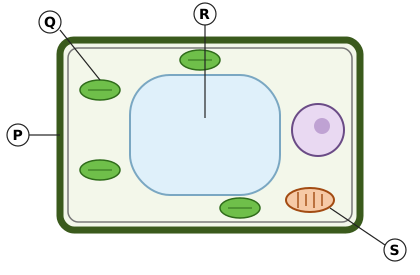
[2 marks]
(a)Namakan struktur P dan Q.Name structures P and Q.
Show answerHide answer
Tick each point you got.
[1 mark]
(b)Nyatakan satu fungsi R.State one function of R.
Show answerHide answer
Tick each point you got.
[1 mark]
(c)S menghasilkan ATP. Namakan proses yang berlaku di S untuk menghasilkan ATP.S produces ATP. Name the process in S that produces ATP.
Show answerHide answer
Tick each point you got.
[2 marks]
(d)Sel daripada akar pokok yang sama mempunyai struktur P, R dan S tetapi tidak mempunyai Q. Terangkan mengapa.A cell from the root of the same tree has P, R and S but does not have Q. Explain why.
Show answerHide answer
Tick each point you got.
22
Question 22
Seorang pelajar menguji empat sampel makanan, W, X, Y dan Z. Jadual 3 menunjukkan keputusan ujian itu. (Larutan Benedict dipanaskan dalam penangas air.)
A student tests four food samples, W, X, Y and Z. Table 3 shows the results of the tests. (Benedict's solution is heated in a water bath.)
| Sampel / Sample | Larutan Benedict / Benedict's solution | Larutan iodin / Iodine solution | Ujian emulsi etanol / Ethanol emulsion test |
|---|---|---|---|
| W | Kekal biru / Stays blue | Perang kekuningan / Brownish yellow | Jernih / Clear |
| X | Mendakan merah bata / Brick-red precipitate | Perang kekuningan / Brownish yellow | Jernih / Clear |
| Y | Kekal biru / Stays blue | Biru tua / Blue-black | Jernih / Clear |
| Z | Kekal biru / Stays blue | Perang kekuningan / Brownish yellow | Emulsi putih / White emulsion |
[1 mark]
(a)Sampel yang manakah mengandungi kanji?Which sample contains starch?
Show answerHide answer
Tick each point you got.
[1 mark]
(b)Sampel yang manakah mengandungi gula penurun?Which sample contains a reducing sugar?
Show answerHide answer
Tick each point you got.
[2 marks]
(c)Sampel Z mengandungi trigliserida. Namakan dua molekul yang terbebas apabila trigliserida dihidrolisiskan.Sample Z contains a triglyceride. Name the two kinds of molecule released when a triglyceride is hydrolysed.
Show answerHide answer
Tick each point you got.
[2 marks]
(d)Sampel W dididihkan dengan asid hidroklorik cair, dineutralkan, kemudian diuji semula dengan larutan Benedict. Mendakan merah bata terbentuk. Apakah yang terkandung dalam W dan terangkan keputusan itu.Sample W is boiled with dilute hydrochloric acid, neutralised, and then tested again with Benedict's solution. A brick-red precipitate forms. What does W contain? Explain the result.
Show answerHide answer
Tick each point you got.
23
Question 23
Rajah 2 menunjukkan tiga sel, W, X dan Y, daripada hujung akar sejenis tumbuhan (2n = 4) yang sedang menjalani mitosis. Sel-sel itu tidak disusun mengikut urutan.Diagram 2 shows three cells, W, X and Y, from the root tip of a plant (2n = 4) undergoing mitosis. The cells are not in order.
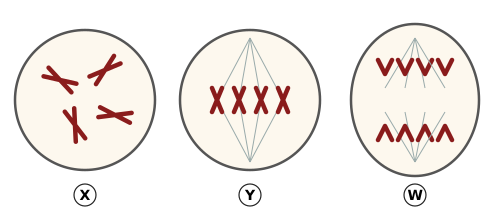
[1 mark]
(a)Namakan peringkat mitosis dalam sel W.Name the stage of mitosis in cell W.
Show answerHide answer
Tick each point you got.
[1 mark]
(b)Susun W, X dan Y mengikut urutan yang betul.Arrange W, X and Y in the correct order.
Show answerHide answer
Tick each point you got.
[2 marks]
(c)Terangkan apa yang berlaku kepada gentian gelendong dalam sel W.Describe what happens to the spindle fibres in cell W.
Show answerHide answer
Tick each point you got.
[2 marks]
(d)Berapakah bilangan kromosom dalam setiap sel anak yang terhasil daripada sel ini? Mengapakah bilangan itu sama dengan sel induk?How many chromosomes are there in each daughter cell formed from this cell? Why is the number the same as in the parent cell?
Show answerHide answer
Tick each point you got.
[1 mark]
(e)Selepas telofasa, sitoplasma sel tumbuhan membahagi. Namakan proses ini dan struktur yang terbentuk di tengah-tengah sel.After telophase the cytoplasm of the plant cell divides. Name this process and the structure that forms in the middle of the cell.
Show answerHide answer
Tick each point you got.
24
Question 24
Jadual 4 menunjukkan tekanan separa oksigen dan karbon dioksida di beberapa tempat dalam badan seorang pendaki yang sihat.
Table 4 shows the partial pressures of oxygen and carbon dioxide at some sites in the body of a healthy climber.
| Tempat / Site | Tekanan separa O₂ / Partial pressure of O₂ (mm Hg) | Tekanan separa CO₂ / Partial pressure of CO₂ (mm Hg) |
|---|---|---|
| Udara dalam alveolus / Air in the alveolus | 105 | 40 |
| Darah dalam arteri pulmonari / Blood in the pulmonary artery | 40 | 46 |
| Darah dalam vena pulmonari / Blood in the pulmonary vein | 100 | 40 |
[1 mark]
(a)Tekanan atmosfera pada aras laut ialah 760 mm Hg dan udara mengandungi 21% oksigen. Hitung tekanan separa oksigen dalam udara yang disedut pada aras laut.Atmospheric pressure at sea level is 760 mm Hg and air contains 21% oxygen. Calculate the partial pressure of oxygen in the air breathed in at sea level.
Show answerHide answer
Tick each point you got.
[2 marks]
(b)Berdasarkan Jadual 4, nyatakan arah resapan oksigen di alveolus dan terangkan mengapa oksigen bergerak ke arah itu.Based on Table 4, state the direction of diffusion of oxygen at the alveolus and explain why oxygen moves in that direction.
Show answerHide answer
Tick each point you got.
[1 mark]
(c)Namakan sebatian yang terbentuk apabila oksigen bergabung dengan hemoglobin dalam eritrosit.Name the compound formed when oxygen combines with haemoglobin in the erythrocyte.
Show answerHide answer
Tick each point you got.
[1 mark]
(d)Dalam bentuk apakah kebanyakan karbon dioksida diangkut dalam darah dari tisu ke peparu?In which form is most of the carbon dioxide carried in the blood from the tissues to the lungs?
Show answerHide answer
Tick each point you got.
[2 marks]
(e)Pendaki itu sampai di sebuah kem pada ketinggian di mana tekanan atmosfera ialah 450 mm Hg. Hitung tekanan separa oksigen di kem itu dan terangkan mengapa dia berasa semput.The climber reaches a camp at a height where atmospheric pressure is 450 mm Hg. Calculate the partial pressure of oxygen at the camp and explain why he feels breathless.
Show answerHide answer
Tick each point you got.
25
Question 25
Rajah 3 menunjukkan keratan jantung manusia dilihat dari hadapan. P, Q, R dan S ialah ruang jantung, manakala T dan U ialah salur darah.Diagram 3 shows a section of the human heart seen from the front. P, Q, R and S are chambers of the heart, while T and U are blood vessels.
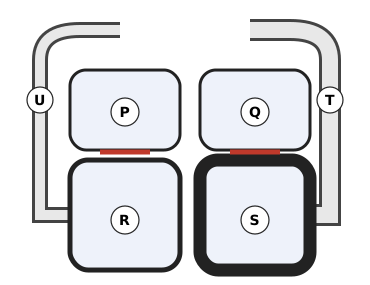
[2 marks]
(a)Namakan ruang P dan ruang S.Name chamber P and chamber S.
Show answerHide answer
Tick each point you got.
[1 mark]
(b)Namakan injap yang terletak di antara ruang Q dan ruang S.Name the valve between chamber Q and chamber S.
Show answerHide answer
Tick each point you got.
[1 mark]
(c)Namakan salur darah T dan nyatakan jenis darah yang diangkutnya.Name blood vessel T and state the type of blood it carries.
Show answerHide answer
Tick each point you got.
[2 marks]
(d)Dinding S lebih tebal daripada dinding R. Terangkan mengapa.The wall of S is thicker than the wall of R. Explain why.
Show answerHide answer
Tick each point you got.
[1 mark]
(e)Di manakah denyutan jantung bermula? Namakan struktur itu.Where does each heartbeat start? Name the structure.
Show answerHide answer
Tick each point you got.
[1 mark]
(f)Bunyi “lub” yang didengar menggunakan stetoskop disebabkan oleh peristiwa apa?What causes the “lub” sound heard through a stethoscope?
Show answerHide answer
Tick each point you got.
26
Question 26
Seorang murid tersentuh cerek panas di dapur dan serta-merta menarik tangannya. Selepas beberapa saat, dia berasa sakit.A student touches a hot kettle in the kitchen and at once pulls her hand away. A few seconds later she feels pain.
[1 mark]
(a)Apakah jenis tindakan yang berlaku apabila dia menarik tangannya dengan cepat?What type of action happens when she pulls her hand away quickly?
Show answerHide answer
Tick each point you got.
[2 marks]
(b)Tulis laluan impuls dalam arka refleks itu bermula daripada reseptor sehingga efektor.Write the pathway of the impulse in the reflex arc, from the receptor to the effector.
Show answerHide answer
Tick each point you got.
[1 mark]
(c)Mengapakah dia hanya berasa sakit selepas menarik tangannya?Why does she feel the pain only after she has pulled her hand away?
Show answerHide answer
Tick each point you got.
[1 mark]
(d)Nyatakan kepentingan tindakan refleks kepada murid itu.State the importance of a reflex action to the student.
Show answerHide answer
Any 1 points
Tick each point you got.
[1 mark]
(e)Impuls merentasi sinaps antara neuron deria dengan neuron geganti. Namakan bahan kimia yang merentasi sinaps itu.The impulse crosses the synapse between the sensory neurone and the relay neurone. Name the chemical that crosses the synapse.
Show answerHide answer
Tick each point you got.
[2 marks]
(f)Terangkan mengapa impuls hanya bergerak dalam satu arah merentasi sinaps.Explain why the impulse travels in one direction only across a synapse.
Show answerHide answer
Tick each point you got.
27
Question 27
Jadual 5 menunjukkan purata ketumpatan tulang bagi sekumpulan lelaki dan wanita pada umur yang berlainan.
Table 5 shows the mean bone density of a group of men and women at different ages.
| Umur (tahun) / Age (years) | Wanita / Women (g cm⁻²) | Lelaki / Men (g cm⁻²) |
|---|---|---|
| 20 | 1.20 | 1.30 |
| 40 | 1.15 | 1.28 |
| 60 | 0.95 | 1.18 |
| 80 | 0.70 | 1.00 |
[2 marks]
(a)Hitung peratusan penurunan ketumpatan tulang wanita daripada umur 40 tahun kepada 60 tahun.Calculate the percentage decrease in the bone density of the women from the age of 40 to 60 years.
Show answerHide answer
Tick each point you got.
[2 marks]
(b)Bandingkan perubahan ketumpatan tulang lelaki dengan wanita dari umur 20 hingga 80 tahun.Compare the change in bone density of men with that of women from age 20 to 80 years.
Show answerHide answer
Tick each point you got.
[2 marks]
(c)Terangkan mengapa ketumpatan tulang wanita menurun dengan lebih cepat selepas umur 40 tahun.Explain why the bone density of women falls faster after the age of 40 years.
Show answerHide answer
Tick each point you got.
[1 mark]
(d)Namakan penyakit tulang yang mungkin dialami oleh wanita berumur 80 tahun itu.Name the bone disorder that the 80-year-old women may suffer from.
Show answerHide answer
Tick each point you got.
[1 mark]
(e)Cadangkan satu amalan gaya hidup yang boleh dilakukan oleh seorang wanita muda untuk mengurangkan risiko ini, dengan sebab.Suggest one lifestyle practice that a young woman can follow to reduce this risk, with a reason.
Show answerHide answer
Any 1 points
Tick each point you got.
Bahagian CSection C
30 marksJawab semua soalan. Tulis jawapan anda di ruang yang disediakan.Answer all questions. Write your answers in the spaces provided.
28
Question 28
Sebuah syarikat membangunkan serbuk pencuci yang mengandungi enzim protease untuk menanggalkan kesan telur dan darah pada pakaian. Dua jenis protease, P dan Q, diuji pada suhu yang berlainan. Rajah 4 menunjukkan keputusannya.A company develops a washing powder that contains a protease enzyme to remove egg and blood stains from clothes. Two protease enzymes, P and Q, are tested at different temperatures. Diagram 4 shows the results.
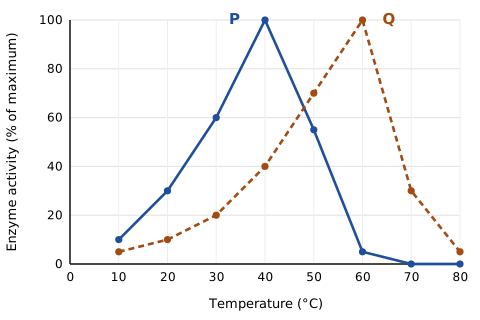
[2 marks]
(a)Apakah maksud enzim?What is meant by an enzyme?
Show answerHide answer
Tick each point you got.
[2 marks]
(b)Enzim protease tidak menanggalkan kesan kanji daripada nasi. Terangkan mengapa.The protease enzyme does not remove stains of starch from rice. Explain why.
Show answerHide answer
Tick each point you got.
[2 marks]
(c)Berdasarkan Rajah 4, nyatakan suhu optimum bagi enzim P dan enzim Q.Based on Diagram 4, state the optimum temperature of enzyme P and of enzyme Q.
Show answerHide answer
Tick each point you got.
[3 marks]
(d)Terangkan perubahan aktiviti enzim P apabila suhu naik daripada 40 °C kepada 60 °C.Explain the change in the activity of enzyme P when the temperature rises from 40 °C to 60 °C.
Show answerHide answer
Tick each point you got.
[3 marks]
(e)Bandingkan katabolisme dengan anabolisme. Nyatakan dua perbezaan dan satu contoh bagi setiap satu.Compare catabolism with anabolism. State two differences and one example of each.
Show answerHide answer
Tick each point you got.
[3 marks]
(f)Serbuk pencuci itu akan digunakan dalam mesin basuh pada suhu 30 °C. Berdasarkan Rajah 4, pilih enzim yang lebih sesuai dan berikan sebab untuk pilihan anda. Cadangkan juga satu perubahan pada kaedah mencuci supaya serbuk itu berfungsi lebih baik.The washing powder will be used in washing machines at 30 °C. Based on Diagram 4, choose the more suitable enzyme and give reasons for your choice. Also suggest one change to the washing method so that the powder works better.
Show answerHide answer
Tick each point you got.
29
Question 29
Seorang murid mengkaji pencernaan protein. Dia memasukkan 5 ml ampaian albumen yang keruh dan 1 ml larutan pepsin ke dalam tiga tabung uji, P, Q dan R, yang mempunyai pH 2, pH 7 dan pH 10. Ketiga-tiga tabung dikekalkan pada 37 °C selama 20 minit. Rajah 5 menunjukkan keputusannya.A student studies the digestion of protein. She puts 5 ml of cloudy albumen suspension and 1 ml of pepsin solution into three test tubes, P, Q and R, at pH 2, pH 7 and pH 10. All three tubes are kept at 37 °C for 20 minutes. Diagram 5 shows the results.
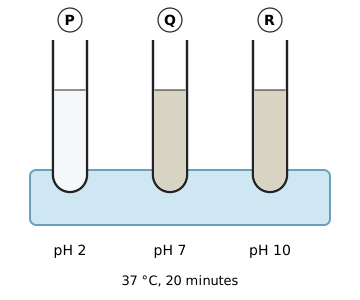
[2 marks]
(a)Nyatakan inferens daripada keputusan dalam Rajah 5.State the inference from the results in Diagram 5.
Show answerHide answer
Tick each point you got.
[2 marks]
(b)Di bahagian manakah dalam salur pencernaan pepsin berfungsi dan bagaimanakah pH yang sesuai dihasilkan di situ?In which part of the alimentary canal does pepsin work, and how is the suitable pH produced there?
Show answerHide answer
Tick each point you got.
[11 marks]
(c)Tripsin ialah enzim yang dirembeskan oleh pankreas dan berfungsi dalam duodenum. Seorang murid membuat hipotesis bahawa tripsin berfungsi paling baik dalam medium beralkali. Rekakan satu eksperimen untuk menguji hipotesis ini. Jawapan anda mesti mengandungi (i) hipotesis, (ii) pemboleh ubah, (iii) bahan dan radas, (iv) prosedur, (v) penjadualan data dan (vi) kesimpulan.Trypsin is an enzyme secreted by the pancreas that works in the duodenum. A student makes the hypothesis that trypsin works best in an alkaline medium. Design an experiment to test this hypothesis. Your answer must include (i) the hypothesis, (ii) the variables, (iii) the materials and apparatus, (iv) the procedure, (v) the tabulation of data and (vi) the conclusion.
Show answerHide answer
Aim: to study the effect of pH on the activity of trypsin. Hypothesis: trypsin digests albumen fastest in an alkaline medium. Manipulated: pH; responding: time for the albumen to turn clear; fixed: temperature (37 °C), volume and concentration of the enzyme and albumen. Method: three tubes of 5 ml albumen suspension with 2 ml buffer pH 4, 7 and 9; add 1 ml trypsin; keep in a water bath at 37 °C; time how long each tube takes to turn clear. Table: pH | time taken (min). Conclusion: shortest time at pH 9, so hypothesis accepted.
Tick each point you got.
Test specification (JSU)
| Chapter | Remembering | Understanding | Applying | Analysing | Evaluating | Creating | Items | marks |
|---|---|---|---|---|---|---|---|---|
| 1. Introduction to Biology and Laboratory Rules | 1 (1) | – | – | – | – | – | 1 | 1 |
| 2. Cell Biology and Organisation | – | 2 (7) | 1 (1) | – | – | – | 3 | 8 |
| 3. Movement of Substances across a Plasma Membrane | 1 (1) | – | – | 1 (1) | – | – | 2 | 2 |
| 4. Chemical Compositions in a Cell | 1 (1) | – | 1 (6) | – | – | – | 2 | 7 |
| 5. Metabolism and Enzymes | – | 2 (2) | – | – | 1 (15) | – | 3 | 17 |
| 6. Cell Division | – | – | – | 2 (8) | – | – | 2 | 8 |
| 7. Cellular Respiration | – | 1 (1) | – | – | – | – | 1 | 1 |
| 8. Respiratory Systems in Humans and Animals | – | – | 2 (8) | – | – | – | 2 | 8 |
| 9. Nutrition and the Human Digestive System | 1 (1) | – | 1 (1) | – | – | 1 (15) | 3 | 17 |
| 10. Transport in Humans and Animals | – | 2 (9) | – | 1 (1) | – | – | 3 | 10 |
| 11. Immunity in Humans | 1 (1) | – | – | – | – | – | 1 | 1 |
| 12. Coordination and Response in Humans | 1 (1) | 1 (8) | – | – | – | – | 2 | 9 |
| 13. Homeostasis and the Human Urinary System | – | – | 1 (1) | – | – | – | 1 | 1 |
| 14. Support and Movement in Humans and Animals | – | – | 1 (1) | 1 (8) | – | – | 2 | 9 |
| 15. Sexual Reproduction, Development and Growth in Humans and Animals | – | – | – | 1 (1) | – | – | 1 | 1 |
| Total | 6 (6) | 8 (27) | 7 (18) | 6 (19) | 1 (15) | 1 (15) | 29 | 100 |
Each cell shows items (marks).