Practice paper, not an official KPM paper
4551
Ujian Akhir Sesi AkademikEnd of Academic Session Test
BiologiBiology
Tingkatan 4, 2 jam 30 minit / 2 hours 30 minutes, 100 marks
Nama / Name
Kelas / Class
Tarikh / Date
Markah / Marks: / 100
Instructions
- Kertas soalan ini mengandungi tiga bahagian: Bahagian A, Bahagian B dan Bahagian C.This question paper consists of three sections: Section A, Section B and Section C.
- Jawab semua soalan.Answer all questions.
- Bahagian A: pilih satu jawapan bagi setiap soalan.Section A: choose one answer for each question.
- Bahagian B dan C: tulis jawapan anda di ruang yang disediakan. Kerja mengira mesti ditunjukkan.Sections B and C: write your answers in the spaces provided. Working must be shown for calculations.
- Rajah yang mengiringi soalan tidak dilukis mengikut skala kecuali dinyatakan.The diagrams in this paper are not drawn to scale unless stated.
- Kalkulator saintifik yang tidak boleh diprogramkan dibenarkan.A non-programmable scientific calculator is allowed.
Answer schemes are in English (DLP).
Practice shows answers as you go. Exam times you and hides answers until you submit.
Bahagian ASection A
20 marksJawab semua soalan. Setiap soalan diikuti oleh empat pilihan jawapan, A, B, C dan D. Pilih satu jawapan sahaja.Answer all questions. Each question is followed by four options, A, B, C and D. Choose one answer only.
1
Question 1
Seorang pelajar ingin mengetahui sama ada lebih banyak baja menjadikan pokok kacang buncis lebih tinggi. Apakah pemboleh ubah dimanipulasikan dalam penyiasatan ini?A student wants to find out whether more fertiliser makes bean plants grow taller. What is the manipulated variable in this investigation?
Show answerHide answer
B
The manipulated variable is the one the investigator changes on purpose: the amount of fertiliser. The height is the responding variable; seed type and volume of water are kept constant.
2
Question 2
Organel yang manakah mengandungi enzim pencernaan untuk menguraikan organel yang telah rosak dan bahan buangan dalam sel?Which organelle contains digestive enzymes to break down worn-out organelles and waste material in a cell?
Show answerHide answer
A
Lysosomes contain hydrolytic (digestive) enzymes. Ribosomes make protein, centrioles form the spindle in animal cells and the Golgi apparatus modifies and packages proteins.
3
Question 3
Sel asinus pankreas merembeskan enzim pencernaan protein ke dalam duodenum. Antara urutan berikut, yang manakah menunjukkan laluan enzim itu dari tempat sintesis hingga dirembeskan keluar sel?An acinar cell of the pancreas secretes a protein-digesting enzyme into the duodenum. Which sequence shows the path of the enzyme from where it is made until it leaves the cell?
Show answerHide answer
C
Proteins for export are made by ribosomes on the rough endoplasmic reticulum, pass to the Golgi apparatus for modification and packaging, and leave in secretory vesicles that fuse with the plasma membrane. Smooth ER does not carry ribosomes, and the Golgi apparatus does not make protein.
4
Question 4
Oksigen bergerak dari alveolus ke dalam darah dalam kapilari peparu. Apakah proses yang terlibat?Oxygen moves from an alveolus into the blood in a lung capillary. Which process is involved?
Show answerHide answer
D
Oxygen is a small non-polar molecule. It passes through the phospholipid bilayer down its concentration gradient by simple diffusion, without a carrier protein or energy.
5
Question 5
Seketul kentang berjisim 4.0 g direndam dalam larutan Y selama 45 minit. Jisimnya menjadi 3.4 g. Apakah kesimpulan yang boleh dibuat?A piece of potato of mass 4.0 g is placed in solution Y for 45 minutes. Its mass becomes 3.4 g. What can be concluded?
Show answerHide answer
B
The mass decreased by 0.6 g, so there was a net loss of water from the cells. Water moves by osmosis from the cell sap (higher water potential) to the stronger solution, so Y is hypertonic to the cell sap.
6
Question 6
Dua monosakarida yang manakah bergabung melalui kondensasi untuk membentuk sukrosa?Which two monosaccharides join by condensation to form sucrose?
Show answerHide answer
C
Sucrose = glucose + fructose. Maltose = glucose + glucose and lactose = glucose + galactose.
7
Question 7
Mengapakah enzim dikatakan bersifat spesifik?Why is an enzyme said to be specific?
Show answerHide answer
A
Specificity comes from the shape of the active site, which fits only its own substrate (lock and key hypothesis). Enzymes are not used up or changed in the reaction.
8
Question 8
Kadar tindak balas yang dimangkinkan oleh amilase meningkat dari 20 °C hingga 37 °C, kemudian jatuh dengan cepat kepada sifar pada 70 °C. Apakah yang menerangkan penurunan kadar itu?The rate of a reaction catalysed by amylase rises from 20 °C to 37 °C, then falls rapidly to zero at 70 °C. What explains the fall?
Show answerHide answer
D
Above the optimum temperature the enzyme is denatured: its three-dimensional shape, including the active site, is permanently changed. Heating increases (not decreases) kinetic energy, and enzymes are not used up.
9
Question 9
Sel soma sejenis tumbuhan mempunyai 12 kromosom (2n = 12). Berapakah bilangan kromatid dalam satu sel pada metafasa mitosis?A somatic cell of a plant has 12 chromosomes (2n = 12). How many chromatids are in one cell at metaphase of mitosis?
Show answerHide answer
C
DNA is replicated in the S phase, so each of the 12 chromosomes consists of two sister chromatids at metaphase: 12 × 2 = 24 chromatids.
10
Question 10
Di manakah piruvat dioksidakan sepenuhnya kepada karbon dioksida dan air semasa respirasi sel aerob?Where is pyruvic acid completely oxidised to carbon dioxide and water during aerobic cellular respiration?
Show answerHide answer
B
Glycolysis takes place in the cytoplasm; the complete oxidation of pyruvic acid with oxygen takes place in the mitochondria.
11
Question 11
Baris yang manakah menunjukkan perubahan semasa penghembusan nafas pada waktu rehat?Which row shows the changes in the diaphragm and thoracic cavity during exhalation at rest?
Show answerHide answer
A
In exhalation the diaphragm relaxes and arches upwards (and the ribs move down and in), so the thoracic volume decreases, the pressure inside rises above atmospheric pressure and air is forced out.
12
Question 12
Apakah peranan hempedu dalam pencernaan?What is the role of bile in digestion?
Show answerHide answer
D
Bile (made in the liver, stored in the gall bladder) has no enzymes. It emulsifies fats into tiny droplets, increasing the surface area for lipase. Lipase digests the lipids.
13
Question 13
Seorang pelajar kerap tidak bersarapan dan tidak makan tengah hari. Dia berasa sakit terbakar di perutnya dan doktor mendapati lapisan perutnya mengalami keradangan. Apakah keadaan yang paling mungkin dialaminya?A student often skips breakfast and lunch. She feels a burning pain in her stomach and the doctor finds that the stomach lining is inflamed. Which condition is most likely?
Show answerHide answer
B
Gastritis is inflammation of the stomach lining. It is caused when gastric juice acts on the lining of an empty stomach, for example in people who skip meals. Anorexia nervosa and bulimia nervosa are eating disorders about body weight, and muscle dysmorphia is a belief that one's body is too small.
14
Question 14
Salur darah yang manakah membawa darah beroksigen dari peparu ke jantung?Which blood vessel carries oxygenated blood from the lungs to the heart?
Show answerHide answer
C
The pulmonary vein is the exception that carries oxygenated blood to the left atrium. The pulmonary artery carries deoxygenated blood to the lungs; the vena cava returns deoxygenated blood from the body; the aorta carries oxygenated blood out of the left ventricle.
15
Question 15
Seorang pesakit berkumpulan darah B memerlukan pemindahan darah. Kumpulan darah penderma yang manakah selamat untuk pesakit itu?A patient of blood group B needs a blood transfusion. Which donor blood groups are safe for this patient?
Show answerHide answer
B
A group B patient has anti-A antibody in the plasma, so antigen A in the donor's red blood cells would cause agglutination. Groups B and O (no antigen A) are safe.
16
Question 16
Seorang kanak-kanak yang pernah menghidap cacar air jarang dijangkiti penyakit itu lagi. Apakah penjelasannya?A child who has had chickenpox rarely gets the disease again. What is the explanation?
Show answerHide answer
D
After the first infection, memory cells formed by lymphocytes remember the antigen. On the next exposure they produce antibodies immediately and in large amounts. Antibodies do not stay for ever and phagocytes are non-specific.
17
Question 17
Faizal menarik tangannya daripada periuk panas sebelum dia merasa kepanasan. Mengapakah hal ini berlaku?Faizal pulls his hand away from a hot pot before he feels the heat. Why does this happen?
Show answerHide answer
A
This is a reflex action. The reflex arc passes through the spinal cord (relay neurone to motor neurone to effector), so the response is made before the impulse reaches the cerebrum, which is why the pain is felt a moment later.
18
Question 18
Seorang murid meminum 1.5 liter air dengan cepat. Baris yang manakah menunjukkan perubahan yang betul dalam badannya?A student drinks 1.5 litres of water quickly. Which row shows the correct changes in the body?
Show answerHide answer
C
Drinking water lowers the osmotic pressure of the blood. Osmoreceptors in the hypothalamus are less stimulated, less ADH is secreted, the distal tubule and collecting duct become less permeable to water and a large volume of dilute urine is passed.
19
Question 19
Lutut dan siku ialah sendi engsel. Pernyataan yang manakah menerangkan pergerakan pada sendi engsel?The knee and the elbow are hinge joints. Which statement describes the movement at a hinge joint?
Show answerHide answer
D
A hinge joint is a freely movable joint that moves in one plane only (bending and straightening). A ball-and-socket joint (shoulder, hip) rotates in all directions.
20
Question 20
Struktur manakah dalam testis yang menghasilkan sel sperma melalui meiosis?Which structure in the testis produces sperm cells by meiosis?
Show answerHide answer
A
Sperm are made (spermatogenesis) in the seminiferous tubules. The epididymis stores and matures them, the vas deferens carries them, and the prostate gland adds fluid to semen.
Bahagian BSection B
50 marksJawab semua soalan dalam bahagian ini.Answer all questions in this section.
21
Question 21
Lima jalur kentang yang sama panjang (5.0 cm) direndam dalam larutan sukrosa yang berlainan kepekatan selama 30 minit. Jadual menunjukkan panjang akhir jalur kentang itu.
Five potato strips, each 5.0 cm long, are placed for 30 minutes in sucrose solutions of different concentrations. The table shows the final length of each strip.
| Kepekatan sukrosa / Sucrose concentration (M) | 0.0 | 0.2 | 0.4 | 0.6 | 0.8 |
|---|---|---|---|---|---|
| Panjang akhir / Final length (cm) | 5.4 | 5.2 | 5.0 | 4.7 | 4.5 |
[1 mark]
(a)Kepekatan sukrosa yang manakah isotonik dengan sap sel kentang? Beri sebab.Which sucrose concentration is isotonic to the potato cell sap? Give a reason.
Show answerHide answer
Tick each point you got.
[1 mark]
(b)Terangkan mengapa jalur kentang dalam 0.0 M menjadi lebih panjang.Explain why the strip in 0.0 M becomes longer.
Show answerHide answer
Tick each point you got.
[2 marks]
(c)Terangkan keputusan dalam larutan 0.8 M.Explain the result in the 0.8 M solution.
Show answerHide answer
Tick each point you got.
[1 mark]
(d)Hitung peratus perubahan panjang jalur kentang dalam larutan 0.6 M.Calculate the percentage change in length of the strip in the 0.6 M solution.
Show answerHide answer
Tick each point you got.
[1 mark]
(e)Nyatakan satu pemboleh ubah yang dimalarkan dalam eksperimen ini.State one variable that is kept constant in this experiment.
Show answerHide answer
Tick each point you got.
22
Question 22
Rajah 1 menunjukkan satu sel haiwan yang sedang menjalani mitosis.Diagram 1 shows an animal cell undergoing mitosis.
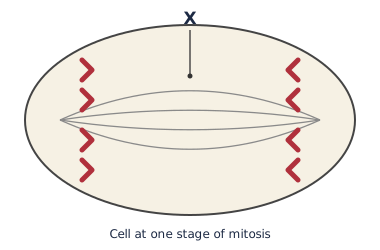
[1 mark]
(a)Namakan peringkat mitosis dalam Rajah 1.Name the stage of mitosis in Diagram 1.
Show answerHide answer
Tick each point you got.
[1 mark]
(b)Namakan struktur X.Name structure X.
Show answerHide answer
Tick each point you got.
[2 marks]
(c)Berapakah bilangan kromosom dalam satu sel soma organisma ini apabila sel itu tidak sedang membahagi? Terangkan jawapan anda.How many chromosomes are in a somatic cell of this organism when the cell is not dividing? Explain your answer.
Show answerHide answer
Tick each point you got.
[1 mark]
(d)Nyatakan satu peristiwa yang berlaku pada peringkat seterusnya.State one event that happens in the next stage.
Show answerHide answer
Tick each point you got.
[1 mark]
(e)Terangkan mengapa dua sel anak mempunyai kandungan genetik yang sama dengan sel induk.Explain why the two daughter cells have the same genetic content as the parent cell.
Show answerHide answer
Tick each point you got.
23
Question 23
Seorang pembuat roti mencampurkan yis, gula, tepung dan air suam, lalu membiarkan doh itu selama satu jam. Doh itu mengembang dua kali ganda dan berbau alkohol.A baker mixes yeast, sugar, flour and warm water and leaves the dough for one hour. The dough doubles in size and smells of alcohol.
[1 mark]
(a)Namakan proses yang dijalankan oleh yis dalam doh itu.Name the process carried out by the yeast in the dough.
Show answerHide answer
Tick each point you got.
[2 marks]
(b)Tulis persamaan perkataan bagi proses ini.Write the word equation for this process.
Show answerHide answer
Tick each point you got.
[1 mark]
(c)Mengapakah doh itu mengembang?Why does the dough rise?
Show answerHide answer
Tick each point you got.
[1 mark]
(d)Roti yang telah dibakar tidak berbau alkohol. Mengapa?The baked bread does not smell of alcohol. Why?
Show answerHide answer
Tick each point you got.
[1 mark]
(e)Nyatakan satu perbezaan antara proses ini dengan respirasi anaerob dalam sel otot manusia.State one difference between this process and anaerobic respiration in human muscle cells.
Show answerHide answer
Tick each point you got.
[1 mark]
(f)Namakan satu makanan yang dihasilkan melalui fermentasi asid laktik.Name one food made by lactic acid fermentation.
Show answerHide answer
Tick each point you got.
24
Question 24
Hadi terpijak paku berkarat dan kulit tapak kakinya terluka. Beberapa jam kemudian kawasan luka itu menjadi merah dan bengkak. Pada hari berikutnya, nodus limfa di pangkal pehanya membengkak dan Hadi demam.Hadi steps on a rusty nail and the skin of his foot is cut. A few hours later the area around the wound is red and swollen. The next day, the lymph nodes in his groin are swollen and he has a fever.
[1 mark]
(a)Namakan bahan kimia yang dibebaskan oleh tisu yang rosak menyebabkan kapilari darah melebar.Name the chemical released by the damaged tissue that causes the blood capillaries to widen.
Show answerHide answer
Tick each point you got.
[1 mark]
(b)Terangkan mengapa kawasan luka menjadi merah.Explain why the wound area turns red.
Show answerHide answer
Tick each point you got.
[2 marks]
(c)Huraikan bagaimana fagosit memusnahkan bakteria yang memasuki luka itu.Describe how a phagocyte destroys the bacteria that enter the wound.
Show answerHide answer
Tick each point you got.
[1 mark]
(d)Antara pertahanan badan yang berikut, yang manakah ialah barisan pertahanan kedua?Which of the following is the second line of defence?
Show answerHide answer
Phagocytosis
The second line of defence is fever, phagocytosis and inflammation. Skin is the first line; memory cells belong to the third line.
[1 mark]
(e)Mengapakah nodus limfa Hadi membengkak?Why are Hadi's lymph nodes swollen?
Show answerHide answer
Tick each point you got.
[1 mark]
(f)Hadi diberi suntikan vaksin tetanus. Namakan jenis imuniti yang diperoleh.Hadi is given a tetanus vaccine injection. Name the type of immunity gained.
Show answerHide answer
Tick each point you got.
25
Question 25
Rajah 2 menunjukkan paras glukosa darah dua orang, P dan Q, selepas mereka makan hidangan yang sama pada minit 0. Julat normal glukosa darah ialah 75 mg hingga 110 mg per 100 ml.Diagram 2 shows the blood glucose level of two people, P and Q, after they eat the same meal at time 0. The normal range of blood glucose is 75 mg to 110 mg per 100 ml.
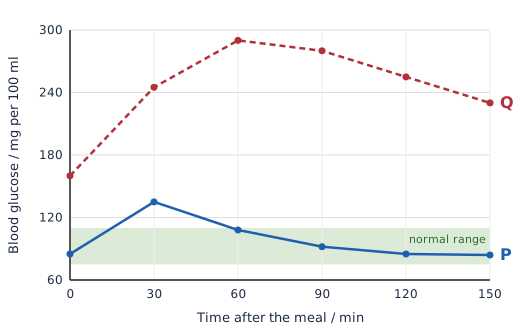
[1 mark]
(a)Nyatakan paras glukosa darah P yang tertinggi dan masa ia dicapai.State the highest blood glucose level of P and the time it is reached.
Show answerHide answer
Tick each point you got.
[2 marks]
(b)Terangkan bagaimana paras glukosa darah P kembali normal antara minit 30 dengan minit 90.Explain how the blood glucose level of P returns to normal between 30 and 90 minutes.
Show answerHide answer
Tick each point you got.
[1 mark]
(c)Namakan jenis mekanisme yang mengembalikan paras glukosa P kepada julat normal.Name the type of mechanism that returns the glucose level of P to the normal range.
Show answerHide answer
Tick each point you got.
[1 mark]
(d)Antara P dan Q, siapakah yang mungkin menghidap diabetes mellitus? Beri satu sebab daripada graf.Which of P and Q is likely to have diabetes mellitus? Give one reason from the graph.
Show answerHide answer
Tick each point you got.
[2 marks]
(e)Terangkan mengapa paras glukosa darah Q kekal tinggi.Explain why the blood glucose level of Q stays high.
Show answerHide answer
Tick each point you got.
[1 mark]
(f)Namakan hormon dan sel pankreas yang bertindak apabila paras glukosa darah jatuh di bawah julat normal.Name the hormone and the pancreas cells that act when the blood glucose level falls below the normal range.
Show answerHide answer
Tick each point you got.
26
Question 26
Jadual menunjukkan ciri-ciri tiga jenis vertebra, P, Q dan R, daripada tulang belakang manusia.
The table shows the features of three types of vertebrae, P, Q and R, from the human vertebral column.
| Vertebra / Vertebra | Ciri / Features |
|---|---|
| P | Paling besar dan kuat; sentrum yang besar; cuaran spina yang pendek / Largest and strongest; large centrum; short spinous process |
| Q | Sentrum kecil; sepasang foramen melintang / Small centrum; a pair of transverse foramina |
| R | Cuaran spina yang panjang; ada muka sendi untuk bersendi dengan tulang rusuk / Long spinous process; facets for joining with ribs |
[3 marks]
(a)Namakan vertebra P, Q dan R.Name vertebrae P, Q and R.
Show answerHide answer
Tick each point you got.
[1 mark]
(b)Mengapakah vertebra P mempunyai sentrum yang besar?Why does vertebra P have a large centrum?
Show answerHide answer
Tick each point you got.
[1 mark]
(c)Nyatakan fungsi salur saraf dalam setiap vertebra.State the function of the neural canal in each vertebra.
Show answerHide answer
Tick each point you got.
[2 marks]
(d)Aini membengkokkan lengannya untuk mengangkat sebuah beg. Nyatakan keadaan otot biseps dan otot triseps, dan tulang yang ditarik ke atas.Aini bends her arm to lift a bag. State the condition of the biceps and the triceps, and the bone that is pulled upwards.
Show answerHide answer
Tick each point you got.
[1 mark]
(e)Namakan struktur yang menghubungkan otot rangka kepada tulang.Name the structure that joins a skeletal muscle to a bone.
Show answerHide answer
Tick each point you got.
27
Question 27
Jadual menunjukkan organel dalam tiga jenis sel, X, Y dan Z.
The table shows the organelles in three types of cells, X, Y and Z.
| Sel / Cell | Jenis sel / Cell type | Organel yang menonjol / Prominent organelles |
|---|---|---|
| X | Sel kelenjar air liur / Salivary gland cell | Jalinan endoplasma kasar yang banyak, jasad Golgi yang besar / Abundant rough endoplasmic reticulum, large Golgi apparatus |
| Y | Sel palisad daun / Leaf palisade cell | Banyak kloroplas, dinding sel, vakuol yang besar / Many chloroplasts, cell wall, large vacuole |
| Z | Sel otot terbang burung / Bird flight muscle cell | Sangat banyak mitokondrion / Very many mitochondria |
[2 marks]
(a)Antara X, Y dan Z, yang manakah sel tumbuhan? Beri satu bukti.Which of X, Y and Z is a plant cell? Give one piece of evidence.
Show answerHide answer
Tick each point you got.
[2 marks]
(b)Terangkan mengapa sel X mempunyai jalinan endoplasma kasar dan jasad Golgi yang banyak.Explain why cell X has abundant rough endoplasmic reticulum and Golgi apparatus.
Show answerHide answer
Tick each point you got.
[2 marks]
(c)Terangkan mengapa sel Z mempunyai mitokondrion yang sangat banyak.Explain why cell Z has very many mitochondria.
Show answerHide answer
Tick each point you got.
[1 mark]
(d)Sekumpulan sel yang serupa seperti Z yang bekerja bersama membentuk apa?A group of similar cells like Z working together forms what?
Show answerHide answer
Tick each point you got.
[1 mark]
(e)Susun tahap organisasi berikut daripada yang terkecil kepada yang terbesar: organ, sel, sistem organ, tisu.Arrange the following levels of organisation from the smallest to the largest: organ, cell, organ system, tissue.
Show answerHide answer
Tick each point you got.
Bahagian CSection C
30 marksJawab semua soalan dalam bahagian ini.Answer all questions in this section.
28
Question 28
Rajah 3 menunjukkan lengkung refleks apabila jari seseorang tertusuk duri.Diagram 3 shows the reflex arc when a person's finger is pricked by a thorn.
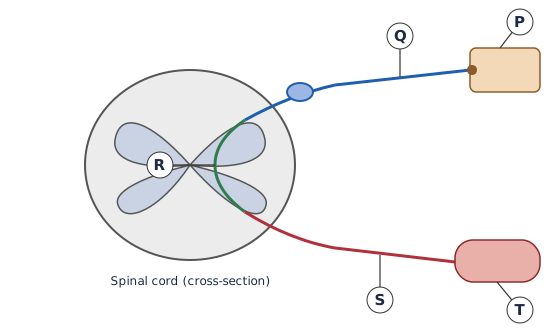
[5 marks]
(a)Namakan struktur P, Q, R, S dan T.Name structures P, Q, R, S and T.
Show answerHide answer
Tick each point you got.
[2 marks]
(b)Terangkan mengapa tindak balas refleks berlaku lebih cepat daripada tindakan sedar, dan mengapa ia penting.Explain why a reflex response is faster than a conscious action, and why it is important.
Show answerHide answer
Tick each point you got.
[2 marks]
(c)Terangkan mengapa impuls hanya bergerak dalam satu arah merentasi sinaps antara neuron Q dengan neuron R.Explain why an impulse travels in one direction only across the synapse between neurone Q and neurone R.
Show answerHide answer
Tick each point you got.
[3 marks]
(d)Bandingkan tindakan sukarela dengan tindakan tak sukarela dengan memberi tiga perbezaan.Compare voluntary action and involuntary action by giving three differences.
Show answerHide answer
Tick each point you got.
[3 marks]
(e)Seorang lelaki mengalami kecederaan pada saraf tunjang di bahagian dadanya dalam satu kemalangan jalan raya. Dia tidak dapat merasa dan menggerakkan kakinya, tetapi apabila doktor mengetuk tendon di bawah lututnya, kakinya masih terhayun. Terangkan ketiga-tiga pemerhatian ini.A man's spinal cord is injured at chest level in a road accident. He cannot feel or move his legs, but when the doctor taps the tendon below his knee, his lower leg still kicks. Explain all three observations.
Show answerHide answer
Tick each point you got.
29
Question 29
Encik Hamdan, 52 tahun, telah menghidap diabetes mellitus selama 12 tahun dan mempunyai tekanan darah tinggi. Dia mengalami bengkak kaki dan sentiasa letih. Jadual 1 menunjukkan keputusan ujian doktor. Jadual 2 menunjukkan paras urea dalam darahnya sebelum dan selepas satu sesi hemodialisis.
Encik Hamdan, aged 52, has had diabetes mellitus for 12 years and has high blood pressure. His feet are swollen and he is always tired. Table 1 shows the results of his doctor's tests. Table 2 shows the urea level in his blood before and after one haemodialysis session.
| Ujian / Test | Julat normal / Normal | Encik Hamdan |
|---|---|---|
| Urea darah / Blood urea (mmol/L) | 2.5 – 7.5 | 28 |
| Protein dalam air kencing / Protein in urine | Tiada / Absent | Ada / Present |
| Isi padu air kencing / Urine volume (ml per hari) | 1200 – 1500 | 350 |
| Masa / Time | Urea darah / Blood urea (mmol/L) |
|---|---|
| Sebelum sesi / Before the session | 28 |
| Selepas 4 jam hemodialisis / After 4 hours of haemodialysis | 9 |
| Dua hari kemudian / Two days later | 24 |
[1 mark]
(a)Namakan struktur dalam nefron yang rosak sehingga membolehkan protein hadir dalam air kencing.Name the structure in the nephron that is damaged so that protein appears in the urine.
Show answerHide answer
Tick each point you got.
[2 marks]
(b)Terangkan mengapa protein biasanya tidak hadir dalam air kencing.Explain why protein is normally absent from urine.
Show answerHide answer
Tick each point you got.
[2 marks]
(c)Terangkan mengapa paras urea dalam darah Encik Hamdan tinggi.Explain why the urea level in Encik Hamdan's blood is high.
Show answerHide answer
Tick each point you got.
[2 marks]
(d)Nyatakan dua penyebab kegagalan buah pinggang Encik Hamdan.State two causes of Encik Hamdan's kidney failure.
Show answerHide answer
Tick each point you got.
[2 marks]
(e)Hitung peratus penurunan urea darah selepas satu sesi hemodialisis 4 jam. Tunjukkan kerja anda.Calculate the percentage decrease in blood urea after one 4-hour haemodialysis session. Show your working.
Show answerHide answer
Tick each point you got.
[2 marks]
(f)Terangkan mengapa paras urea meningkat semula dalam tempoh dua hari selepas sesi itu.Explain why the urea level rises again within two days after the session.
Show answerHide answer
Tick each point you got.
[4 marks]
(g)Doktor mencadangkan dua pilihan rawatan jangka panjang: hemodialisis tiga kali seminggu atau pemindahan buah pinggang. Nilaikan kedua-dua pilihan dan nyatakan pilihan yang anda cadangkan dengan satu sebab.The doctor suggests two long-term treatments: haemodialysis three times a week, or a kidney transplant. Evaluate both options and state which you would recommend, with a reason.
Show answerHide answer
Tick each point you got.
Test specification (JSU)
| Chapter | Remembering | Understanding | Applying | Analysing | Evaluating | Creating | Items | marks |
|---|---|---|---|---|---|---|---|---|
| 1. Introduction to Biology and Laboratory Rules | – | – | 1 (1) | – | – | – | 1 | 1 |
| 2. Cell Biology and Organisation | 1 (1) | 1 (8) | – | 1 (1) | – | – | 3 | 10 |
| 3. Movement of Substances across a Plasma Membrane | – | 1 (1) | 1 (6) | 1 (1) | – | – | 3 | 8 |
| 4. Chemical Compositions in a Cell | 1 (1) | – | – | – | – | – | 1 | 1 |
| 5. Metabolism and Enzymes | – | 1 (1) | 1 (1) | – | – | – | 2 | 2 |
| 6. Cell Division | – | – | 1 (1) | 1 (6) | – | – | 2 | 7 |
| 7. Cellular Respiration | 1 (1) | 1 (7) | – | – | – | – | 2 | 8 |
| 8. Respiratory Systems in Humans and Animals | – | – | – | 1 (1) | – | – | 1 | 1 |
| 9. Nutrition and the Human Digestive System | – | 1 (1) | 1 (1) | – | – | – | 2 | 2 |
| 10. Transport in Humans and Animals | 1 (1) | – | 1 (1) | – | – | – | 2 | 2 |
| 11. Immunity in Humans | – | 2 (8) | – | – | – | – | 2 | 8 |
| 12. Coordination and Response in Humans | – | 1 (1) | – | – | 1 (15) | – | 2 | 16 |
| 13. Homeostasis and the Human Urinary System | – | – | – | 2 (9) | 1 (15) | – | 3 | 24 |
| 14. Support and Movement in Humans and Animals | 2 (9) | – | – | – | – | – | 2 | 9 |
| 15. Sexual Reproduction, Development and Growth in Humans and Animals | 1 (1) | – | – | – | – | – | 1 | 1 |
| Total | 7 (14) | 8 (27) | 6 (11) | 6 (18) | 2 (30) | 0 (0) | 29 | 100 |
Each cell shows items (marks).