Practice paper, not an official KPM paperKertas latihan, bukan kertas rasmi KPM
4551
Ujian Akhir Sesi AkademikEnd of Academic Session Test
BiologiBiology
Tingkatan 4, 2 jam 30 minit / 2 hours 30 minutes, 100 marksmarkah
Nama / NameNama
Kelas / ClassKelas
Tarikh / DateTarikh
Markah / marksmarkah: / 100
InstructionsArahan
- Kertas soalan ini mengandungi tiga bahagian: Bahagian A, Bahagian B dan Bahagian C.This question paper consists of three sections: Section A, Section B and Section C.
- Jawab semua soalan.Answer all questions.
- Bahagian A: pilih satu jawapan bagi setiap soalan.Section A: choose one answer for each question.
- Bahagian B dan C: tulis jawapan anda di ruang yang disediakan. Kerja mengira mesti ditunjukkan.Sections B and C: write your answers in the spaces provided. Working must be shown for calculations.
- Rajah yang mengiringi soalan tidak dilukis mengikut skala kecuali dinyatakan.The diagrams in this paper are not drawn to scale unless stated.
- Kalkulator saintifik yang tidak boleh diprogramkan dibenarkan.A non-programmable scientific calculator is allowed.
Answer schemes are in English (DLP).Skema jawapan dalam Bahasa Inggeris (DLP).
Practice shows answers as you go. Exam times you and hides answers until you submit.Latihan menunjukkan jawapan semasa menjawab. Peperiksaan menetapkan masa dan menyembunyikan jawapan sehingga dihantar.
Bahagian ASection A
20 marksmarkahJawab semua soalan. Setiap soalan diikuti oleh empat pilihan jawapan, A, B, C dan D. Pilih satu jawapan sahaja.Answer all questions. Each question is followed by four options, A, B, C and D. Choose one answer only.
1
QuestionSoalan 1
Sebelum menjalankan eksperimen, seorang pelajar menulis, "Semakin banyak cahaya matahari yang diterima oleh sebatang pokok, semakin banyak kanji yang dihasilkan." Apakah pernyataan ini?Before an experiment, a student writes, "The more sunlight a plant receives, the more starch it makes." What is this statement?
Show answerTunjuk jawapanHide answerSembunyi jawapan
A
A hypothesis is a statement that predicts the relationship between the manipulated and responding variables and is tested by the experiment. A conclusion is written after the results are analysed; an observation is something seen or measured.
2
QuestionSoalan 2
Struktur manakah memberikan bentuk tetap kepada sel tumbuhan dan menghalangnya daripada pecah dalam larutan hipotonik?Which structure gives a plant cell a fixed shape and stops it from bursting in a hypotonic solution?
Show answerTunjuk jawapanHide answerSembunyi jawapan
B
The cell wall is made of cellulose and is strong and rigid. It resists the pressure of the water that enters the cell, so the cell becomes turgid and does not burst. The plasma membrane is thin and elastic.
3
QuestionSoalan 3
Sel P ialah kubus bersisi 2 µm dan sel Q ialah kubus bersisi 4 µm. Bagaimanakah nisbah luas permukaan kepada isi padu sel P berbanding dengan sel Q?Cell P is a cube with sides of 2 µm and cell Q is a cube with sides of 4 µm. How does the surface area to volume ratio of cell P compare with that of cell Q?
Show answerTunjuk jawapanHide answerSembunyi jawapan
C
Cell P: surface area = 6 × 2 × 2 = 24 µm², volume = 8 µm³, ratio = 3. Cell Q: surface area = 6 × 4 × 4 = 96 µm², volume = 64 µm³, ratio = 1.5. P has twice the ratio of Q, so a small cell exchanges substances faster per unit volume.
4
QuestionSoalan 4
Pernyataan yang manakah menerangkan pengangkutan aktif dengan betul?Which statement describes active transport correctly?
Show answerTunjuk jawapanHide answerSembunyi jawapan
D
Active transport uses a carrier protein and energy from ATP to move particles from a region of lower concentration to a region of higher concentration. Diffusion and facilitated diffusion move particles down the gradient without ATP.
5
QuestionSoalan 5
Empat beg tiub Visking berisi larutan sukrosa 0.2 M, 0.4 M, 0.6 M dan 0.8 M direndam dalam bikar larutan sukrosa 0.5 M selama 30 minit. Tiub Visking telap kepada air tetapi tidak telap kepada sukrosa. Beg yang manakah mengalami penurunan jisim yang paling besar?Four Visking tubing bags containing 0.2 M, 0.4 M, 0.6 M and 0.8 M sucrose solution are placed in a beaker of 0.5 M sucrose solution for 30 minutes. Visking tubing is permeable to water but not to sucrose. Which bag shows the greatest decrease in mass?
Show answerTunjuk jawapanHide answerSembunyi jawapan
B
Water leaves a bag only if the solution inside is weaker than the 0.5 M outside, so the 0.2 M and 0.4 M bags lose mass. The 0.2 M bag has the largest difference in concentration (0.3 M), so it loses the most water. The 0.6 M and 0.8 M bags gain water.
6
QuestionSoalan 6
Pasangan yang manakah menunjukkan monomer dan polimer dengan betul?Which pair shows the monomer and the polymer correctly?
Show answerTunjuk jawapanHide answerSembunyi jawapan
C
Glycogen, starch and cellulose are polysaccharides made of glucose units. Proteins are polymers of amino acids. Lipids are not true polymers; a triglyceride is made of glycerol and fatty acids.
7
QuestionSoalan 7
Bagaimanakah enzim mempercepat tindak balas biokimia?How does an enzyme speed up a biochemical reaction?
Show answerTunjuk jawapanHide answerSembunyi jawapan
A
An enzyme is a biological catalyst. It lowers the activation energy by forming an enzyme-substrate complex, so the reaction takes place faster at body temperature. It does not supply energy and is not changed permanently.
8
QuestionSoalan 8
Dalam satu eksperimen, substrat berlebihan, suhu 37 °C dan pH optimum. Kepekatan enzim digandakan. Apakah kesan kepada kadar tindak balas awal?In an experiment the substrate is in excess, the temperature is 37 °C and the pH is optimum. The concentration of the enzyme is doubled. What is the effect on the initial rate of reaction?
Show answerTunjuk jawapanHide answerSembunyi jawapan
D
When substrate is in excess, the number of active sites is the limiting factor. Doubling the enzyme concentration doubles the number of active sites, so the initial rate of reaction doubles.
9
QuestionSoalan 9
Sel soma seekor haiwan mempunyai 8 kromosom (2n = 8). Berapakah bilangan bivalen yang terbentuk semasa profasa I meiosis?A somatic cell of an animal has 8 chromosomes (2n = 8). How many bivalents are formed during prophase I of meiosis?
Show answerTunjuk jawapanHide answerSembunyi jawapan
C
In prophase I the homologous chromosomes pair up, each pair forming one bivalent. Eight chromosomes make 4 homologous pairs, so 4 bivalents are formed.
10
QuestionSoalan 10
Apakah yang berlaku kepada asid piruvik dalam sel otot yang kekurangan oksigen semasa senaman lasak?What happens to pyruvic acid in muscle cells that lack oxygen during vigorous exercise?
Show answerTunjuk jawapanHide answerSembunyi jawapan
B
Without oxygen, muscle cells carry out anaerobic respiration and change pyruvic acid into lactic acid. Ethanol and carbon dioxide are the products of fermentation in yeast.
11
QuestionSoalan 11
Tiga penyakit sistem respirasi diterangkan dalam jadual.
Baris yang manakah menamakan P, Q dan R dengan betul?Three diseases of the respiratory system are described in the table. Which row names P, Q and R correctly?
| Penyakit / Disease | Penerangan / Description |
|---|---|
| P | Bronkiol menjadi sempit kerana keradangan dan otot licin mengecut, biasanya dicetuskan oleh alergen / Bronchioles narrow because of inflammation and contraction of smooth muscle, usually triggered by allergens |
| Q | Dinding alveolus musnah dan bergabung menjadi kantung udara yang besar / Alveolar walls break down and join into larger air sacs |
| R | Bronkus meradang dan menghasilkan banyak mukus, menyebabkan batuk berpanjangan / Bronchi are inflamed and produce much mucus, causing a long-lasting cough |
Show answerTunjuk jawapanHide answerSembunyi jawapan
A
Asthma is narrowing of the bronchioles, often triggered by allergens. Emphysema is destruction of the alveolar walls, which reduces the surface area for gaseous exchange. Chronic bronchitis is inflammation of the bronchi with excess mucus and a persistent cough.
12
QuestionSoalan 12
Mineral manakah diperlukan untuk membentuk hemoglobin dalam sel darah merah?Which mineral is needed to make haemoglobin in red blood cells?
Show answerTunjuk jawapanHide answerSembunyi jawapan
D
Haemoglobin contains iron, which binds oxygen. A lack of iron causes anaemia. Calcium is for bones and teeth, iodine is for thyroxine and sodium is for nerve impulses and water balance.
13
QuestionSoalan 13
Sebungkus makanan ringan mengandungi 10 g karbohidrat, 5 g protein dan 6 g lemak. Nilai tenaga karbohidrat dan protein ialah 17 kJ g⁻¹ dan nilai tenaga lemak ialah 37 kJ g⁻¹. Berapakah jumlah nilai tenaga makanan ringan itu?A packet of snack contains 10 g of carbohydrate, 5 g of protein and 6 g of fat. The energy value of carbohydrate and of protein is 17 kJ g⁻¹ and the energy value of fat is 37 kJ g⁻¹. What is the total energy value of the snack?
Show answerTunjuk jawapanHide answerSembunyi jawapan
B
(10 × 17) + (5 × 17) + (6 × 37) = 170 + 85 + 222 = 477 kJ. 357 kJ uses 17 kJ g⁻¹ for fat as well.
14
QuestionSoalan 14
Kebuk jantung yang manakah mengepam darah beroksigen ke seluruh badan?Which chamber of the heart pumps oxygenated blood to the whole body?
Show answerTunjuk jawapanHide answerSembunyi jawapan
C
The left ventricle has the thickest wall and pumps oxygenated blood into the aorta, which sends it to the whole body. The right ventricle pumps deoxygenated blood to the lungs.
15
QuestionSoalan 15
Tekanan darah seorang lelaki ialah 160/100 mm Hg. Pernyataan yang manakah betul tentang keadaannya?A man has a blood pressure of 160/100 mm Hg. Which statement about his condition is correct?
Show answerTunjuk jawapanHide answerSembunyi jawapan
D
Normal blood pressure is about 120/80 mm Hg. Readings persistently above 140/90 mm Hg are hypertension. Both his systolic (160) and diastolic (100) values are high, and hypertension damages blood vessels and the heart.
16
QuestionSoalan 16
Mengapakah vaksin yang disuntik ke dalam badan seorang kanak-kanak merangsang imuniti tanpa menyebabkan penyakit?Why does a vaccine injected into a child stimulate immunity without causing the disease?
Show answerTunjuk jawapanHide answerSembunyi jawapan
A
A vaccine contains weakened or killed pathogens (or their antigens). They are antigens that cause the body to make its own antibodies and memory cells, giving artificial active immunity, but they cannot cause the disease. Ready-made antibodies are given in artificial passive immunity.
17
QuestionSoalan 17
Sejurus sebelum perlumbaan, jantung Aisha berdegup kencang dan dia bernafas dengan cepat. Hormon daripada kelenjar manakah yang bertanggungjawab?Just before a race, Aisha's heart beats fast and she breathes quickly. A hormone from which gland is responsible?
Show answerTunjuk jawapanHide answerSembunyi jawapan
C
In a stressful or exciting situation the adrenal glands secrete adrenaline, which raises the heartbeat rate, the breathing rate and the blood glucose level to prepare the body for action.
18
QuestionSoalan 18
Glukosa dikesan dalam air kencing seorang pesakit. Apakah penjelasan yang paling mungkin?Glucose is found in a patient's urine. What is the most likely explanation?
Show answerTunjuk jawapanHide answerSembunyi jawapan
B
Glucose is filtered at the glomerulus and normally all of it is reabsorbed in the proximal convoluted tubule. When the blood glucose level is very high, as in untreated diabetes mellitus, the carriers are saturated and some glucose remains in the filtrate and urine.
19
QuestionSoalan 19
Tulang yang manakah ialah sebahagian daripada rangka paksi?Which bone is part of the axial skeleton?
Show answerTunjuk jawapanHide answerSembunyi jawapan
D
The axial skeleton consists of the skull, vertebral column, ribs and sternum. The humerus, femur and scapula belong to the appendicular skeleton (limbs and girdles).
20
QuestionSoalan 20
Di manakah persenyawaan biasanya berlaku dalam sistem pembiakan wanita?Where does fertilisation normally take place in the female reproductive system?
Show answerTunjuk jawapanHide answerSembunyi jawapan
A
The sperm swim up through the uterus to meet the secondary oocyte in the upper part of the oviduct, where fertilisation takes place. The zygote then travels to the uterus and implants in the endometrium.
Bahagian BSection B
50 marksmarkahJawab semua soalan dalam bahagian ini.Answer all questions in this section.
21
QuestionSoalan 21
Seorang pelajar menjalankan ujian makanan ke atas tiga sampel tidak diketahui, K, L dan M. Untuk ujian hidrolisis, sampel dipanaskan dengan asid hidroklorik cair, kemudian dineutralkan dengan natrium hidrogen karbonat sebelum diuji dengan larutan Benedict. Jadual menunjukkan keputusan.
A student carries out food tests on three unknown samples, K, L and M. For the hydrolysis test, the sample is heated with dilute hydrochloric acid, then neutralised with sodium hydrogen carbonate before it is tested with Benedict's solution. The table shows the results.
| Sampel / Sample | Iodin / Iodine | Benedict (langsung / direct) | Benedict selepas hidrolisis / after hydrolysis | Biuret |
|---|---|---|---|---|
| K | Perang kekuningan / Yellowish-brown | Biru / Blue | Merah bata / Brick-red | Biru / Blue |
| L | Biru tua / Blue-black | Biru / Blue | Merah bata / Brick-red | Biru / Blue |
| M | Perang kekuningan / Yellowish-brown | Merah bata / Brick-red | Merah bata / Brick-red | Ungu / Violet |
[1 markmarkah]
(a)Namakan karbohidrat yang terdapat dalam sampel L.Name the carbohydrate present in sample L.
Show answerTunjuk jawapanHide answerSembunyi jawapan
Tick each point you got.Tandakan setiap isi yang betul.
[2 marksmarkah]
(b)Sampel K tidak memberikan perubahan dengan larutan Benedict secara langsung tetapi menghasilkan mendakan merah bata selepas hidrolisis. Terangkan keputusan ini.Sample K gives no change with Benedict's solution directly but gives a brick-red precipitate after hydrolysis. Explain this result.
Show answerTunjuk jawapanHide answerSembunyi jawapan
Tick each point you got.Tandakan setiap isi yang betul.
[1 markmarkah]
(c)Mengapakah hasil hidrolisis perlu dineutralkan sebelum larutan Benedict ditambah?Why must the hydrolysed mixture be neutralised before Benedict's solution is added?
Show answerTunjuk jawapanHide answerSembunyi jawapan
Tick each point you got.Tandakan setiap isi yang betul.
[1 markmarkah]
(d)Namakan dua kelas makanan dalam sampel M.Name two food classes in sample M.
Show answerTunjuk jawapanHide answerSembunyi jawapan
Tick each point you got.Tandakan setiap isi yang betul.
[1 markmarkah]
(e)Nyatakan ikatan yang dikesan oleh ujian Biuret.State the bond that is detected by the Biuret test.
Show answerTunjuk jawapanHide answerSembunyi jawapan
Tick each point you got.Tandakan setiap isi yang betul.
22
QuestionSoalan 22
Seorang pelajar mengkaji kesan suhu air ke atas kadar denyutan jantung kutu air (Daphnia). Satu ekor kutu air diletakkan dalam air pada setiap suhu selama lima minit dan bilangan denyutan jantung dalam satu minit dikira di bawah mikroskop. Jadual menunjukkan keputusannya.
A student investigates the effect of water temperature on the heartbeat rate of a water flea (Daphnia). One water flea is placed in water at each temperature for five minutes and the number of heartbeats in one minute is counted under a microscope. The table shows the results.
| Suhu air / Water temperature (°C) | 10 | 15 | 20 | 25 | 30 | 35 |
|---|---|---|---|---|---|---|
| Denyutan jantung seminit / Heartbeats per minute | 180 | 226 | 275 | 330 | 385 | 310 |
[2 marksmarkah]
(a)Nyatakan pemboleh ubah dimanipulasikan dan pemboleh ubah bergerak balas dalam penyiasatan ini.State the manipulated variable and the responding variable in this investigation.
Show answerTunjuk jawapanHide answerSembunyi jawapan
Tick each point you got.Tandakan setiap isi yang betul.
[1 markmarkah]
(b)Pada suhu manakah kadar denyutan jantung paling tinggi?At which temperature is the heartbeat rate the highest?
Show answerTunjuk jawapanHide answerSembunyi jawapan
Tick each point you got.Tandakan setiap isi yang betul.
[1 markmarkah]
(c)Nyatakan jenis graf yang paling sesuai untuk mempersembahkan data ini dan beri satu sebab.State the most suitable type of graph to present these data and give one reason.
Show answerTunjuk jawapanHide answerSembunyi jawapan
Tick each point you got.Tandakan setiap isi yang betul.
[1 markmarkah]
(d)Cadangkan bagaimana kebolehpercayaan keputusan dapat ditingkatkan.Suggest how the reliability of the results can be improved.
Show answerTunjuk jawapanHide answerSembunyi jawapan
Tick each point you got.Tandakan setiap isi yang betul.
[1 markmarkah]
(e)Daphnia ialah haiwan hidup. Nyatakan satu langkah untuk melayannya dengan baik semasa eksperimen.Daphnia is a living animal. State one step to treat it humanely during the experiment.
Show answerTunjuk jawapanHide answerSembunyi jawapan
Tick each point you got.Tandakan setiap isi yang betul.
23
QuestionSoalan 23
Rajah 1 menunjukkan empat peringkat meiosis, P, Q, R dan S, dalam satu sel haiwan (2n = 4). Peringkat itu tidak disusun mengikut urutan.Diagram 1 shows four stages of meiosis, P, Q, R and S, in an animal cell (2n = 4). The stages are not arranged in order.
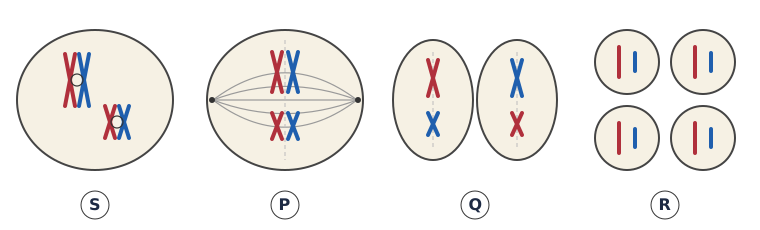
[1 markmarkah]
(a)Namakan peringkat dalam P.Name the stage in P.
Show answerTunjuk jawapanHide answerSembunyi jawapan
Tick each point you got.Tandakan setiap isi yang betul.
[1 markmarkah]
(b)Susun P, Q, R dan S mengikut urutan peristiwa yang betul.Arrange P, Q, R and S in the correct order of events.
Show answerTunjuk jawapanHide answerSembunyi jawapan
Tick each point you got.Tandakan setiap isi yang betul.
[1 markmarkah]
(c)Berapakah bilangan kromosom dalam setiap sel pada R? Nyatakan istilah bagi bilangan kromosom ini.How many chromosomes are in each cell at R? State the term for this chromosome number.
Show answerTunjuk jawapanHide answerSembunyi jawapan
Tick each point you got.Tandakan setiap isi yang betul.
[1 markmarkah]
(d)Nyatakan satu peristiwa dalam S yang menyebabkan variasi genetik.State one event in S that causes genetic variation.
Show answerTunjuk jawapanHide answerSembunyi jawapan
Tick each point you got.Tandakan setiap isi yang betul.
[2 marksmarkah]
(e)Nyatakan dua perbezaan tentang kelakuan kromosom dalam meiosis I dengan dalam mitosis, dari metafasa hingga anafasa.State two differences between how chromosomes behave in meiosis I and in mitosis, from metaphase to anaphase.
Show answerTunjuk jawapanHide answerSembunyi jawapan
Tick each point you got.Tandakan setiap isi yang betul.
[1 markmarkah]
(f)Seorang bayi dilahirkan dengan sindrom Down. Berapakah bilangan kromosom dalam sel somanya?A baby is born with Down syndrome. How many chromosomes are in its somatic cells?
Show answerTunjuk jawapanHide answerSembunyi jawapan
Tick each point you got.Tandakan setiap isi yang betul.
24
QuestionSoalan 24
Rajah 2 menunjukkan aras antibodi dalam darah seorang lelaki. Pada hari 0 dia dijangkiti bakteria A buat kali pertama. Pada hari 30 dia dijangkiti bakteria A buat kali kedua dan bakteria B buat kali pertama. Dia tidak diberi apa-apa vaksin.Diagram 2 shows the antibody levels in the blood of a man. On day 0 he is infected with bacterium A for the first time. On day 30 he is infected with bacterium A for the second time and with bacterium B for the first time. He is not given any vaccine.
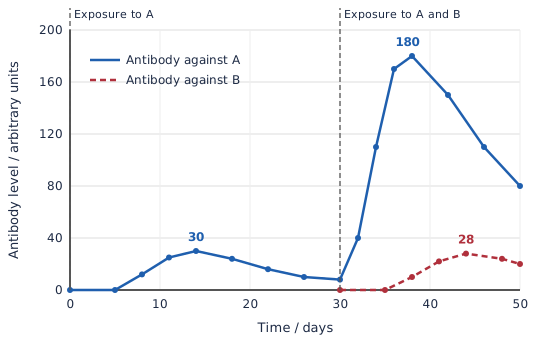
[1 markmarkah]
(a)Nyatakan aras antibodi tertinggi terhadap bakteria A selepas jangkitan pertama.State the highest antibody level against bacterium A after the first infection.
Show answerTunjuk jawapanHide answerSembunyi jawapan
Tick each point you got.Tandakan setiap isi yang betul.
[1 markmarkah]
(b)Berapa kali ganda aras antibodi tertinggi selepas jangkitan kedua oleh A berbanding dengan selepas jangkitan pertama?How many times higher is the highest antibody level after the second infection by A than after the first infection?
Show answerTunjuk jawapanHide answerSembunyi jawapan
Tick each point you got.Tandakan setiap isi yang betul.
[2 marksmarkah]
(c)Terangkan mengapa tindak balas imun terhadap A selepas jangkitan kedua lebih cepat dan lebih kuat.Explain why the immune response to A after the second infection is faster and stronger.
Show answerTunjuk jawapanHide answerSembunyi jawapan
Tick each point you got.Tandakan setiap isi yang betul.
[2 marksmarkah]
(d)Terangkan mengapa tindak balas terhadap bakteria B pada hari 30 hingga 50 menyerupai tindak balas pertama terhadap A.Explain why the response to bacterium B from day 30 to day 50 is like the first response to A.
Show answerTunjuk jawapanHide answerSembunyi jawapan
Tick each point you got.Tandakan setiap isi yang betul.
[1 markmarkah]
(e)Nyatakan jenis imuniti yang diperoleh oleh lelaki itu terhadap A selepas jangkitan pertama.State the type of immunity the man gained against A after the first infection.
Show answerTunjuk jawapanHide answerSembunyi jawapan
Natural active immunity
He made his own antibodies after catching the infection, so the immunity is active and natural. Artificial immunity needs a vaccine or an injection of antibodies.
25
QuestionSoalan 25
Rajah 3 menunjukkan struktur sendi engsel pada lutut manusia. P, Q, R dan S ialah struktur pada sendi itu.Diagram 3 shows the structure of a hinge joint at the human knee. P, Q, R and S are structures of the joint.
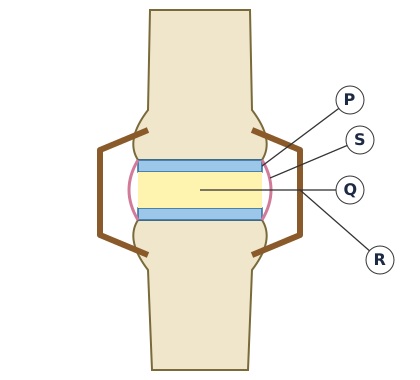
[4 marksmarkah]
(a)Namakan struktur P, Q, R dan S.Name structures P, Q, R and S.
Show answerTunjuk jawapanHide answerSembunyi jawapan
Tick each point you got.Tandakan setiap isi yang betul.
[1 markmarkah]
(b)Nyatakan satu fungsi P.State one function of P.
Show answerTunjuk jawapanHide answerSembunyi jawapan
Tick each point you got.Tandakan setiap isi yang betul.
[1 markmarkah]
(c)Nyatakan fungsi R.State the function of R.
Show answerTunjuk jawapanHide answerSembunyi jawapan
Tick each point you got.Tandakan setiap isi yang betul.
[1 markmarkah]
(d)Seorang warga emas mengadu sendi lututnya sakit dan kaku. Nyatakan satu amalan yang membantu menjaga kesihatan sendi dan tulang.An elderly woman complains that her knee joints are painful and stiff. State one practice that helps to keep the joints and bones healthy.
Show answerTunjuk jawapanHide answerSembunyi jawapan
Tick each point you got.Tandakan setiap isi yang betul.
[1 markmarkah]
(e)Kebanyakan mamalia yang berjalan menggunakan sendi engsel pada kaki. Terangkan satu kelebihan sendi engsel berbanding dengan sendi lesung dan bebola untuk pergerakan itu.Walking in most mammals uses hinge joints in the legs. Explain one advantage of a hinge joint over a ball-and-socket joint for this movement.
Show answerTunjuk jawapanHide answerSembunyi jawapan
Tick each point you got.Tandakan setiap isi yang betul.
26
QuestionSoalan 26
Jadual menunjukkan tiga haiwan, P, Q dan R, dan ciri sistem respirasi masing-masing.
The table shows three animals, P, Q and R, and the features of their respiratory systems.
| Haiwan / Animal | Ciri / Feature |
|---|---|
| P: belalang / grasshopper | Udara masuk melalui lubang di sepanjang abdomen ke dalam tiub bercabang yang berakhir dengan tiub halus berisi cecair yang menyentuh sel otot / Air enters through openings along the abdomen into branching tubes that end in tiny fluid-filled tubes touching the muscle cells |
| Q: ikan / fish | Air mengalir ke dalam mulut dan melalui struktur seperti sikat merah di belakang kepala; darah mengalir dalam arah bertentangan dengan air / Water flows in through the mouth and over red comb-like structures behind the head; blood flows in the opposite direction to the water |
| R: katak yang berehat dalam air kolam / frog resting in pond water | Pertukaran gas melalui permukaan badan yang nipis, lembap dan mempunyai banyak kapilari darah / Gas exchange takes place through a thin, moist body surface with many blood capillaries |
[3 marksmarkah]
(a)Namakan struktur respirasi bagi P, Q dan R.Name the respiratory structure of P, Q and R.
Show answerTunjuk jawapanHide answerSembunyi jawapan
Tick each point you got.Tandakan setiap isi yang betul.
[1 markmarkah]
(b)Namakan bahagian insang Q yang menjadi tapak pertukaran gas.Name the part of the gills of Q where gaseous exchange takes place.
Show answerTunjuk jawapanHide answerSembunyi jawapan
Tick each point you got.Tandakan setiap isi yang betul.
[2 marksmarkah]
(c)Terangkan kelebihan aliran darah dalam arah bertentangan dengan aliran air pada lamela insang.Explain the advantage of blood flowing in the opposite direction to the water over the gill lamellae.
Show answerTunjuk jawapanHide answerSembunyi jawapan
Tick each point you got.Tandakan setiap isi yang betul.
[1 markmarkah]
(d)Mengapakah kulit R mesti sentiasa lembap?Why must the skin of R always be moist?
Show answerTunjuk jawapanHide answerSembunyi jawapan
Tick each point you got.Tandakan setiap isi yang betul.
[1 markmarkah]
(e)Seorang perokok tegar didiagnosis menghidap emfisema. Terangkan mengapa dia sesak nafas.A heavy smoker is diagnosed with emphysema. Explain why he is short of breath.
Show answerTunjuk jawapanHide answerSembunyi jawapan
Tick each point you got.Tandakan setiap isi yang betul.
27
QuestionSoalan 27
Rajah 4 menunjukkan kesan pH ke atas kadar tindak balas dua enzim pencernaan manusia, P dan Q. Satu enzim ialah pepsin yang bertindak dalam perut dan satu lagi ialah tripsin yang bertindak dalam duodenum.Diagram 4 shows the effect of pH on the rate of reaction of two human digestive enzymes, P and Q. One is pepsin, which acts in the stomach, and the other is trypsin, which acts in the duodenum.
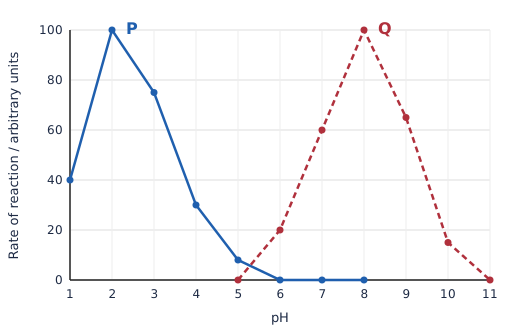
[1 markmarkah]
(a)Nyatakan pH optimum bagi enzim Q.State the optimum pH of enzyme Q.
Show answerTunjuk jawapanHide answerSembunyi jawapan
Tick each point you got.Tandakan setiap isi yang betul.
[2 marksmarkah]
(b)Enzim yang manakah ialah pepsin? Beri satu sebab.Which enzyme is pepsin? Give a reason.
Show answerTunjuk jawapanHide answerSembunyi jawapan
Tick each point you got.Tandakan setiap isi yang betul.
[2 marksmarkah]
(c)Terangkan apa yang berlaku kepada enzim P pada pH 7.Explain what happens to enzyme P at pH 7.
Show answerTunjuk jawapanHide answerSembunyi jawapan
Tick each point you got.Tandakan setiap isi yang betul.
[1 markmarkah]
(d)Hitung peratus penurunan kadar tindak balas enzim Q apabila pH berubah daripada pH optimum kepada pH 10.Calculate the percentage decrease in the rate of reaction of enzyme Q when the pH changes from the optimum pH to pH 10.
Show answerTunjuk jawapanHide answerSembunyi jawapan
Tick each point you got.Tandakan setiap isi yang betul.
[1 markmarkah]
(e)Penguraian protein oleh pepsin ialah tindak balas katabolisme atau anabolisme? Beri satu sebab.Is the digestion of protein by pepsin a catabolic or an anabolic reaction? Give a reason.
Show answerTunjuk jawapanHide answerSembunyi jawapan
Tick each point you got.Tandakan setiap isi yang betul.
[1 markmarkah]
(f)Nyatakan satu kegunaan enzim dalam industri makanan.State one use of enzymes in the food industry.
Show answerTunjuk jawapanHide answerSembunyi jawapan
Tick each point you got.Tandakan setiap isi yang betul.
Bahagian CSection C
30 marksmarkahJawab semua soalan dalam bahagian ini.Answer all questions in this section.
28
QuestionSoalan 28
Rajah 5 menunjukkan empat peringkat mitosis dalam satu sel haiwan (2n = 4). Peringkat itu tidak disusun mengikut urutan.Diagram 5 shows four stages of mitosis in an animal cell (2n = 4). The stages are not arranged in order.
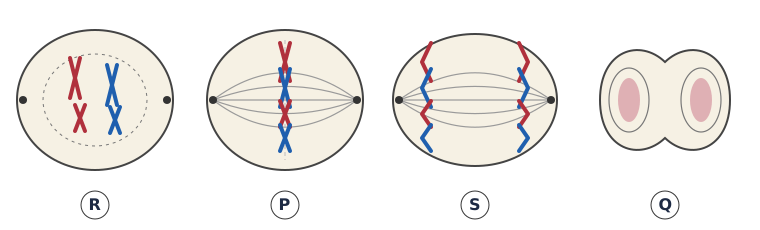
[4 marksmarkah]
(a)Namakan peringkat P, Q, R dan S.Name stages P, Q, R and S.
Show answerTunjuk jawapanHide answerSembunyi jawapan
Tick each point you got.Tandakan setiap isi yang betul.
[1 markmarkah]
(b)Susun P, Q, R dan S mengikut urutan peristiwa yang betul.Arrange P, Q, R and S in the correct order of events.
Show answerTunjuk jawapanHide answerSembunyi jawapan
Tick each point you got.Tandakan setiap isi yang betul.
[2 marksmarkah]
(c)Huraikan apa yang berlaku kepada kromosom pada peringkat S.Describe what happens to the chromosomes at stage S.
Show answerTunjuk jawapanHide answerSembunyi jawapan
Tick each point you got.Tandakan setiap isi yang betul.
[3 marksmarkah]
(d)Bandingkan mitosis dengan meiosis dengan memberi tiga perbezaan.Compare mitosis and meiosis by giving three differences.
Show answerTunjuk jawapanHide answerSembunyi jawapan
Tick each point you got.Tandakan setiap isi yang betul.
[2 marksmarkah]
(e)Dalam satu kajian, 3% sel kulit normal sedang bermitosis tetapi 24% sel dalam satu ketumbuhan kulit sedang bermitosis. Terangkan apa yang ditunjukkan oleh data ini dan bagaimana ia boleh menyebabkan ketumbuhan itu membesar.In a study, 3% of normal skin cells are in mitosis but 24% of the cells in a skin growth are in mitosis. Explain what these data show and how this can make the growth enlarge.
Show answerTunjuk jawapanHide answerSembunyi jawapan
Tick each point you got.Tandakan setiap isi yang betul.
[3 marksmarkah]
(f)Seorang murid berkata, "Meiosis tidak perlu. Gamet boleh dihasilkan melalui mitosis kerana mitosis menghasilkan sel anak yang sama dengan sel induk." Nilaikan kenyataan ini dengan menggunakan bilangan kromosom manusia (46).A student says, "Meiosis is not necessary. Gametes can be made by mitosis because mitosis makes daughter cells that are the same as the parent cell." Evaluate this statement using the human chromosome number (46).
Show answerTunjuk jawapanHide answerSembunyi jawapan
Tick each point you got.Tandakan setiap isi yang betul.
29
QuestionSoalan 29
Seorang pelajar mengkaji kesan suhu ke atas aktiviti enzim amilase. Dia mencampurkan 2 cm³ larutan kanji 1% dengan 1 cm³ larutan amilase dalam setiap tabung uji dan merendam setiap tabung dalam kukus air pada suhu yang berlainan. Setiap 30 saat, setitik campuran diuji dengan larutan iodin pada jubin. Jadual menunjukkan masa untuk campuran tidak lagi memberikan warna biru tua dengan iodin.
A student investigates the effect of temperature on the activity of the enzyme amylase. She mixes 2 cm³ of 1% starch solution with 1 cm³ of amylase solution in each test tube and places each tube in a water bath at a different temperature. Every 30 seconds, a drop of the mixture is tested with iodine solution on a tile. The table shows the time taken for the mixture to stop giving a blue-black colour with iodine.
| Suhu / Temperature (°C) | 10 | 20 | 30 | 40 | 50 | 60 |
|---|---|---|---|---|---|---|
| Masa / Time taken (min) | 16.0 | 8.0 | 4.0 | 2.0 | 5.0 | Tiada perubahan selepas 20 min / No change after 20 min |
[3 marksmarkah]
(a)Nyatakan pemboleh ubah dimanipulasikan, pemboleh ubah bergerak balas dan satu pemboleh ubah dimalarkan.State the manipulated variable, the responding variable and one constant variable.
Show answerTunjuk jawapanHide answerSembunyi jawapan
Tick each point you got.Tandakan setiap isi yang betul.
[1 markmarkah]
(b)Nyatakan hipotesis bagi eksperimen ini.State a hypothesis for this experiment.
Show answerTunjuk jawapanHide answerSembunyi jawapan
Tick each point you got.Tandakan setiap isi yang betul.
[3 marksmarkah]
(c)Huraikan bagaimana pelajar itu memastikan campuran dalam setiap tabung mencapai suhu yang dikehendaki sebelum enzim bertindak.Describe how the student makes sure that the mixture in each tube reaches the required temperature before the enzyme acts.
Show answerTunjuk jawapanHide answerSembunyi jawapan
Tick each point you got.Tandakan setiap isi yang betul.
[2 marksmarkah]
(d)Hitung kadar tindak balas pada 20 °C dan 40 °C dengan menggunakan kadar = 1 ÷ masa. Berapa kali lebih cepat kadar pada 40 °C berbanding dengan 20 °C?Calculate the rate of reaction at 20 °C and at 40 °C using rate = 1 ÷ time. How many times faster is the rate at 40 °C than at 20 °C?
Show answerTunjuk jawapanHide answerSembunyi jawapan
Tick each point you got.Tandakan setiap isi yang betul.
[2 marksmarkah]
(e)Terangkan keputusan pada 10 °C hingga 40 °C dan pada 50 °C hingga 60 °C.Explain the results from 10 °C to 40 °C and from 50 °C to 60 °C.
Show answerTunjuk jawapanHide answerSembunyi jawapan
Tick each point you got.Tandakan setiap isi yang betul.
[2 marksmarkah]
(f)Satu sampel daripada tabung 40 °C (selepas 2 minit) dan satu sampel daripada tabung 60 °C (selepas 20 minit) dididihkan dengan larutan Benedict. Nyatakan keputusan dan terangkan.A sample from the 40 °C tube (after 2 minutes) and a sample from the 60 °C tube (after 20 minutes) are each boiled with Benedict's solution. State the results and explain.
Show answerTunjuk jawapanHide answerSembunyi jawapan
Tick each point you got.Tandakan setiap isi yang betul.
[2 marksmarkah]
(g)Pelajar itu membuat kesimpulan bahawa suhu optimum amilase ialah tepat 40 °C. Nilaikan kesimpulan itu dan cadangkan satu penambahbaikan.The student concludes that the optimum temperature of amylase is exactly 40 °C. Evaluate this conclusion and suggest one improvement.
Show answerTunjuk jawapanHide answerSembunyi jawapan
Tick each point you got.Tandakan setiap isi yang betul.
Test specification (JSU)Jadual Spesifikasi Ujian (JSU)
| Chapter | RememberingMengingat | UnderstandingMemahami | ApplyingMengaplikasi | AnalysingMenganalisis | EvaluatingMenilai | CreatingMencipta | Items | marksmarkah |
|---|---|---|---|---|---|---|---|---|
| 1. Introduction to Biology and Laboratory Rules | – | 1 (1) | 1 (6) | – | – | – | 2 | 7 |
| 2. Cell Biology and Organisation | 1 (1) | – | – | 1 (1) | – | – | 2 | 2 |
| 3. Movement of Substances across a Plasma Membrane | 1 (1) | – | – | 1 (1) | – | – | 2 | 2 |
| 4. Chemical Compositions in a Cell | 1 (1) | – | – | 1 (6) | – | – | 2 | 7 |
| 5. Metabolism and Enzymes | 1 (1) | – | 2 (9) | – | – | 1 (15) | 4 | 25 |
| 6. Cell Division | – | 1 (7) | 1 (1) | – | 1 (15) | – | 3 | 23 |
| 7. Cellular Respiration | – | 1 (1) | – | – | – | – | 1 | 1 |
| 8. Respiratory Systems in Humans and Animals | – | 1 (8) | – | 1 (1) | – | – | 2 | 9 |
| 9. Nutrition and the Human Digestive System | 1 (1) | – | 1 (1) | – | – | – | 2 | 2 |
| 10. Transport in Humans and Animals | 1 (1) | – | 1 (1) | – | – | – | 2 | 2 |
| 11. Immunity in Humans | – | 1 (1) | – | 1 (7) | – | – | 2 | 8 |
| 12. Coordination and Response in Humans | – | – | 1 (1) | – | – | – | 1 | 1 |
| 13. Homeostasis and the Human Urinary System | – | – | – | 1 (1) | – | – | 1 | 1 |
| 14. Support and Movement in Humans and Animals | 2 (9) | – | – | – | – | – | 2 | 9 |
| 15. Sexual Reproduction, Development and Growth in Humans and Animals | 1 (1) | – | – | – | – | – | 1 | 1 |
| TotalJumlah | 9 (16) | 5 (18) | 7 (19) | 6 (17) | 1 (15) | 1 (15) | 29 | 100 |
Each cell shows items (marks).Setiap petak menunjukkan item (markah).