Practice paper, not an official KPM paper
4541
Peperiksaan Akhir Tahun Tingkatan 4 (model)Form 4 End-of-Year Examination (model)
KimiaChemistry
Tingkatan 4, 2 jam 30 minit / 2 hours 30 minutes, 100 marks
Nama / Name
Kelas / Class
Tarikh / Date
Markah / Marks: / 100
Instructions
- Kertas soalan ini mengandungi empat bahagian: Bahagian A, B, C dan D.This question paper consists of four sections: Section A, B, C and D.
- Bahagian A: pilih satu jawapan bagi setiap soalan.Section A: choose one answer for each question.
- Bahagian B: jawab semua soalan.Section B: answer all questions.
- Bahagian C: jawab mana-mana satu soalan. Bahagian D: jawab soalan yang diberi.Section C: answer any one question. Section D: answer the question given.
- Tunjukkan langkah-langkah penting dalam kerja mengira anda. Tulis persamaan kimia yang seimbang.Show your working. Write balanced chemical equations.
- Rajah tidak dilukis mengikut skala kecuali dinyatakan. Jadual Berkala Unsur dan kalkulator saintifik dibenarkan.Diagrams are not drawn to scale unless stated. The Periodic Table of Elements and a scientific calculator are allowed.
Answer schemes are in English (DLP).
Practice shows answers as you go. Exam times you and hides answers until you submit.
Bahagian ASection A
20 marksJawab semua soalan. Setiap soalan diikuti oleh empat pilihan jawapan, A, B, C dan D. Pilih satu jawapan sahaja.Answer all questions. Each question is followed by four options, A, B, C and D. Choose one answer only.
1
Question 1
Seorang murid menguji hipotesis, "Semakin pekat cuka, semakin cepat kulit telur larut." Apakah pemboleh ubah bergerak balas dalam eksperimen ini?A pupil tests the hypothesis, "The more concentrated the vinegar, the faster an eggshell dissolves." What is the responding variable in this experiment?
Show answerHide answer
B
The concentration is changed on purpose (manipulated variable). The time taken depends on it, so it is measured: the responding variable. Mass of eggshell and volume of vinegar are fixed variables.
2
Question 2
Ion Y³⁺ mempunyai 10 elektron dan nombor nukleon 27. Berapakah bilangan neutron dalam satu atom Y?An ion Y³⁺ has 10 electrons and nucleon number 27. How many neutrons are in one atom of Y?
Show answerHide answer
C
Y³⁺ has lost 3 electrons, so the atom had 10 + 3 = 13 electrons = 13 protons. Neutrons = nucleon number − proton number = 27 − 13 = 14.
3
Question 3
Klorin semula jadi mengandungi 75% ³⁵Cl dan 25% ³⁷Cl. Berapakah jisim atom relatif klorin?Natural chlorine contains 75% ³⁵Cl and 25% ³⁷Cl. What is the relative atomic mass of chlorine?
Show answerHide answer
A
(75 × 35 + 25 × 37) ÷ 100 = 35.5. The simple average 36.0 ignores the abundances.
4
Question 4
Berapakah jisim formula relatif ammonium sulfat, (NH₄)₂SO₄? [Jisim atom relatif: H = 1, N = 14, O = 16, S = 32]What is the relative formula mass of ammonium sulphate, (NH₄)₂SO₄? [Relative atomic mass: H = 1, N = 14, O = 16, S = 32]
Show answerHide answer
D
2 × (14 + 4 × 1) + 32 + 4 × 16 = 36 + 32 + 64 = 132.
5
Question 5
Berapakah bilangan atom oksigen dalam 0.10 mol asid sulfurik, H₂SO₄? [Pemalar Avogadro = 6.02 × 10²³ mol⁻¹]How many oxygen atoms are in 0.10 mol of sulphuric acid, H₂SO₄? [Avogadro constant = 6.02 × 10²³ mol⁻¹]
Show answerHide answer
B
Each molecule has 4 oxygen atoms: 0.10 × 4 × 6.02 × 10²³ = 2.4 × 10²³.
6
Question 6
Berapakah jisim 2.4 dm³ gas ammonia, NH₃, pada keadaan bilik? [Jisim atom relatif: H = 1, N = 14; isi padu molar = 24 dm³ mol⁻¹]What is the mass of 2.4 dm³ of ammonia gas, NH₃, at room conditions? [Relative atomic mass: H = 1, N = 14; molar volume = 24 dm³ mol⁻¹]
Show answerHide answer
C
Moles = 2.4 ÷ 24 = 0.10 mol. Mass = 0.10 × 17 = 1.7 g. (0.10 g is the number of moles, not the mass.)
7
Question 7
Aluminium terbakar dalam oksigen: 4Al + 3O₂ → 2Al₂O₃. Berapakah jisim aluminium oksida yang terbentuk apabila 5.4 g aluminium terbakar sepenuhnya? [Jisim atom relatif: O = 16, Al = 27]Aluminium burns in oxygen: 4Al + 3O₂ → 2Al₂O₃. What mass of aluminium oxide is formed when 5.4 g of aluminium burns completely? [Relative atomic mass: O = 16, Al = 27]
Show answerHide answer
A
n(Al) = 5.4 ÷ 27 = 0.20 mol. 4 mol Al gives 2 mol Al₂O₃, so n(Al₂O₃) = 0.10 mol. Mass = 0.10 × 102 = 10.2 g. Forgetting the ratio gives 20.4 g.
8
Question 8
Susunan elektron atom unsur Z ialah 2.8.8.1. Di manakah kedudukan Z dalam Jadual Berkala Unsur?The electron arrangement of an atom of element Z is 2.8.8.1. Where is Z in the Periodic Table of Elements?
Show answerHide answer
D
One valence electron gives Group 1. Four shells occupied gives Period 4.
9
Question 9
Gas klorin dialirkan ke dalam larutan natrium hidroksida sejuk. Apakah hasilnya?Chlorine gas is passed into cold sodium hydroxide solution. What are the products?
Show answerHide answer
B
Cl₂ + 2NaOH → NaCl + NaOCl + H₂O. No hydrogen gas is released in this reaction.
10
Question 10
Sebatian yang manakah ialah sebatian kovalen?Which compound is a covalent compound?
Show answerHide answer
C
CCl₄ is formed from two non-metals (carbon and chlorine) that share electrons. The others are formed from a metal and a non-metal, so they are ionic.
11
Question 11
Natrium klorida melebur pada 801 °C manakala tetraklorometana melebur pada −23 °C. Mengapakah?Sodium chloride melts at 801 °C but tetrachloromethane melts at −23 °C. Why?
Show answerHide answer
A
Melting an ionic compound means separating oppositely charged ions held by strong electrostatic forces. A covalent compound only needs the weak intermolecular forces overcome; its covalent bonds stay intact.
12
Question 12
Atom J mempunyai susunan elektron 2.8.3 dan atom L mempunyai susunan elektron 2.6. Apakah formula sebatian yang terbentuk apabila J bertindak balas dengan L?Atom J has the electron arrangement 2.8.3 and atom L has the electron arrangement 2.6. What is the formula of the compound formed when J reacts with L?
Show answerHide answer
D
J loses 3 electrons to form J³⁺; L gains 2 electrons to form L²⁻. Charges balance with 2 J³⁺ (+6) and 3 L²⁻ (−6): J₂L₃.
13
Question 13
Berapakah nilai pH larutan barium hidroksida, Ba(OH)₂, 0.005 mol dm⁻³?What is the pH of 0.005 mol dm⁻³ barium hydroxide solution, Ba(OH)₂?
Show answerHide answer
C
Ba(OH)₂ is a strong diprotic alkali: [OH⁻] = 2 × 0.005 = 0.010 mol dm⁻³, pOH = 2, pH = 14 − 2 = 12.0. 11.7 comes from forgetting the factor of 2.
14
Question 14
25.0 cm³ asid sulfurik 0.20 mol dm⁻³ dineutralkan oleh larutan natrium hidroksida 0.50 mol dm⁻³. Berapakah isi padu natrium hidroksida yang diperlukan?25.0 cm³ of 0.20 mol dm⁻³ sulphuric acid is neutralised by 0.50 mol dm⁻³ sodium hydroxide solution. What volume of sodium hydroxide solution is needed?
Show answerHide answer
B
H₂SO₄ + 2NaOH → Na₂SO₄ + 2H₂O. n(H₂SO₄) = 0.20 × 25.0 ÷ 1000 = 0.0050 mol; n(NaOH) = 0.010 mol; V = 0.010 ÷ 0.50 = 0.0200 dm³ = 20.0 cm³.
15
Question 15
Tindakan yang manakah akan mengurangkan kadar tindak balas antara zink dengan asid sulfurik?Which action will decrease the rate of the reaction between zinc and sulphuric acid?
Show answerHide answer
D
Water dilutes the acid, so there are fewer H⁺ ions per unit volume and fewer effective collisions. Powder (larger surface area), warming (higher temperature) and copper(II) sulphate (a catalyst) all increase the rate.
16
Question 16
Jadual berikut menunjukkan empat eksperimen yang menggunakan 5.0 g magnesium dan 50 cm³ asid hidroklorik. Pasangan eksperimen yang manakah menunjukkan kesan saiz bahan tindak balas ke atas kadar tindak balas?
The table shows four experiments that use 5.0 g of magnesium and 50 cm³ of hydrochloric acid. Which pair of experiments shows the effect of the size of the reactant on the rate of reaction?
| Eksperimen | Bentuk magnesium | Kepekatan asid (mol dm⁻³) | Suhu (°C) | Masa (s) |
|---|---|---|---|---|
| I | Pita | 0.5 | 30 | 120 |
| II | Pita | 0.5 | 40 | 60 |
| III | Serbuk | 0.5 | 40 | 20 |
| IV | Serbuk | 1.0 | 40 | 10 |
| Experiment | Form of magnesium | Concentration of acid (mol dm⁻³) | Temperature (°C) | Time (s) |
|---|---|---|---|---|
| I | Ribbon | 0.5 | 30 | 120 |
| II | Ribbon | 0.5 | 40 | 60 |
| III | Powder | 0.5 | 40 | 20 |
| IV | Powder | 1.0 | 40 | 10 |
Show answerHide answer
A
To test one factor only the other factors must be the same. II and III differ only in the form of magnesium (ribbon or powder). I and II differ in temperature; III and IV differ in concentration; I and IV differ in three factors.
17
Question 17
Apakah komposisi keluli tahan karat?What is the composition of stainless steel?
Show answerHide answer
C
Stainless steel is iron with carbon, chromium and nickel. Copper and tin make bronze, copper and zinc make brass, and the last option is duralumin.
18
Question 18
Pasangan jenis kaca dan kegunaannya yang manakah betul?Which pair of glass type and its use is correct?
Show answerHide answer
B
Fused glass (almost pure silica) is transparent to light and heat-resistant, so it is used for lenses and optical fibres. Oven dishes and lab flasks are borosilicate glass; windows are soda-lime glass; lead crystal is for decorative items and lenses.
19
Question 19
Mengapakah seramik digunakan untuk melapik relau?Why is ceramic used to line a furnace?
Show answerHide answer
D
Ceramics withstand very high temperatures and are heat insulators. They are hard and brittle, not soft or elastic.
20
Question 20
Jadual menunjukkan sifat empat bahan yang dipertimbangkan untuk membuat sebuah kuali. Bahan yang manakah paling sesuai?
The table shows the properties of four materials considered for making a frying pan. Which material is the most suitable?
| Bahan | Takat lebur (°C) | Pengaliran haba | Kerapuhan | Ketoksikan |
|---|---|---|---|---|
| P | 1450 | Baik | Tidak rapuh | Tidak toksik |
| Q | 330 | Baik | Tidak rapuh | Toksik |
| R | 1700 | Lemah | Rapuh | Tidak toksik |
| S | 1100 | Baik | Rapuh | Tidak toksik |
| Material | Melting point (°C) | Heat conduction | Brittleness | Toxicity |
|---|---|---|---|---|
| P | 1450 | Good | Not brittle | Non-toxic |
| Q | 330 | Good | Not brittle | Toxic |
| R | 1700 | Poor | Brittle | Non-toxic |
| S | 1100 | Good | Brittle | Non-toxic |
Show answerHide answer
A
A frying pan must have a high melting point, conduct heat well, not break when knocked and be safe for food. Only P meets all of these. Q melts too easily and is toxic, R conducts heat poorly and is brittle, and S is brittle.
Bahagian BSection B
40 marksJawab semua soalan. Tulis jawapan anda di ruang yang disediakan.Answer all questions. Write your answers in the spaces provided.
21
Question 21
Sebuah bot porselin ditimbang ketika kosong, bersama ferum oksida, dan bersama ferum yang tinggal selepas ferum oksida dipanaskan dalam aliran gas hidrogen sehingga jisim malar. Keputusan ditunjukkan dalam jadual. [Jisim atom relatif: O = 16, Fe = 56]
A porcelain boat is weighed empty, with iron oxide, and with the iron left after the oxide is heated in a stream of hydrogen gas until the mass is constant. The results are in the table. [Relative atomic mass: O = 16, Fe = 56]
| Penimbangan | Jisim (g) |
|---|---|
| Bot kosong | 25.40 |
| Bot + ferum oksida | 30.04 |
| Bot + ferum selepas pemanasan | 28.76 |
| Weighing | Mass (g) |
|---|---|
| Empty boat | 25.40 |
| Boat + iron oxide | 30.04 |
| Boat + iron after heating | 28.76 |
[1 mark]
(a)Mengapakah pemanasan, penyejukan dan penimbangan diulang sehingga jisim malar diperoleh?Why are heating, cooling and weighing repeated until a constant mass is obtained?
Show answerHide answer
Tick each point you got.
[2 marks]
(b)Hitung jisim ferum dan jisim oksigen dalam sampel itu.Calculate the mass of iron and the mass of oxygen in the sample.
Show answerHide answer
Tick each point you got.
[3 marks]
(c)Tentukan formula empirik ferum oksida itu. Tunjukkan kerja mengira anda.Determine the empirical formula of the iron oxide. Show your working.
Show answerHide answer
Fe₃O₄
Tick each point you got.
[1 mark]
(d)Aliran hidrogen diteruskan semasa ferum disejukkan. Mengapa?The stream of hydrogen is continued while the iron cools. Why?
Show answerHide answer
Tick each point you got.
[1 mark]
(e)Mengapakah kaedah ini tidak boleh digunakan untuk menentukan formula empirik magnesium oksida?Why can this method not be used to find the empirical formula of magnesium oxide?
Show answerHide answer
Tick each point you got.
22
Question 22
Jadual menunjukkan sifat tiga bahan W, X dan Y (W, X dan Y bukan simbol sebenar).
The table shows the properties of three substances W, X and Y (W, X and Y are not the actual symbols).
| Bahan | Takat lebur (°C) | Takat didih (°C) | Mengalirkan elektrik ketika pepejal | Mengalirkan elektrik ketika leburan |
|---|---|---|---|---|
| W | 801 | 1413 | Tidak | Ya |
| X | −23 | 77 | Tidak | Tidak |
| Y | 1085 | 2562 | Ya | Ya |
| Substance | Melting point (°C) | Boiling point (°C) | Conducts electricity as a solid | Conducts electricity when molten |
|---|---|---|---|---|
| W | 801 | 1413 | No | Yes |
| X | −23 | 77 | No | No |
| Y | 1085 | 2562 | Yes | Yes |
[3 marks]
(a)Kenal pasti bahan yang merupakan (i) sebatian ion, (ii) sebatian kovalen, (iii) logam.Identify the substance that is (i) an ionic compound, (ii) a covalent compound, (iii) a metal.
Show answerHide answer
Tick each point you got.
[2 marks]
(b)Terangkan mengapa W tidak mengalirkan elektrik ketika pepejal tetapi mengalirkan elektrik ketika leburan.Explain why W does not conduct electricity as a solid but conducts electricity when molten.
Show answerHide answer
Tick each point you got.
[1 mark]
(c)Terangkan mengapa takat lebur X rendah.Explain why the melting point of X is low.
Show answerHide answer
Tick each point you got.
[2 marks]
(d)Unsur J (susunan elektron 2.8.8.1) bertindak balas dengan unsur L (susunan elektron 2.8.7) untuk membentuk W. Huraikan pembentukan ikatan dalam W.Element J (electron arrangement 2.8.8.1) reacts with element L (electron arrangement 2.8.7) to form W. Describe the formation of the bond in W.
Show answerHide answer
Tick each point you got.
23
Question 23
Barium sulfat, BaSO₄, disediakan dengan menambah 50.0 cm³ larutan barium klorida, BaCl₂, 0.20 mol dm⁻³ kepada larutan natrium sulfat, Na₂SO₄, yang berlebihan. Satu mendakan putih terbentuk. [Jisim atom relatif: O = 16, S = 32, Ba = 137]Barium sulphate, BaSO₄, is prepared by adding 50.0 cm³ of 0.20 mol dm⁻³ barium chloride solution, BaCl₂, to excess sodium sulphate solution, Na₂SO₄. A white precipitate forms. [Relative atomic mass: O = 16, S = 32, Ba = 137]
[1 mark]
(a)Namakan jenis tindak balas ini.Name the type of this reaction.
Show answerHide answer
Tick each point you got.
[2 marks]
(b)Tulis persamaan ion bagi pembentukan mendakan itu, dengan simbol keadaan.Write the ionic equation for the formation of the precipitate, with state symbols.
Show answerHide answer
Ba²⁺(aq) + SO₄²⁻(aq) → BaSO₄(s)
Tick each point you got.
[2 marks]
(c)Huraikan bagaimana mendakan itu dipisahkan untuk mendapat serbuk barium sulfat yang kering dan tulen.Describe how the precipitate is separated to obtain dry, pure barium sulphate powder.
Show answerHide answer
Tick each point you got.
[3 marks]
(d)Hitung jisim maksimum barium sulfat yang boleh terbentuk.Calculate the maximum mass of barium sulphate that can be formed.
Show answerHide answer
2.33 g
Tick each point you got.
24
Question 24
Serpihan marmar (kalsium karbonat) yang berlebihan ditambah kepada 25.0 cm³ asid hidroklorik 0.20 mol dm⁻³. Gas karbon dioksida yang terbebas dikumpulkan dalam picagari gas. Rajah 1 menunjukkan graf isi padu gas melawan masa. [Isi padu molar = 24 dm³ mol⁻¹ pada keadaan bilik]Excess marble chips (calcium carbonate) are added to 25.0 cm³ of 0.20 mol dm⁻³ hydrochloric acid. The carbon dioxide gas released is collected in a gas syringe. Diagram 1 shows the graph of the volume of gas against time. [Molar volume = 24 dm³ mol⁻¹ at room conditions]
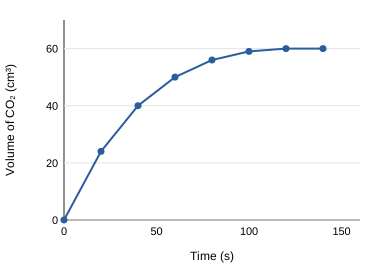
[2 marks]
(a)Hitung (i) kadar tindak balas purata dalam 20 s pertama dan (ii) kadar tindak balas purata keseluruhan.Calculate (i) the average rate of reaction in the first 20 s and (ii) the overall average rate of reaction.
Show answerHide answer
Tick each point you got.
[2 marks]
(b)Terangkan mengapa kadar tindak balas berkurang dengan masa.Explain why the rate of reaction decreases with time.
Show answerHide answer
Tick each point you got.
[2 marks]
(c)Tunjukkan dengan pengiraan bahawa isi padu maksimum karbon dioksida ialah 60 cm³. Persamaan: CaCO₃ + 2HCl → CaCl₂ + H₂O + CO₂Show by calculation that the maximum volume of carbon dioxide is 60 cm³. Equation: CaCO₃ + 2HCl → CaCl₂ + H₂O + CO₂
Show answerHide answer
Tick each point you got.
[2 marks]
(d)Eksperimen diulang dengan serbuk marmar yang berlebihan, dengan semua keadaan lain sama. Nyatakan dan terangkan kesan ke atas (i) kadar tindak balas dan (ii) isi padu maksimum gas.The experiment is repeated with excess marble powder, with all other conditions the same. State and explain the effect on (i) the rate of reaction and (ii) the maximum volume of gas.
Show answerHide answer
Tick each point you got.
25
Question 25
Cecair asetamida panas disejukkan perlahan-lahan dan suhunya dicatat setiap 2 minit. Keputusannya ditunjukkan dalam jadual.
Hot liquid acetamide is cooled slowly and its temperature is recorded every 2 minutes. The results are in the table.
| Masa (min) | 0 | 2 | 4 | 6 | 8 | 10 | 12 | 14 |
|---|---|---|---|---|---|---|---|---|
| Suhu (°C) | 96 | 90 | 84 | 82 | 82 | 82 | 76 | 70 |
| Time (min) | 0 | 2 | 4 | 6 | 8 | 10 | 12 | 14 |
|---|---|---|---|---|---|---|---|---|
| Temperature (°C) | 96 | 90 | 84 | 82 | 82 | 82 | 76 | 70 |
[1 mark]
(a)Apakah takat beku asetamida?What is the freezing point of acetamide?
Show answerHide answer
Tick each point you got.
[1 mark]
(b)Nyatakan keadaan jirim asetamida pada minit ke-4.State the physical state of acetamide at the 4th minute.
Show answerHide answer
Tick each point you got.
[2 marks]
(c)Terangkan mengapa suhu tidak berubah dari minit ke-6 hingga minit ke-10.Explain why the temperature does not change from the 6th to the 10th minute.
Show answerHide answer
Tick each point you got.
[2 marks]
(d)Huraikan susunan dan pergerakan zarah asetamida pada minit ke-12.Describe the arrangement and movement of the particles of acetamide at the 12th minute.
Show answerHide answer
Tick each point you got.
[2 marks]
(e)Oksigen mempunyai isotop ¹⁶O dan ¹⁸O. Nyatakan satu persamaan dan satu perbezaan antara atom ¹⁶O dengan atom ¹⁸O.Oxygen has the isotopes ¹⁶O and ¹⁸O. State one similarity and one difference between an atom of ¹⁶O and an atom of ¹⁸O.
Show answerHide answer
Tick each point you got.
Bahagian CSection C
20 marksJawab mana-mana satu soalan. Tulis jawapan anda di ruang yang disediakan.Answer any one question. Write your answers in the spaces provided.
26Choose 1
Question 26
Seorang murid ingin mengkaji sama ada suhu air mempengaruhi masa yang diambil oleh sebiji tablet berbuih (vitamin C) untuk larut sepenuhnya. Dia menggunakan 100 cm³ air pada setiap suhu dan satu tablet yang sama saiz setiap kali. Keputusannya ditunjukkan dalam Jadual 1.
A pupil wants to find out whether the temperature of water affects the time taken for an effervescent (vitamin C) tablet to dissolve completely. He uses 100 cm³ of water at each temperature and a tablet of the same size each time. His results are shown in Table 1.
| Suhu air (°C) | 20 | 30 | 40 | 50 | 60 |
|---|---|---|---|---|---|
| Masa untuk larut (s) | 110 | 78 | 54 | 38 | 26 |
| Temperature of water (°C) | 20 | 30 | 40 | 50 | 60 |
|---|---|---|---|---|---|
| Time to dissolve (s) | 110 | 78 | 54 | 38 | 26 |
[3 marks]
(a)Nyatakan (i) pemboleh ubah dimanipulasikan, (ii) pemboleh ubah bergerak balas dan (iii) satu pemboleh ubah dimalarkan.State (i) the manipulated variable, (ii) the responding variable and (iii) one fixed variable.
Show answerHide answer
Tick each point you got.
[1 mark]
(b)Nyatakan tujuan eksperimen ini.State the aim of this experiment.
Show answerHide answer
Tick each point you got.
[1 mark]
(c)Nyatakan satu hipotesis bagi eksperimen ini.State a hypothesis for this experiment.
Show answerHide answer
Tick each point you got.
[2 marks]
(d)Namakan dua alat yang diperlukan untuk mengukur pemboleh ubah dimanipulasikan dan pemboleh ubah bergerak balas.Name two pieces of apparatus needed to measure the manipulated variable and the responding variable.
Show answerHide answer
Tick each point you got.
[4 marks]
(e)Huraikan prosedur eksperimen ini secara ringkas.Describe briefly the procedure of this experiment.
Show answerHide answer
Tick each point you got.
[2 marks]
(f)Bina satu jadual untuk merekod keputusan eksperimen ini dengan tajuk dan unit yang betul.Construct a table to record the results of this experiment with correct headings and units.
Show answerHide answer
Tick each point you got.
[2 marks]
(g)Berdasarkan Jadual 1, nyatakan satu inferens dan satu kesimpulan.Based on Table 1, state one inference and one conclusion.
Show answerHide answer
Tick each point you got.
[1 mark]
(h)Ramalkan masa yang diambil oleh tablet itu untuk larut pada 45 °C.Predict the time taken for the tablet to dissolve at 45 °C.
Show answerHide answer
Tick each point you got.
[2 marks]
(i)Nyatakan dua langkah berjaga-jaga yang perlu diambil semasa menggunakan air panas dalam eksperimen ini.State two safety precautions to be taken when using hot water in this experiment.
Show answerHide answer
Any 2 points
Tick each point you got.
[2 marks]
(j)Cadangkan dua cara untuk menjadikan keputusan eksperimen ini lebih boleh dipercayai.Suggest two ways to make the results of this experiment more reliable.
Show answerHide answer
Any 2 points
Tick each point you got.
27Choose 1
Question 27
Jadual 2 menunjukkan data bagi beberapa unsur Kumpulan 1 dan Kumpulan 17. Jadual 3 menunjukkan jejari atom unsur Kala 3.
Table 2 shows data for some Group 1 and Group 17 elements. Table 3 shows the atomic radius of the Period 3 elements.
| Unsur Kumpulan 1 | Takat lebur (°C) |
|---|---|
| Litium | 186 |
| Natrium | 98 |
| Kalium | 64 |
| Unsur Kumpulan 17 | Takat lebur (°C) | Takat didih (°C) |
|---|---|---|
| Klorin | −101 | −34 |
| Bromin | −7 | 59 |
| Iodin | 114 | 184 |
| Unsur Kala 3 | Na | Mg | Al | Si | P | S | Cl |
|---|---|---|---|---|---|---|---|
| Jejari atom (nm) | 0.186 | 0.160 | 0.143 | 0.118 | 0.110 | 0.104 | 0.100 |
| Group 1 element | Melting point (°C) |
|---|---|
| Lithium | 186 |
| Sodium | 98 |
| Potassium | 64 |
| Group 17 element | Melting point (°C) | Boiling point (°C) |
|---|---|---|
| Chlorine | −101 | −34 |
| Bromine | −7 | 59 |
| Iodine | 114 | 184 |
| Period 3 element | Na | Mg | Al | Si | P | S | Cl |
|---|---|---|---|---|---|---|---|
| Atomic radius (nm) | 0.186 | 0.160 | 0.143 | 0.118 | 0.110 | 0.104 | 0.100 |
[2 marks]
(a)Nyatakan corak perubahan takat lebur unsur Kumpulan 1 menuruni kumpulan, dan ramalkan takat lebur rubidium berbanding kalium.State the trend in the melting point of Group 1 elements down the group, and predict the melting point of rubidium compared with potassium.
Show answerHide answer
Tick each point you got.
[3 marks]
(b)Kalium bertindak balas dengan air. Nyatakan dua pemerhatian dan tulis persamaan kimia yang seimbang bagi tindak balas itu.Potassium reacts with water. State two observations and write the balanced chemical equation for the reaction.
Show answerHide answer
Tick each point you got.
[2 marks]
(c)Terangkan mengapa kalium lebih reaktif daripada natrium.Explain why potassium is more reactive than sodium.
Show answerHide answer
Tick each point you got.
[2 marks]
(d)Nyatakan keadaan jirim bromin pada suhu bilik (25 °C). Ramalkan sama ada takat didih astatin lebih tinggi atau lebih rendah daripada 184 °C.State the physical state of bromine at room temperature (25 °C). Predict whether the boiling point of astatine is higher or lower than 184 °C.
Show answerHide answer
Tick each point you got.
[3 marks]
(e)Terangkan mengapa kereaktifan unsur Kumpulan 17 berkurang menuruni kumpulan.Explain why the reactivity of Group 17 elements decreases down the group.
Show answerHide answer
Tick each point you got.
[2 marks]
(f)Nyatakan corak jejari atom merentasi Kala 3 dan terangkan jawapan anda.State the trend in atomic radius across Period 3 and explain your answer.
Show answerHide answer
Tick each point you got.
[3 marks]
(g)Natrium oksida, aluminium oksida dan sulfur dioksida ialah oksida unsur Kala 3. Klasifikasikan setiap oksida sebagai oksida asid, oksida bes atau oksida amfoterik.Sodium oxide, aluminium oxide and sulphur dioxide are oxides of Period 3 elements. Classify each oxide as an acidic, basic or amphoteric oxide.
Show answerHide answer
Tick each point you got.
[3 marks]
(h)Argon, unsur Kumpulan 18, digunakan untuk mengisi mentol lampu berfilamen. Terangkan mengapa argon sesuai digunakan.Argon, a Group 18 element, is used to fill filament light bulbs. Explain why argon is suitable.
Show answerHide answer
Tick each point you got.
Bahagian DSection D
20 marksJawab soalan ini. Tulis jawapan anda di ruang yang disediakan.Answer this question. Write your answers in the spaces provided.
28
Question 28
Sebuah kilang di Kuching mengeluarkan peralatan dapur dan bot nelayan kecil. Jurutera kilang itu perlu memilih bahan yang betul untuk setiap produk. Produk 1 ialah pinggan kalis ketuhar. Produk 2 ialah mangkuk hiasan yang berkilau. Produk 3 ialah pelapik relau pembakaran. Produk 4 ialah kipas bot daripada gangsa (kuprum 90%, stanum 10%). Produk 5 ialah badan bot daripada gentian kaca. Jadual 4 menunjukkan empat bahan yang dipertimbangkan untuk badan bot.
A factory in Kuching makes kitchenware and small fishing boats. The factory engineer must choose the right material for each product. Product 1 is an oven-proof dish. Product 2 is a sparkling decorative bowl. Product 3 is the lining of a kiln. Product 4 is a boat propeller made of bronze (90% copper, 10% tin). Product 5 is a boat hull made of fibre glass. Table 4 shows four materials considered for the hull.
| Bahan | Ketumpatan (g cm⁻³) | Kekuatan | Tindak balas dengan air laut | Kos |
|---|---|---|---|---|
| Keluli lembut | 7.9 | Kuat | Berkarat dengan cepat | Rendah |
| Gentian kaca | 1.9 | Kuat dan lentur | Tiada | Sederhana |
| Aluminium tulen | 2.7 | Lembut | Tiada | Sederhana |
| Seramik | 3.9 | Sangat keras tetapi rapuh | Tiada | Tinggi |
| Material | Density (g cm⁻³) | Strength | Reaction with sea water | Cost |
|---|---|---|---|---|
| Mild steel | 7.9 | Strong | Rusts quickly | Low |
| Fibre glass | 1.9 | Strong and flexible | None | Medium |
| Pure aluminium | 2.7 | Soft | None | Medium |
| Ceramic | 3.9 | Very hard but brittle | None | High |
[2 marks]
(a)Produk 1 dibuat daripada kaca borosilikat. Nyatakan satu komponen kaca ini selain silika dan satu sifatnya yang menjadikannya sesuai.Product 1 is made of borosilicate glass. State one component of this glass other than silica and one property that makes it suitable.
Show answerHide answer
Tick each point you got.
[3 marks]
(b)Produk 2 dibuat daripada kaca hablur plumbum. Nyatakan dua sifat yang menjadikannya sesuai untuk mangkuk hiasan, dan satu sebab ia tidak sesuai untuk botol susu bayi.Product 2 is made of lead crystal glass. State two properties that make it suitable for a decorative bowl, and one reason it is not suitable for a baby's milk bottle.
Show answerHide answer
Tick each point you got.
[3 marks]
(c)Produk 3 dibuat daripada seramik. Nyatakan dua sifat seramik yang menjadikannya sesuai dan satu kelemahannya.Product 3 is made of ceramic. State two properties of ceramic that make it suitable and one weakness.
Show answerHide answer
Tick each point you got.
[3 marks]
(d)Terangkan mengapa gangsa dalam Produk 4 lebih keras daripada kuprum tulen, berdasarkan susunan atom.Explain, using the arrangement of atoms, why the bronze in Product 4 is harder than pure copper.
Show answerHide answer
Tick each point you got.
[4 marks]
(e)Gentian kaca ialah bahan komposit. (i) Namakan matriks dan bahan penguat dalam gentian kaca. (ii) Terangkan mengapa gentian kaca lebih sesuai untuk badan bot berbanding kaca sahaja.Fibre glass is a composite material. (i) Name the matrix and the strengthening substance in fibre glass. (ii) Explain why fibre glass is more suitable for a boat hull than glass alone.
Show answerHide answer
Tick each point you got.
[5 marks]
(f)Berdasarkan Jadual 4, pilih bahan yang paling sesuai untuk badan bot. Berikan dua sebab bagi pilihan anda dan satu sebab masing-masing mengapa dua bahan lain ditolak.Based on Table 4, choose the most suitable material for the boat hull. Give two reasons for your choice and one reason each why two other materials are rejected.
Show answerHide answer
Tick each point you got.
Test specification (JSU)
| Chapter | Remembering | Understanding | Applying | Analysing | Evaluating | Creating | Items | marks |
|---|---|---|---|---|---|---|---|---|
| 1. Introduction to Chemistry | – | – | 2 (21) | – | – | – | 2 | 21 |
| 2. Matter and the Atomic Structure | – | 1 (8) | 2 (2) | – | – | – | 3 | 10 |
| 3. The Mole Concept, Chemical Formula and Equation | – | – | 5 (12) | – | – | – | 5 | 12 |
| 4. The Periodic Table of Elements | – | 2 (2) | – | 1 (20) | – | – | 3 | 22 |
| 5. Chemical Bond | 1 (1) | 2 (9) | 1 (1) | – | – | – | 4 | 11 |
| 6. Acid, Base and Salt | – | – | 3 (10) | – | – | – | 3 | 10 |
| 7. Rate of Reaction | – | 1 (1) | – | 2 (9) | – | – | 3 | 10 |
| 8. Manufactured Substances in Industry | 2 (2) | 1 (1) | – | – | 2 (21) | – | 5 | 24 |
| Total | 3 (3) | 7 (21) | 13 (46) | 3 (29) | 2 (21) | 0 (0) | 28 | 120 |
Each cell shows items (marks).