Practice paper, not an official KPM paper
4541
Peperiksaan Akhir Tahun Tingkatan 4 (model)Form 4 End-of-Year Examination (model)
KimiaChemistry
Tingkatan 4, 2 jam 30 minit / 2 hours 30 minutes, 100 marks
Nama / Name
Kelas / Class
Tarikh / Date
Markah / Marks: / 100
Instructions
- Kertas soalan ini mengandungi empat bahagian: Bahagian A, B, C dan D.This question paper consists of four sections: Section A, B, C and D.
- Bahagian A: pilih satu jawapan bagi setiap soalan.Section A: choose one answer for each question.
- Bahagian B: jawab semua soalan.Section B: answer all questions.
- Bahagian C: jawab mana-mana satu soalan. Bahagian D: jawab soalan yang diberi.Section C: answer any one question. Section D: answer the question given.
- Tunjukkan langkah-langkah penting dalam kerja mengira anda. Tulis persamaan kimia yang seimbang.Show your working. Write balanced chemical equations.
- Rajah tidak dilukis mengikut skala kecuali dinyatakan. Jadual Berkala Unsur dan kalkulator saintifik dibenarkan.Diagrams are not drawn to scale unless stated. The Periodic Table of Elements and a scientific calculator are allowed.
Answer schemes are in English (DLP).
Practice shows answers as you go. Exam times you and hides answers until you submit.
Bahagian ASection A
20 marksJawab semua soalan. Setiap soalan diikuti oleh empat pilihan jawapan, A, B, C dan D. Pilih satu jawapan sahaja. [Jisim atom relatif: H = 1, C = 12, O = 16, Al = 27, Ca = 40; pemalar Avogadro = 6.02 × 10²³ mol⁻¹; isi padu molar = 24 dm³ mol⁻¹ pada suhu bilik]Answer all questions. Each question is followed by four options, A, B, C and D. Choose one answer only. [Relative atomic mass: H = 1, C = 12, O = 16, Al = 27, Ca = 40; Avogadro constant = 6.02 × 10²³ mol⁻¹; molar volume = 24 dm³ mol⁻¹ at room conditions]
1
Question 1
Seorang murid ingin menjalankan eksperimen yang membebaskan gas klorin yang toksik dan berbau sangat menyengat. Di manakah eksperimen itu harus dijalankan?A student wants to carry out an experiment that releases chlorine gas, which is toxic and has a very pungent smell. Where should the experiment be carried out?
Show answerHide answer
C
Experiments that release toxic vapours or pungent gases such as chlorine, ammonia and bromine must be done in a fume chamber. The safety shower and eyewash are for washing after an accident and a fire extinguisher is for putting out fires.
2
Question 2
Seorang murid mengkaji sama ada jenis logam mempengaruhi isi padu gas hidrogen yang terbebas dalam masa 2 minit apabila logam bertindak balas dengan 50 cm³ asid hidroklorik 1.0 mol dm⁻³ pada 30 °C. Pernyataan yang manakah betul?A student investigates whether the type of metal affects the volume of hydrogen gas released in 2 minutes when the metal reacts with 50 cm³ of 1.0 mol dm⁻³ hydrochloric acid at 30 °C. Which statement is correct?
Show answerHide answer
D
The type of metal is the manipulated variable (what is changed). The volume of hydrogen released in 2 minutes is what is measured, so it is the responding variable. Temperature, acid concentration and acid volume are fixed variables.
3
Question 3
Atom unsur Y mempunyai nombor proton 11 dan nombor nukleon 23. Berapakah bilangan neutron dalam atom Y?An atom of element Y has proton number 11 and nucleon number 23. How many neutrons are in the atom of Y?
Show answerHide answer
B
Neutrons = nucleon number - proton number = 23 - 11 = 12.
4
Question 4
Jadual 1 menunjukkan bilangan zarah subatom dalam empat zarah, P, Q, R dan S. Zarah yang manakah ialah isotop bagi unsur yang sama?
Table 1 shows the number of subatomic particles in four particles, P, Q, R and S. Which particles are isotopes of the same element?
| Jadual 1 / Table 1 | P | Q | R | S |
|---|---|---|---|---|
| Proton / Protons | 17 | 17 | 18 | 19 |
| Neutron / Neutrons | 18 | 20 | 22 | 20 |
| Elektron / Electrons | 17 | 17 | 18 | 18 |
Show answerHide answer
A
Isotopes have the same number of protons but different numbers of neutrons. P and Q both have 17 protons but 18 and 20 neutrons. R has 18 protons and S has 19, so they are different elements (S, with 18 electrons, is an ion).
5
Question 5
Berapakah jumlah bilangan atom dalam 0.20 mol gas ammonia, NH₃?What is the total number of atoms in 0.20 mol of ammonia gas, NH₃?
Show answerHide answer
B
Molecules = 0.20 × 6.02 × 10²³ = 1.2 × 10²³. Each NH₃ molecule has 4 atoms, so atoms = 4 × 1.2 × 10²³ = 4.8 × 10²³. 1.2 × 10²³ counts molecules, not atoms.
6
Question 6
Aluminium bertindak balas dengan asid hidroklorik berlebihan mengikut persamaan: 2Al + 6HCl → 2AlCl₃ + 3H₂. Berapakah isi padu gas hidrogen yang terbebas pada suhu bilik apabila 2.7 g aluminium bertindak balas lengkap?Aluminium reacts with excess hydrochloric acid according to the equation: 2Al + 6HCl → 2AlCl₃ + 3H₂. What volume of hydrogen gas is released at room conditions when 2.7 g of aluminium reacts completely?
Show answerHide answer
C
n(Al) = 2.7 ÷ 27 = 0.10 mol. From the equation 2 mol Al gives 3 mol H₂, so n(H₂) = 0.10 × 3/2 = 0.15 mol. Volume = 0.15 × 24 = 3.6 dm³. 2.4 dm³ uses a 1 : 1 ratio.
7
Question 7
Susunan elektron bagi atom unsur X ialah 2.8.5. Apakah kedudukan unsur X dalam Jadual Berkala Unsur?The electron arrangement of an atom of element X is 2.8.5. What is the position of element X in the Periodic Table of Elements?
Show answerHide answer
A
5 valence electrons in a main group from 13 to 18 means group = 5 + 10 = 15. Three shells are filled, so it is in Period 3.
8
Question 8
Rubidium terletak di bawah kalium dalam Kumpulan 1. Pernyataan yang manakah tentang rubidium adalah betul?Rubidium is below potassium in Group 1. Which statement about rubidium is correct?
Show answerHide answer
C
Group 1 atoms donate one electron to form M⁺, so the oxide is M₂O (Rb₂O). Down the group reactivity increases, melting point decreases and atomic radius increases, so A, B and D are all wrong.
9
Question 9
Antara yang berikut, yang manakah ialah ciri istimewa unsur peralihan?Which of the following is a special characteristic of transition elements?
Show answerHide answer
D
Transition elements form coloured ions and compounds (e.g. Cu²⁺ blue, Fe³⁺ brown), act as catalysts, have more than one oxidation number and form complex ions. They are hard, dense metals with high melting points.
10
Question 10
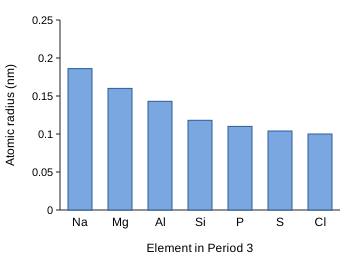
Rajah 1 menunjukkan jejari atom bagi unsur-unsur dalam Kala 3. Apakah yang menerangkan perubahan jejari atom dari natrium ke klorin?Diagram 1 shows the atomic radius of elements in Period 3. What explains the change in atomic radius from sodium to chlorine?
Show answerHide answer
B
All Period 3 atoms have three filled shells. Across the period the number of protons increases, so the nuclear charge is higher and pulls the electrons in the same shells closer. Valence electrons increase, not decrease.
11
Question 11
Sebatian yang manakah mengandungi ikatan kovalen sahaja?Which compound contains covalent bonds only?
Show answerHide answer
D
CCl₄ is formed from two non-metals (carbon and chlorine) that share electrons, so it has covalent bonds. NaCl, MgO and K₂O are formed from a metal and a non-metal and have ionic bonds.
12
Question 12
Atom magnesium mempunyai susunan elektron 2.8.2 dan atom klorin 2.8.7. Pernyataan yang manakah menerangkan pembentukan magnesium klorida dengan betul?A magnesium atom has electron arrangement 2.8.2 and a chlorine atom has 2.8.7. Which statement correctly explains the formation of magnesium chloride?
Show answerHide answer
A
Mg (2.8.2) donates 2 electrons to become Mg²⁺ (2.8). Each Cl (2.8.7) receives 1 electron to become Cl⁻ (2.8.8), so two Cl atoms are needed: MgCl₂. A metal and a non-metal form an ionic bond by electron transfer, not sharing.
13
Question 13
Unsur Z mempunyai nombor proton 6 dan unsur Y mempunyai nombor proton 16. Antara yang berikut, yang manakah menerangkan sebatian yang terbentuk apabila Z bertindak balas dengan Y?Element Z has proton number 6 and element Y has proton number 16. Which of the following describes the compound formed when Z reacts with Y?
Show answerHide answer
B
Z is 2.4 (4 valence electrons) and Y is 2.8.6 (6 valence electrons). Both are non-metals, so they share electrons. Z needs 4 more electrons and each Y needs 2, so one Z atom shares two electrons with each of two Y atoms: ZY₂ with two double bonds.
14
Question 14
Suatu larutan asid hidroklorik mempunyai pH 4. Berapakah kepekatan ion hidrogen, H⁺, dalam larutan itu?A solution of hydrochloric acid has a pH of 4. What is the concentration of hydrogen ions, H⁺, in the solution?
Show answerHide answer
C
pH = -log [H⁺], so [H⁺] = 10⁻⁴ = 1.0 × 10⁻⁴ mol dm⁻³. 1.0 × 10⁻¹⁰ is the [OH⁻] (pOH = 10).
15
Question 15
Pasangan bahan tindak balas yang manakah sesuai untuk menyediakan barium sulfat yang tidak larut dalam air?Which pair of reactants is suitable for preparing barium sulphate, which is insoluble in water?
Show answerHide answer
A
An insoluble salt is made by double decomposition: two soluble salt solutions, one with Ba²⁺ and one with SO₄²⁻. Barium nitrate and potassium sulphate are both soluble, and they give BaSO₄ plus soluble KNO₃. B uses an insoluble carbonate, C gives barium chloride and D gives soluble BaCl₂.
16
Question 16
Sebanyak 20.0 cm³ asid sulfurik 0.150 mol dm⁻³ meneutralkan sepenuhnya V cm³ larutan natrium hidroksida 0.200 mol dm⁻³. Persamaan: H₂SO₄ + 2NaOH → Na₂SO₄ + 2H₂O. Berapakah nilai V?20.0 cm³ of 0.150 mol dm⁻³ sulphuric acid neutralises V cm³ of 0.200 mol dm⁻³ sodium hydroxide solution completely. Equation: H₂SO₄ + 2NaOH → Na₂SO₄ + 2H₂O. What is the value of V?
Show answerHide answer
D
n(H₂SO₄) = 0.150 × 20.0 ÷ 1000 = 0.0030 mol. The ratio acid : alkali = 1 : 2, so n(NaOH) = 0.0060 mol. V = 0.0060 × 1000 ÷ 0.200 = 30.0 cm³. 15.0 cm³ ignores the 1 : 2 ratio.
17
Question 17
Ketulan zink digantikan dengan serbuk zink yang sama jisim dalam tindak balas dengan asid sulfurik cair. Mengapakah kadar tindak balas bertambah?Lumps of zinc are replaced with zinc powder of the same mass in a reaction with dilute sulphuric acid. Why does the rate of reaction increase?
Show answerHide answer
B
Powder has a larger total surface area than lumps of the same mass, so more zinc atoms are exposed to the acid and the frequency of effective collisions rises. Activation energy, acid concentration and particle energy do not change.
18
Question 18
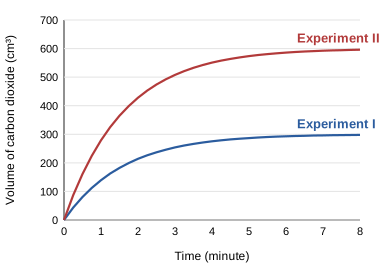
Rajah 2 menunjukkan graf isi padu gas karbon dioksida melawan masa bagi dua eksperimen. Dalam Eksperimen I, 50 cm³ asid hidroklorik 0.50 mol dm⁻³ bertindak balas dengan ketulan marmar berlebihan (CaCO₃ + 2HCl → CaCl₂ + H₂O + CO₂). Eksperimen II berbeza dalam satu faktor sahaja. Apakah yang dilakukan dalam Eksperimen II?Diagram 2 shows graphs of the volume of carbon dioxide gas against time for two experiments. In Experiment I, 50 cm³ of 0.50 mol dm⁻³ hydrochloric acid reacts with excess marble chips (CaCO₃ + 2HCl → CaCl₂ + H₂O + CO₂). Experiment II differs in one factor only. What was done in Experiment II?
Show answerHide answer
C
n(HCl) = 0.50 × 50 ÷ 1000 = 0.025 mol, giving 0.0125 mol CO₂ = 0.0125 × 24 000 = 300 cm³ (curve I). Curve II ends at 600 cm³, so twice as many moles of acid reacted: the acid concentration was doubled to 1.00 mol dm⁻³. Higher temperature, smaller chips or a catalyst would make the curve steeper but would not change the final volume, because the acid is the limiting reactant.
19
Question 19
Jenis kaca yang manakah digunakan untuk membuat bikar makmal kerana tahan haba dan tidak mudah retak apabila dipanaskan?Which type of glass is used to make laboratory beakers because it is heat resistant and does not crack easily when heated?
Show answerHide answer
D
Borosilicate glass contains boron oxide, which gives it a low expansion coefficient and heat resistance, so it is used for beakers and flasks. Soda-lime glass cracks with sudden temperature changes.
20
Question 20
Konkrit bertetulang digunakan untuk membina jambatan dan empangan. Pernyataan yang manakah menerangkan sumbangan setiap komponennya?Reinforced concrete is used to build bridges and dams. Which statement explains the contribution of each component?
Show answerHide answer
A
Concrete is strong under compression but weak when stretched. Steel has high stretching strength. Together they resist both compression and stretching (textbook Section 8.4).
Bahagian BSection B
40 marksJawab semua soalan. Tulis jawapan anda di ruang yang disediakan.Answer all questions. Write your answers in the spaces provided.
21
Question 21
Sekumpulan murid mengkaji kesan saiz zarah gula terhadap masa yang diambil untuk 5 g gula larut dalam 100 cm³ air pada suhu bilik. Mereka menggunakan gula kasar, gula halus dan gula kiub. Jawab soalan yang berikut.A group of students investigates the effect of the size of sugar particles on the time taken for 5 g of sugar to dissolve in 100 cm³ of water at room temperature. They use coarse sugar, fine sugar and a sugar cube. Answer the following questions.
[2 marks]
(a)Nyatakan pemboleh ubah dimanipulasikan dan pemboleh ubah bergerak balas.State the manipulated variable and the responding variable.
Show answerHide answer
Tick each point you got.
[1 mark]
(b)Nyatakan satu pemboleh ubah dimalarkan.State one fixed variable.
Show answerHide answer
Tick each point you got.
[2 marks]
(c)Tulis satu hipotesis bagi eksperimen ini.Write a hypothesis for this experiment.
Show answerHide answer
Tick each point you got.
[2 marks]
(d)Logam natrium digunakan dalam eksperimen lain. Bagaimanakah natrium disimpan di dalam makmal dan mengapa?Sodium metal is used in another experiment. How is sodium stored in the laboratory and why?
Show answerHide answer
Tick each point you got.
[1 mark]
(e)Namakan alat keselamatan makmal yang digunakan untuk membasuh mata selepas terkena percikan bahan kimia.Name the laboratory safety equipment used to wash the eyes after a chemical splash.
Show answerHide answer
Tick each point you got.
22
Question 22
Jadual 2 menunjukkan bilangan zarah subatom bagi atom-atom W, X, Y dan Z. Huruf-huruf itu bukan simbol sebenar unsur.
Table 2 shows the number of subatomic particles in atoms W, X, Y and Z. The letters are not the actual symbols of the elements.
| Jadual 2 / Table 2 | W | X | Y | Z |
|---|---|---|---|---|
| Proton / Protons | 17 | 17 | 11 | 12 |
| Neutron / Neutrons | 18 | 20 | 12 | 12 |
[2 marks]
(a)Atom manakah ialah isotop bagi satu sama lain? Beri satu sebab.Which two atoms are isotopes of each other? Give one reason.
Show answerHide answer
Tick each point you got.
[1 mark]
(b)Nyatakan nombor nukleon bagi atom Y.State the nucleon number of atom Y.
Show answerHide answer
Tick each point you got.
[1 mark]
(c)Tulis susunan elektron bagi atom Y.Write the electron arrangement of atom Y.
Show answerHide answer
Tick each point you got.
[1 mark]
(d)Tulis perwakilan piawai bagi atom Z.Write the standard representation of atom Z.
Show answerHide answer
Tick each point you got.
[2 marks]
(e)Unsur Q mempunyai dua isotop: Q-69 dengan kelimpahan semula jadi 60% dan Q-71 dengan kelimpahan 40%. Hitung jisim atom relatif unsur Q.Element Q has two isotopes: Q-69 with natural abundance 60% and Q-71 with abundance 40%. Calculate the relative atomic mass of element Q.
Show answerHide answer
Tick each point you got.
[1 mark]
(f)Nyatakan satu kegunaan kobalt-60 dalam bidang perubatan.State one use of cobalt-60 in medicine.
Show answerHide answer
Tick each point you got.
23
Question 23
Serpihan marmar berlebihan (kalsium karbonat) bertindak balas dengan 50 cm³ asid hidroklorik cair. Isi padu gas yang terkumpul dicatat setiap minit dalam Jadual 3.
Excess marble chips (calcium carbonate) react with 50 cm³ of dilute hydrochloric acid. The volume of gas collected is recorded every minute in Table 3.
| Masa (minit) / Time (minute) | 0 | 1 | 2 | 3 | 4 | 5 | 6 |
|---|---|---|---|---|---|---|---|
| Isi padu gas (cm³) / Volume of gas (cm³) | 0 | 32 | 52 | 64 | 70 | 72 | 72 |
[2 marks]
(a)Tulis persamaan kimia seimbang bagi tindak balas ini.Write the balanced chemical equation for this reaction.
Show answerHide answer
Tick each point you got.
[2 marks]
(b)Hitung kadar tindak balas purata bagi keseluruhan tindak balas.Calculate the average rate of reaction for the whole reaction.
Show answerHide answer
Tick each point you got.
[3 marks]
(c)Mengapakah kadar tindak balas berkurang apabila masa bertambah? Terangkan menggunakan teori perlanggaran.Why does the rate of reaction decrease as time passes? Explain using collision theory.
Show answerHide answer
Tick each point you got.
[1 mark]
(d)Cadangkan satu perubahan untuk menambahkan kadar tindak balas ini tanpa mengubah isi padu gas maksimum.Suggest one change to increase the rate of this reaction without changing the maximum volume of gas.
Show answerHide answer
Tick each point you got.
24
Question 24
Jawab soalan yang berikut tentang bahan buatan dalam industri.Answer the following questions about manufactured substances in industry.
[1 mark]
(a)Apakah komponen utama yang terdapat dalam semua jenis kaca?What is the main component found in all types of glass?
Show answerHide answer
Tick each point you got.
[2 marks]
(b)Nyatakan jenis kaca yang digunakan untuk membuat kelalang makmal dan satu sifat yang menjadikannya sesuai.State the type of glass used to make laboratory flasks and one property that makes it suitable.
Show answerHide answer
Tick each point you got.
[2 marks]
(c)Pewter ialah aloi timah dengan sedikit antimoni dan kuprum. Terangkan mengapa pewter lebih keras daripada timah tulen.Pewter is an alloy of tin with a little antimony and copper. Explain why pewter is harder than pure tin.
Show answerHide answer
Tick each point you got.
[2 marks]
(d)Dalam konkrit bertetulang, namakan matriks dan bahan penguat.In reinforced concrete, name the matrix and the strengthening substance.
Show answerHide answer
Tick each point you got.
[1 mark]
(e)Nyatakan satu sifat seramik yang menjadikannya sesuai sebagai pelapik relau.State one property of ceramics that makes them suitable as the lining of a furnace.
Show answerHide answer
Tick each point you got.
25
Question 25
Unsur P, Q dan R mempunyai nombor proton masing-masing 12, 17 dan 6. Huruf-huruf itu bukan simbol sebenar unsur. P bertindak balas dengan Q untuk membentuk sebatian PQ₂ dan R bertindak balas dengan Q untuk membentuk sebatian RQ₄.Elements P, Q and R have proton numbers 12, 17 and 6 respectively. The letters are not the actual symbols of the elements. P reacts with Q to form compound PQ₂ and R reacts with Q to form compound RQ₄.
[2 marks]
(a)Tulis susunan elektron bagi atom P dan atom Q.Write the electron arrangement of an atom of P and an atom of Q.
Show answerHide answer
Tick each point you got.
[3 marks]
(b)Terangkan pembentukan PQ₂ dari segi pemindahan elektron.Explain the formation of PQ₂ in terms of electron transfer.
Show answerHide answer
Tick each point you got.
[2 marks]
(c)PQ₂ tidak mengalirkan arus elektrik dalam keadaan pepejal tetapi mengalirkan arus elektrik dalam keadaan leburan. Terangkan.PQ₂ does not conduct electricity in the solid state but conducts electricity in the molten state. Explain.
Show answerHide answer
Tick each point you got.
[1 mark]
(d)RQ₄ mempunyai takat didih yang rendah. Terangkan mengapa.RQ₄ has a low boiling point. Explain why.
Show answerHide answer
Tick each point you got.
Bahagian CSection C
20 marksJawab satu soalan sahaja daripada soalan 26 dan soalan 27. [Jisim atom relatif: H = 1, C = 12, O = 16, Fe = 56; isi padu molar = 24 dm³ mol⁻¹ pada suhu bilik]Answer one question only from question 26 and question 27. [Relative atomic mass: H = 1, C = 12, O = 16, Fe = 56; molar volume = 24 dm³ mol⁻¹ at room conditions]
26Choose 1
Question 26
Seorang murid menentukan formula empirik suatu oksida besi dengan memanaskannya dalam aliran gas hidrogen sehingga semua oksida bertukar menjadi logam besi. Keputusan eksperimen ditunjukkan dalam Jadual 4.
A student determines the empirical formula of an oxide of iron by heating it in a stream of hydrogen gas until all the oxide changes to iron metal. The results of the experiment are shown in Table 4.
| Jadual 4 / Table 4 | Jisim / Mass (g) |
|---|---|
| Bot pembakaran kosong / Empty combustion boat | 12.40 |
| Bot pembakaran + oksida besi / Combustion boat + iron oxide | 15.60 |
| Bot pembakaran + besi (jisim malar) / Combustion boat + iron (constant mass) | 14.64 |
[2 marks]
(a)Hitung jisim besi dan jisim oksigen dalam oksida itu.Calculate the mass of iron and the mass of oxygen in the oxide.
Show answerHide answer
Tick each point you got.
[3 marks]
(b)Tentukan formula empirik oksida besi itu.Determine the empirical formula of the iron oxide.
Show answerHide answer
Tick each point you got.
[1 mark]
(c)Mengapakah aliran gas hidrogen diteruskan semasa besi disejukkan?Why is the flow of hydrogen gas continued while the iron cools?
Show answerHide answer
Tick each point you got.
[1 mark]
(d)Mengapakah murid itu memanaskan, menyejukkan dan menimbang bot beberapa kali sehingga jisim malar diperoleh?Why does the student heat, cool and weigh the boat several times until a constant mass is obtained?
Show answerHide answer
Tick each point you got.
[2 marks]
(e)Tulis persamaan kimia seimbang bagi tindak balas antara besi(III) oksida dengan hidrogen.Write the balanced chemical equation for the reaction between iron(III) oxide and hydrogen.
Show answerHide answer
Tick each point you got.
[3 marks]
(f)Hitung jisim besi yang terhasil apabila 48.0 g besi(III) oksida diturunkan sepenuhnya. [Jisim molar Fe₂O₃ = 160 g mol⁻¹]Calculate the mass of iron obtained when 48.0 g of iron(III) oxide is completely reduced. [Molar mass of Fe₂O₃ = 160 g mol⁻¹]
Show answerHide answer
Tick each point you got.
[2 marks]
(g)Hitung isi padu gas hidrogen yang diperlukan pada suhu bilik untuk tindak balas lengkap dalam (f).Calculate the volume of hydrogen gas needed at room conditions for the complete reaction in (f).
Show answerHide answer
Tick each point you got.
[2 marks]
(h)Kaedah ini tidak sesuai untuk menentukan formula empirik magnesium oksida. Terangkan mengapa dan cadangkan kaedah yang sesuai.This method is not suitable for determining the empirical formula of magnesium oxide. Explain why and suggest a suitable method.
Show answerHide answer
Tick each point you got.
[2 marks]
(i)Satu sebatian karbon mempunyai formula empirik CH₂O dan jisim molekul relatif 180. Tentukan formula molekulnya.A carbon compound has empirical formula CH₂O and relative molecular mass 180. Determine its molecular formula.
Show answerHide answer
Tick each point you got.
[2 marks]
(j)Bezakan formula empirik dengan formula molekul.State the difference between an empirical formula and a molecular formula.
Show answerHide answer
Tick each point you got.
27Choose 1
Question 27
Jadual 5 menunjukkan jejari atom dan takat lebur bagi unsur-unsur Kumpulan 1.
Table 5 shows the atomic radius and melting point of elements in Group 1.
| Unsur / Element | Jejari atom / Atomic radius (nm) | Takat lebur / Melting point (°C) |
|---|---|---|
| Litium / Lithium | 0.133 | 186 |
| Natrium / Sodium | 0.186 | 98 |
| Kalium / Potassium | 0.203 | 64 |
| Rubidium | 0.248 | 39 |
[3 marks]
(a)Nyatakan corak perubahan takat lebur menuruni kumpulan dan terangkan.State the trend in melting point down the group and explain it.
Show answerHide answer
Tick each point you got.
[2 marks]
(b)Ramalkan sama ada jejari atom dan takat lebur sesium lebih besar atau lebih kecil daripada rubidium.Predict whether the atomic radius and the melting point of caesium are larger or smaller than those of rubidium.
Show answerHide answer
Tick each point you got.
[3 marks]
(c)Rubidium bertindak balas dengan air lebih cergas daripada natrium. Terangkan sebab perbezaan kereaktifan itu.Rubidium reacts with water more vigorously than sodium. Explain the reason for the difference in reactivity.
Show answerHide answer
Tick each point you got.
[2 marks]
(d)Tulis persamaan kimia seimbang bagi tindak balas rubidium dengan air.Write the balanced chemical equation for the reaction of rubidium with water.
Show answerHide answer
Tick each point you got.
[1 mark]
(e)Apakah yang berlaku kepada kertas litmus merah apabila dicelup dalam larutan yang terhasil dalam (d)?What happens to red litmus paper when it is dipped into the solution formed in (d)?
Show answerHide answer
Tick each point you got.
[2 marks]
(f)Klorin, bromin dan iodin ialah unsur Kumpulan 17. Menuruni kumpulan, keadaan fizik berubah daripada gas kepada cecair kepada pepejal. Terangkan mengapa takat didih meningkat.Chlorine, bromine and iodine are Group 17 elements. Down the group the physical state changes from gas to liquid to solid. Explain why the boiling point increases.
Show answerHide answer
Tick each point you got.
[3 marks]
(g)Kereaktifan unsur Kumpulan 17 berkurang menuruni kumpulan, sebaliknya daripada Kumpulan 1. Terangkan mengapa fluorin lebih reaktif daripada iodin.The reactivity of Group 17 elements decreases down the group, the opposite of Group 1. Explain why fluorine is more reactive than iodine.
Show answerHide answer
Tick each point you got.
[2 marks]
(h)Natrium oksida dan sulfur dioksida dilarutkan dalam air. Nyatakan sifat larutan yang terhasil bagi setiap oksida.Sodium oxide and sulphur dioxide are each dissolved in water. State the nature of the solution formed by each oxide.
Show answerHide answer
Tick each point you got.
[2 marks]
(i)Neon tidak bertindak balas dengan unsur lain dan digunakan dalam papan iklan. Terangkan mengapa neon tidak reaktif.Neon does not react with other elements and is used in advertising boards. Explain why neon is unreactive.
Show answerHide answer
Tick each point you got.
Bahagian DSection D
20 marksJawab soalan ini. Tulis jawapan anda di ruang yang disediakan. [Jisim atom relatif: I = 127, Pb = 207]Answer this question. Write your answers in the spaces provided. [Relative atomic mass: I = 127, Pb = 207]
28
Question 28
Seorang murid menjalankan analisis kualitatif ke atas dua garam, X dan Y. Pepejal X ialah hablur hijau yang larut dalam air. Pepejal Y ialah pepejal putih yang larut dalam air. Keputusan ujian ditunjukkan dalam Jadual 6 dan Jadual 7.
A student carries out qualitative analysis on two salts, X and Y. Solid X is a green crystal that dissolves in water. Solid Y is a white solid that dissolves in water. The results of the tests are shown in Table 6 and Table 7.
| Jadual 6 / Table 6: X | Ujian / Test | Pemerhatian / Observation |
|---|---|---|
| 1 | Larutkan X dalam air; tambah larutan natrium hidroksida setitik demi setitik, kemudian berlebihan Dissolve X in water; add sodium hydroxide solution drop by drop, then in excess | Mendakan hijau; tidak larut dalam natrium hidroksida berlebihan Green precipitate; does not dissolve in excess sodium hydroxide |
| 2 | Larutan X + larutan kalium heksasianoferat(III) Solution of X + potassium hexacyanoferrate(III) solution | Mendakan biru tua Dark blue precipitate |
| 3 | Larutan X + asid hidroklorik cair berlebihan, kemudian larutan barium klorida Solution of X + excess dilute hydrochloric acid, then barium chloride solution | Mendakan putih White precipitate |
| Jadual 7 / Table 7: Y | Ujian / Test | Pemerhatian / Observation |
|---|---|---|
| 4 | Panaskan Y dengan kuat Heat Y strongly | Gas perang dan gas yang menyalakan semula kayu uji berbara; baki perang semasa panas, kuning semasa sejuk A brown gas and a gas that relights a glowing splinter; residue brown when hot, yellow when cold |
| 5 | Larutan Y + larutan natrium hidroksida, kemudian berlebihan Solution of Y + sodium hydroxide solution, then in excess | Mendakan putih; larut dalam natrium hidroksida berlebihan White precipitate; dissolves in excess sodium hydroxide |
| 6 | Larutan Y + larutan ammonia, kemudian berlebihan Solution of Y + ammonia solution, then in excess | Mendakan putih; tidak larut dalam ammonia berlebihan White precipitate; does not dissolve in excess ammonia |
| 7 | Larutan Y + larutan kalium iodida Solution of Y + potassium iodide solution | Mendakan kuning Yellow precipitate |
[2 marks]
(a)Namakan kation dalam X dan nyatakan ujian yang mengesahkannya.Name the cation in X and state which test confirms it.
Show answerHide answer
Tick each point you got.
[1 mark]
(b)Mengapakah larutan natrium hidroksida ditambah sehingga berlebihan dalam Ujian 1?Why is sodium hydroxide solution added until it is in excess in Test 1?
Show answerHide answer
Tick each point you got.
[1 mark]
(c)Mengapakah asid hidroklorik cair berlebihan ditambah sebelum barium klorida dalam Ujian 3?Why is excess dilute hydrochloric acid added before barium chloride in Test 3?
Show answerHide answer
Tick each point you got.
[2 marks]
(d)Nyatakan anion dalam X dan tulis persamaan ion bagi pembentukan mendakan putih dalam Ujian 3.State the anion in X and write the ionic equation for the formation of the white precipitate in Test 3.
Show answerHide answer
Tick each point you got.
[1 mark]
(e)Namakan garam X.Name salt X.
Show answerHide answer
Tick each point you got.
[1 mark]
(f)Tulis persamaan ion bagi pembentukan mendakan hijau dalam Ujian 1.Write the ionic equation for the formation of the green precipitate in Test 1.
Show answerHide answer
Tick each point you got.
[2 marks]
(g)Namakan gas perang dalam Ujian 4 dan nyatakan anion yang ditunjukkan olehnya.Name the brown gas in Test 4 and state the anion it shows.
Show answerHide answer
Tick each point you got.
[3 marks]
(h)Nyatakan kation dalam Y. Terangkan bagaimana Ujian 5, 6 dan 7 membezakannya daripada kation lain yang memberi mendakan putih.State the cation in Y. Explain how Tests 5, 6 and 7 distinguish it from other cations that give a white precipitate.
Show answerHide answer
Tick each point you got.
[2 marks]
(i)Tulis persamaan kimia seimbang bagi penguraian terma Y.Write the balanced chemical equation for the thermal decomposition of Y.
Show answerHide answer
Tick each point you got.
[3 marks]
(j)Plumbum(II) iodida, PbI₂, disediakan dengan mencampurkan 50 cm³ larutan plumbum(II) nitrat 0.20 mol dm⁻³ dengan kalium iodida berlebihan. Hitung jisim PbI₂ yang terbentuk.Lead(II) iodide, PbI₂, is prepared by mixing 50 cm³ of 0.20 mol dm⁻³ lead(II) nitrate solution with excess potassium iodide. Calculate the mass of PbI₂ formed.
Show answerHide answer
Tick each point you got.
[2 marks]
(k)Huraikan bagaimana pepejal PbI₂ kering diperoleh daripada campuran selepas tindak balas dalam (j).Describe how dry solid PbI₂ is obtained from the mixture after the reaction in (j).
Show answerHide answer
Tick each point you got.
Test specification (JSU)
| Chapter | Remembering | Understanding | Applying | Analysing | Evaluating | Creating | Items | marks |
|---|---|---|---|---|---|---|---|---|
| 1. Introduction to Chemistry | 1 (1) | – | 2 (9) | – | – | – | 3 | 10 |
| 2. Matter and the Atomic Structure | – | – | 3 (10) | – | – | – | 3 | 10 |
| 3. The Mole Concept, Chemical Formula and Equation | – | – | 3 (22) | – | – | – | 3 | 22 |
| 4. The Periodic Table of Elements | 1 (1) | 1 (1) | 1 (1) | 1 (1) | 1 (20) | – | 5 | 24 |
| 5. Chemical Bond | 1 (1) | 1 (1) | – | 2 (9) | – | – | 4 | 11 |
| 6. Acid, Base and Salt | – | 1 (1) | 2 (2) | 1 (20) | – | – | 4 | 23 |
| 7. Rate of Reaction | – | 1 (1) | – | 2 (9) | – | – | 3 | 10 |
| 8. Manufactured Substances in Industry | 2 (9) | 1 (1) | – | – | – | – | 3 | 10 |
| Total | 5 (12) | 5 (5) | 11 (44) | 6 (39) | 1 (20) | 0 (0) | 28 | 120 |
Each cell shows items (marks).