Mathematics questions, chapter 5
Nama / NameKelas / ClassTarikh / Date
Network in Graph Theory
45 marks. Use Practice to check each answer as you go, or Exam to answer everything first. Show your working for Section B.
Section A: objective questions
12 marksChoose the correct answer. Each question carries 1 mark.
1
Question 1
In a graph, a line that joins two vertices is called a(n)
Show answerHide answer
B
The dots are vertices and the lines joining them are edges. A loop is a special edge that starts and ends at the same vertex.
2
Question 2
A social network is drawn as a graph. What do the edges represent?
Show answerHide answer
B
In a social network the vertices are individuals, groups or organisations, and the edges are the relationships between them.
3
Question 3
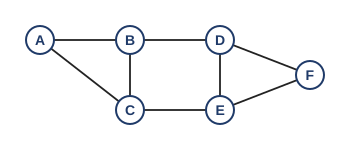
Diagram 1 shows a simple graph. What is the sum of the degrees of all the vertices?
Show answerHide answer
C
There are 8 edges. Sum of degrees = 2 × 8 = 16. The number 8 is just the number of edges, and 6 is the number of vertices.
4
Question 4
The sum of the degrees of a simple graph is 18. How many edges does the graph have?
Show answerHide answer
B
Sum of degrees = 2 × number of edges, so the number of edges = 18 ÷ 2 = 9.
5
Question 5
Which set of vertex degrees can be the degrees of a graph?
Show answerHide answer
C
A graph needs an even sum of degrees. 3 + 3 + 3 + 2 + 1 = 12 is even. The other sets add to 13, 13 and 11, which are odd.
6
Question 6
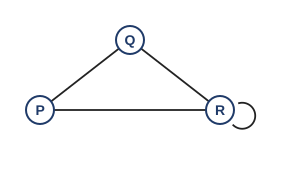
Diagram 2 shows a graph with a loop at vertex R. What is the degree of vertex R?
Show answerHide answer
D
Edges QR and PR give 2. The loop adds 2 more. d(R) = 2 + 2 = 4. Counting the loop as 1 gives 3.
7
Question 7
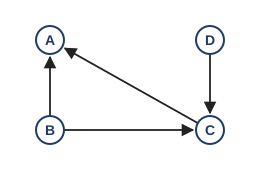
Diagram 3 shows a directed graph. What is dout(B), the number of edges coming out of B?
Show answerHide answer
D
The arrows leaving B are B to A and B to C, so dout(B) = 2. No arrow goes into B.
8
Question 8
Which of the following is a weighted graph?
Show answerHide answer
C
A weighted graph has a value on each edge, such as distance, time or cost. The other three only show relationships.
9
Question 9
A tree has 9 vertices. How many edges does it have?
Show answerHide answer
A
A tree with n vertices has n − 1 edges, so 9 − 1 = 8.
10
Question 10
A connected graph has 7 vertices and 7 edges. Which statement is true?
Show answerHide answer
B
A tree with 7 vertices has 7 − 1 = 6 edges. With 7 edges there is a closed path, so two vertices can be joined in more than one way.
11
Question 11
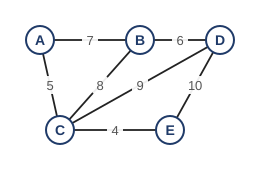
Diagram 4 shows an undirected weighted graph. What is the minimum total weight of a tree from this graph?
Show answerHide answer
C
5 vertices need 4 edges. Choose the smallest weights that do not form a closed path: 4 (CE), 5 (AC), 6 (BD), 7 (AB). Total = 4 + 5 + 6 + 7 = 22. Weight 8 is skipped because B and C are already linked.
12
Question 12
Graph G has V = {P, Q, R, S} and E = {(P, Q), (Q, R), (R, S), (S, P)}. Which of these is a subgraph of G?
Show answerHide answer
A
The vertices and the edges must come from G. (P, R) is not an edge of G, (Q, S) is not an edge of G, and T is not a vertex of G.
Section B: structured questions
33 marksAnswer all questions. Show your working.
13
Question 13
A graph has V = {P, Q, R, S, T} and E = {(P, Q), (P, Q), (Q, R), (R, S), (S, T), (T, T)}.
[1 mark]
(a)State n(V) and n(E).
Show answerHide answer
Tick each point you got.
[3 marks]
(b)Find the degree of each vertex and the sum of the degrees.
Show answerHide answer
Tick each point you got.
[1 mark]
(c)Explain why this is not a simple graph.
Show answerHide answer
Tick each point you got.
14
Question 14
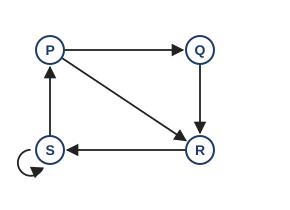
Diagram 5 shows a directed graph.
[2 marks]
(a)State din(S) and dout(S).
Show answerHide answer
Tick each point you got.
[2 marks]
(b)Find the sum of the degrees of all the vertices.
Show answerHide answer
Tick each point you got.
[1 mark]
(c)The edge (S, S) is a
Show answerHide answer
loop
An edge that starts and ends at the same vertex is a loop.
15
Question 15
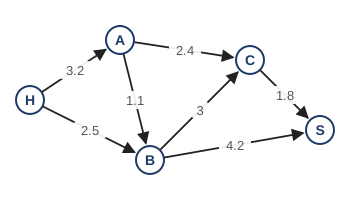
Diagram 6 shows the one-way cycling routes, in km, from the school hall H to the stadium S. A, B and C are junctions.
[2 marks]
(a)Find the shortest route from H to S and its distance.
Show answerHide answer
Tick each point you got.
[2 marks]
(b)Find the longest route from H to S and its distance.
Show answerHide answer
Tick each point you got.
[2 marks]
(c)A cyclist wants a route of more than 7 km but less than 8 km. State the routes that can be chosen.
Show answerHide answer
Tick each point you got.
16
Question 16
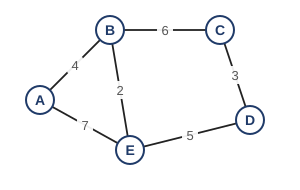
Diagram 7 shows an undirected weighted graph of five villages. The weights are distances in km.
[1 mark]
(a)How many edges must be removed to form a tree?
Show answerHide answer
Tick each point you got.
[2 marks]
(b)State the edges that are removed to give a tree with minimum total weight.
Show answerHide answer
Tick each point you got.
[1 mark]
(c)Find the minimum total weight.
Show answerHide answer
Tick each point you got.
17
Question 17
Table 1 shows the two clubs each pupil has joined.
The information is shown as a graph. The vertices are the clubs and the edges are the pupils.
| Pupil | Clubs |
|---|---|
| Hana | Chess, Drama |
| Iqbal | Chess, Robotics |
| Jia | Drama, Robotics |
| Kumar | Robotics, Music |
| Lina | Music, Chess |
[2 marks]
(a)Write the set of edges E as pairs of clubs.
Show answerHide answer
Tick each point you got.
[1 mark]
(b)State the degree of the vertex Robotics and what it means.
Show answerHide answer
Tick each point you got.
[2 marks]
(c)State the sum of the degrees of the graph and explain how it is related to the number of pupils.
Show answerHide answer
Tick each point you got.
18
Question 18
A family of 4 adults travels from town X to town Y. The bus fare is RM42 per adult and takes 4 hours. The train fare is RM28 per adult and takes 6 hours. A shared car costs RM90 for the whole car and takes 3.5 hours.
[3 marks]
(a)Calculate the total cost of each choice for the 4 adults.
Show answerHide answer
Tick each point you got.
[2 marks]
(b)The family must arrive in less than 4 hours. Which choice should they take? Give a reason.
Show answerHide answer
Tick each point you got.
19
Question 19
Draw a simple graph with 5 vertices whose degrees are 1, 1, 2, 3 and 3.
[1 mark]
(a)Show that such a graph can exist.
Show answerHide answer
Tick each point you got.
[2 marks]
(b)Draw the graph, with no loops and no multiple edges.
Show answerHide answer
For example A-B, B-C, C-D, D-E and B-D: d(A) = 1, d(B) = 3, d(C) = 2, d(D) = 3, d(E) = 1.
Tick each point you got.