Mathematics notes, chapter 6
Linear Inequalities in Two Variables
Textbook Mathematics Form 4 KSSM (DLP), pages 154–181
What this chapter covers
- Represent situations in the form of a linear inequality in two variables, make and verify conjectures about the points in the region of a linear inequality, and determine and shade the region that satisfies it (6.1)
- Represent situations as a system of linear inequalities, determine the points and region that satisfy the system, and shade the common region (6.2)
- Write the inequalities that define a shaded region and solve problems involving systems of linear inequalities in two variables (6.2)
6.1Linear inequalities in two variables
A linear inequality in two variables compares two quantities that are not equal, using >, <, ≥ or ≤. It has the form ax + by > c (or <, ≥, ≤), and the highest power of each variable is 1.
Representing a situation
Choose a variable for each quantity, then turn the words into an inequality.
Example 1 (textbook p. 156): books
A reference book costs RM14 and an exercise book costs RM9. Taufik can spend at most RM100.Let x = number of reference books and y = number of exercise books.
Total cost ≤ 100, so 14x + 9y ≤ 100.
Example 2 (textbook p. 157): clear decimals and fractions
Small poster RM12.50 (k), large poster RM18.50 (b), allocation RM150: 12.50k + 18.50b ≤ 150.Multiply both sides by 2 to remove the decimals: 25k + 37b ≤ 300.
Keep x and y for the two different things you count. Always say what each letter stands for.
Points on, above and below a line
A straight line y = mx + c splits the Cartesian plane into three groups of points.
| Where the point is | What it satisfies |
|---|---|
| On the line | y = mx + c |
| In the region above the line | y > mx + c |
| In the region below the line | y < mx + c |
| To the right of x = k | x > k |
| To the left of x = k | x < k |
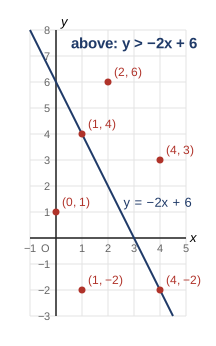
Example 4 (textbook p. 160): test a point without drawing
Does (2, 5) satisfy y = −3x + 6, y > −3x + 6 or y < −3x + 6?Put x = 2 into the right side: −3(2) + 6 = 0.
Compare with y = 5: 5 > 0, so the point satisfies y > −3x + 6.
Drawing and shading a region
| Inequality | Line | Points on the line |
|---|---|---|
| > or < | Dashed line | Not included |
| ≥ or ≤ | Solid line | Included |
- Change the inequality to an equation and find two points (or the intercepts).
- Draw the line: dashed for > and <, solid for ≥ and ≤.
- Decide the side. For y > or y ≥, shade above; for y < or y ≤, shade below. For x > k shade the right; for x < k shade the left.
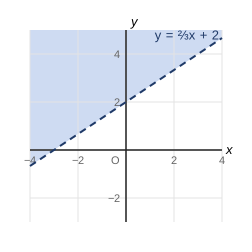
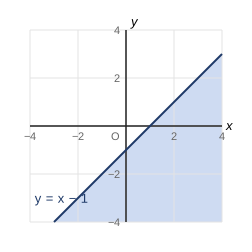
If the inequality has a negative y, such as x − y > 4, multiply by −1 so that y is positive. Multiplying or dividing by a negative number reverses the sign: x − y > 4 becomes y < x − 4.
Shading the wrong side after rearranging. Check with one test point, for example (0, 0) when the line does not pass through the origin, and substitute it into the original inequality.
Which side is shaded, and is the line solid or dashed, for 2y + x ≥ 2?
Show answerHide answer
2y ≥ −x + 2, so y ≥ −½x + 1. Solid line (≥), shade above.
6.2Systems of linear inequalities in two variables
A system of linear inequalities is two or more linear inequalities taken together. The common region is the region that satisfies every inequality in the system.
Words into inequalities
| Situation | Inequality |
|---|---|
| y is greater than x | y > x |
| y is not more than x | y ≤ x |
| y is not less than x | y ≥ x |
| y is at least k times x | y ≥ kx |
| y is at most k times x | y ≤ kx |
| Maximum of y is k | y ≤ k |
| Minimum of y is k | y ≥ k |
| Sum of x and y is greater than k | x + y > k |
| Difference between y and x is less than k | y − x < k |
| y is more than x by at least k | y − x ≥ k |
Quantities that are counted (people, items) cannot be negative, so add x ≥ 0 and y ≥ 0. This keeps the graph in the first quadrant.
Example 8 (textbook p. 166): ink cartridges
x cartridges of brand X (RM14 each) and y of brand Y (RM18 each). (a) At most 25 in total. (b) Y is at least twice X. (c) Y is at most 8. (d) Total cost at most RM400.(a) x + y ≤ 25 (b) y ≥ 2x (c) y ≤ 8 (d) 14x + 18y ≤ 400
Testing a region
To find which region satisfies a system, put one point from each region into all the inequalities. The region where every statement is true is the answer.
Table of points (textbook p. 167)
For x + y ≤ 8 and y ≥ 3, the point (3, 4) gives 3 + 4 ≤ 8 (true) and 4 ≥ 3 (true). The point (2, 1) gives 2 + 1 ≤ 8 (true) but 1 ≥ 3 (false). So (3, 4) is in the region that satisfies the system and (2, 1) is not.Shading the common region
- Draw every boundary line (solid or dashed as the sign says).
- For each inequality, mark its region with a letter or light shading.
- The region marked by all of them is the common region. Shade only this region.
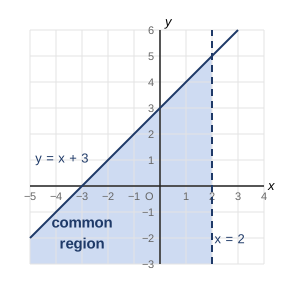
Writing the inequalities for a shaded region
- Find the equation of each boundary line from two points: gradient m = (y₂ − y₁) ÷ (x₂ − x₁), then y = mx + c.
- Solid boundary: ≥ or ≤. Dashed boundary: > or <.
- Shaded above the line: y > (or ≥). Shaded below: y < (or ≤). Shaded to the right of x = k: x > (or ≥) k. Shaded to the left: x < (or ≤) k.
- The x-axis is y = 0 and the y-axis is x = 0.
Example 12(a) (textbook p. 171): shaded region
A region is below the dashed line x + y = 8, above the x-axis and to the right of the y-axis. The inequalities are x + y < 8, y ≥ 0 and x ≥ 0.Solving problems
Worked problem: a camp (following Example 14, textbook p. 173)
At most 18 pupils are chosen. The number of boys x is at least twice the number of girls y.(a) x + y ≤ 18 and x ≥ 2y (with x ≥ 0 and y ≥ 0).
(b) Draw x + y = 18 and x = 2y. The corner is where x = 2y meets x + y = 18: 3y = 18, so y = 6, x = 12.
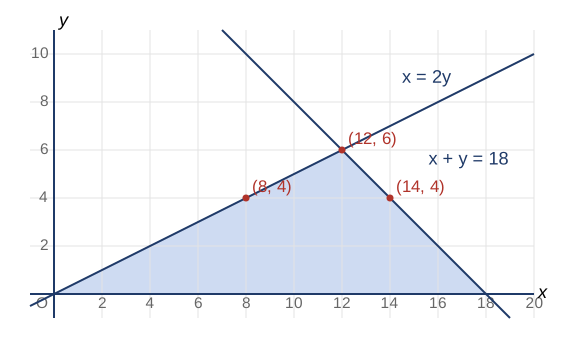
(d) Can there be 8 girls? No. y = 8 needs x ≥ 16 and x ≤ 10 at the same time, which is impossible, so it is outside the common region.
Writing "at most" as < instead of ≤. "At most", "not more than" and "maximum" all use ≤. "At least", "not less than" and "minimum" use ≥. Only "more than", "less than", "exceeds" are strict.
State the inequality for "the number of chairs y exceeds the number of tables x by at least 6".
Show answerHide answer
y − x ≥ 6