Practice paper, not an official KPM paper
55
Ujian Akhir Sesi AkademikEnd of Academic Session Test
FizikPhysics
Tingkatan 4, 2 jam 30 minit / 2 hours 30 minutes, 100 marks
Nama / Name
Kelas / Class
Tarikh / Date
Markah / Marks: / 100
Instructions
- Kertas soalan ini mengandungi empat bahagian: Bahagian A, B, C dan D.This question paper consists of four sections: Section A, B, C and D.
- Bahagian A: pilih satu jawapan bagi setiap soalan.Section A: choose one answer for each question.
- Bahagian B dan D: jawab semua soalan. Bahagian C: jawab mana-mana satu soalan.Sections B and D: answer all questions. Section C: answer any one question.
- Tulis jawapan anda di ruang yang disediakan. Tunjukkan jalan kerja bagi pengiraan.Write your answers in the spaces provided. Show your working for calculations.
- Rajah yang mengiringi soalan tidak dilukis mengikut skala kecuali dinyatakan.The diagrams in this paper are not drawn to scale unless stated.
- Anda dibenarkan menggunakan kalkulator saintifik. Senarai rumus disediakan.You may use a scientific calculator. A list of formulae is provided.
- Ambil g = 9.81 m s⁻², G = 6.67 × 10⁻¹¹ N m² kg⁻² dan c = 3.00 × 10⁸ m s⁻¹.Take g = 9.81 m s⁻², G = 6.67 × 10⁻¹¹ N m² kg⁻² and c = 3.00 × 10⁸ m s⁻¹.
Answer schemes are in English (DLP).
Practice shows answers as you go. Exam times you and hides answers until you submit.
Bahagian ASection A
20 marksJawab semua soalan. Setiap soalan diikuti oleh empat pilihan jawapan, A, B, C dan D. Pilih satu jawapan sahaja.Answer all questions. Each question is followed by four options, A, B, C and D. Choose one answer only.
1
Question 1
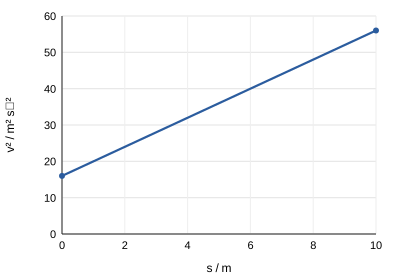
Rajah 1 menunjukkan graf v² melawan s bagi sebuah troli yang bergerak dengan pecutan seragam. Menggunakan v² = u² + 2as, apakah halaju awal, u, dan pecutan, a, troli itu?Diagram 1 shows a graph of v² against s for a trolley moving with uniform acceleration. Using v² = u² + 2as, what are the initial velocity, u, and the acceleration, a, of the trolley?
Show answerHide answer
C
The y-intercept is u² = 16, so u = 4.0 m s⁻¹. The gradient = (56 − 16) ÷ 10 = 4.0 m s⁻², which equals 2a, so a = 2.0 m s⁻². Taking the intercept (16) as u, or the gradient (4.0) as a, are the common slips.
2
Question 2
Hana meletakkan sekeping syiling di atas sekeping kad yang diletakkan di atas mulut sebuah gelas. Dia memetik kad itu dengan pantas secara mengufuk dan syiling itu jatuh ke dalam gelas. Mengapakah syiling itu jatuh ke dalam gelas?Hana puts a coin on a card that rests on the mouth of a glass. She flicks the card away quickly in a horizontal direction and the coin drops into the glass. Why does the coin drop into the glass?
Show answerHide answer
A
The coin has inertia: it tends to stay at rest when the card is pulled away quickly, so gravity makes it drop into the glass (Newton's First Law). Friction acts horizontally, and gravity always acts on the coin.
3
Question 3
Troli P berjisim 0.80 kg bergerak pada 1.5 m s⁻¹ dan berlanggar dengan troli Q berjisim 0.40 kg yang pegun. Selepas perlanggaran, troli P bergerak dalam arah yang sama pada 0.50 m s⁻¹. Berapakah halaju troli Q selepas perlanggaran?Trolley P of mass 0.80 kg moving at 1.5 m s⁻¹ collides with a stationary trolley Q of mass 0.40 kg. After the collision, trolley P moves in the same direction at 0.50 m s⁻¹. What is the velocity of trolley Q after the collision?
Show answerHide answer
D
Momentum is conserved: 0.80 × 1.5 + 0 = 0.80 × 0.50 + 0.40 v, so 1.20 = 0.40 + 0.40 v and v = 2.0 m s⁻¹.
4
Question 4
Sebuah lif berjisim 500 kg ditarik ke atas oleh kabel dengan tegangan 6 405 N. Berapakah pecutan lif itu?A lift of mass 500 kg is pulled upwards by a cable with a tension of 6 405 N. What is the acceleration of the lift?
Show answerHide answer
A
Resultant force = T − mg = 6 405 − 500 × 9.81 = 6 405 − 4 905 = 1 500 N upwards. a = F ÷ m = 1 500 ÷ 500 = 3.0 m s⁻². 12.8 comes from forgetting the weight (T ÷ m).
5
Question 5
Dalam suatu sistem tertutup, kuantiti manakah sentiasa diabadikan dalam semua jenis perlanggaran, termasuk perlanggaran tak kenyal?In a closed system, which quantity is always conserved in every type of collision, including an inelastic collision?
Show answerHide answer
B
The Principle of Conservation of Momentum: total momentum before = total momentum after, in any collision of a closed system. Kinetic energy is lost in an inelastic collision.
6
Question 6
Seorang pemain bola jaring melontar bola tegak ke atas dan menangkapnya semula di tangannya selepas 3.0 s. Berapakah ketinggian maksimum yang dicapai oleh bola itu? [Abaikan rintangan udara]A netball player throws a ball vertically upwards and catches it again at the same point after 3.0 s. What is the maximum height reached by the ball? [Ignore air resistance]
Show answerHide answer
C
The ball takes 1.5 s to reach the top, where v = 0. h = ½gt² = ½ × 9.81 × 1.5² = 11.0 m. 44.1 m uses the whole 3.0 s, and 14.7 m is the launch speed (g × 1.5).
7
Question 7
Hukum Kepler yang manakah menyatakan bahawa kuasa dua tempoh orbit sebuah planet adalah berkadar terus dengan kuasa tiga jejari orbitnya?Which of Kepler's laws states that the square of the orbital period of a planet is directly proportional to the cube of its orbital radius?
Show answerHide answer
D
Kepler's third law: T² ∝ r³, so T²/r³ is the same for all planets orbiting the Sun. The first law is about elliptical orbits and the second about equal areas in equal times.
8
Question 8
Sebuah planet mempunyai jisim 6.4 × 10²³ kg dan jejari 3.4 × 10⁶ m. Berapakah pecutan graviti di permukaan planet itu?A planet has a mass of 6.4 × 10²³ kg and a radius of 3.4 × 10⁶ m. What is the gravitational acceleration at the surface of the planet?
Show answerHide answer
B
g = GM/r² = (6.67 × 10⁻¹¹ × 6.4 × 10²³) ÷ (3.4 × 10⁶)² = 4.27 × 10¹³ ÷ 1.156 × 10¹³ = 3.69 m s⁻². 1.26 × 10⁷ comes from not squaring r.
9
Question 9
Sebuah bulan berjisim 3.0 × 10²³ kg mempunyai jejari 2.4 × 10⁶ m. Berapakah halaju lepas bagi bulan itu?A moon of mass 3.0 × 10²³ kg has a radius of 2.4 × 10⁶ m. What is the escape velocity of the moon?
Show answerHide answer
A
v = √(2GM/R) = √(2 × 6.67 × 10⁻¹¹ × 3.0 × 10²³ ÷ 2.4 × 10⁶) = √(1.67 × 10⁷) = 4.08 × 10³ m s⁻¹. 2.89 × 10³ leaves out the factor 2 and 1.67 × 10⁷ forgets the square root.
10
Question 10
Seorang tukang masak mendapati bahawa kulit tangannya melecur lebih teruk apabila terkena wap pada 100 °C berbanding air mendidih pada 100 °C. Mengapakah hal ini berlaku?A cook finds that her hand is scalded more badly by steam at 100 °C than by boiling water at 100 °C. Why does this happen?
Show answerHide answer
C
Steam at 100 °C condenses on the skin and releases its latent heat of vaporisation, in addition to the heat released as the water cools. Boiling water and steam are both at 100 °C.
11
Question 11
Sebuah dapur elektrik 2.0 kW memanaskan 1.5 kg minyak masak yang mempunyai muatan haba tentu 2 000 J kg⁻¹ °C⁻¹ daripada 30 °C kepada 90 °C. Berapakah masa yang diambil? [Anggap semua haba diserap oleh minyak]A 2.0 kW electric stove heats 1.5 kg of cooking oil of specific heat capacity 2 000 J kg⁻¹ °C⁻¹ from 30 °C to 90 °C. How long does it take? [Assume all the heat is absorbed by the oil]
Show answerHide answer
B
Pt = mcΔθ: 2 000 × t = 1.5 × 2 000 × 60 = 180 000 J, so t = 90 s.
12
Question 12
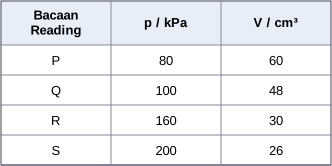
Jadual 1 menunjukkan empat bacaan tekanan, p, dan isi padu, V, bagi satu jisim tetap gas pada suhu malar. Tiga bacaan mematuhi hukum Boyle. Bacaan yang manakah tidak mematuhi hukum Boyle?Table 1 shows four readings of pressure, p, and volume, V, of a fixed mass of gas at constant temperature. Three readings obey Boyle's law. Which reading does not obey Boyle's law?
Show answerHide answer
D
Boyle's law: pV is constant. P: 80 × 60 = 4 800; Q: 100 × 48 = 4 800; R: 160 × 30 = 4 800; S: 200 × 26 = 5 200. Only S does not fit.
13
Question 13
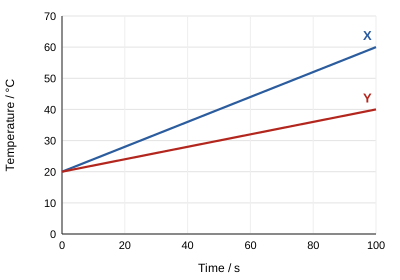
Rajah 2 menunjukkan graf suhu melawan masa bagi cecair X dan cecair Y yang mempunyai jisim sama dan dipanaskan oleh pemanas elektrik yang sama. Pernyataan yang manakah betul?Diagram 2 shows temperature-time graphs of liquid X and liquid Y of equal mass, heated by the same electric heater. Which statement is correct?
Show answerHide answer
A
Same mass, same heater and same time means the same heat Q is absorbed (D is wrong). Q = mcΔθ, so c = Q/(mΔθ). X rises by 40 °C and Y by 20 °C, so c of Y is twice c of X.
14
Question 14
Gelombang elektromagnet yang manakah digunakan dalam alat kawalan jauh televisyen?Which electromagnetic wave is used in the remote control of a television?
Show answerHide answer
C
Infrared rays are used in remote controls (and in thermal imaging and night vision).
15
Question 15
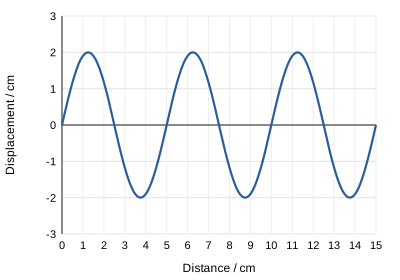
Rajah 3 menunjukkan graf sesaran melawan jarak bagi gelombang air yang mempunyai frekuensi 8.0 Hz. Berapakah laju gelombang itu?Diagram 3 shows a displacement-distance graph of a water wave of frequency 8.0 Hz. What is the speed of the wave?
Show answerHide answer
B
Three complete waves fit in 15 cm, so λ = 5.0 cm. v = fλ = 8.0 × 5.0 = 40 cm s⁻¹. 16 uses the amplitude (2 cm), and 120 uses the whole 15 cm.
16
Question 16
Dalam eksperimen dwicelah Young, jarak antara dua pinggir cerah bersebelahan ialah 1.2 mm apabila cahaya hijau dengan panjang gelombang 5.0 × 10⁻⁷ m digunakan. Apakah jarak ini jika cahaya hijau diganti dengan cahaya merah yang panjang gelombangnya 6.5 × 10⁻⁷ m dan semua keadaan lain tidak berubah?In a Young's double-slit experiment, the distance between two adjacent bright fringes is 1.2 mm when green light of wavelength 5.0 × 10⁻⁷ m is used. What is this distance if the green light is replaced with red light of wavelength 6.5 × 10⁻⁷ m and everything else stays the same?
Show answerHide answer
B
λ = ax/D, so x ∝ λ when a and D are fixed. x = 1.2 × (6.5 ÷ 5.0) = 1.56 mm. 0.92 mm inverts the ratio and 2.03 mm squares it.
17
Question 17
Cahaya bergerak dari udara ke dalam kaca. Apakah yang berlaku kepada laju, panjang gelombang dan frekuensi cahaya itu?Light travels from air into glass. What happens to the speed, the wavelength and the frequency of the light?
Show answerHide answer
A
Light slows down in glass (a denser medium). The frequency is fixed by the source, so from v = fλ the wavelength decreases too.
18
Question 18
Seberkas cahaya dari udara jatuh ke atas sebuah bongkah plastik lut sinar pada sudut tuju 50°. Sudut biasan ialah 30°. Berapakah indeks biasan plastik itu?A ray of light from air strikes a transparent plastic block at an angle of incidence of 50°. The angle of refraction is 30°. What is the refractive index of the plastic?
Show answerHide answer
C
n = sin i ÷ sin r = sin 50° ÷ sin 30° = 0.766 ÷ 0.500 = 1.53. 1.67 is 50 ÷ 30, which wrongly uses the angles themselves.
19
Question 19
Sebatang pensel setinggi 4.0 cm diletakkan 30 cm dari sebuah kanta cembung yang panjang fokusnya 12 cm. Berapakah tinggi imej yang terbentuk?A pencil 4.0 cm tall is placed 30 cm from a convex lens of focal length 12 cm. What is the height of the image formed?
Show answerHide answer
B
1/v = 1/f − 1/u = 1/12 − 1/30 = 1/20, so v = 20 cm. m = v/u = 20/30 = 0.667. Image height = 0.667 × 4.0 = 2.7 cm. 6.0 cm comes from inverting m (u/v).
20
Question 20
Seberkas cahaya di dalam sebuah plastik lut sinar jatuh ke atas sempadan plastik-udara. Pantulan dalam penuh baru sahaja berlaku apabila sudut tuju ialah 45°. Berapakah indeks biasan plastik itu?A ray of light inside a transparent plastic strikes the plastic-air boundary. Total internal reflection only just happens when the angle of incidence is 45°. What is the refractive index of the plastic?
Show answerHide answer
D
The critical angle c = 45°, so n = 1/sin c = 1 ÷ sin 45° = 1.41. 0.71 is sin 45° itself, and a refractive index can never be less than 1.
Bahagian BSection B
40 marksJawab semua soalan. Tulis jawapan anda di ruang yang disediakan. Setiap soalan bernilai 10 markah.Answer all questions. Write your answers in the spaces provided. Each question is worth 10 marks.
21
Question 21
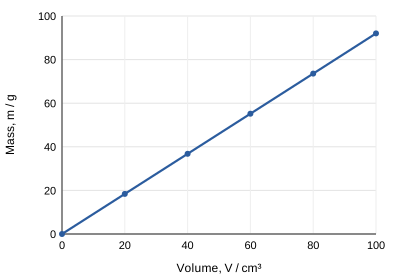
Seorang pelajar mengkaji hubungan antara jisim, m, dan isi padu, V, minyak masak. Rajah 4 menunjukkan graf m melawan V yang diplot daripada keputusannya. Dia juga mencatat bahawa seorang penunggang basikal bergerak pada laju 36 km j⁻¹.A student studies the relationship between the mass, m, and the volume, V, of cooking oil. Diagram 4 shows the graph of m against V plotted from her results. She also notes that a cyclist rides at a speed of 36 km h⁻¹.
[2 marks]
(a)Antara jisim, laju, daya, suhu dan luas, namakan dua kuantiti asas.From mass, speed, force, temperature and area, name two base quantities.
Show answerHide answer
Tick each point you got.
[1 mark]
(b)Namakan satu kuantiti vektor daripada senarai dalam (a).Name one vector quantity from the list in (a).
Show answerHide answer
Tick each point you got.
[2 marks]
(c)Tukarkan laju penunggang basikal itu, 36 km j⁻¹, kepada m s⁻¹.Convert the speed of the cyclist, 36 km h⁻¹, to m s⁻¹.
Show answerHide answer
Tick each point you got.
[1 mark]
(d)Nyatakan hubungan antara m dengan V berdasarkan Rajah 4.State the relationship between m and V based on Diagram 4.
Show answerHide answer
Tick each point you got.
[2 marks]
(e)Hitung kecerunan graf itu.Calculate the gradient of the graph.
Show answerHide answer
Tick each point you got.
[1 mark]
(f)Apakah kuantiti fizik yang diwakili oleh kecerunan graf itu?What physical quantity is represented by the gradient of the graph?
Show answerHide answer
Tick each point you got.
[1 mark]
(g)Ramalkan jisim 150 cm³ minyak masak itu.Predict the mass of 150 cm³ of the cooking oil.
Show answerHide answer
Tick each point you got.
22
Question 22
Rajah 5 menunjukkan dua keping pita detik, P dan Q, yang ditarik melalui sebuah jangka masa detik berfrekuensi 50 Hz oleh dua buah troli. Jarak antara dua titik bersebelahan pada pita P ialah 0.50 cm. Seorang penunggang motosikal dan motosikalnya mempunyai jisim 250 kg bergerak pada 24 m s⁻¹ di sebatang jalan raya.Diagram 5 shows two ticker tapes, P and Q, pulled through a ticker timer of frequency 50 Hz by two trolleys. The distance between two adjacent dots on tape P is 0.50 cm. A motorcyclist and motorcycle of total mass 250 kg travel at 24 m s⁻¹ along a road.

[2 marks]
(a)Huraikan gerakan troli yang menghasilkan pita P dan pita Q.Describe the motion of the trolleys that produced tape P and tape Q.
Show answerHide answer
Tick each point you got.
[2 marks]
(b)Hitung halaju troli bagi pita P dalam cm s⁻¹.Calculate the velocity of the trolley for tape P in cm s⁻¹.
Show answerHide answer
Tick each point you got.
[1 mark]
(c)Takrifkan inersia.Define inertia.
Show answerHide answer
Tick each point you got.
[1 mark]
(d)Hitung momentum penunggang motosikal dan motosikalnya.Calculate the momentum of the motorcyclist and the motorcycle.
Show answerHide answer
Tick each point you got.
[2 marks]
(e)Motosikal itu dibrek dan berhenti dalam masa 4.0 s. Hitung purata daya yang bertindak pada motosikal dan penunggangnya.The motorcycle brakes and stops in 4.0 s. Calculate the average force acting on the motorcycle and its rider.
Show answerHide answer
Tick each point you got.
[2 marks]
(f)Sebuah beg udara kereta mengurangkan kecederaan pemandu semasa kemalangan. Terangkan mengapa.A car airbag reduces injury to the driver in an accident. Explain why.
Show answerHide answer
Tick each point you got.
23
Question 23
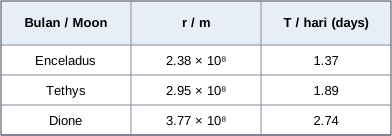
Jadual 2 menunjukkan jejari orbit, r, dan tempoh orbit, T, bagi tiga buah bulan planet Zuhal, Enceladus, Tethys dan Dione. Jisim Zuhal ialah M.Table 2 shows the orbital radius, r, and the orbital period, T, of three moons of the planet Saturn: Enceladus, Tethys and Dione. The mass of Saturn is M.
[1 mark]
(a)Nyatakan hukum ketiga Kepler.State Kepler's third law.
Show answerHide answer
Tick each point you got.
[2 marks]
(b)Tunjukkan bahawa bulan Enceladus dan Tethys mematuhi hukum itu dengan mengira T²/r³ bagi kedua-duanya (T dalam hari dan r dalam m).Show that Enceladus and Tethys obey the law by calculating T²/r³ for both (T in days and r in m).
Show answerHide answer
Tick each point you got.
[2 marks]
(c)Bulan Titan mengorbit pada jejari 1.22 × 10⁹ m. Hitung tempoh orbitnya dalam hari.The moon Titan orbits at a radius of 1.22 × 10⁹ m. Calculate its orbital period in days.
Show answerHide answer
Tick each point you got.
[1 mark]
(d)Tukarkan tempoh orbit Enceladus kepada saat.Convert the orbital period of Enceladus to seconds.
Show answerHide answer
Tick each point you got.
[3 marks]
(e)Hitung jisim Zuhal menggunakan data bagi Enceladus. [M = 4π²r³ / GT²]Calculate the mass of Saturn using the data for Enceladus. [M = 4π²r³ / GT²]
Show answerHide answer
Tick each point you got.
[1 mark]
(f)Daya yang manakah menyediakan daya memusat yang menyebabkan Enceladus mengorbit Zuhal?Which force provides the centripetal force that keeps Enceladus in orbit around Saturn?
Show answerHide answer
Tick each point you got.
24
Question 24
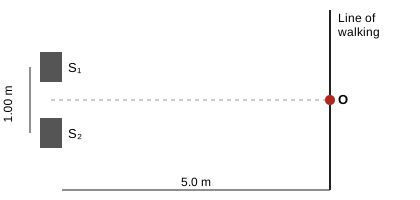
Rajah 6 menunjukkan dua pembesar suara, S₁ dan S₂, yang dipisahkan sejauh 1.00 m dan disambungkan kepada satu penjana isyarat yang sama. Kedua-duanya memancarkan bunyi berfrekuensi 1 360 Hz. Laju bunyi di udara ialah 340 m s⁻¹. Seorang murid berjalan sepanjang satu garis lurus sejauh 5.0 m dari pembesar suara dan mendengar bunyi kuat dan lemah secara berselang-seli. O terletak pada pembahagi dua sama serenjang S₁S₂.Diagram 6 shows two loudspeakers, S₁ and S₂, 1.00 m apart and connected to the same signal generator. Both emit sound of frequency 1 360 Hz. The speed of sound in air is 340 m s⁻¹. A pupil walks along a straight line 5.0 m from the loudspeakers and hears loud and soft sounds alternately. O is on the perpendicular bisector of S₁S₂.
[1 mark]
(a)Namakan fenomena yang menyebabkan bunyi kuat dan lemah itu.Name the phenomenon that causes the loud and soft sounds.
Show answerHide answer
Tick each point you got.
[1 mark]
(b)Mengapakah kedua-dua pembesar suara disambungkan kepada satu penjana isyarat yang sama?Why are the two loudspeakers connected to the same signal generator?
Show answerHide answer
Tick each point you got.
[2 marks]
(c)Hitung panjang gelombang bunyi itu.Calculate the wavelength of the sound.
Show answerHide answer
Tick each point you got.
[2 marks]
(d)Hitung jarak antara dua kedudukan bunyi kuat yang bersebelahan. [λ = ax / D]Calculate the distance between two adjacent positions of loud sound. [λ = ax / D]
Show answerHide answer
Tick each point you got.
[2 marks]
(e)Apakah jenis bunyi yang didengar di O? Terangkan jawapan anda.What type of sound is heard at O? Explain your answer.
Show answerHide answer
Tick each point you got.
[1 mark]
(f)Berapakah beza lintasan di kedudukan bunyi lemah yang pertama dari O?What is the path difference at the first position of soft sound from O?
Show answerHide answer
Tick each point you got.
[1 mark]
(g)Cadangkan satu perubahan yang menjadikan jarak antara kedudukan bunyi kuat lebih besar.Suggest one change that makes the distance between the loud positions larger.
Show answerHide answer
Any 1 points
Tick each point you got.
Bahagian CSection C
20 marksJawab mana-mana satu soalan. Setiap soalan bernilai 20 markah.Answer any one question. Each question is worth 20 marks.
25Choose 1
Question 25
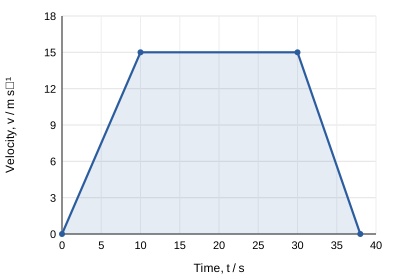
Rajah 7 menunjukkan graf halaju-masa bagi sebuah kereta api berjisim 2.4 × 10⁵ kg yang bergerak di atas landasan lurus antara dua stesen.Diagram 7 shows the velocity-time graph of a train of mass 2.4 × 10⁵ kg moving along a straight track between two stations.
[2 marks]
(a)Hitung pecutan kereta api itu dalam 10 s yang pertama.Calculate the acceleration of the train in the first 10 s.
Show answerHide answer
Tick each point you got.
[2 marks]
(b)Hitung nyahpecutan kereta api itu dari t = 30 s hingga t = 38 s.Calculate the deceleration of the train from t = 30 s to t = 38 s.
Show answerHide answer
Tick each point you got.
[2 marks]
(c)Hitung jumlah jarak antara kedua-dua stesen itu.Calculate the total distance between the two stations.
Show answerHide answer
Tick each point you got.
[1 mark]
(d)Hitung laju purata kereta api itu bagi seluruh perjalanan.Calculate the average speed of the train for the whole journey.
Show answerHide answer
Tick each point you got.
[2 marks]
(e)Hitung daya paduan yang diperlukan untuk memecut kereta api itu dalam 10 s yang pertama.Calculate the resultant force needed to accelerate the train in the first 10 s.
Show answerHide answer
Tick each point you got.
[2 marks]
(f)Geseran sebanyak 4.0 × 10⁴ N bertindak pada kereta api dalam 10 s yang pertama. Hitung daya tujah enjin kereta api itu.A friction force of 4.0 × 10⁴ N acts on the train in the first 10 s. Calculate the driving force of the train's engine.
Show answerHide answer
Tick each point you got.
[2 marks]
(g)Seorang penumpang yang berdiri tergelincir ke hadapan apabila kereta api mula menyahpecut pada t = 30 s. Terangkan mengapa, dengan menggunakan konsep inersia.A standing passenger stumbles forward when the train starts to decelerate at t = 30 s. Explain why, using the concept of inertia.
Show answerHide answer
Tick each point you got.
[3 marks]
(h)Seorang gimnas berjisim 50 kg mendarat pada halaju 6.0 m s⁻¹ dan berhenti. Pada lantai keras, dia berhenti dalam 0.050 s. Pada tilam tebal, dia berhenti dalam 0.40 s. Hitung daya impuls pada lantai keras dan pada tilam.A gymnast of mass 50 kg lands at 6.0 m s⁻¹ and stops. On a hard floor she stops in 0.050 s. On a thick mat she stops in 0.40 s. Calculate the impulsive force on the hard floor and on the mat.
Show answerHide answer
Tick each point you got.
[4 marks]
(i)Seorang jurutera mereka bentuk gerabak kereta api yang lebih selamat untuk perlanggaran. Cadangkan dua ciri reka bentuk dan terangkan fungsi setiap satu.An engineer designs a safer train carriage for collisions. Suggest two design features and explain the function of each.
Show answerHide answer
Accept any other reasonable safety feature with a reason based on impulsive force (time of impact) or inertia.
Tick each point you got.
26Choose 1
Question 26
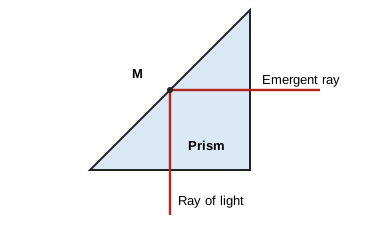
Jadual 3 menunjukkan sudut tuju, i, dan sudut biasan, r, apabila seberkas cahaya dari udara melalui sebuah bongkah kaca. Rajah 8 menunjukkan seberkas cahaya yang memasuki sebuah prisma bersudut tegak yang diperbuat daripada kaca yang sama.Table 3 shows the angle of incidence, i, and the angle of refraction, r, when a ray of light from air passes into a glass block. Diagram 8 shows a ray of light entering a right-angled prism made of the same glass.

[1 mark]
(a)Nyatakan hukum Snell.State Snell's law.
Show answerHide answer
Tick each point you got.
[2 marks]
(b)Menggunakan sudut tuju 50° dalam Jadual 3, hitung indeks biasan kaca itu.Using the angle of incidence of 50° in Table 3, calculate the refractive index of the glass.
Show answerHide answer
Tick each point you got.
[1 mark]
(c)Hitung laju cahaya di dalam kaca itu.Calculate the speed of light in the glass.
Show answerHide answer
Tick each point you got.
[2 marks]
(d)Hitung sudut genting kaca itu.Calculate the critical angle of the glass.
Show answerHide answer
Tick each point you got.
[2 marks]
(e)Nyatakan dua syarat untuk pantulan dalam penuh berlaku.State two conditions for total internal reflection to occur.
Show answerHide answer
Tick each point you got.
[2 marks]
(f)Dalam Rajah 8, sudut tuju sinar di M ialah 45°. Terangkan mengapa sinar itu dipantulkan sepenuhnya di M.In Diagram 8, the angle of incidence of the ray at M is 45°. Explain why the ray is totally reflected at M.
Show answerHide answer
Tick each point you got.
[2 marks]
(g)Sebuah slaid setinggi 3.0 cm diletakkan 12 cm dari kanta cembung berfokus 10 cm dalam sebuah projektor. Hitung jarak imej dari kanta.A slide 3.0 cm tall is placed 12 cm from a convex lens of focal length 10 cm in a projector. Calculate the distance of the image from the lens.
Show answerHide answer
Tick each point you got.
[2 marks]
(h)Hitung pembesaran linear dan tinggi imej pada skrin.Calculate the linear magnification and the height of the image on the screen.
Show answerHide answer
Tick each point you got.
[2 marks]
(i)Nyatakan dua ciri imej pada skrin itu.State two characteristics of the image on the screen.
Show answerHide answer
Any 2 points
Tick each point you got.
[2 marks]
(j)Seorang nelayan menombak ikan di dalam air yang jernih. Terangkan mengapa dia perlu menujukan tombaknya ke bawah kedudukan ikan yang dilihatnya.A fisherman spears a fish in clear water. Explain why he must aim the spear below the position where he sees the fish.
Show answerHide answer
Tick each point you got.
[2 marks]
(k)Sebuah binokular menggunakan prisma bersudut tegak seperti dalam Rajah 8, bukannya cermin satah. Cadangkan dua kelebihan menggunakan prisma.A pair of binoculars uses right-angled prisms like the one in Diagram 8 instead of plane mirrors. Suggest two advantages of using prisms.
Show answerHide answer
Any 2 points
Tick each point you got.
Bahagian DSection D
20 marksSoalan ini wajib dijawab. Soalan bernilai 20 markah.This question is compulsory. It is worth 20 marks.
27
Question 27
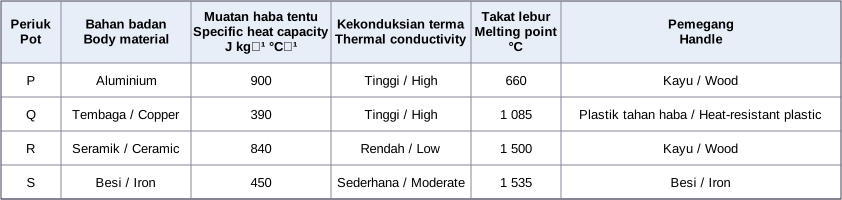
Sebuah kedai peralatan dapur ingin menjual periuk yang memanaskan makanan dengan cepat, tidak lebur dan selamat dipegang. Jadual 4 menunjukkan ciri-ciri empat buah periuk, P, Q, R dan S. Muatan haba tentu air ialah 4 200 J kg⁻¹ °C⁻¹ dan haba pendam tentu pengewapan air ialah 2.26 × 10⁶ J kg⁻¹.A kitchenware shop wants to sell a pot that heats food quickly, does not melt and is safe to hold. Table 4 shows the features of four pots, P, Q, R and S. The specific heat capacity of water is 4 200 J kg⁻¹ °C⁻¹ and the specific latent heat of vaporisation of water is 2.26 × 10⁶ J kg⁻¹.
[1 mark]
(a)Apakah yang dimaksudkan dengan muatan haba tentu?What is meant by specific heat capacity?
Show answerHide answer
Tick each point you got.
[8 marks]
(b)Berdasarkan Jadual 4, nyatakan ciri yang sesuai bagi (i) muatan haba tentu badan periuk, (ii) kekonduksian terma badan periuk, (iii) takat lebur badan periuk dan (iv) bahan pemegang. Beri satu sebab bagi setiap ciri itu.Based on Table 4, state the suitable feature of (i) the specific heat capacity of the body, (ii) the thermal conductivity of the body, (iii) the melting point of the body and (iv) the handle material. Give one reason for each feature.
Show answerHide answer
Tick each point you got.
[1 mark]
(c)Periuk yang manakah paling sesuai? Beri satu sebab.Which pot is the most suitable? Give one reason.
Show answerHide answer
Tick each point you got.
[2 marks]
(d)Periuk Q berjisim 0.60 kg mengandungi 1.5 kg air pada 28 °C. Muatan haba tentu kuprum ialah 390 J kg⁻¹ °C⁻¹. Hitung haba yang diserap oleh air untuk mencapai 100 °C.Pot Q of mass 0.60 kg contains 1.5 kg of water at 28 °C. The specific heat capacity of copper is 390 J kg⁻¹ °C⁻¹. Calculate the heat absorbed by the water to reach 100 °C.
Show answerHide answer
Tick each point you got.
[2 marks]
(e)Hitung haba yang diserap oleh periuk itu dan jumlah haba yang diperlukan.Calculate the heat absorbed by the pot and the total heat required.
Show answerHide answer
Tick each point you got.
[3 marks]
(f)Sebuah dapur elektrik berkuasa 2.0 kW dan 80% cekap. Hitung masa yang diambil untuk memanaskan periuk dan air itu hingga 100 °C.An electric stove has a power of 2.0 kW and is 80% efficient. Calculate the time taken to heat the pot and the water to 100 °C.
Show answerHide answer
Tick each point you got.
[2 marks]
(g)Selepas itu, 0.10 kg air dididihkan menjadi wap pada 100 °C. Hitung haba yang diperlukan.After that, 0.10 kg of the water is boiled into steam at 100 °C. Calculate the heat required.
Show answerHide answer
Tick each point you got.
[1 mark]
(h)Mengapakah suhu air kekal 100 °C semasa air mendidih walaupun haba terus dibekalkan?Why does the temperature of the water stay at 100 °C while it boils even though heat is still supplied?
Show answerHide answer
Tick each point you got.
Test specification (JSU)
| Chapter | Remembering | Understanding | Applying | Analysing | Evaluating | Creating | Items | marks |
|---|---|---|---|---|---|---|---|---|
| 1. Measurement | – | 1 (10) | 1 (1) | – | – | – | 2 | 11 |
| 2. Force and Motion I | 1 (1) | 2 (11) | 3 (3) | – | 1 (20) | – | 7 | 35 |
| 3. Gravitation | 1 (1) | – | 3 (12) | – | – | – | 4 | 13 |
| 4. Heat | – | 1 (1) | 1 (1) | 2 (2) | 1 (20) | – | 5 | 24 |
| 5. Waves | 1 (1) | – | 2 (2) | 1 (10) | – | – | 4 | 13 |
| 6. Light and Optics | – | 1 (1) | 3 (3) | – | 1 (20) | – | 5 | 24 |
| Total | 3 (3) | 5 (23) | 13 (22) | 3 (12) | 3 (60) | 0 (0) | 27 | 120 |
Each cell shows items (marks).