Practice paper, not an official KPM paper
55
Ujian Akhir Sesi AkademikEnd of Academic Session Test
FizikPhysics
Tingkatan 4, 2 jam 30 minit / 2 hours 30 minutes, 100 marks
Nama / Name
Kelas / Class
Tarikh / Date
Markah / Marks: / 100
Instructions
- Kertas soalan ini mengandungi empat bahagian: Bahagian A, B, C dan D.This question paper consists of four sections: Section A, B, C and D.
- Bahagian A: pilih satu jawapan bagi setiap soalan.Section A: choose one answer for each question.
- Bahagian B dan D: jawab semua soalan. Bahagian C: jawab mana-mana satu soalan.Sections B and D: answer all questions. Section C: answer any one question.
- Tulis jawapan anda di ruang yang disediakan. Tunjukkan jalan kerja bagi pengiraan.Write your answers in the spaces provided. Show your working for calculations.
- Rajah yang mengiringi soalan tidak dilukis mengikut skala kecuali dinyatakan.The diagrams in this paper are not drawn to scale unless stated.
- Anda dibenarkan menggunakan kalkulator saintifik. Senarai rumus disediakan.You may use a scientific calculator. A list of formulae is provided.
Answer schemes are in English (DLP).
Practice shows answers as you go. Exam times you and hides answers until you submit.
Bahagian ASection A
20 marksJawab semua soalan. Setiap soalan diikuti oleh empat pilihan jawapan, A, B, C dan D. Pilih satu jawapan sahaja.Answer all questions. Each question is followed by four options, A, B, C and D. Choose one answer only.
1
Question 1
Panjang sebuah bakteria yang dilihat di bawah mikroskop ialah 2.5 µm. Berapakah panjang ini dalam meter?The length of a bacterium seen under a microscope is 2.5 µm. What is this length in metres?
Show answerHide answer
B
The prefix micro (µ) means 10⁻⁶, so 2.5 µm = 2.5 × 10⁻⁶ m. 10⁻³ is milli and 10⁻⁹ is nano.
2
Question 2
Pita detik yang ditarik oleh sebuah troli dipotong kepada jalur 5 detik. Panjang jalur berturut-turut ialah 1.5 cm, 3.0 cm, 4.5 cm dan 6.0 cm. Apakah jenis gerakan troli itu?A ticker tape pulled by a trolley is cut into strips of 5 ticks. The lengths of successive strips are 1.5 cm, 3.0 cm, 4.5 cm and 6.0 cm. What type of motion does the trolley have?
Show answerHide answer
C
The strip length increases by the same amount (1.5 cm) each time, so the velocity increases at a constant rate: uniform acceleration. Equal strip lengths would mean uniform velocity.
3
Question 3
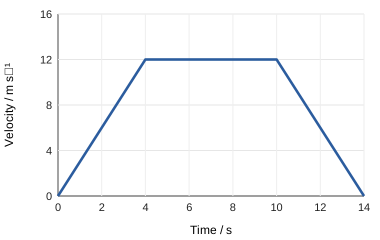
Rajah 1 menunjukkan graf halaju-masa bagi sebuah motosikal pada sebuah jalan lurus. Berapakah jarak yang dilalui oleh motosikal itu dalam 14 s?Diagram 1 shows the velocity-time graph of a motorcycle on a straight road. What is the distance travelled by the motorcycle in 14 s?
Show answerHide answer
A
Distance = area under the graph = a trapezium: ½ × (6 + 14) × 12 = 120 m. 168 m is 12 × 14 (as if the speed stayed at 12 m s⁻¹ throughout); 84 m is ½ × 14 × 12 (a triangle).
4
Question 4
Sebiji bola berjisim 0.50 kg yang bergerak pada 6.0 m s⁻¹ menghentam dinding dan melantun balik pada 4.0 m s⁻¹ dalam arah bertentangan. Berapakah magnitud impuls yang dikenakan oleh dinding pada bola itu?A ball of mass 0.50 kg moving at 6.0 m s⁻¹ hits a wall and rebounds at 4.0 m s⁻¹ in the opposite direction. What is the magnitude of the impulse the wall exerts on the ball?
Show answerHide answer
D
Impulse = change in momentum = m(v − u) = 0.50 × [(−4.0) − 6.0] = −5.0 N s, magnitude 5.0 N s. The velocities are in opposite directions, so they are added, not subtracted (1.0 N s is the mistake).
5
Question 5
Enjin sebuah kereta berjisim 900 kg menghasilkan daya tujah 3 000 N ke hadapan. Daya geseran jalan raya ialah 1 200 N. Berapakah pecutan kereta itu?The engine of a car of mass 900 kg produces a forward thrust of 3 000 N. The road friction is 1 200 N. What is the acceleration of the car?
Show answerHide answer
B
Resultant force = 3 000 − 1 200 = 1 800 N. a = F ÷ m = 1 800 ÷ 900 = 2.0 m s⁻². 3.3 uses the thrust only and 4.7 adds the friction.
6
Question 6
Sepucuk senapang berjisim 2.0 kg menembak sebutir peluru berjisim 20 g pada laju 300 m s⁻¹. Senapang itu pada mulanya pegun dan bebas bergerak. Berapakah laju sentakan senapang itu?A gun of mass 2.0 kg fires a bullet of mass 20 g at a speed of 300 m s⁻¹. The gun is at rest at first and is free to move. What is the recoil speed of the gun?
Show answerHide answer
C
Conservation of momentum: 0 = (0.020 × 300) − (2.0 × V). 6.0 = 2.0 V, so V = 3.0 m s⁻¹. 0.30 comes from using 20 g without converting to kg.
7
Question 7
Hukum Kegravitian Semesta Newton ialah F = Gm₁m₂ ÷ r². Apakah unit S.I. bagi pemalar graviti, G?Newton's Universal Law of Gravitation is F = Gm₁m₂ ÷ r². What is the S.I. unit of the gravitational constant, G?
Show answerHide answer
D
G = Fr² ÷ (m₁m₂), so its unit is N m² ÷ kg² = N m² kg⁻².
8
Question 8
Planet X mempunyai jisim dua kali jisim Bumi dan jejari dua kali jejari Bumi. Berapakah pecutan graviti di permukaan planet X? [g di permukaan Bumi = 9.8 m s⁻²]Planet X has twice the mass of the Earth and twice the radius of the Earth. What is the gravitational acceleration at the surface of planet X? [g at the Earth's surface = 9.8 m s⁻²]
Show answerHide answer
B
g = GM/r². Doubling M doubles g; doubling r divides g by 2² = 4. So g = 9.8 × 2 ÷ 4 = 4.9 m s⁻².
9
Question 9
Dua bulan, P dan Q, mengorbit planet yang sama. Bulan P berjejari orbit 4.0 × 10⁵ km dengan tempoh 8.0 hari. Jejari orbit bulan Q ialah 1.6 × 10⁶ km. Berapakah tempoh orbit bulan Q?Two moons, P and Q, orbit the same planet. Moon P has an orbital radius of 4.0 × 10⁵ km and a period of 8.0 days. The orbital radius of moon Q is 1.6 × 10⁶ km. What is the orbital period of moon Q?
Show answerHide answer
A
Kepler's third law: T² ∝ r³ for the same planet. r is 4 times larger, so T is 4^1.5 = 8 times larger: 8.0 × 8 = 64 days. 32 days would wrongly give T ∝ r.
10
Question 10
Dasar sebuah periuk dibuat daripada logam yang bermuatan haba tentu rendah. Mengapakah logam itu sesuai?The base of a cooking pot is made of a metal with a low specific heat capacity. Why is this suitable?
Show answerHide answer
C
Specific heat capacity is the heat needed per kg for a 1 °C rise. A low value means a small amount of heat gives a large rise in temperature, so the pot heats up quickly.
11
Question 11
Pemanas 1.0 kW digunakan untuk memanaskan 0.25 kg air daripada 30 °C kepada 90 °C. Berapakah masa yang diambil jika tiada haba hilang? [Muatan haba tentu air = 4 200 J kg⁻¹ °C⁻¹]A 1.0 kW heater is used to heat 0.25 kg of water from 30 °C to 90 °C. What is the time taken if no heat is lost? [Specific heat capacity of water = 4 200 J kg⁻¹ °C⁻¹]
Show answerHide answer
A
Q = mcθ = 0.25 × 4 200 × 60 = 63 000 J. Pt = Q, so t = 63 000 ÷ 1 000 = 63 s.
12
Question 12
Jadual 1 menunjukkan isi padu V suatu jisim gas tetap pada tekanan malar apabila suhunya berubah. Berapakah nilai V pada 127 °C?
Table 1 shows the volume V of a fixed mass of gas at constant pressure as its temperature changes. What is the value of V at 127 °C?
| Suhu / °C | 27 | 77 | 127 |
|---|---|---|---|
| V / cm³ | 60 | 70 | ? |
| Temperature / °C | 27 | 77 | 127 |
|---|---|---|---|
| V / cm³ | 60 | 70 | ? |
Show answerHide answer
B
Charles' law: V ÷ T is constant with T in kelvin. 127 °C = 400 K; V = 60 × 400 ÷ 300 = 80 cm³. 282 cm³ comes from using °C instead of kelvin.
13
Question 13
Pemanas rendam 300 W diletakkan dalam corong yang mengandungi ais hancur pada 0 °C. Berapakah jisim ais yang melebur dalam 5.0 minit jika semua haba diserap oleh ais? [Haba pendam tentu pelakuran ais = 3.34 × 10⁵ J kg⁻¹]A 300 W immersion heater is placed in a funnel of crushed ice at 0 °C. What mass of ice melts in 5.0 minutes if all the heat is absorbed by the ice? [Specific latent heat of fusion of ice = 3.34 × 10⁵ J kg⁻¹]
Show answerHide answer
D
Q = Pt = 300 × (5.0 × 60) = 90 000 J. m = Q ÷ l = 90 000 ÷ 3.34 × 10⁵ = 0.27 kg. Using 5.0 s instead of 300 s gives 0.0045 kg.
14
Question 14
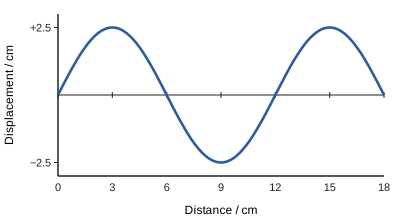
Rajah 2 menunjukkan graf sesaran melawan jarak bagi suatu gelombang melintang pada suatu ketika. Frekuensi gelombang itu ialah 50 Hz. Berapakah laju gelombang itu?Diagram 2 shows the displacement-distance graph of a transverse wave at one instant. The frequency of the wave is 50 Hz. What is the speed of the wave?
Show answerHide answer
B
One full wavelength is from the crest at 3 cm to the next crest at 15 cm: λ = 12 cm = 0.12 m. v = fλ = 50 × 0.12 = 6.0 m s⁻¹. 600 is the answer in cm s⁻¹ written with the wrong unit.
15
Question 15
Dalam eksperimen dwicelah Young, jarak antara dua celah ialah 0.30 mm, jarak celah ke skrin ialah 2.0 m dan jarak antara dua pinggir cerah bersebelahan ialah 4.0 mm. Berapakah panjang gelombang cahaya itu?In a Young's double-slit experiment, the distance between the two slits is 0.30 mm, the distance from the slits to the screen is 2.0 m and the distance between two adjacent bright fringes is 4.0 mm. What is the wavelength of the light?
Show answerHide answer
C
λ = ax ÷ D = (0.30 × 10⁻³)(4.0 × 10⁻³) ÷ 2.0 = 6.0 × 10⁻⁷ m. Convert mm to m before calculating; 6.0 × 10⁻⁴ m results from leaving the slit separation in mm.
16
Question 16
Seorang budak menepuk tangan di hadapan sebuah tebing bukit dan mendengar gema 0.80 s kemudian. Berapakah jarak budak itu dari tebing? [Laju bunyi di udara = 340 m s⁻¹]A boy claps his hands in front of a cliff and hears the echo 0.80 s later. What is the distance of the boy from the cliff? [Speed of sound in air = 340 m s⁻¹]
Show answerHide answer
A
The sound travels to the cliff and back, so 2d = vt = 340 × 0.80 = 272 m and d = 136 m. 272 m forgets to halve the distance.
17
Question 17
Apakah takrif indeks biasan, n, bagi sesuatu medium?What is the definition of the refractive index, n, of a medium?
Show answerHide answer
D
n = c ÷ v: the speed of light in a vacuum divided by the speed of light in the medium. Option B is the inverse ratio, which would be less than 1.
18
Question 18
Sinar cahaya bergerak di dalam sebuah blok kaca (n = 1.52) dan menuju ke permukaan kaca-udara pada sudut tuju 25° dalam kaca. Berapakah sudut yang dibuat oleh sinar itu dengan garis normal apabila keluar ke udara?A ray of light travels inside a glass block (n = 1.52) and strikes the glass-air surface at an angle of incidence of 25° in the glass. What angle does the ray make with the normal when it emerges into the air?
Show answerHide answer
D
By the reversibility of light, n = sin(angle in air) ÷ sin(angle in glass). sin r = 1.52 × sin 25° = 0.642, so r = 40.0°. 16.1° divides instead of multiplying; 38.0° multiplies the angles instead of the sines.
19
Question 19
Sebuah kanta cembung berjarak fokus 12 cm. Objek diletakkan 30 cm dari kanta. Berapakah jarak imej dari kanta?A convex lens has a focal length of 12 cm. An object is placed 30 cm from the lens. What is the image distance from the lens?
Show answerHide answer
C
1/v = 1/f − 1/u = 1/12 − 1/30 = 3/60, so v = 20 cm (a real image). 8.6 cm adds the reciprocals and 42 cm adds the distances.
20
Question 20
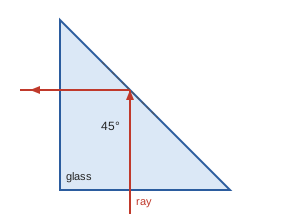
Rajah 3 menunjukkan sinar cahaya memasuki sebuah prisma kaca bersudut tegak (n = 1.50) pada sudut 90° kepada permukaan tegaknya. Sinar itu menuju ke permukaan serong pada sudut tuju 45°. Pernyataan yang manakah betul?Diagram 3 shows a ray of light entering a right-angled glass prism (n = 1.50) at 90° to its vertical face. The ray strikes the sloping face at an angle of incidence of 45°. Which statement is correct?
Show answerHide answer
D
sin c = 1/n = 1/1.50, so c = 41.8°. The angle of incidence (45°) is greater than c and the ray travels from the denser to the less dense medium, so total internal reflection occurs. 48.2° is the complement of the critical angle.
Bahagian BSection B
40 marksJawab semua soalan.Answer all questions.
21
Question 21
Seorang murid mengkaji hubungan antara tekanan dengan isi padu udara yang terperangkap dalam sebuah picagari yang disambung kepada tolok tekanan. Dia menggerakkan omboh untuk mengubah isi padu dan membaca tekanan pada tolok. Suhu udara dikekalkan. Jadual 2 menunjukkan keputusannya.
A pupil investigates the relationship between the pressure and the volume of air trapped in a syringe connected to a pressure gauge. She moves the plunger to change the volume and reads the pressure on the gauge. The temperature of the air is kept constant. Table 2 shows her results.
| Tekanan, P / kPa | 100 | 125 | 160 | 200 |
|---|---|---|---|---|
| Isi padu, V / cm³ | 80 | 64 | 50 | 40 |
| P × V / kPa cm³ |
| Pressure, P / kPa | 100 | 125 | 160 | 200 |
|---|---|---|---|---|
| Volume, V / cm³ | 80 | 64 | 50 | 40 |
| P × V / kPa cm³ |
[2 marks]
(a)Nyatakan pemboleh ubah dimanipulasikan dan pemboleh ubah bergerak balas.State the manipulated variable and the responding variable.
Show answerHide answer
Tick each point you got.
[2 marks]
(b)Hitung P × V bagi setiap set bacaan dan lengkapkan baris terakhir Jadual 2.Calculate P × V for each set of readings and complete the last row of Table 2.
Show answerHide answer
Tick each point you got.
[1 mark]
(c)Nyatakan hubungan antara P dan V berdasarkan keputusan itu.State the relationship between P and V from the results.
Show answerHide answer
Tick each point you got.
[2 marks]
(d)Ramalkan isi padu udara apabila tekanannya 250 kPa.Predict the volume of the air when its pressure is 250 kPa.
Show answerHide answer
Tick each point you got.
[2 marks]
(e)Dengan menggunakan teori kinetik gas, terangkan mengapa tekanan bertambah apabila isi padu berkurang.Using the kinetic theory of gases, explain why the pressure increases when the volume decreases.
Show answerHide answer
Tick each point you got.
[1 mark]
(f)Selain suhu, nyatakan satu kuantiti yang dikekalkan dalam eksperimen ini.Besides the temperature, state one quantity that is kept constant in this experiment.
Show answerHide answer
Tick each point you got.
22
Question 22
Fizik menggunakan kuantiti asas dan kuantiti terbitan untuk menerangkan alam sekitar.Physics uses base quantities and derived quantities to describe the world around us.
[2 marks]
(a)Terangkan perbezaan antara kuantiti asas dengan kuantiti terbitan. Beri satu contoh bagi setiap jenis.Explain the difference between a base quantity and a derived quantity. Give one example of each.
Show answerHide answer
Tick each point you got.
[2 marks]
(b)Tenaga kinetik diberi oleh E = ½mv². Terbitkan unit S.I. bagi tenaga kinetik dalam unit asas S.I.Kinetic energy is given by E = ½mv². Derive the S.I. unit of kinetic energy in S.I. base units.
Show answerHide answer
Tick each point you got.
[1 mark]
(c)Ketumpatan sebuah blok aluminium ialah 2.7 g cm⁻³. Tukarkan nilai ini kepada kg m⁻³.The density of an aluminium block is 2.7 g cm⁻³. Convert this value to kg m⁻³.
Show answerHide answer
Tick each point you got.
[1 mark]
(d)Pecutan ialah kuantiti __________.Acceleration is a __________ quantity.
Show answerHide answer
vector
Acceleration has both magnitude and direction.
[1 mark]
(e)Jarak ialah kuantiti __________.Distance is a __________ quantity.
Show answerHide answer
scalar
Distance has magnitude only; displacement is the vector.
[1 mark]
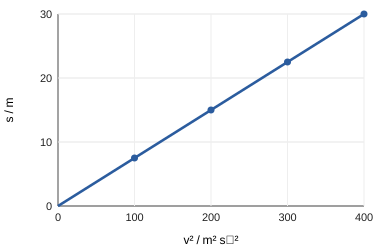
(f)Rajah 4 menunjukkan graf jarak berhenti s sebuah kereta melawan v², dengan v ialah laju kereta. Nyatakan hubungan antara s dengan v².Diagram 4 shows the graph of the stopping distance s of a car against v², where v is the speed of the car. State the relationship between s and v².
Show answerHide answer
Tick each point you got.
[2 marks]
(g)Hitung kecerunan graf dan nyatakan unitnya.Calculate the gradient of the graph and state its unit.
Show answerHide answer
Tick each point you got.
23
Question 23
Rajah 5 menunjukkan dua pembesar suara, S₁ dan S₂, yang dipisahkan sejauh a = 3.0 m di dalam sebuah dewan sekolah. Kedua-duanya disambung kepada satu penjana isyarat yang sama dan memancarkan bunyi berfrekuensi 1 700 Hz. Seorang murid berjalan di sepanjang garis yang selari dengan S₁S₂ pada jarak D = 4.0 m dan mendengar bunyi kuat di O dan P, serta bunyi lemah di antara titik-titik itu. [Laju bunyi di udara = 340 m s⁻¹]Diagram 5 shows two loudspeakers, S₁ and S₂, separated by a = 3.0 m in a school hall. Both are connected to the same signal generator and emit sound of frequency 1 700 Hz. A pupil walks along a line parallel to S₁S₂ at a distance D = 4.0 m and hears loud sound at O and at P, and soft sound between them. [Speed of sound in air = 340 m s⁻¹]
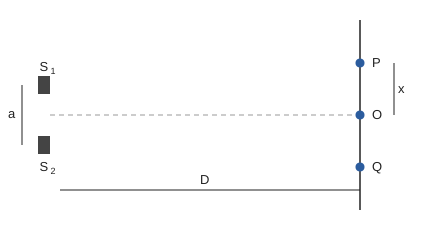
[1 mark]
(a)Namakan fenomena yang menghasilkan kawasan bunyi kuat dan bunyi lemah.Name the phenomenon that produces the regions of loud sound and soft sound.
Show answerHide answer
Tick each point you got.
[1 mark]
(b)Mengapakah kedua-dua pembesar suara disambung kepada penjana isyarat yang sama?Why are both loudspeakers connected to the same signal generator?
Show answerHide answer
Tick each point you got.
[2 marks]
(c)Hitung panjang gelombang bunyi itu.Calculate the wavelength of the sound.
Show answerHide answer
Tick each point you got.
[2 marks]
(d)Hitung jarak x antara O dengan P.Calculate the distance x between O and P.
Show answerHide answer
Tick each point you got.
[2 marks]
(e)Di sebuah titik R, beza laluan bunyi daripada S₁ dan S₂ ialah 1.5λ. Adakah bunyi di R kuat atau lemah? Berikan sebab.At a point R, the path difference of the sound from S₁ and S₂ is 1.5λ. Is the sound at R loud or soft? Give a reason.
Show answerHide answer
Tick each point you got.
[2 marks]
(f)Frekuensi dinaikkan kepada 2 000 Hz. Bagaimanakah jarak x berubah? Terangkan jawapan anda.The frequency is increased to 2 000 Hz. How does the distance x change? Explain your answer.
Show answerHide answer
Tick each point you got.
24
Question 24
Sebuah projektor slaid menggunakan sebuah kanta cembung berjarak fokus 10.0 cm. Slaid setinggi 3.6 cm diletakkan 10.5 cm dari kanta dan imej terbentuk pada skrin.A slide projector uses a convex lens of focal length 10.0 cm. A slide 3.6 cm high is placed 10.5 cm from the lens and an image forms on the screen.
[3 marks]
(a)Nyatakan tiga ciri imej pada skrin.State three characteristics of the image on the screen.
Show answerHide answer
Tick each point you got.
[2 marks]
(b)Hitung jarak imej dari kanta.Calculate the image distance from the lens.
Show answerHide answer
Tick each point you got.
[2 marks]
(c)Hitung pembesaran linear dan ketinggian imej.Calculate the linear magnification and the height of the image.
Show answerHide answer
Tick each point you got.
[1 mark]
(d)Mengapakah slaid dimasukkan ke dalam projektor secara terbalik?Why is the slide put into the projector upside down?
Show answerHide answer
Tick each point you got.
[2 marks]
(e)Projektor itu dialihkan lebih jauh dari skrin. Adakah kanta perlu digerakkan lebih dekat atau lebih jauh dari slaid supaya imej kembali jelas? Terangkan.The projector is moved farther from the screen. To focus the image again, should the lens be moved nearer to or farther from the slide? Explain.
Show answerHide answer
Tick each point you got.
Bahagian CSection C
20 marksJawab satu soalan sahaja.Answer one question only.
25Choose 1
Question 25
Sebuah satelit penderiaan jauh SK-1 berjisim 1 500 kg mengorbit Bumi pada ketinggian 8.0 × 10⁵ m dari permukaan Bumi dalam orbit bulat. [G = 6.67 × 10⁻¹¹ N m² kg⁻²; jisim Bumi = 5.97 × 10²⁴ kg; jejari Bumi = 6.37 × 10⁶ m.]A remote-sensing satellite SK-1 of mass 1 500 kg moves in a circular orbit at a height of 8.0 × 10⁵ m above the surface of the Earth. [G = 6.67 × 10⁻¹¹ N m² kg⁻²; mass of the Earth = 5.97 × 10²⁴ kg; radius of the Earth = 6.37 × 10⁶ m.]
[2 marks]
(a)Nyatakan Hukum Kegravitian Semesta Newton.State Newton's Universal Law of Gravitation.
Show answerHide answer
Tick each point you got.
[3 marks]
(b)Hitung daya graviti Bumi ke atas SK-1.Calculate the gravitational force of the Earth on SK-1.
Show answerHide answer
Tick each point you got.
[3 marks]
(c)Nyatakan daya yang menyediakan daya memusat bagi SK-1, dan hitung laju orbitnya.State the force that provides the centripetal force for SK-1 and calculate its orbital speed.
Show answerHide answer
Tick each point you got.
[2 marks]
(d)Hitung tempoh orbit SK-1 dalam minit.Calculate the orbital period of SK-1 in minutes.
Show answerHide answer
Tick each point you got.
[2 marks]
(e)Nyatakan dua ciri orbit sebuah satelit geopegun.State two characteristics of the orbit of a geostationary satellite.
Show answerHide answer
Any 2 points
Tick each point you got.
[2 marks]
(f)Hitung halaju lepas dari permukaan Marikh. [Jisim Marikh = 6.42 × 10²³ kg; jejari Marikh = 3.39 × 10⁶ m]Calculate the escape velocity from the surface of Mars. [Mass of Mars = 6.42 × 10²³ kg; radius of Mars = 3.39 × 10⁶ m]
Show answerHide answer
Tick each point you got.
[2 marks]
(g)Seorang angkasawan di dalam sebuah kapal angkasa dalam orbit yang serupa terapung dan kelihatan tanpa berat. Terangkan mengapa walaupun daya graviti masih bertindak ke atasnya.An astronaut inside a spacecraft in a similar orbit floats and appears weightless. Explain why this happens even though gravity still acts on the astronaut.
Show answerHide answer
Tick each point you got.
[4 marks]
(h)Sebuah syarikat penyiaran mencadangkan penggunaan satelit seperti SK-1 untuk siaran televisyen berterusan ke Malaysia. Adakah anda bersetuju? Beri dua sebab.A broadcasting company suggests using a satellite like SK-1 for continuous television broadcasts to Malaysia. Do you agree? Give two reasons.
Show answerHide answer
Tick each point you got.
26Choose 1
Question 26
Dalam sebuah makmal, sebuah blok aluminium berjisim 0.80 kg dipanaskan oleh pemanas rendam 100 W. Suhu blok naik daripada 30 °C kepada 50 °C dalam 160 s. Di kantin sekolah, sebuah dandang elektrik 1.8 kW digunakan untuk mendidihkan 1.5 kg air pada 28 °C. [Muatan haba tentu air = 4 200 J kg⁻¹ °C⁻¹; haba pendam tentu pengewapan air = 2.26 × 10⁶ J kg⁻¹]In a laboratory, an aluminium block of mass 0.80 kg is heated by a 100 W immersion heater. The temperature of the block rises from 30 °C to 50 °C in 160 s. In the school canteen, a 1.8 kW electric urn is used to boil 1.5 kg of water at 28 °C. [Specific heat capacity of water = 4 200 J kg⁻¹ °C⁻¹; specific latent heat of vaporisation of water = 2.26 × 10⁶ J kg⁻¹]
[1 mark]
(a)Apakah yang dimaksudkan dengan muatan haba tentu?What is meant by specific heat capacity?
Show answerHide answer
Tick each point you got.
[3 marks]
(b)Hitung muatan haba tentu aluminium berdasarkan keputusan eksperimen itu.Calculate the specific heat capacity of aluminium from the results of the experiment.
Show answerHide answer
Tick each point you got.
[2 marks]
(c)Nilai sebenar muatan haba tentu aluminium ialah 900 J kg⁻¹ °C⁻¹. Terangkan mengapa nilai eksperimen lebih besar, dan cadangkan satu penambahbaikan.The accepted value of the specific heat capacity of aluminium is 900 J kg⁻¹ °C⁻¹. Explain why the experimental value is larger and suggest one improvement.
Show answerHide answer
Tick each point you got.
[3 marks]
(d)Hitung masa yang diambil oleh dandang untuk mendidihkan air itu sehingga 100 °C.Calculate the time taken by the urn to bring the water to 100 °C.
Show answerHide answer
Tick each point you got.
[3 marks]
(e)Dandang itu terus memanaskan air yang mendidih selama 60 s lagi. Hitung jisim air yang menjadi wap.The urn keeps heating the boiling water for another 60 s. Calculate the mass of water that changes into steam.
Show answerHide answer
Tick each point you got.
[2 marks]
(f)Mengapakah wap air pada 100 °C menyebabkan kelecuran yang lebih teruk daripada air mendidih pada 100 °C?Why does steam at 100 °C cause a more severe burn than boiling water at 100 °C?
Show answerHide answer
Tick each point you got.
[3 marks]
(g)Sebuah periuk tekanan yang bertutup mengandungi udara pada 27 °C dan 100 kPa. Periuk itu dipanaskan sehingga udara mencapai 127 °C. Isi padu udara dianggap malar. Hitung tekanan udara itu dan namakan hukum gas yang digunakan.A sealed pressure cooker contains air at 27 °C and 100 kPa. It is heated until the air reaches 127 °C. The volume of the air is taken as constant. Calculate the pressure of the air and name the gas law you used.
Show answerHide answer
Tick each point you got.
[3 marks]
(h)Jadual 3 menunjukkan tiga bahan untuk dasar sebuah periuk. Pilih bahan yang paling sesuai supaya periuk cepat panas dan haba merebak ke makanan. Berikan alasan anda.
Table 3 shows three materials for the base of a cooking pot. Choose the most suitable material so that the pot heats up quickly and spreads the heat to the food. Give your reasons.
| Bahan | Muatan haba tentu / J kg⁻¹ °C⁻¹ | Pengalir haba | Takat lebur / °C |
|---|---|---|---|
| X | 390 | Baik | 1 085 |
| Y | 880 | Baik | 660 |
| Z | 880 | Lemah | 1 550 |
| Material | Specific heat capacity / J kg⁻¹ °C⁻¹ | Heat conductor | Melting point / °C |
|---|---|---|---|
| X | 390 | Good | 1 085 |
| Y | 880 | Good | 660 |
| Z | 880 | Poor | 1 550 |
Show answerHide answer
Tick each point you got.
Bahagian DSection D
20 marksJawab soalan ini.Answer this question.
27
Question 27
Kelab Sains sekolah merancang untuk membina periskop bagi memerhati burung di atas pokok dari dalam sebuah pondok. Periskop itu mesti menghasilkan imej tunggal yang terang dan tegak. Jadual 4 menunjukkan empat pilihan reka bentuk untuk komponen pemantul.
The school Science Club plans to build a periscope to watch birds in the trees from inside a hut. The periscope must give a single, bright, upright image. Table 4 shows four design options for the reflecting component.
| Pilihan | Komponen pemantul | Indeks biasan bahan | Sudut tuju sinar pada permukaan pemantul |
|---|---|---|---|
| A | Prisma bersudut tegak | 1.33 | 45° |
| B | Prisma bersudut tegak | 1.52 | 45° |
| C | Cermin satah berperak di belakang kaca | - | 45° |
| D | Prisma bersudut tegak | 1.52 | 30° |
| Option | Reflecting component | Refractive index of material | Angle of incidence of the ray on the reflecting surface |
|---|---|---|---|
| A | Right-angled prism | 1.33 | 45° |
| B | Right-angled prism | 1.52 | 45° |
| C | Plane mirror silvered at the back of glass | - | 45° |
| D | Right-angled prism | 1.52 | 30° |
[1 mark]
(a)Namakan fenomena cahaya yang digunakan oleh prisma dalam periskop itu.Name the light phenomenon used by the prisms in the periscope.
Show answerHide answer
Tick each point you got.
[9 marks]
(b)Pilih pilihan yang paling sesuai. Beri alasan untuk pilihan anda dan sebab setiap pilihan lain tidak sesuai.Choose the most suitable option. Give reasons for your choice and explain why each of the other options is not suitable.
Show answerHide answer
Tick each point you got.
[2 marks]
(c)Hitung sudut genting bahan dalam pilihan B.Calculate the critical angle of the material in option B.
Show answerHide answer
Tick each point you got.
[2 marks]
(d)Hitung laju cahaya dalam prisma pilihan B. [Laju cahaya dalam vakum = 3.0 × 10⁸ m s⁻¹]Calculate the speed of light in the prism of option B. [Speed of light in a vacuum = 3.0 × 10⁸ m s⁻¹]
Show answerHide answer
Tick each point you got.
[4 marks]
(e)Seorang ahli kelab berkata prisma daripada bahan berindeks biasan 1.25 juga boleh digunakan. Dengan pengiraan, nilaikan kenyataan itu.A club member says a prism made of a material with refractive index 1.25 can also be used. Use a calculation to evaluate this statement.
Show answerHide answer
Tick each point you got.
[2 marks]
(f)Nyatakan dua ciri imej akhir yang dilihat melalui periskop itu.State two characteristics of the final image seen through the periscope.
Show answerHide answer
Any 2 points
Tick each point you got.
Test specification (JSU)
| Chapter | Remembering | Understanding | Applying | Analysing | Evaluating | Creating | Items | marks |
|---|---|---|---|---|---|---|---|---|
| 1. Measurement | – | 2 (11) | – | – | – | – | 2 | 11 |
| 2. Force and Motion I | – | 1 (1) | 3 (3) | 1 (1) | – | – | 5 | 5 |
| 3. Gravitation | 1 (1) | – | 1 (1) | 1 (1) | 1 (20) | – | 4 | 23 |
| 4. Heat | – | 1 (1) | 3 (12) | 1 (1) | 1 (20) | – | 6 | 34 |
| 5. Waves | – | – | 4 (13) | – | – | – | 4 | 13 |
| 6. Light and Optics | 1 (1) | – | 3 (12) | 1 (1) | – | 1 (20) | 6 | 34 |
| Total | 2 (2) | 4 (13) | 14 (41) | 4 (4) | 2 (40) | 1 (20) | 27 | 120 |
Each cell shows items (marks).