Practice paper, not an official KPM paper
55
Ujian Akhir Sesi AkademikEnd of Academic Session Test
FizikPhysics
Tingkatan 4, 2 jam 30 minit / 2 hours 30 minutes, 100 marks
Nama / Name
Kelas / Class
Tarikh / Date
Markah / Marks: / 100
Instructions
- Kertas soalan ini mengandungi empat bahagian: Bahagian A, B, C dan D.This question paper consists of four sections: Section A, B, C and D.
- Bahagian A: pilih satu jawapan bagi setiap soalan.Section A: choose one answer for each question.
- Bahagian B dan D: jawab semua soalan. Bahagian C: jawab mana-mana satu soalan.Sections B and D: answer all questions. Section C: answer any one question.
- Tulis jawapan anda di ruang yang disediakan. Tunjukkan jalan kerja bagi pengiraan.Write your answers in the spaces provided. Show your working for calculations.
- Rajah tidak dilukis mengikut skala kecuali dinyatakan.The diagrams in this paper are not drawn to scale unless stated.
- Anda dibenarkan menggunakan kalkulator saintifik. Senarai rumus disediakan.You may use a scientific calculator. A list of formulae is provided.
- Ambil g = 9.81 m s⁻², G = 6.67 × 10⁻¹¹ N m² kg⁻², jisim Bumi = 5.97 × 10²⁴ kg, jejari Bumi = 6.37 × 10⁶ m.Take g = 9.81 m s⁻², G = 6.67 × 10⁻¹¹ N m² kg⁻², mass of the Earth = 5.97 × 10²⁴ kg, radius of the Earth = 6.37 × 10⁶ m.
Answer schemes are in English (DLP).
Practice shows answers as you go. Exam times you and hides answers until you submit.
Bahagian ASection A
20 marksJawab semua soalan. Setiap soalan diikuti oleh empat pilihan jawapan, A, B, C dan D. Pilih satu jawapan sahaja.Answer all questions. Each question is followed by four options, A, B, C and D. Choose one answer only.
1
Question 1
Hukum Kegravitian Semesta Newton ialah F = Gm₁m₂/r². Apakah unit bagi pemalar kegravitian, G, dalam unit asas S.I.?Newton's Universal Law of Gravitation is F = Gm₁m₂/r². What is the unit of the gravitational constant, G, in S.I. base units?
Show answerHide answer
A
G = Fr² / (m₁m₂). The unit is (kg m s⁻²)(m²)/(kg²) = m³ kg⁻¹ s⁻².
2
Question 2
Sekeping kad diletakkan di atas sebuah gelas dan sekeping syiling diletakkan di atas kad itu. Apabila kad itu dipetik dengan pantas secara mengufuk, syiling itu jatuh ke dalam gelas. Mengapakah syiling itu tidak bergerak bersama kad?A card is placed on a glass and a coin is placed on the card. When the card is flicked quickly and horizontally, the coin drops into the glass. Why does the coin not move with the card?
Show answerHide answer
C
Inertia is the tendency of an object to stay at rest (or in uniform motion) unless a force acts on it (Newton's First Law). The coin stays at rest and falls into the glass.
3
Question 3
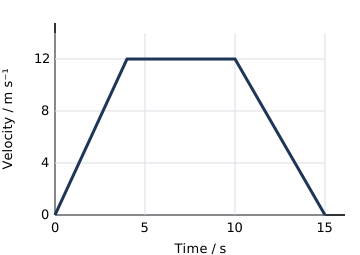
Rajah 1 menunjukkan graf halaju-masa bagi sebuah tram. Berapakah jumlah jarak yang dilalui oleh tram itu dalam 15 s?Diagram 1 shows the velocity-time graph of a tram. What is the total distance travelled by the tram in 15 s?
Show answerHide answer
B
Distance = area under the graph = ½(4)(12) + (6)(12) + ½(5)(12) = 24 + 72 + 30 = 126 m. 180 m is 15 × 12, which treats the whole journey as constant velocity.
4
Question 4
Seorang pemain papan selaju berjisim 60 kg berdiri pegun di atas permukaan licin. Dia membaling sebiji bola berjisim 3.0 kg dengan halaju 10 m s⁻¹ ke hadapan. Berapakah halaju sentakan ke belakang pemain itu?A skateboarder of mass 60 kg stands at rest on a smooth surface. She throws a ball of mass 3.0 kg forwards at a velocity of 10 m s⁻¹. What is the recoil velocity of the skateboarder?
Show answerHide answer
D
Total momentum before = 0, so 60v + 3.0 × 10 = 0. Magnitude of v = 30 ÷ 60 = 0.50 m s⁻¹, in the opposite direction to the ball. 0.48 m s⁻¹ comes from dividing by the combined mass (63 kg).
5
Question 5
Sebuah lif berjisim 800 kg (termasuk penumpang) memecut ke atas dengan pecutan 1.5 m s⁻². Berapakah tegangan dalam kabel lif itu? [g = 9.81 m s⁻²]A lift of mass 800 kg (including the passengers) accelerates upwards at 1.5 m s⁻². What is the tension in the lift cable? [g = 9.81 m s⁻²]
Show answerHide answer
B
Resultant force upwards = T − mg = ma. T = m(g + a) = 800 × (9.81 + 1.5) = 9 048 N ≈ 9.05 × 10³ N. 7.85 × 10³ N is mg alone and 6.65 × 10³ N is m(g − a).
6
Question 6
Sebiji bola berjisim 0.15 kg menghentam dinding dengan laju 12 m s⁻¹ dan melantun balik dengan laju 8 m s⁻¹. Masa sentuhan bola dengan dinding ialah 0.010 s. Berapakah purata daya impuls yang bertindak pada bola itu?A ball of mass 0.15 kg hits a wall at a speed of 12 m s⁻¹ and rebounds at a speed of 8 m s⁻¹. The ball is in contact with the wall for 0.010 s. What is the average impulsive force acting on the ball?
Show answerHide answer
D
Taking the initial direction as positive, change in momentum = 0.15(−8) − 0.15(12) = −3.0 N s. F = 3.0 ÷ 0.010 = 300 N. 60 N comes from subtracting the speeds (12 − 8) instead of adding them because the direction reverses.
7
Question 7
Jisim salah satu daripada dua jasad digandakan tiga kali dan jarak antara pusat kedua-dua jasad itu digandakan dua kali. Apakah daya graviti yang baharu berbanding dengan daya graviti asal, F?The mass of one of two bodies is tripled and the distance between the centres of the two bodies is doubled. What is the new gravitational force compared with the original force, F?
Show answerHide answer
C
F ∝ m₁m₂/r². New force = 3 × (1/2²) × F = ¾ F.
8
Question 8
Bulan X mengorbit sebuah planet pada jejari 2.0 × 10⁸ m dengan tempoh 1.2 hari. Bulan Y mengorbit planet yang sama pada jejari 8.0 × 10⁸ m. Berapakah tempoh orbit bulan Y?Moon X orbits a planet at a radius of 2.0 × 10⁸ m with a period of 1.2 days. Moon Y orbits the same planet at a radius of 8.0 × 10⁸ m. What is the orbital period of moon Y?
Show answerHide answer
A
Kepler's third law: T₂²/T₁² = r₂³/r₁³. T₂ = 1.2 × (4)^(3/2) = 1.2 × 8 = 9.6 days. 4.8 days comes from using r instead of r³/².
9
Question 9
Halaju lepas dari permukaan Bumi ialah 11.2 km s⁻¹. Planet X mempunyai jisim empat kali jisim Bumi dan jejari dua kali jejari Bumi. Berapakah halaju lepas dari permukaan planet X?The escape velocity from the surface of the Earth is 11.2 km s⁻¹. Planet X has four times the mass of the Earth and twice the radius of the Earth. What is the escape velocity from the surface of planet X?
Show answerHide answer
C
v = √(2GM/R), so v ∝ √(M/R). The ratio is √(4/2) = √2 = 1.41, so v = 11.2 × 1.41 = 15.8 km s⁻¹.
10
Question 10
Muatan haba tentu kuprum ialah 390 J kg⁻¹ °C⁻¹. Apakah maksud pernyataan ini?The specific heat capacity of copper is 390 J kg⁻¹ °C⁻¹. What does this statement mean?
Show answerHide answer
B
Specific heat capacity, c, is the amount of heat needed to raise the temperature of 1 kg of the substance by 1 °C. Option A describes the specific latent heat of fusion.
11
Question 11
Berapakah haba yang dibebaskan apabila 0.25 kg air pada 0 °C membeku menjadi ais pada 0 °C? [Haba pendam tentu pelakuran ais = 3.34 × 10⁵ J kg⁻¹]How much heat is released when 0.25 kg of water at 0 °C freezes into ice at 0 °C? [Specific latent heat of fusion of ice = 3.34 × 10⁵ J kg⁻¹]
Show answerHide answer
D
Q = ml = 0.25 × 3.34 × 10⁵ = 8.35 × 10⁴ J. The temperature stays at 0 °C while the water freezes.
12
Question 12
Sebuah gelembung udara berisi padu 4.0 cm³ berada di dasar sebuah tasik pada tekanan 300 kPa. Gelembung itu naik ke permukaan tasik, tempat tekanan ialah 100 kPa. Anggap suhu air tetap. Berapakah isi padu gelembung itu di permukaan?An air bubble of volume 4.0 cm³ is at the bottom of a lake where the pressure is 300 kPa. The bubble rises to the surface of the lake, where the pressure is 100 kPa. Assume the temperature of the water is constant. What is the volume of the bubble at the surface?
Show answerHide answer
A
Boyle's law: P₁V₁ = P₂V₂. V₂ = (300 × 4.0) ÷ 100 = 12 cm³. The pressure falls to one third, so the volume becomes three times larger.
13
Question 13
Sebongkah aluminium berjisim 0.50 kg pada 100 °C dimasukkan ke dalam 0.40 kg air pada 20 °C dalam bekas bertebat. Berapakah suhu akhir campuran itu? [Muatan haba tentu aluminium = 900 J kg⁻¹ °C⁻¹; air = 4 200 J kg⁻¹ °C⁻¹. Abaikan kehilangan haba.]A 0.50 kg block of aluminium at 100 °C is placed into 0.40 kg of water at 20 °C in an insulated container. What is the final temperature of the mixture? [Specific heat capacity of aluminium = 900 J kg⁻¹ °C⁻¹; water = 4 200 J kg⁻¹ °C⁻¹. Ignore heat loss.]
Show answerHide answer
B
Heat lost by aluminium = heat gained by water: 0.50 × 900 × (100 − θ) = 0.40 × 4 200 × (θ − 20). 450(100 − θ) = 1 680(θ − 20), so 78 600 = 2 130θ and θ = 36.9 °C ≈ 37 °C. 60 °C is the simple average of 100 °C and 20 °C, which ignores the different heat capacities.
14
Question 14
Dua tala bunyi, P dan Q, mempunyai frekuensi yang sama. Tala bunyi P dipukul dan didekatkan kepada tala bunyi Q yang pegun. Tala bunyi Q mula bergetar dan mengeluarkan bunyi. Fenomena apakah ini?Two tuning forks, P and Q, have the same frequency. Tuning fork P is struck and held near tuning fork Q, which is at rest. Tuning fork Q starts to vibrate and produces a sound. What is this phenomenon?
Show answerHide answer
D
Resonance occurs when a system is made to vibrate by an external force at its natural frequency, with a large amplitude. P forces Q to vibrate at Q's natural frequency.
15
Question 15
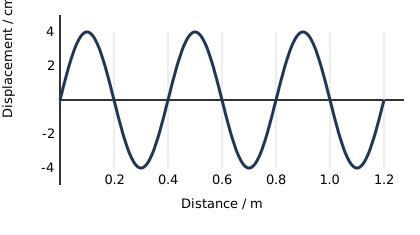
Rajah 2 menunjukkan graf sesaran-jarak bagi gelombang pada seutas tali yang digetarkan dengan frekuensi 15 Hz. Berapakah laju gelombang itu?Diagram 2 shows the displacement-distance graph of a wave on a rope vibrated at a frequency of 15 Hz. What is the speed of the wave?
Show answerHide answer
A
Three complete waves occupy 1.2 m, so λ = 1.2 ÷ 3 = 0.40 m. v = fλ = 15 × 0.40 = 6.0 m s⁻¹. 18 m s⁻¹ comes from using 1.2 m as the wavelength.
16
Question 16
Dalam eksperimen dwicelah Young, jarak antara dua celah digandakan dua kali dan jarak antara celah dengan skrin dikurangkan separuh. Cahaya yang sama digunakan. Apakah yang berlaku kepada jarak antara dua pinggir cerah bersebelahan, x?In Young's double-slit experiment, the distance between the two slits is doubled and the distance from the slits to the screen is halved. The same light is used. What happens to the distance between two adjacent bright fringes, x?
Show answerHide answer
C
λ = ax/D, so x = λD/a. Doubling a and halving D gives x → λ(D/2)/(2a) = x/4.
17
Question 17
Sebuah kolam renang kelihatan lebih cetek daripada kedalaman sebenarnya apabila dilihat dari tepi kolam. Mengapakah keadaan ini berlaku?A swimming pool looks shallower than its real depth when seen from the side of the pool. Why does this happen?
Show answerHide answer
B
Rays from the bottom bend away from the normal as they enter air (a less dense medium). They appear to come from a point that is higher than the real bottom, so the apparent depth is smaller than the real depth.
18
Question 18
Seberkas cahaya masuk dari udara ke dalam sejenis cecair dengan sudut tuju 45°. Sudut biasan ialah 30°. Berapakah indeks biasan cecair itu?A ray of light enters a liquid from air with an angle of incidence of 45°. The angle of refraction is 30°. What is the refractive index of the liquid?
Show answerHide answer
D
n = sin i / sin r = sin 45° / sin 30° = 0.707 ÷ 0.500 = 1.41.
19
Question 19
Sebuah projektor slaid menggunakan kanta cembung berjarak fokus 8.0 cm. Slaid diletakkan pada jarak 8.8 cm dari kanta. Pada jarak berapakah skrin mesti diletakkan dari kanta supaya imej yang jelas terbentuk?A slide projector uses a convex lens of focal length 8.0 cm. The slide is placed 8.8 cm from the lens. At what distance from the lens must the screen be placed to obtain a clear image?
Show answerHide answer
C
1/v = 1/f − 1/u = 1/8.0 − 1/8.8 = 0.125 − 0.1136 = 0.01136, so v = 88 cm. Linear magnification = 88 ÷ 8.8 = 10.
20
Question 20
Sebuah prisma kaca berindeks biasan 1.52 digunakan di dalam sebuah binokular. Seberkas cahaya di dalam prisma itu menuju ke sempadan kaca-udara dengan sudut tuju 45°. Apakah yang berlaku kepada sinar itu?A glass prism of refractive index 1.52 is used in a pair of binoculars. A ray of light inside the prism strikes the glass-air boundary at an angle of incidence of 45°. What happens to the ray?
Show answerHide answer
A
sin c = 1/n = 1/1.52 = 0.658, so c = 41.1°. The angle of incidence (45°) is greater than c, and the ray goes from the denser medium to the less dense medium, so total internal reflection occurs.
Bahagian BSection B
40 marksJawab semua soalan. Tulis jawapan anda di ruang yang disediakan.Answer all questions. Write your answers in the spaces provided.
21
Question 21
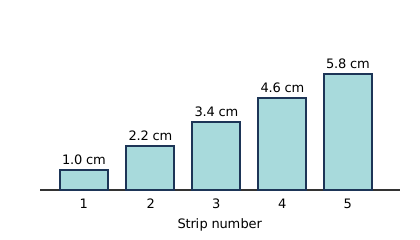
Seorang murid menarik sebuah troli berjisim 0.80 kg menuruni landasan condong. Pita detik yang ditarik oleh troli itu melalui jangka masa detik berfrekuensi 50 Hz. Pita itu dipotong kepada jalur yang setiap satunya mengandungi 5 detik dan jalur itu ditampal bersebelahan seperti dalam Rajah 3.A pupil pulls a trolley of mass 0.80 kg down an inclined track. The ticker tape pulled by the trolley passes through a ticker timer of frequency 50 Hz. The tape is cut into strips of 5 ticks each and the strips are pasted side by side as shown in Diagram 3.
[1 mark]
(a)Berapakah masa bagi satu jalur yang mengandungi 5 detik?What is the time taken by one strip of 5 ticks?
Show answerHide answer
Tick each point you got.
[1 mark]
(b)Huraikan gerakan troli itu berdasarkan Rajah 3.Describe the motion of the trolley based on Diagram 3.
Show answerHide answer
Tick each point you got.
[2 marks]
(c)Hitung halaju awal dan halaju akhir troli itu dalam cm s⁻¹.Calculate the initial velocity and the final velocity of the trolley in cm s⁻¹.
Show answerHide answer
Tick each point you got.
[2 marks]
(d)Hitung pecutan troli itu dalam m s⁻². Masa dari jalur pertama ke jalur kelima ialah 0.40 s.Calculate the acceleration of the trolley in m s⁻². The time from the first strip to the fifth strip is 0.40 s.
Show answerHide answer
Tick each point you got.
[2 marks]
(e)Hitung daya paduan yang bertindak pada troli itu.Calculate the resultant force acting on the trolley.
Show answerHide answer
Tick each point you got.
[2 marks]
(f)Beban berjisim 0.40 kg diletakkan di atas troli itu dan daya paduan yang sama bertindak. Hitung pecutan baharu troli itu dan nyatakan hubungan antara pecutan dengan jisim.A load of mass 0.40 kg is placed on the trolley and the same resultant force acts. Calculate the new acceleration of the trolley and state the relationship between acceleration and mass.
Show answerHide answer
Tick each point you got.
22
Question 22
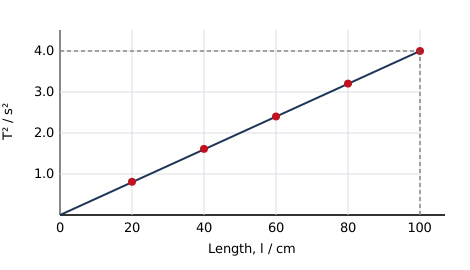
Zahrin mengkaji hubungan antara panjang bandul ringkas, l, dengan tempoh ayunannya, T. Dia mengukur masa bagi 20 ayunan lengkap bagi setiap panjang. Jadual 1 menunjukkan keputusannya dan Rajah 4 menunjukkan graf T² melawan l.
Jadual 1Zahrin investigates the relationship between the length of a simple pendulum, l, and its period, T. He measures the time for 20 complete oscillations for each length. Table 1 shows his results and Diagram 4 shows the graph of T² against l.
Table 1
| l / cm | 20 | 40 | 60 | 80 | 100 |
|---|---|---|---|---|---|
| T / s | 0.90 | 1.27 | 1.55 | 1.79 | 2.00 |
| T² / s² | 0.81 | 1.61 | ? | 3.20 | 4.00 |
| l / cm | 20 | 40 | 60 | 80 | 100 |
|---|---|---|---|---|---|
| T / s | 0.90 | 1.27 | 1.55 | 1.79 | 2.00 |
| T² / s² | 0.81 | 1.61 | ? | 3.20 | 4.00 |
[2 marks]
(a)Nyatakan pemboleh ubah dimanipulasikan dan pemboleh ubah bergerak balas.State the manipulated variable and the responding variable.
Show answerHide answer
Tick each point you got.
[1 mark]
(b)Hitung T² apabila l = 60 cm.Calculate T² when l = 60 cm.
Show answerHide answer
Tick each point you got.
[1 mark]
(c)Berdasarkan Rajah 4, nyatakan hubungan antara T² dengan l.Based on Diagram 4, state the relationship between T² and l.
Show answerHide answer
Tick each point you got.
[2 marks]
(d)Hitung kecerunan graf itu dan nyatakan unitnya dalam s² m⁻¹.Calculate the gradient of the graph and state its unit in s² m⁻¹.
Show answerHide answer
Tick each point you got.
[2 marks]
(e)Bagi bandul ringkas, T² = (4π²/g) l. Hitung nilai g daripada kecerunan graf.For a simple pendulum, T² = (4π²/g) l. Calculate the value of g from the gradient of the graph.
Show answerHide answer
Tick each point you got.
[1 mark]
(f)Ramalkan T apabila l = 150 cm.Predict T when l = 150 cm.
Show answerHide answer
Tick each point you got.
[1 mark]
(g)Mengapakah masa bagi 20 ayunan diukur dan bukan masa bagi satu ayunan?Why is the time for 20 oscillations measured instead of the time for one oscillation?
Show answerHide answer
Tick each point you got.
23
Question 23
Jadual 2 menunjukkan data bagi tiga planet yang mengorbit Matahari dalam orbit yang hampir bulatan. Jisim Matahari tidak diberi.
Jadual 2Table 2 shows data for three planets that orbit the Sun in almost circular orbits. The mass of the Sun is not given.
Table 2
| Planet | Jejari orbit / m | Tempoh orbit / hari |
|---|---|---|
| Zuhrah | 1.08 × 10¹¹ | 225 |
| Bumi | 1.50 × 10¹¹ | 365 |
| Marikh | 2.28 × 10¹¹ | ? |
| Planet | Orbital radius / m | Orbital period / days |
|---|---|---|
| Venus | 1.08 × 10¹¹ | 225 |
| Earth | 1.50 × 10¹¹ | 365 |
| Mars | 2.28 × 10¹¹ | ? |
[1 mark]
(a)Apakah yang membekalkan daya memusat kepada Bumi?What provides the centripetal force on the Earth?
Show answerHide answer
Tick each point you got.
[3 marks]
(b)Hitung jisim Matahari menggunakan data Bumi. [1 hari = 86 400 s]Calculate the mass of the Sun using the data for the Earth. [1 day = 86 400 s]
Show answerHide answer
Tick each point you got.
[2 marks]
(c)Hitung tempoh orbit Marikh dalam hari.Calculate the orbital period of Mars in days.
Show answerHide answer
Tick each point you got.
[2 marks]
(d)Hitung laju linear Bumi.Calculate the linear speed of the Earth.
Show answerHide answer
Tick each point you got.
[2 marks]
(e)Laju linear Marikh ialah 2.42 × 10⁴ m s⁻¹. Bandingkan laju linear Bumi dengan laju linear Marikh dan terangkan jawapan anda menggunakan v = √(GM/r).The linear speed of Mars is 2.42 × 10⁴ m s⁻¹. Compare the linear speed of the Earth with that of Mars and explain your answer using v = √(GM/r).
Show answerHide answer
Tick each point you got.
24
Question 24
Aina menyediakan teh ais. Dia memasukkan 0.050 kg ketulan ais pada 0 °C ke dalam 0.25 kg teh panas pada 30 °C di dalam sebuah bekas bertebat dan mengacaunya sehingga semua ais melebur. [Muatan haba tentu teh = 4 200 J kg⁻¹ °C⁻¹; haba pendam tentu pelakuran ais = 3.34 × 10⁵ J kg⁻¹]Aina makes iced tea. She puts 0.050 kg of ice cubes at 0 °C into 0.25 kg of hot tea at 30 °C in an insulated container and stirs until all the ice has melted. [Specific heat capacity of tea = 4 200 J kg⁻¹ °C⁻¹; specific latent heat of fusion of ice = 3.34 × 10⁵ J kg⁻¹]
[1 mark]
(a)Apakah yang dimaksudkan dengan haba pendam tentu pelakuran?What is meant by specific latent heat of fusion?
Show answerHide answer
Tick each point you got.
[1 mark]
(b)Hitung haba yang diperlukan untuk melebur semua ais itu.Calculate the heat needed to melt all the ice.
Show answerHide answer
Tick each point you got.
[3 marks]
(c)Hitung suhu akhir teh itu.Calculate the final temperature of the tea.
Show answerHide answer
Tick each point you got.
[2 marks]
(d)Terangkan mengapa 0.050 kg ais pada 0 °C menyejukkan teh lebih berkesan daripada 0.050 kg air pada 0 °C.Explain why 0.050 kg of ice at 0 °C cools the tea more effectively than 0.050 kg of water at 0 °C.
Show answerHide answer
Tick each point you got.
[2 marks]
(e)Sebuah tin minuman berkarbonat tertutup mempunyai tekanan 200 kPa pada 27 °C. Tin itu didinginkan dalam peti sejuk sehingga 5 °C. Hitung tekanan gas di dalam tin itu. Anggap isi padu tetap.A sealed can of fizzy drink has a pressure of 200 kPa at 27 °C. The can is cooled in a refrigerator to 5 °C. Calculate the pressure of the gas in the can. Assume the volume is constant.
Show answerHide answer
Tick each point you got.
[1 mark]
(f)Terangkan mengapa tekanan gas berkurang apabila suhu menurun, menggunakan teori kinetik gas.Explain why the gas pressure decreases when the temperature decreases, using the kinetic theory of gas.
Show answerHide answer
Tick each point you got.
Bahagian CSection C
20 marksJawab mana-mana satu soalan sahaja. Tulis jawapan anda di ruang yang disediakan.Answer any one question. Write your answers in the spaces provided.
25Choose 1
Question 25
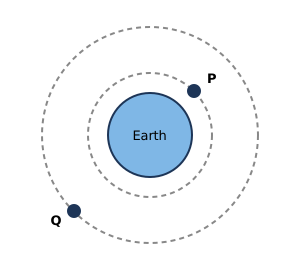
Rajah 5 menunjukkan dua satelit buatan manusia, P dan Q, yang mengorbit Bumi. Satelit P ialah satelit pemerhatian cuaca berjisim 850 kg pada ketinggian 6.00 × 10⁵ m dari permukaan Bumi. Satelit Q ialah satelit geopegun.Diagram 5 shows two artificial satellites, P and Q, orbiting the Earth. Satellite P is a weather observation satellite of mass 850 kg at a height of 6.00 × 10⁵ m above the surface of the Earth. Satellite Q is a geostationary satellite.
[1 mark]
(a)Nyatakan Hukum Kegravitian Semesta Newton.State Newton's Universal Law of Gravitation.
Show answerHide answer
Tick each point you got.
[2 marks]
(b)Hitung daya graviti yang bertindak ke atas satelit P.Calculate the gravitational force acting on satellite P.
Show answerHide answer
Tick each point you got.
[2 marks]
(c)Hitung laju linear satelit P.Calculate the linear speed of satellite P.
Show answerHide answer
Tick each point you got.
[2 marks]
(d)Hitung tempoh orbit satelit P dalam minit.Calculate the orbital period of satellite P in minutes.
Show answerHide answer
Tick each point you got.
[3 marks]
(e)Hitung jejari orbit dan ketinggian satelit geopegun Q dari permukaan Bumi. [Tempoh orbit = 24 jam]Calculate the orbital radius and the height of geostationary satellite Q above the surface of the Earth. [Orbital period = 24 hours]
Show answerHide answer
Tick each point you got.
[2 marks]
(f)Nyatakan dua ciri satelit geopegun.State two characteristics of a geostationary satellite.
Show answerHide answer
Any 2 points
Tick each point you got.
[2 marks]
(g)Hitung halaju lepas dari permukaan Bumi.Calculate the escape velocity from the surface of the Earth.
Show answerHide answer
Tick each point you got.
[3 marks]
(h)Seorang murid berkata, "Jika enjin satelit P dimatikan, satelit itu akan serta-merta jatuh ke Bumi kerana ditarik oleh daya graviti." Nilaikan pernyataan itu.A pupil says, "If the engine of satellite P is switched off, the satellite will immediately fall to the Earth because gravity pulls it down." Evaluate the statement.
Show answerHide answer
Tick each point you got.
[3 marks]
(i)Sebuah agensi angkasa ingin melancarkan satelit untuk memetakan keseluruhan permukaan Bumi, termasuk kawasan kutub. Cadangkan jenis orbit dan ketinggian yang sesuai, dengan satu sebab bagi setiap cadangan.A space agency wants to launch a satellite to map the entire surface of the Earth, including the polar regions. Suggest a suitable type of orbit and height, with one reason for each suggestion.
Show answerHide answer
Any 3 points
Tick each point you got.
26Choose 1
Question 26
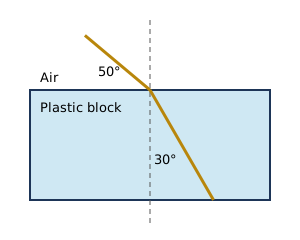
Rajah 6 menunjukkan seberkas cahaya yang bergerak dari udara ke dalam sebuah blok plastik lut sinar. Sudut tuju ialah 50° dan sudut biasan ialah 30°.Diagram 6 shows a ray of light moving from air into a transparent plastic block. The angle of incidence is 50° and the angle of refraction is 30°.
[2 marks]
(a)Hitung indeks biasan plastik itu.Calculate the refractive index of the plastic.
Show answerHide answer
Tick each point you got.
[1 mark]
(b)Hitung laju cahaya di dalam plastik itu. [Laju cahaya dalam udara = 3.00 × 10⁸ m s⁻¹]Calculate the speed of light in the plastic. [Speed of light in air = 3.00 × 10⁸ m s⁻¹]
Show answerHide answer
Tick each point you got.
[2 marks]
(c)Hitung sudut genting plastik itu.Calculate the critical angle of the plastic.
Show answerHide answer
Tick each point you got.
[2 marks]
(d)Di dalam blok itu, sinar cahaya yang lain menuju ke permukaan plastik-udara dengan sudut tuju 55°. Nyatakan apa yang berlaku kepada sinar itu dan beri satu sebab.Inside the block, another ray of light strikes the plastic-air surface at an angle of incidence of 55°. State what happens to the ray and give one reason.
Show answerHide answer
Tick each point you got.
[2 marks]
(e)Sebuah kolam renang berair (n = 1.33) mempunyai kedalaman sebenar 2.4 m. Hitung kedalaman ketara kolam itu apabila dilihat dari atas.A swimming pool of water (n = 1.33) has a real depth of 2.4 m. Calculate the apparent depth of the pool when it is viewed from above.
Show answerHide answer
Tick each point you got.
[3 marks]
(f)Sebuah kamera menggunakan kanta cembung berjarak fokus 5.0 cm. Seorang kawan setinggi 1.60 m berdiri 4.0 m dari kanta. Hitung jarak imej dan tinggi imej pada filem.A camera uses a convex lens of focal length 5.0 cm. A friend of height 1.60 m stands 4.0 m from the lens. Calculate the image distance and the height of the image on the film.
Show answerHide answer
Tick each point you got.
[2 marks]
(g)Nyatakan dua ciri imej yang terbentuk pada filem dalam (f).State two characteristics of the image formed on the film in (f).
Show answerHide answer
Any 2 points
Tick each point you got.
[3 marks]
(h)Berlian (n = 2.42) kelihatan lebih berkilauan daripada batu kaca (n = 1.52) yang dipotong dengan bentuk yang sama. Hitung sudut genting berlian dan terangkan mengapa berlian lebih berkilauan.A diamond (n = 2.42) sparkles more than a piece of glass (n = 1.52) cut to the same shape. Calculate the critical angle of the diamond and explain why the diamond sparkles more.
Show answerHide answer
Tick each point you got.
[3 marks]
(i)Sebuah gentian optik digunakan untuk menghantar isyarat telefon melalui kabel yang melengkung. Cadangkan hubungan antara indeks biasan teras dengan indeks biasan salutan, dan terangkan mengapa isyarat cahaya tidak keluar daripada gentian itu.An optical fibre is used to send a telephone signal through a cable that bends. Suggest the relationship between the refractive index of the core and that of the cladding, and explain why the light signal does not escape from the fibre.
Show answerHide answer
Tick each point you got.
Bahagian DSection D
20 marksSoalan ini wajib dijawab. Tulis jawapan anda di ruang yang disediakan.This question is compulsory. Write your answers in the spaces provided.
27
Question 27
Sebuah dewan sekolah yang besar akan dipasang sistem bunyi. Pasukan guru perlu memilih sistem yang paling sesuai supaya bunyi kedengaran jelas dan sekata di seluruh dewan. Jadual 3 menunjukkan empat cadangan, A, B, C dan D.
Jadual 3
Laju bunyi dalam udara = 340 m s⁻¹.A large school hall is to be fitted with a sound system. The teachers must choose the most suitable system so that the sound is clear and even throughout the hall. Table 3 shows four suggestions, A, B, C and D.
Table 3
Speed of sound in air = 340 m s⁻¹.
| Cadangan | Pembesar suara | Penutup dinding dan siling | Frekuensi asli tiang penyokong |
|---|---|---|---|
| A | Tweeter sahaja (2 000 Hz hingga 20 000 Hz) | Panel busa akustik | 5 Hz |
| B | Woofer dan tweeter (50 Hz hingga 20 000 Hz) | Jubin seramik berkilat | 5 Hz |
| C | Woofer dan tweeter (50 Hz hingga 20 000 Hz) | Panel busa akustik | 5 Hz |
| D | Woofer dan tweeter (50 Hz hingga 20 000 Hz) | Panel busa akustik | 200 Hz |
Laju bunyi dalam udara = 340 m s⁻¹.A large school hall is to be fitted with a sound system. The teachers must choose the most suitable system so that the sound is clear and even throughout the hall. Table 3 shows four suggestions, A, B, C and D.
| Suggestion | Loudspeakers | Wall and ceiling covering | Natural frequency of the support stands |
|---|---|---|---|
| A | Tweeter only (2 000 Hz to 20 000 Hz) | Acoustic foam panels | 5 Hz |
| B | Woofer and tweeter (50 Hz to 20 000 Hz) | Glossy ceramic tiles | 5 Hz |
| C | Woofer and tweeter (50 Hz to 20 000 Hz) | Acoustic foam panels | 5 Hz |
| D | Woofer and tweeter (50 Hz to 20 000 Hz) | Acoustic foam panels | 200 Hz |
Speed of sound in air = 340 m s⁻¹.
[7 marks]
(a)Cadangan yang manakah paling sesuai? Terangkan pilihan anda dengan membandingkan ciri pembesar suara, penutup dinding dan frekuensi asli tiang penyokong.Which suggestion is the most suitable? Explain your choice by comparing the loudspeakers, the wall covering and the natural frequency of the support stands.
Show answerHide answer
Marks are given for the choice (1) and for a correct reason for each of the three features (2 each, with the rejected alternative named).
Tick each point you got.
[3 marks]
(b)Woofer menghasilkan bunyi yang tersebar ke seluruh dewan tetapi bunyi tweeter lebih terarah. Terangkan sebabnya menggunakan pembelauan.A woofer's sound spreads throughout the hall but a tweeter's sound is more directional. Explain why, using diffraction.
Show answerHide answer
Tick each point you got.
[2 marks]
(c)Hitung panjang gelombang bunyi yang dihasilkan oleh woofer pada 85 Hz dan oleh tweeter pada 8 500 Hz.Calculate the wavelength of the sound produced by the woofer at 85 Hz and by the tweeter at 8 500 Hz.
Show answerHide answer
Tick each point you got.
[3 marks]
(d)Seorang murid berdiri 25.5 m di hadapan dinding belakang dewan yang tidak dipasang panel busa. Dia menepuk tangan sekali. Hitung masa yang diambil sehingga dia mendengar gema. Adakah gema itu kedengaran berasingan daripada bunyi asal jika masa minimum untuk mendengar gema yang jelas ialah 0.10 s? Beri satu sebab.A pupil stands 25.5 m in front of the back wall of the hall, which has no foam panels. She claps her hands once. Calculate the time taken until she hears the echo. Will the echo be heard separately from the original sound if the minimum time for a clear echo is 0.10 s? Give one reason.
Show answerHide answer
Tick each point you got.
[3 marks]
(e)Bunyi berfrekuensi 680 Hz bergerak dari udara sejuk (340 m s⁻¹) ke lapisan udara panas berhampiran lampu pentas, tempat lajunya ialah 356 m s⁻¹. Hitung panjang gelombang bunyi itu dalam lapisan udara panas dan nyatakan apa yang berlaku kepada frekuensinya.Sound of frequency 680 Hz travels from cool air (340 m s⁻¹) into a layer of hot air near the stage lights, where its speed is 356 m s⁻¹. Calculate the wavelength of the sound in the hot air and state what happens to its frequency.
Show answerHide answer
Tick each point you got.
[2 marks]
(f)Di beberapa tempat dalam dewan, bunyi daripada dua pembesar suara yang memancarkan bunyi koheren bertindih dan menjadi sangat perlahan. Nyatakan jenis interferens di tempat itu dan terangkan bagaimana ia berlaku.At some places in the hall, the sound from two loudspeakers emitting coherent sound overlaps and becomes very soft. State the type of interference at those places and explain how it occurs.
Show answerHide answer
Tick each point you got.
Test specification (JSU)
| Chapter | Remembering | Understanding | Applying | Analysing | Evaluating | Creating | Items | marks |
|---|---|---|---|---|---|---|---|---|
| 1. Measurement | – | – | 1 (1) | 1 (10) | – | – | 2 | 11 |
| 2. Force and Motion I | – | 1 (1) | 4 (13) | 1 (1) | – | – | 6 | 15 |
| 3. Gravitation | – | 1 (1) | 2 (11) | 1 (1) | 1 (20) | – | 5 | 33 |
| 4. Heat | – | 1 (1) | 3 (12) | 1 (1) | – | – | 5 | 14 |
| 5. Waves | – | 1 (1) | 2 (2) | – | – | 1 (20) | 4 | 23 |
| 6. Light and Optics | – | 1 (1) | 2 (2) | 1 (1) | – | 1 (20) | 5 | 24 |
| Total | 0 (0) | 5 (5) | 14 (41) | 5 (14) | 1 (20) | 2 (40) | 27 | 120 |
Each cell shows items (marks).