Practice paper, not an official KPM paperKertas latihan, bukan kertas rasmi KPM
55
Ujian Akhir Sesi AkademikEnd of Academic Session Test
FizikPhysics
Tingkatan 4, 2 jam 30 minit / 2 hours 30 minutes, 100 marksmarkah
Nama / NameNama
Kelas / ClassKelas
Tarikh / DateTarikh
Markah / marksmarkah: / 100
InstructionsArahan
- Kertas soalan ini mengandungi empat bahagian: Bahagian A, B, C dan D.This question paper consists of four sections: Section A, B, C and D.
- Bahagian A: pilih satu jawapan bagi setiap soalan.Section A: choose one answer for each question.
- Bahagian B dan D: jawab semua soalan. Bahagian C: jawab mana-mana satu soalan.Sections B and D: answer all questions. Section C: answer any one question.
- Tulis jawapan anda di ruang yang disediakan. Tunjukkan jalan kerja bagi pengiraan.Write your answers in the spaces provided. Show your working for calculations.
- Rajah tidak dilukis mengikut skala kecuali dinyatakan.The diagrams in this paper are not drawn to scale unless stated.
- Anda dibenarkan menggunakan kalkulator saintifik. Senarai rumus disediakan.You may use a scientific calculator. A list of formulae is provided.
- Ambil g = 9.81 m s⁻², G = 6.67 × 10⁻¹¹ N m² kg⁻², jisim Bumi = 5.97 × 10²⁴ kg, jejari Bumi = 6.37 × 10⁶ m.Take g = 9.81 m s⁻², G = 6.67 × 10⁻¹¹ N m² kg⁻², mass of the Earth = 5.97 × 10²⁴ kg, radius of the Earth = 6.37 × 10⁶ m.
Answer schemes are in English (DLP).Skema jawapan dalam Bahasa Inggeris (DLP).
Practice shows answers as you go. Exam times you and hides answers until you submit.Latihan menunjukkan jawapan semasa menjawab. Peperiksaan menetapkan masa dan menyembunyikan jawapan sehingga dihantar.
Bahagian ASection A
20 marksmarkahJawab semua soalan. Setiap soalan diikuti oleh empat pilihan jawapan, A, B, C dan D. Pilih satu jawapan sahaja.Answer all questions. Each question is followed by four options, A, B, C and D. Choose one answer only.
1
QuestionSoalan 1
Haba pendam tentu, l, ditakrifkan sebagai l = Q/m, dengan Q ialah tenaga haba dalam joule (J) dan m ialah jisim. Apakah unit bagi l dalam unit asas S.I.? [1 J = 1 kg m² s⁻²]Specific latent heat, l, is defined as l = Q/m, where Q is the heat energy in joules (J) and m is the mass. What is the unit of l in S.I. base units? [1 J = 1 kg m² s⁻²]
Show answerTunjuk jawapanHide answerSembunyi jawapan
B
l = Q ÷ m, so the unit is (kg m² s⁻²) ÷ kg = m² s⁻². Option A is the unit of Q (the joule), which still has the kilogram in it.
2
QuestionSoalan 2
Semasa misi Apollo 15, seorang angkasawan menjatuhkan sebilah tukul dan sehelai bulu burung serentak dari ketinggian yang sama di permukaan Bulan. Kedua-duanya sampai ke permukaan pada masa yang sama. Mengapakah keadaan ini berlaku?During the Apollo 15 mission, an astronaut dropped a hammer and a feather at the same time from the same height on the surface of the Moon. Both reached the surface together. Why did this happen?
Show answerTunjuk jawapanHide answerSembunyi jawapan
D
Without air resistance every object in free fall has the same gravitational acceleration, whatever its mass. The Moon does have gravity (about one sixth of the Earth's), and the hammer is much heavier than the feather.
3
QuestionSoalan 3
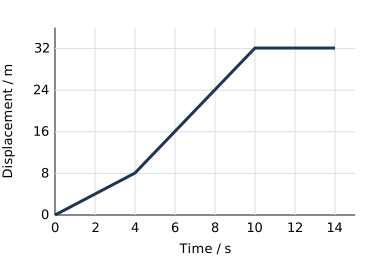
Rajah 1 menunjukkan graf sesaran-masa bagi seorang pelari. Berapakah halaju pelari itu dari t = 4 s hingga t = 10 s?Diagram 1 shows the displacement-time graph of a runner. What is the velocity of the runner from t = 4 s to t = 10 s?
Show answerTunjuk jawapanHide answerSembunyi jawapan
A
Velocity = gradient of the displacement-time graph = (32 − 8) ÷ (10 − 4) = 24 ÷ 6 = 4.0 m s⁻¹. 2.0 m s⁻¹ is the velocity in the first 4 s, and 3.2 m s⁻¹ is 32 m ÷ 10 s, the average velocity of the whole first 10 s.
4
QuestionSoalan 4
Seorang budak lelaki berjisim 60 kg berlari pada 4.0 m s⁻¹ lalu melompat ke atas sebuah papan selaju pegun berjisim 20 kg. Berapakah halaju budak lelaki dan papan selaju itu bersama-sama sejurus selepas melompat?A boy of mass 60 kg runs at 4.0 m s⁻¹ and jumps onto a stationary skateboard of mass 20 kg. What is the velocity of the boy and the skateboard together just after the jump?
Show answerTunjuk jawapanHide answerSembunyi jawapan
C
Momentum is conserved: 60 × 4.0 + 20 × 0 = (60 + 20)v, so v = 240 ÷ 80 = 3.0 m s⁻¹. 4.0 m s⁻¹ ignores the extra mass that has to be moved.
5
QuestionSoalan 5
Sebuah roket berjisim 2.0 × 10⁴ kg dilancarkan secara menegak dengan daya tujah 4.0 × 10⁵ N. Berapakah pecutan roket itu pada saat dilancarkan? [g = 9.81 m s⁻²]A rocket of mass 2.0 × 10⁴ kg is launched vertically with a thrust of 4.0 × 10⁵ N. What is the acceleration of the rocket at lift-off? [g = 9.81 m s⁻²]
Show answerTunjuk jawapanHide answerSembunyi jawapan
B
Weight = 2.0 × 10⁴ × 9.81 = 1.96 × 10⁵ N. Resultant force = 4.0 × 10⁵ − 1.96 × 10⁵ = 2.04 × 10⁵ N, so a = 2.04 × 10⁵ ÷ 2.0 × 10⁴ = 10.2 m s⁻². 20.0 m s⁻² forgets the weight and 29.8 m s⁻² adds g instead of subtracting it.
6
QuestionSoalan 6
Kanta sebuah teleskop dibungkus dengan polistirena sebelum dihantar menaiki lori. Mengapakah polistirena dapat mengurangkan kerosakan kanta itu jika kotak jatuh?The lens of a telescope is packed in polystyrene before it is sent by lorry. Why does the polystyrene reduce the damage to the lens if the box is dropped?
Show answerTunjuk jawapanHide answerSembunyi jawapan
D
The change of momentum is the same, but F = (mv − mu) ÷ t, so a longer impact time gives a smaller impulsive force. Padding does not change the mass, the inertia or the change in momentum.
7
QuestionSoalan 7
Sebuah stesen angkasa mengorbit pada ketinggian yang sama dengan jejari Bumi dari permukaan Bumi. Berapakah pecutan graviti di kedudukan stesen itu? [g di permukaan Bumi = 9.81 m s⁻²]A space station orbits at a height above the Earth's surface that is equal to the radius of the Earth. What is the gravitational acceleration at the position of the station? [g at the surface of the Earth = 9.81 m s⁻²]
Show answerTunjuk jawapanHide answerSembunyi jawapan
C
The distance from the centre of the Earth is R + R = 2R. g ∝ 1/r², so g = 9.81 ÷ 2² = 2.45 m s⁻². 4.91 m s⁻² uses 1/r instead of 1/r², and 1.09 m s⁻² uses r = 3R.
8
QuestionSoalan 8
Jejari orbit Musytari mengelilingi Matahari ialah 5.2 kali jejari orbit Bumi. Berapakah tempoh orbit Musytari dalam tahun Bumi?The orbital radius of Jupiter around the Sun is 5.2 times the orbital radius of the Earth. What is the orbital period of Jupiter in Earth years?
Show answerTunjuk jawapanHide answerSembunyi jawapan
A
Kepler's third law: T² ∝ r³, so T = 1 × (5.2)^(3/2) = 11.9 years. 27 years is 5.2² (squaring instead of using r³/²) and 2.3 years is √5.2.
9
QuestionSoalan 9
Planet X mempunyai ketumpatan purata yang sama dengan Bumi tetapi jejarinya dua kali jejari Bumi. Berapakah halaju lepas dari permukaan planet X? [Halaju lepas dari permukaan Bumi = 11.2 km s⁻¹]Planet X has the same average density as the Earth but its radius is twice the radius of the Earth. What is the escape velocity from the surface of planet X? [Escape velocity from the surface of the Earth = 11.2 km s⁻¹]
Show answerTunjuk jawapanHide answerSembunyi jawapan
D
Same density means M ∝ R³ (volume), so the mass of X is 2³ = 8 times the Earth's. v = √(2GM/R), so v ∝ √(M/R) = √(8/2) = 2. v = 2 × 11.2 = 22.4 km s⁻¹. 44.8 km s⁻¹ forgets the square root.
10
QuestionSoalan 10
Sehelai kain basah dibalut pada sebuah botol air supaya air di dalamnya kekal sejuk. Mengapakah kaedah ini berkesan?A wet cloth is wrapped around a bottle of water to keep the water inside cool. Why is this method effective?
Show answerTunjuk jawapanHide answerSembunyi jawapan
B
When water evaporates from the cloth, it takes the latent heat of vaporisation from the cloth and the bottle, so they cool down. This is cooling by evaporation (the same idea as sweating).
11
QuestionSoalan 11
Sebuah pemanas rendam berkuasa 500 W dan berkecekapan 70% digunakan untuk memanaskan 1.0 kg minyak masak selama 3.0 minit. Suhu minyak itu naik sebanyak 30 °C. Berapakah muatan haba tentu minyak itu?A 500 W immersion heater which is 70% efficient is used to heat 1.0 kg of cooking oil for 3.0 minutes. The temperature of the oil rises by 30 °C. What is the specific heat capacity of the oil?
Show answerTunjuk jawapanHide answerSembunyi jawapan
C
Heat absorbed by the oil = 0.70 × 500 × (3.0 × 60) = 63 000 J. c = Q ÷ (mΔθ) = 63 000 ÷ (1.0 × 30) = 2 100 J kg⁻¹ °C⁻¹. 3 000 ignores the efficiency.
12
QuestionSoalan 12
Satu jisim tetap gas pada suhu 27 °C dipanaskan pada tekanan tetap sehingga isi padunya bertambah sebanyak 20%. Berapakah suhu akhir gas itu?A fixed mass of gas at 27 °C is heated at constant pressure until its volume has increased by 20%. What is the final temperature of the gas?
Show answerTunjuk jawapanHide answerSembunyi jawapan
A
Charles' law: V₁/T₁ = V₂/T₂ with T in kelvin. T₁ = 300 K and V₂ = 1.2V₁, so T₂ = 1.2 × 300 = 360 K = 87 °C. 32 °C comes from multiplying the Celsius temperature by 1.2 and 360 °C forgets to subtract 273.
13
QuestionSoalan 13
Berapakah haba yang dibebaskan apabila 0.15 kg stim pada 100 °C terkondensasi menjadi air pada 100 °C? [Haba pendam tentu pengewapan air = 2.26 × 10⁶ J kg⁻¹]How much heat is released when 0.15 kg of steam at 100 °C condenses into water at 100 °C? [Specific latent heat of vaporisation of water = 2.26 × 10⁶ J kg⁻¹]
Show answerTunjuk jawapanHide answerSembunyi jawapan
D
Q = ml = 0.15 × 2.26 × 10⁶ = 3.39 × 10⁵ J. The temperature stays at 100 °C while the steam condenses, so no mcΔθ term is needed.
14
QuestionSoalan 14
Pernyataan yang manakah benar tentang semua gelombang elektromagnet dalam vakum?Which statement is true about all electromagnetic waves in a vacuum?
Show answerTunjuk jawapanHide answerSembunyi jawapan
B
All electromagnetic waves are transverse, need no medium and travel at c = 3.00 × 10⁸ m s⁻¹ in a vacuum. They differ in frequency and wavelength.
15
QuestionSoalan 15
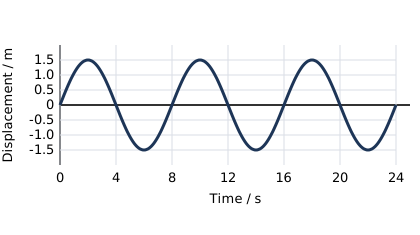
Sebuah pelampung di pelabuhan turun naik apabila ombak laut melaluinya. Rajah 2 menunjukkan graf sesaran-masa bagi pelampung itu. Jarak antara dua puncak ombak yang berturutan ialah 56 m. Berapakah laju ombak itu?A buoy in a harbour moves up and down as sea waves pass it. Diagram 2 shows the displacement-time graph of the buoy. The distance between two successive wave crests is 56 m. What is the speed of the waves?
Show answerTunjuk jawapanHide answerSembunyi jawapan
A
Three complete waves take 24 s, so T = 24 ÷ 3 = 8.0 s. The wavelength is 56 m, so v = λ ÷ T = 56 ÷ 8.0 = 7.0 m s⁻¹. 448 m s⁻¹ multiplies λ by T and 18.7 m s⁻¹ divides 56 by the number of waves.
16
QuestionSoalan 16
Dalam eksperimen dwicelah Young, jarak antara dua celah ialah 0.40 mm dan skrin berada 1.5 m dari celah. Jarak antara pinggir cerah pertama dengan pinggir cerah keenam ialah 9.0 mm. Berapakah panjang gelombang cahaya itu?In Young's double-slit experiment, the distance between the two slits is 0.40 mm and the screen is 1.5 m from the slits. The distance from the first bright fringe to the sixth bright fringe is 9.0 mm. What is the wavelength of the light?
Show answerTunjuk jawapanHide answerSembunyi jawapan
C
From the first to the sixth bright fringe there are 5 gaps, so x = 9.0 ÷ 5 = 1.8 mm. λ = ax/D = (0.40 × 10⁻³)(1.8 × 10⁻³) ÷ 1.5 = 4.8 × 10⁻⁷ m. Dividing by 6 gives 4.0 × 10⁻⁷ m, and using 9.0 mm as x gives 6.0 × 10⁻⁷ m.
17
QuestionSoalan 17
Pada hari yang panas, seorang pemandu melihat "lopak air" di atas jalan raya di hadapannya, tetapi apabila tiba di tempat itu jalan raya kering. Apakah yang menyebabkan fenomena ini?On a hot day, a driver sees a "puddle of water" on the road ahead, but when the car reaches the place the road is dry. What causes this phenomenon?
Show answerTunjuk jawapanHide answerSembunyi jawapan
D
Air near the hot road is optically less dense. Rays from the sky are refracted away from the normal until they reach the critical angle and are totally reflected towards the driver's eye, forming a mirage.
18
QuestionSoalan 18
Cahaya merah berpanjang gelombang 660 nm di dalam udara memasuki air yang berindeks biasan 1.33. Berapakah panjang gelombang cahaya itu di dalam air?Red light of wavelength 660 nm in air enters water of refractive index 1.33. What is the wavelength of the light in the water?
Show answerTunjuk jawapanHide answerSembunyi jawapan
B
The frequency stays the same, so λ ∝ v and n = c/v = λ(air)/λ(water). λ(water) = 660 ÷ 1.33 = 496 nm. 878 nm multiplies by n instead of dividing.
19
QuestionSoalan 19
Sebuah kanta cekung mempunyai panjang fokus 15 cm. Sebuah objek diletakkan 30 cm dari kanta itu. Di manakah imej terbentuk?A concave lens has a focal length of 15 cm. An object is placed 30 cm from the lens. Where is the image formed?
Show answerTunjuk jawapanHide answerSembunyi jawapan
C
For a concave lens f = −15 cm. 1/v = 1/f − 1/u = −1/15 − 1/30 = −3/30, so v = −10 cm. The negative sign means a virtual image on the same side as the object.
20
QuestionSoalan 20
Sebuah teleskop astronomi dilaraskan secara normal. Jarak antara kanta objektif dengan kanta mata ialah 105 cm dan pembesaran teleskop itu ialah 20. Apakah panjang fokus kanta objektif dan kanta mata?An astronomical telescope is in normal adjustment. The distance between the objective lens and the eyepiece lens is 105 cm and the magnification of the telescope is 20. What are the focal lengths of the objective lens and the eyepiece lens?
Show answerTunjuk jawapanHide answerSembunyi jawapan
A
At normal adjustment L = fo + fe = 105 cm and M = fo/fe = 20, so fo = 20fe. Then 21fe = 105, fe = 5.0 cm and fo = 100 cm. Option B has the right separation but M = 9.5, and D has M = 4.
Bahagian BSection B
40 marksmarkahJawab semua soalan. Tulis jawapan anda di ruang yang disediakan.Answer all questions. Write your answers in the spaces provided.
21
QuestionSoalan 21
Jadual 1 menunjukkan kekuatan medan graviti, g, di permukaan empat jasad dalam Sistem Suria. Seorang angkasawan berjisim 75 kg (termasuk pakaian angkasanya) akan menjelajah jasad-jasad itu.
Jadual 1Table 1 shows the gravitational field strength, g, on the surface of four bodies in the Solar System. An astronaut of mass 75 kg (including the spacesuit) will explore these bodies.
Table 1
| Jasad | Bumi | Bulan | Marikh | Musytari |
|---|---|---|---|---|
| g / N kg⁻¹ | 9.81 | 1.62 | 3.73 | 24.8 |
| Body | Earth | Moon | Mars | Jupiter |
|---|---|---|---|---|
| g / N kg⁻¹ | 9.81 | 1.62 | 3.73 | 24.8 |
[2 marksmarkah]
(a)Nyatakan dua perbezaan antara jisim dengan berat.State two differences between mass and weight.
Show answerTunjuk jawapanHide answerSembunyi jawapan
Tick each point you got.Tandakan setiap isi yang betul.
[2 marksmarkah]
(b)Hitung berat angkasawan itu di Bumi dan di Bulan.Calculate the weight of the astronaut on the Earth and on the Moon.
Show answerTunjuk jawapanHide answerSembunyi jawapan
Tick each point you got.Tandakan setiap isi yang betul.
[1 markmarkah]
(c)Berapakah jisim angkasawan itu di Marikh?What is the mass of the astronaut on Mars?
Show answerTunjuk jawapanHide answerSembunyi jawapan
Tick each point you got.Tandakan setiap isi yang betul.
[2 marksmarkah]
(d)Sebiji batu dijatuhkan daripada keadaan rehat dari ketinggian 1.5 m di atas permukaan Marikh. Hitung masa yang diambil oleh batu itu untuk sampai ke permukaan. Abaikan rintangan udara.A rock is dropped from rest from a height of 1.5 m above the surface of Mars. Calculate the time taken by the rock to reach the surface. Ignore air resistance.
Show answerTunjuk jawapanHide answerSembunyi jawapan
Tick each point you got.Tandakan setiap isi yang betul.
[3 marksmarkah]
(e)Sebuah pendarat berjisim 2 400 kg berlepas dari permukaan Bulan secara menegak dengan daya tujah ke atas 5 200 N. Hitung pecutan pendarat itu.A lander of mass 2 400 kg takes off vertically from the surface of the Moon with an upward thrust of 5 200 N. Calculate the acceleration of the lander.
Show answerTunjuk jawapanHide answerSembunyi jawapan
Tick each point you got.Tandakan setiap isi yang betul.
22
QuestionSoalan 22
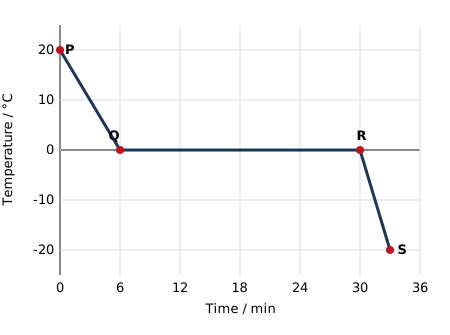
Fatimah membekukan 0.30 kg air pada 20 °C di dalam sebuah peti sejuk beku. Sebuah penderia suhu merekodkan suhu air itu dan Rajah 3 menunjukkan lengkung penyejukannya. Peti sejuk beku itu mengeluarkan haba daripada air pada kadar yang tetap. [Muatan haba tentu air = 4 200 J kg⁻¹ °C⁻¹; haba pendam tentu pelakuran ais = 3.34 × 10⁵ J kg⁻¹]Fatimah freezes 0.30 kg of water at 20 °C in a freezer. A temperature sensor records the temperature of the water and Diagram 3 shows its cooling curve. The freezer removes heat from the water at a constant rate. [Specific heat capacity of water = 4 200 J kg⁻¹ °C⁻¹; specific latent heat of fusion of ice = 3.34 × 10⁵ J kg⁻¹]
[1 markmarkah]
(a)Apakah perubahan fasa yang berlaku dari Q ke R?What change of phase takes place from Q to R?
Show answerTunjuk jawapanHide answerSembunyi jawapan
Tick each point you got.Tandakan setiap isi yang betul.
[1 markmarkah]
(b)Nyatakan takat beku air berdasarkan Rajah 3.State the freezing point of water based on Diagram 3.
Show answerTunjuk jawapanHide answerSembunyi jawapan
Tick each point you got.Tandakan setiap isi yang betul.
[2 marksmarkah]
(c)Terangkan mengapa suhu tidak berubah dari Q ke R walaupun haba terus dikeluarkan daripada air.Explain why the temperature does not change from Q to R although heat is still removed from the water.
Show answerTunjuk jawapanHide answerSembunyi jawapan
Tick each point you got.Tandakan setiap isi yang betul.
[2 marksmarkah]
(d)Hitung haba yang dikeluarkan daripada air dari P ke Q.Calculate the heat removed from the water from P to Q.
Show answerTunjuk jawapanHide answerSembunyi jawapan
Tick each point you got.Tandakan setiap isi yang betul.
[2 marksmarkah]
(e)Hitung kadar pengeluaran haba oleh peti sejuk beku itu dalam W.Calculate the rate at which the freezer removes heat, in W.
Show answerTunjuk jawapanHide answerSembunyi jawapan
Tick each point you got.Tandakan setiap isi yang betul.
[2 marksmarkah]
(f)Hitung masa, dalam minit, yang diambil untuk membekukan semua air itu dan semak jawapan anda dengan Rajah 3.Calculate the time, in minutes, taken to freeze all the water and check your answer with Diagram 3.
Show answerTunjuk jawapanHide answerSembunyi jawapan
Tick each point you got.Tandakan setiap isi yang betul.
23
QuestionSoalan 23
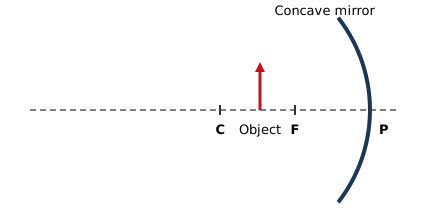
Rajah 4 menunjukkan sebuah cermin cekung dengan titik P, F dan C ditandakan pada paksi utama. Jejari kelengkungan cermin itu ialah 30 cm dan sebuah objek diletakkan 22 cm dari P.Diagram 4 shows a concave mirror with the points P, F and C marked on the principal axis. The radius of curvature of the mirror is 30 cm and an object is placed 22 cm from P.
[2 marksmarkah]
(a)Namakan titik F dan titik C.Name point F and point C.
Show answerTunjuk jawapanHide answerSembunyi jawapan
Tick each point you got.Tandakan setiap isi yang betul.
[1 markmarkah]
(b)Hitung panjang fokus cermin itu.Calculate the focal length of the mirror.
Show answerTunjuk jawapanHide answerSembunyi jawapan
Tick each point you got.Tandakan setiap isi yang betul.
[3 marksmarkah]
(c)Nyatakan kedudukan imej dan dua ciri imej yang terbentuk oleh objek dalam Rajah 4.State the position of the image and two characteristics of the image formed by the object in Diagram 4.
Show answerTunjuk jawapanHide answerSembunyi jawapan
Tick each point you got.Tandakan setiap isi yang betul.
[2 marksmarkah]
(d)Seorang doktor gigi memegang sebuah cermin cekung kecil supaya gigi pesakit berada di antara F dan P. Nyatakan ciri imej gigi itu dan terangkan mengapa cermin cekung digunakan.A dentist holds a small concave mirror so that the tooth of a patient is between F and P. State the characteristics of the image of the tooth and explain why a concave mirror is used.
Show answerTunjuk jawapanHide answerSembunyi jawapan
Tick each point you got.Tandakan setiap isi yang betul.
[2 marksmarkah]
(e)Sebuah dapur suria menggunakan cermin cekung yang besar. Di manakah periuk mesti diletakkan dan mengapa?A solar cooker uses a large concave mirror. Where must the pot be placed and why?
Show answerTunjuk jawapanHide answerSembunyi jawapan
Tick each point you got.Tandakan setiap isi yang betul.
24
QuestionSoalan 24
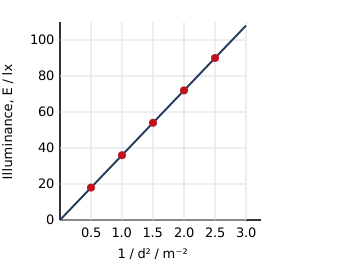
Sebuah stesen cuaca sekolah mengukur beberapa kuantiti fizik, termasuk halaju angin dan suhu udara. Murid-murid juga mengkaji hubungan antara pencahayaan, E, pada sebuah sensor cahaya dengan jarak, d, sensor itu dari sebuah lampu. Rajah 5 menunjukkan graf E melawan 1/d². Unit pencahayaan ialah lux (lx).A school weather station measures several physical quantities, including wind velocity and air temperature. The pupils also investigate the relationship between the illuminance, E, on a light sensor and the distance, d, of the sensor from a lamp. Diagram 5 shows the graph of E against 1/d². The unit of illuminance is the lux (lx).
[2 marksmarkah]
(a)Nyatakan sama ada setiap kuantiti berikut ialah kuantiti skalar atau kuantiti vektor: (i) halaju angin, (ii) suhu udara.State whether each of the following quantities is a scalar quantity or a vector quantity: (i) wind velocity, (ii) air temperature.
Show answerTunjuk jawapanHide answerSembunyi jawapan
Tick each point you got.Tandakan setiap isi yang betul.
[2 marksmarkah]
(b)Muatan haba tentu, c, diberi oleh Q = mcΔθ. Terbitkan unit c dalam unit asas S.I. [1 J = 1 kg m² s⁻²; Δθ dalam K]Specific heat capacity, c, is given by Q = mcΔθ. Derive the unit of c in S.I. base units. [1 J = 1 kg m² s⁻²; Δθ in K]
Show answerTunjuk jawapanHide answerSembunyi jawapan
Tick each point you got.Tandakan setiap isi yang betul.
[1 markmarkah]
(c)Berdasarkan Rajah 5, nyatakan hubungan antara E dengan 1/d².Based on Diagram 5, state the relationship between E and 1/d².
Show answerTunjuk jawapanHide answerSembunyi jawapan
Tick each point you got.Tandakan setiap isi yang betul.
[2 marksmarkah]
(d)Hitung kecerunan graf itu dan nyatakan unitnya.Calculate the gradient of the graph and state its unit.
Show answerTunjuk jawapanHide answerSembunyi jawapan
Tick each point you got.Tandakan setiap isi yang betul.
[2 marksmarkah]
(e)Gunakan graf itu untuk menentukan E apabila d = 0.80 m.Use the graph to find E when d = 0.80 m.
Show answerTunjuk jawapanHide answerSembunyi jawapan
Tick each point you got.Tandakan setiap isi yang betul.
[1 markmarkah]
(f)Namakan kaedah membaca graf yang digunakan dalam (e).Name the method of reading the graph used in (e).
Show answerTunjuk jawapanHide answerSembunyi jawapan
Tick each point you got.Tandakan setiap isi yang betul.
Bahagian CSection C
20 marksmarkahJawab mana-mana satu soalan sahaja. Tulis jawapan anda di ruang yang disediakan.Answer any one question. Write your answers in the spaces provided.
25Choose 1Pilih 1
QuestionSoalan 25
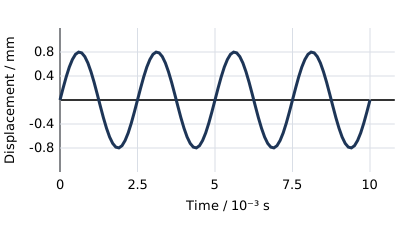
Sebuah balai cerap di puncak bukit mempunyai siren amaran. Rajah 6 menunjukkan graf sesaran-masa bagi diafragma siren itu semasa ia mengeluarkan bunyi. [Laju bunyi dalam udara = 340 m s⁻¹]An observatory on a hilltop has a warning siren. Diagram 6 shows the displacement-time graph of the diaphragm of the siren while it produces a sound. [Speed of sound in air = 340 m s⁻¹]
[1 markmarkah]
(a)Namakan jenis gelombang bunyi dan nyatakan arah getaran zarah udara berbanding arah perambatan gelombang itu.Name the type of sound wave and state the direction of vibration of the air particles relative to the direction of propagation of the wave.
Show answerTunjuk jawapanHide answerSembunyi jawapan
Tick each point you got.Tandakan setiap isi yang betul.
[2 marksmarkah]
(b)Berdasarkan Rajah 6, nyatakan amplitud dan tempoh gelombang itu.Based on Diagram 6, state the amplitude and the period of the wave.
Show answerTunjuk jawapanHide answerSembunyi jawapan
Tick each point you got.Tandakan setiap isi yang betul.
[2 marksmarkah]
(c)Hitung frekuensi dan panjang gelombang bunyi itu.Calculate the frequency and the wavelength of the sound.
Show answerTunjuk jawapanHide answerSembunyi jawapan
Tick each point you got.Tandakan setiap isi yang betul.
[2 marksmarkah]
(d)Seorang pemerhati di balai cerap melihat kilat dan mendengar guruh 6.8 s kemudian. Hitung jarak kilat itu dari pemerhati. Abaikan masa yang diambil oleh cahaya.An observer at the observatory sees a lightning flash and hears the thunder 6.8 s later. Calculate the distance of the lightning from the observer. Ignore the time taken by the light.
Show answerTunjuk jawapanHide answerSembunyi jawapan
Tick each point you got.Tandakan setiap isi yang betul.
[2 marksmarkah]
(e)Teleskop radio di balai cerap itu menerima isyarat daripada hidrogen di angkasa pada frekuensi 1.42 × 10⁹ Hz. Hitung panjang gelombang isyarat itu. [Laju gelombang elektromagnet dalam vakum = 3.00 × 10⁸ m s⁻¹]The radio telescope at the observatory receives a signal from hydrogen in space at a frequency of 1.42 × 10⁹ Hz. Calculate the wavelength of the signal. [Speed of electromagnetic waves in a vacuum = 3.00 × 10⁸ m s⁻¹]
Show answerTunjuk jawapanHide answerSembunyi jawapan
Tick each point you got.Tandakan setiap isi yang betul.
[2 marksmarkah]
(f)Isyarat radio FM berpanjang gelombang kira-kira 3 m boleh diterima di belakang sebuah bukit, tetapi cahaya daripada pemancar itu tidak dapat dilihat. Terangkan mengapa, menggunakan pembelauan.An FM radio signal of wavelength about 3 m can be received behind a hill, but the light from the transmitter cannot be seen. Explain why, using diffraction.
Show answerTunjuk jawapanHide answerSembunyi jawapan
Tick each point you got.Tandakan setiap isi yang betul.
[3 marksmarkah]
(g)Menara yang menyokong sebuah teleskop mempunyai frekuensi asli 2.0 Hz. Tiupan angin yang berkala pada 2.0 Hz menyebabkan menara itu bergoyang dengan amplitud yang sangat besar. (i) Namakan fenomena itu. (ii) Mengapakah amplitud menjadi sangat besar? (iii) Cadangkan satu cara untuk mengurangkan goyangan itu.The tower that supports a telescope has a natural frequency of 2.0 Hz. Periodic gusts of wind at 2.0 Hz make the tower sway with a very large amplitude. (i) Name the phenomenon. (ii) Why does the amplitude become very large? (iii) Suggest one way to reduce the swaying.
Show answerTunjuk jawapanHide answerSembunyi jawapan
Tick each point you got.Tandakan setiap isi yang betul.
[3 marksmarkah]
(h)Seorang murid berkata, "Gelombang radio mengambil masa lebih lama daripada cahaya nampak untuk sampai dari sebuah galaksi yang jauh kerana frekuensinya lebih rendah." Nilaikan pernyataan itu.A pupil says, "Radio waves take longer than visible light to arrive from a distant galaxy because their frequency is lower." Evaluate the statement.
Show answerTunjuk jawapanHide answerSembunyi jawapan
Tick each point you got.Tandakan setiap isi yang betul.
[3 marksmarkah]
(i)Seorang jurutera memakai fon telinga penyingkir bunyi bising. Fon telinga itu menghasilkan bunyinya sendiri untuk mengurangkan bunyi bising mesin. Terangkan bagaimana bunyi daripada fon telinga itu mengurangkan bunyi bising, menggunakan interferens.An engineer wears noise-cancelling earphones. The earphones produce a sound of their own to reduce the noise of a machine. Explain how the sound from the earphones reduces the noise, using interference.
Show answerTunjuk jawapanHide answerSembunyi jawapan
Tick each point you got.Tandakan setiap isi yang betul.
26Choose 1Pilih 1
QuestionSoalan 26
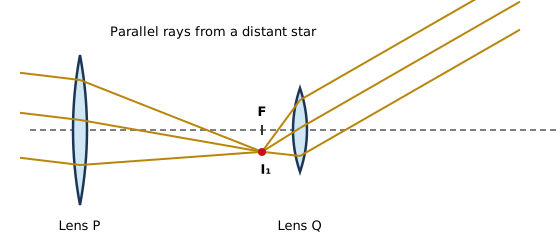
Rajah 7 menunjukkan sebuah teleskop astronomi yang dilaraskan secara normal. Kanta P mempunyai panjang fokus 120 cm dan kanta Q mempunyai panjang fokus 6.0 cm. Titik F ialah titik fokus bersama kedua-dua kanta dan I₁ ialah imej pertama.Diagram 7 shows an astronomical telescope in normal adjustment. Lens P has a focal length of 120 cm and lens Q has a focal length of 6.0 cm. Point F is the common focal point of both lenses and I₁ is the first image.
[2 marksmarkah]
(a)Namakan kanta P dan kanta Q, dan beri satu sebab bagi jawapan anda.Name lens P and lens Q, and give one reason for your answer.
Show answerTunjuk jawapanHide answerSembunyi jawapan
Tick each point you got.Tandakan setiap isi yang betul.
[2 marksmarkah]
(b)Nyatakan dua ciri imej pertama, I₁, yang dibentuk oleh kanta P.State two characteristics of the first image, I₁, formed by lens P.
Show answerTunjuk jawapanHide answerSembunyi jawapan
Any 2 pointsMana-mana 2 isi
Tick each point you got.Tandakan setiap isi yang betul.
[2 marksmarkah]
(c)Hitung pembesaran teleskop itu dan jarak antara kanta P dengan kanta Q.Calculate the magnification of the telescope and the distance between lens P and lens Q.
Show answerTunjuk jawapanHide answerSembunyi jawapan
Tick each point you got.Tandakan setiap isi yang betul.
[2 marksmarkah]
(d)Nyatakan dua ciri imej akhir yang dilihat oleh pemerhati.State two characteristics of the final image seen by the observer.
Show answerTunjuk jawapanHide answerSembunyi jawapan
Any 2 pointsMana-mana 2 isi
Tick each point you got.Tandakan setiap isi yang betul.
[3 marksmarkah]
(e)Untuk menguji kanta P, seorang murid mengarahkannya ke sebuah menara setinggi 25 m yang berjarak 60 m. Hitung jarak imej dan tinggi imej yang dibentuk oleh kanta P sahaja.To test lens P, a pupil points it at a tower of height 25 m that is 60 m away. Calculate the image distance and the height of the image formed by lens P alone.
Show answerTunjuk jawapanHide answerSembunyi jawapan
Tick each point you got.Tandakan setiap isi yang betul.
[3 marksmarkah]
(f)Sebuah teleskop pantulan di balai cerap menggunakan cermin cekung utama berjejari kelengkungan 24.0 m. Hitung panjang fokus cermin itu dan terangkan mengapa cermin utama dibuat dengan diameter yang besar.A reflecting telescope at the observatory uses a main concave mirror of radius of curvature 24.0 m. Calculate the focal length of the mirror and explain why the main mirror is made with a large diameter.
Show answerTunjuk jawapanHide answerSembunyi jawapan
Tick each point you got.Tandakan setiap isi yang betul.
[3 marksmarkah]
(g)Sebuah cermin cembung dipasang di sudut koridor balai cerap supaya pengawal dapat melihat orang yang menghampiri. Nyatakan dua ciri imej yang dilihat dan satu sebab cermin cembung digunakan.A convex mirror is fixed at a corner of a corridor in the observatory so that the guard can see people approaching. State two characteristics of the image seen and one reason for using a convex mirror.
Show answerTunjuk jawapanHide answerSembunyi jawapan
Tick each point you got.Tandakan setiap isi yang betul.
[3 marksmarkah]
(h)Seorang murid ingin meningkatkan pembesaran teleskop itu. Cadangan Ali: gantikan kanta Q dengan kanta berpanjang fokus 12 cm. Cadangan Siti: gantikan kanta P dengan kanta berpanjang fokus 150 cm. Nilaikan kedua-dua cadangan dengan mengira pembesaran baharu.A pupil wants to increase the magnification of the telescope. Ali's suggestion: replace lens Q with a lens of focal length 12 cm. Siti's suggestion: replace lens P with a lens of focal length 150 cm. Evaluate both suggestions by calculating the new magnification.
Show answerTunjuk jawapanHide answerSembunyi jawapan
Tick each point you got.Tandakan setiap isi yang betul.
Bahagian DSection D
20 marksmarkahSoalan ini wajib dijawab. Tulis jawapan anda di ruang yang disediakan.This question is compulsory. Write your answers in the spaces provided.
27
QuestionSoalan 27
Agensi angkasa negara merancang untuk melancarkan sebuah satelit cuaca supaya balai cerap dapat memantau awan monsun di atas Semenanjung Malaysia tanpa henti. Jadual 2 menunjukkan empat cadangan orbit, A, B, C dan D. Semua satelit mengorbit Bumi dalam orbit bulatan.
Jadual 2The national space agency plans to launch a weather satellite so that the observatory can monitor monsoon clouds over Peninsular Malaysia without a break. Table 2 shows four orbit suggestions, A, B, C and D. All the satellites move around the Earth in circular orbits.
Table 2
| Cadangan | Ketinggian dari permukaan Bumi | Satah orbit | Arah orbit | Jisim satelit |
|---|---|---|---|---|
| A | 9.0 × 10⁵ m | Merentasi kutub utara dan kutub selatan | Utara ke selatan | 450 kg |
| B | 3.58 × 10⁷ m | Di atas khatulistiwa | Sama dengan arah putaran Bumi | 650 kg |
| C | 3.58 × 10⁷ m | Di atas khatulistiwa | Bertentangan dengan arah putaran Bumi | 650 kg |
| D | 2.00 × 10⁷ m | Di atas khatulistiwa | Sama dengan arah putaran Bumi | 800 kg |
| Suggestion | Height above the Earth's surface | Plane of orbit | Direction of orbit | Mass of satellite |
|---|---|---|---|---|
| A | 9.0 × 10⁵ m | Across the north pole and the south pole | North to south | 450 kg |
| B | 3.58 × 10⁷ m | Above the equator | Same as the rotation of the Earth | 650 kg |
| C | 3.58 × 10⁷ m | Above the equator | Opposite to the rotation of the Earth | 650 kg |
| D | 2.00 × 10⁷ m | Above the equator | Same as the rotation of the Earth | 800 kg |
[7 marksmarkah]
(a)Cadangan yang manakah paling sesuai? Terangkan pilihan anda dengan membandingkan ketinggian, satah orbit dan arah orbit.Which suggestion is the most suitable? Explain your choice by comparing the height, the plane of the orbit and the direction of the orbit.
Show answerTunjuk jawapanHide answerSembunyi jawapan
Marks are given for the choice (1) and for a correct reason for the height, the plane and the direction (1 each, with the rejected alternative named).
Tick each point you got.Tandakan setiap isi yang betul.
[2 marksmarkah]
(b)Jisim satelit-satelit dalam Jadual 2 berbeza. Terangkan mengapa jisim satelit tidak perlu dipertimbangkan dalam memilih orbit.The masses of the satellites in Table 2 are different. Explain why the mass of the satellite does not need to be considered in choosing the orbit.
Show answerTunjuk jawapanHide answerSembunyi jawapan
Tick each point you got.Tandakan setiap isi yang betul.
[3 marksmarkah]
(c)Hitung laju linear satelit dalam cadangan B.Calculate the linear speed of the satellite in suggestion B.
Show answerTunjuk jawapanHide answerSembunyi jawapan
Tick each point you got.Tandakan setiap isi yang betul.
[3 marksmarkah]
(d)Gunakan hukum ketiga Kepler dan tempoh orbit cadangan B (24 jam) untuk menghitung tempoh orbit satelit dalam cadangan A, dalam minit. Berapa kalikah satelit A mengelilingi Bumi dalam 24 jam?Use Kepler's third law and the orbital period of suggestion B (24 hours) to calculate the orbital period of the satellite in suggestion A, in minutes. How many times does satellite A go around the Earth in 24 hours?
Show answerTunjuk jawapanHide answerSembunyi jawapan
Tick each point you got.Tandakan setiap isi yang betul.
[2 marksmarkah]
(e)Hitung tempoh orbit satelit dalam cadangan D, dalam jam, dan nyatakan sama ada satelit itu geopegun.Calculate the orbital period of the satellite in suggestion D, in hours, and state whether the satellite is geostationary.
Show answerTunjuk jawapanHide answerSembunyi jawapan
Tick each point you got.Tandakan setiap isi yang betul.
[3 marksmarkah]
(f)Seorang juruteknik berkata, "Pada ketinggian 3.58 × 10⁷ m tiada daya graviti, jadi satelit B terapung pegun di atas tempat yang sama." Nilaikan pernyataan itu.A technician says, "At a height of 3.58 × 10⁷ m there is no gravitational force, so satellite B floats at rest above the same place." Evaluate the statement.
Show answerTunjuk jawapanHide answerSembunyi jawapan
Tick each point you got.Tandakan setiap isi yang betul.
Test specification (JSU)Jadual Spesifikasi Ujian (JSU)
| Chapter | RememberingMengingat | UnderstandingMemahami | ApplyingMengaplikasi | AnalysingMenganalisis | EvaluatingMenilai | CreatingMencipta | Items | marksmarkah |
|---|---|---|---|---|---|---|---|---|
| 1. Measurement | – | – | 2 (11) | – | – | – | 2 | 11 |
| 2. Force and Motion I | – | 2 (2) | 4 (13) | – | – | – | 6 | 15 |
| 3. Gravitation | – | – | 2 (2) | 1 (1) | – | 1 (20) | 4 | 23 |
| 4. Heat | – | 1 (1) | 2 (2) | 2 (11) | – | – | 5 | 14 |
| 5. Waves | 1 (1) | – | 1 (1) | 1 (1) | 1 (20) | – | 4 | 23 |
| 6. Light and Optics | – | 2 (11) | 2 (2) | 1 (1) | – | 1 (20) | 6 | 34 |
| TotalJumlah | 1 (1) | 5 (14) | 13 (31) | 5 (14) | 1 (20) | 2 (40) | 27 | 120 |
Each cell shows items (marks).Setiap petak menunjukkan item (markah).