Additional Mathematics notes, chapter 1
Circular Measure
Textbook Additional Mathematics Form 5 (DLP), pages 1–27
What this chapter covers
- Define a radian and convert angles between radians and degrees (1.1)
- Use the arc length formula s = rθ to find arc length, radius and angle, and the perimeter of a segment, and solve problems (1.2)
- Use the sector area formula A = ½r²θ to find area, radius and angle, find the area of a segment and solve problems (1.3)
- Apply arc length, sector area and related formulae to solve problems on circular measures in real life (1.4)
1.1Radian
Angles in circular measure are usually written in degrees. In Additional Mathematics we also use a second unit, the radian. It is built from the circle itself, which makes formulae for arcs and sectors much shorter.
One radian is the size of the angle subtended at the centre of a circle by an arc whose length is the same as the radius. "rad" stands for radian.
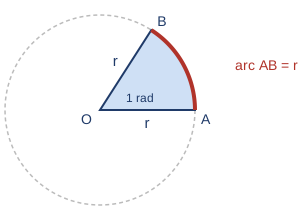
If the arc is 2 times the radius the angle is 2 rad, if it is 3 times the radius the angle is 3 rad, and so on. A full circle has arc length 2πr, so the angle is 2π rad.
2π rad = 360° so π rad = 180°
1 rad = 180°π ≈ 57.29° and 1° = π180° ≈ 0.01746 rad
1 rad = 180°π ≈ 57.29° and 1° = π180° ≈ 0.01746 rad
| To change | Multiply by |
|---|---|
| radians into degrees | 180°π |
| degrees into radians | π180° |
| Degrees | 30° | 45° | 60° | 90° | 180° | 270° | 360° |
|---|---|---|---|---|---|---|---|
| Radians | π6 | π4 | π3 | π2 | π | 3π2 | 2π |
Example 1 (textbook p. 3): radians into degrees [use π = 3.142]
(a) 2π5 rad = 2π5 × 180°π = 72°(b) 2.25 rad = 2.25 × 180°3.142 = 128.9° (128° 54′)
Example 2 (textbook p. 4): degrees into radians
(a) 40° = 40° × π180° = 2π9 rad (in terms of π)(b) 110° 30′ = 110.5° × 3.142180° = 1.929 rad and 320° × 3.142180° = 5.586 rad
Leave the answer "in terms of π" when the question says so. Otherwise use π = 3.142 and give three decimal places for radians.
Mixing up the two conversions. A radian is bigger than a degree (1 rad ≈ 57°), so degrees to radians gives a smaller number, and radians to degrees gives a larger one.
(a) Convert 3π4 rad into degrees. (b) Convert 225° into radians in terms of π.
Show answerHide answer
(a) 3π4 × 180°π = 135°
(b) 225° × π180° = 5π4 rad
(b) 225° × π180° = 5π4 rad
1.2Arc length of a circle
The arc length is a fraction of the circumference, and that fraction is the same as the angle's fraction of a full turn.
In degrees: arc length = θ360° × 2πr
In radians: s = rθ
In radians: s = rθ
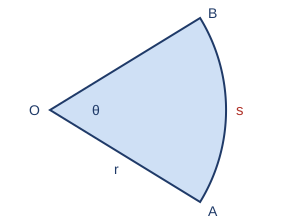
Using s = rθ with θ in degrees. The formula only works when θ is in radians. Convert first.
Example 3 (textbook p. 6): arc length [use π = 3.142]
(a) r = 5 cm, θ = 0.9 rad: s = 5 × 0.9 = 4.5 cm(b) r = 6 cm, θ = 2π3 rad: s = 6 × 2π3 = 4π = 12.57 cm
(c) r = 10 cm, reflex angle 360° − 140° = 220° = 220° × 3.142180° = 3.84 rad: s = 10 × 3.84 = 38.4 cm
Example 4 (textbook p. 7): finding r and θ
Arc AB = 2.6 cm subtends 1.3 rad. Then r = s ÷ θ = 2.6 ÷ 1.3 = 2 cm.If arc BC = 1.4 cm in the same circle, ∠BOC = 1.4 ÷ 2 = 0.7 rad.
Perimeter of a segment
A segment is the region between an arc and its chord. Its perimeter is the arc plus the chord.
Perimeter of segment = arc length + chord
Chord AB = 2r sin(θ2) or by the cosine rule AB² = r² + r² − 2r² cos θ
Chord AB = 2r sin(θ2) or by the cosine rule AB² = r² + r² − 2r² cos θ
Example 5 (textbook p. 8)
Circle r = 10 cm, chord AC subtends 114° at O.114° = 114° × 3.142180° = 1.990 rad, so arc = 10 × 1.990 = 19.90 cm.
Chord AC = 2 × 10 × sin 57° = 16.77 cm.
Perimeter = 19.90 + 16.77 = 36.67 cm.
Example 6 (textbook p. 9): shot put region [use π = 3.142]
Two sectors AOB and POQ with the same centre O, ∠AOB = ∠POQ = 50°, OA = 2 m and AP = 8 m, so OP = 10 m. Find the perimeter of ABQP.50° = 50° × 3.142180° = 0.873 rad.
Arc AB = 2 × 0.873 = 1.746 m and arc PQ = 10 × 0.873 = 8.73 m.
Perimeter = 1.746 + 8 + 8.73 + 8 = 26.48 m.
A sector has r = 7 cm and θ = 0.8 rad. Find (a) the arc length (b) the perimeter of the sector.
Show answerHide answer
(a) s = 7 × 0.8 = 5.6 cm
(b) 7 + 7 + 5.6 = 19.6 cm
(b) 7 + 7 + 5.6 = 19.6 cm
1.3Area of sector of a circle
In degrees: A = θ360° × πr²
In radians: A = 12r²θ (also A = 12rs, because s = rθ)
In radians: A = 12r²θ (also A = 12rs, because s = rθ)
Example 7 (textbook p. 13): area of sector
(a) r = 12 cm, θ = 1.7 rad: A = 12 × 12² × 1.7 = 122.4 cm²(b) r = 10 cm, ∠MON = 124° so the reflex angle is 236° = 4.12 rad: A = 12 × 10² × 4.12 = 206 cm²
Example 8 (textbook p. 14): finding r or θ
Area = 35 cm². (a) θ = 0.7: 12r²(0.7) = 35, r² = 100, r = 10 cm.(b) r = 11 cm: 12(121)θ = 35, θ = 0.5785 rad.
Area of segment
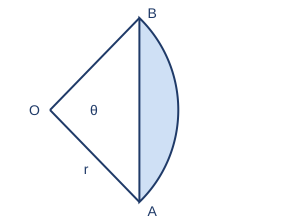
Area of segment = 12r²θ − 12r² sin θ = 12r²(θ − sin θ) (θ in radians)
Example 9 (textbook p. 15)
r = 6 cm, θ = 2.2 rad.Sector = 12 × 36 × 2.2 = 39.60 cm². Triangle = 12 × 36 × sin 2.2 = 14.55 cm² (calculator in radian mode, or 126°).
Segment = 39.60 − 14.55 = 25.05 cm².
Subtracting a shaded region from a bigger sector is the same idea: area of region between two sectors with the same centre = 12(R² − r²)θ. This is Example 10, the paper fan (textbook p. 17).
Entering sin θ on the calculator in degree mode when θ is in radians. For θ = 2.2 rad, sin 2.2 = 0.8085 only in radian mode.
A sector has area 24 cm² and r = 6 cm. Find θ.
Show answerHide answer
12 × 36 × θ = 24, so 18θ = 24 and θ = 43 rad
1.4Application of circular measures
Real shapes such as tunnels, windows, tracks and logos are put together from sectors, segments and triangles. Use these steps.
- Read the diagram. Mark r, θ (in radians) and what is asked: a length, an area or a perimeter.
- Split the shape into sectors and triangles (or subtract one from another).
- Apply s = rθ, A = 12r²θ and A = 12ab sin C; use the sine or cosine rule for chords.
- Check units: cm or m for lengths, cm² or m² for areas.
Example 11 (textbook p. 20): train tunnel
Major segment ABC, centre O, r = 4 m, ∠AOC = 1.8 rad.(a) AC² = 4² + 4² − 2(4)(4) cos 1.8 = 39.27, so AC = 6.267 m.
(b) Reflex angle = 2π − 1.8 = 4.484 rad. Major arc = 4 × 4.484 = 17.94 m.
(c) Triangle AOC = 12 × 4 × 4 × sin 1.8 = 7.791 m². Major sector = 12 × 16 × 4.484 = 35.87 m².
Cross-section = 7.791 + 35.87 = 43.66 m².
If the centre O lies inside the major segment, add the triangle to the major sector. For a minor segment you subtract it.
A sector has r = 5 cm and arc length 8 cm. Find its perimeter and area.
Show answerHide answer
Perimeter = 5 + 5 + 8 = 18 cm. θ = 8 ÷ 5 = 1.6 rad, A = 12 × 25 × 1.6 = 20 cm² (or 12rs = 12 × 5 × 8)