English
Instructions
- This model paper has Paper 1 (Reading and Use of English, 40 marks) and Paper 2 (Writing, 60 marks). In the real SPM the two papers are taken separately and each lasts 1 hour 30 minutes.
- Answer all questions in Paper 1 and in Parts 1 and 2 of Paper 2. In Paper 2 Part 3, choose one question.
- Paper 1: choose or write the answer for each question.
- Paper 2: write your answers in the spaces provided.
Practice shows answers as you go. Exam times you and hides answers until you submit.
Paper 1 Part 1
8 marksQuestion 1
Please help us protect the birds.
Stay on the boardwalk. Do not feed the birds or the monkeys.
There are no rubbish bins in the park, so please take your litter home.
Dogs on leads only.
Bird tower open 8.00 a.m. to 5.00 p.m.
Show answerHide answer
Question 2
Front Office, Seri Pantai Hotel
Show answerHide answer
Question 3
KAMPUNG BATU HERITAGE TRAIL
A 1.5 km walk past twelve old houses, a stone well and a mosque more than a hundred years old. Pick up a free leaflet at the museum entrance, or join a guided tour (RM8 a person, minimum four people). We recommend shoes with a good grip, as the old stone steps can be slippery after rain. The trail is not suitable for wheelchairs.Show answerHide answer
Question 4
Hundreds of children in our district start the school year without a single textbook.
Bring your old storybooks, dictionaries and textbooks (in good condition, please) to the blue boxes at the Community Hall before 30 June.
Volunteers are also welcome to help sort the books on Saturday 5 July at 9.00 a.m.
Show answerHide answer
Question 5
Show answerHide answer
Question 6
Farah_R: I used to think vloggers just got paid to talk about themselves. Then I made one ten-minute video: three hours of filming and five hours of editing. Respect! Still, I wish they would tell us when a video is sponsored. Otherwise it is hard to trust their reviews.
Show answerHide answer
Question 7
30% off all shoes | 20% off all bags
Buy two shirts, get the third free
Show your student card for an extra 5% off non-sale items
Sale items cannot be exchanged or refunded.
Show answerHide answer
Question 8
SCIENCE LABORATORY RULES
1. Never enter the lab without a teacher.2. Tie back long hair and wear goggles when heating chemicals.
3. Report every spill or breakage to the teacher at once. Never touch broken glass with your hands.
4. Do not eat or drink in the lab.
5. Wash your hands before you leave.
Show answerHide answer
Paper 1 Part 2
10 marksQuestion 9
MY GREENEST HOLIDAY YET
Posted by Dania, 8 April
Last month my family spent a week on Pulau Langkawi, and it was our first truly eco-friendly holiday. My mother, (9) ______ works for a travel agency, found the hotel online. In the past we (10) ______ choose big resorts with the air-conditioning running day and night, but this time we wanted to leave a smaller footprint.
The hotel (11) ______ entirely by solar panels, and by the time we arrived it (12) ______ plastic straws and bottles. The manager encouraged guests (13) ______ their towels more than once. The beach was so spotless that the staff (14) ______ have cleaned it every morning.
On the second day, our guide asked us (15) ______ we had ever walked through a mangrove forest. Our bicycles were old and the brakes were broken, so we (16) ______ them repaired in the village for only RM10. The (17) ______ we cycled, the happier we felt, and we saw eagles, monkeys and even an otter.
I truly believe that if more tourists (18) ______ like us, the island's beaches would stay beautiful for many years.
Show answerHide answer
Question 10
Show answerHide answer
Question 11
Show answerHide answer
Question 12
Show answerHide answer
Question 13
Show answerHide answer
Question 14
Show answerHide answer
Question 15
Show answerHide answer
Question 16
Show answerHide answer
Question 17
Show answerHide answer
Question 18
Show answerHide answer
Paper 1 Part 3
8 marksQuestion 19
THE SEA THAT WALKED AWAY
1 Fifty years ago, the town of Muynak in Central Asia was a busy fishing port. Boats left every dawn and came back full, and a factory canned the catch for shops hundreds of kilometres away. Today a visitor to Muynak stands in a desert, and the nearest water is many kilometres off. Rusting ships lie on the dry sand like toys left behind by a giant child.
2 The Aral Sea was once one of the largest lakes in the world, fed by two great rivers. In the 1960s, however, engineers decided to divert the rivers' water to irrigate cotton fields on the dry plains. The plan worked: the fields turned green and cotton became a valuable export. But the lake depended on those rivers, and it began to shrink. By the time officials understood how serious the problem was, it was too late to save the whole sea.
3 The effects went far beyond the fishing industry. As the lake dried up, the wind lifted salt and chemicals from the old sea bed and blew them into nearby villages, making people ill. Summers became hotter and winters colder, because the water no longer softened the climate. Many fishermen lost their jobs and left to look for work elsewhere. Those who stayed said it felt as if their home had been stolen.
4 There is, however, a small ray of hope. In 2005 a dam was completed to keep the water in the northern part of the lake. Within a few years the water level rose, the salt in the water fell and the fish returned. Fishing boats now set out again from the town of Aralsk. Experts warn, though, that the southern part will probably never come back.
5 Environmentalists say that the Aral Sea teaches us a hard lesson: when we change a natural system to solve one problem, we may create a much bigger one. Engineers in many countries now study its story before they plan new dams and irrigation schemes.
Show answerHide answer
Question 20
Show answerHide answer
Question 21
Show answerHide answer
Question 22
Show answerHide answer
Question 23
Show answerHide answer
Question 24
Show answerHide answer
Question 25
Show answerHide answer
Question 26
Show answerHide answer
Paper 1 Part 4
6 marksQuestion 27
BOOKS ON THE BUS
A volunteering project brings reading to the villages
When Nadia Hamid, a university student, volunteered at a rural primary school three years ago, she was surprised to find that most of the children had never owned a book. (27) ______ The nearest public library was ninety minutes away by bus, and few families owned a car.
Nadia decided to act. With ten friends and a borrowed minibus, she began taking boxes of donated books to different villages every second Saturday. (28) ______ Each volunteer then takes a small group of children and reads aloud for an hour.
The project grew faster than anybody expected. (29) ______ Local companies offered to pay for the petrol, and a bookshop now sells the project new titles at half price.
The benefits are not only for the children. (30) ______ One student said that she used to be too shy to speak in class, but after a few months of story sessions she could even act out the characters.
Teachers in the villages have noticed changes, too. (31) ______ "One boy who used to hate reading now asks for a new story every week," said a headteacher.
Nadia says that the work is far from finished. (32) ______ "If you can give just two hours a month, we can reach another village," she says.
| A | Pupils who join the sessions read more often, and their school marks are slowly improving. |
| B | Within six months, more than fifty people had signed up to help. |
| C | A town library with a large children's section will open next year. |
| D | Many of the volunteers say that the work has made them more confident. |
| E | She soon learnt that this was not because the parents did not care about education. |
| F | At present, twelve villages are on a waiting list because there are not enough volunteers or books. |
| G | On arrival, the volunteers spread mats under a tree and lay the books out in a reading corner. |
| H | Books for adults are also kept on the bus, but few people borrow them. |
Show answerHide answer
Question 28
Show answerHide answer
Question 29
Show answerHide answer
Question 30
Show answerHide answer
Question 31
Show answerHide answer
Question 32
Show answerHide answer
Paper 1 Part 5
8 marksQuestion 33
A Hafiz, 16
My school is only two kilometres from home, but I used to be driven there every morning. Last year I bought a second-hand bicycle and now I cycle in all weather. I feel fitter, and I am not adding to the traffic jam outside the gate. What annoys me is that our canteen still serves food in polystyrene boxes. I have written to the principal asking her to switch to paper boxes, but nobody has replied yet.
B Priya, 17
I am the president of our school's Green Club. Last term we put a collection box in the library for old mobile phones and batteries, which a company recycles safely. Many students brought things from home that nobody uses any more. We also persuaded the headmaster to ban single-use plastic cups at school events, and the new rule starts next month. It was not easy, but we gave him a list of the costs and the savings.
C Mr Lim, 68
Since I retired, I have turned the roof of my flat into a small farm, with chillies, spinach and long beans growing in old paint tins. I put out buckets when it rains and use that water on the plants instead of the tap. My grandchildren visit every Sunday, and I show them how seeds grow and which insects are friends of the garden. They used to think that vegetables simply come from the supermarket!
D Sofia, 16
During the March holidays I joined a volunteer trip to an island off the east coast. We spent four days cleaning a beach and filled more than sixty sacks, mostly with plastic bottles and fishing nets. A ranger showed us a turtle that had swallowed a plastic bag, and seeing it changed how I think about everything I throw away. Since coming home, I always carry my own cloth bag and water bottle.
Show answerHide answer
Question 34
Show answerHide answer
Question 35
Show answerHide answer
Question 36
Show answerHide answer
Question 37
Show answerHide answer
Question 38
Show answerHide answer
Question 39
Show answerHide answer
Question 40
Show answerHide answer
Paper 2 Part 1
20 marksQuestion 41
Our school's Interact Club is organising a volunteer day at the Happy Paws animal shelter this Saturday, from 8.00 a.m. to 1.00 p.m. They need people to wash the dogs, clean the cages and play with the puppies. Would you like to join us? Which job would you prefer, and why? Also, can you bring a friend? Please let me know soon, because I must tell the organiser how many people are coming.
Alex
From: ______________ To: alex@email.com
Show answerHide answer
Hi Alex,
Thanks for inviting me to the volunteer day at Happy Paws. I would love to join you!
I would prefer to play with the puppies because I adore animals, and I think the young ones need plenty of attention. I can also bring my cousin, Farid, who is keen to help.
Please tell the organiser that we will bring our own gloves and water bottles.
See you on Saturday!
Best wishes,
Mei
Alex asks four things: will you come, which job and why, can you bring a friend, and whether you can reply soon. Answer every question, give a reason for the job, and end with a friendly line. Do not copy whole sentences from Alex's email.
Rating scale used for Paper 2 Parts 1 and 2 (CEFR B1 to B2), 0 to 5 marks for each of the four areas:
| Scale | Content | Communicative achievement | Organisation | Language |
|---|---|---|---|---|
| 5 | All content is relevant to the task. The target reader is fully informed. | Uses the conventions of the task to hold the reader's attention and communicate straightforward ideas. | Text is well organised and coherent, using a variety of linking words and cohesive devices. | Uses a range of everyday vocabulary appropriately, with occasional inappropriate use of less common words. Uses a range of simple and some complex grammatical forms with a good degree of control. Errors do not impede communication. |
| 4 | Performance shares features of scores 3 and 5. | |||
| 3 | Minor irrelevances and/or omissions may be present. The target reader is on the whole informed. | Uses the conventions of the task in generally appropriate ways to communicate straightforward ideas. | Text is connected and coherent, using basic linking words and a limited number of cohesive devices. | Uses everyday vocabulary generally appropriately, though some words are repeated. Uses simple grammatical forms with a good degree of control. Errors are noticeable but meaning can still be determined. |
| 2 | Performance shares features of scores 1 and 3. | |||
| 1 | Irrelevances and/or misinterpretation of the task may be present. The target reader is minimally informed. | Produces text that communicates simple ideas in simple ways. | Production is unlikely to be connected, though simple connectors (and, but) may be used. | Produces basic vocabulary of isolated words and phrases. Produces few simple grammatical forms with only limited control. |
| 0 | Content is totally irrelevant. The target reader is not informed. | Performance below band 1. | ||
The tick points above give the same 20 marks: five for each area. Tick honestly, then check that your total matches the band you would give each area.
Paper 2 Part 2
20 marksQuestion 42
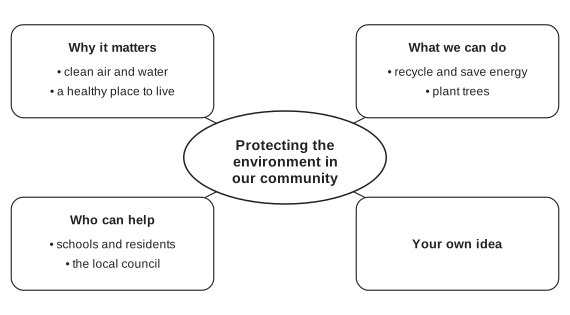
Write an essay of 125 to 150 words on protecting the environment in our community.
You must use the notes below to help you.
Show answerHide answer
Our community is our home, so we must protect the environment around us. First of all, a clean environment keeps people healthy. If the air and rivers are polluted, many of us, especially children, will fall ill.
There are many things that we can do. We should recycle paper, cans and bottles, and we ought to switch off lights and fans when we leave a room. Planting trees along the road also gives shade and cleans the air.
Schools, residents and the local council can work together. For example, the council can provide more recycling bins, while students can organise a clean-up day every month. Another idea is a community garden.
In my opinion, small actions by everyone can make a big difference. If each of us does our part, our neighbourhood will be a better place for future generations.
Turn each box into one paragraph. Write each note as a full sentence, then add a reason or an example. Do not copy the notes as a list. Your own idea counts as content, so give it a place in the third paragraph or its own paragraph. Finish with your opinion.
This part is marked with the same rating scale as Part 1 (see the table under Paper 2 Part 1): Content, Communicative achievement, Organisation and Language, 0 to 5 marks each. Content 5 means every note is covered and developed, so a missing note or no own idea takes Content down to about 3. Writing under 100 words or over 180 words usually loses a mark in Organisation.
Paper 2 Part 3
20 marksQuestion 43
Question 43. Your teacher has asked you to write a story for the school magazine.
Your story must begin with this sentence:
When the bus broke down in the middle of nowhere, we knew our holiday was not going to be what we had planned.
Write your story.
Show answerHide answer
When the bus broke down in the middle of nowhere, we knew our holiday was not going to be what we had planned. The driver lifted the bonnet, shook his head and told us that the engine had overheated. There was no signal on our phones, and the nearest village was twelve kilometres away.
My little sister, Alia, began to cry, so Dad suggested that we should walk along the road together while the driver waited for help. At first the walk was almost pleasant: birds were singing and the hills were green. However, dark clouds soon gathered, and within minutes heavy rain was pouring down. We ran into an old wooden shelter beside the road, soaked and shivering.
"If we had left earlier, none of this would have happened," Mum sighed. Just then we heard a motorbike. An old man in a yellow raincoat stopped in front of us and, without asking any questions, offered to take us to his village. He made two trips, carrying two of us each time, and by evening we were sitting in his kitchen, drinking hot ginger tea.
His wife cooked rice and fried fish for dinner, and the children taught Alia to play congkak. We slept on mats, listening to the rain on the roof.
It was not the beach holiday we had dreamed about, but it became the most memorable trip of my life, and we still send a card to that village every year.
Plan a beginning (the breakdown), a problem that gets worse, a turning point and an ending. Keep the opening line exactly as given and then carry on from it: the story is about a journey that goes wrong, so do not change the subject. Use description and feelings and at least one line of direct speech.
Part 3 is marked with the same four areas as Parts 1 and 2 (0 to 5 each; see the table under Paper 2 Part 1). Only one question is answered, so only one is marked.
Question 44
Question 44. You see this announcement in an English-language magazine.
Write an article about a place in Malaysia that visitors must see. Describe the place, say what visitors can do there and explain why everyone should go.
Write your article.
Show answerHide answer
Reaching for the Clouds: Mount Kinabalu
Have you ever stood above the clouds? If you have not, then Mount Kinabalu in Sabah is the place for you. At more than four thousand metres, it is the highest mountain in Malaysia, and it is a World Heritage Site because of its rich plants and animals.
The scenery is breathtaking. As you climb through the park, the warm rainforest slowly gives way to mossy trees and then to bare grey rock. Along the way you may see colourful orchids, giant pitcher plants and, if you are lucky, a few shy mountain squirrels.
Most visitors climb in two days. On the first day, you walk for about six hours to a rest house near the top and sleep there. At 2.00 a.m. the next morning, you set off again by torchlight so that you can reach the summit at sunrise. It is cold, steep and tiring, but when the sun appears above a sea of clouds, every tired step is worth it. Climbers must hire a licensed guide and book their permits months ahead.
You do not have to climb to enjoy the area. There are gentle walks, hot springs and a cool, misty park where you can relax with a cup of tea.
In my opinion, everybody should visit Mount Kinabalu at least once. It will show you how beautiful our country is, and it will make you proud to be Malaysian.
Choose a place you know well enough to give details about. Keep the three parts of the task in order: the place, what visitors can do and why everyone should go. Use a title and address the reader as you. A real place is fine, but only write facts you are sure of; your opinion matters more than numbers.
Marked with the same four areas as Parts 1 and 2 (0 to 5 each; see the table under Paper 2 Part 1).
Question 45
Question 45. Your school took part in a river clean-up project last month. Your principal has asked you to write a report on it.
In your report, you should:
- describe what the students did
- say what the results were
- make recommendations for future projects.
Write your report.
Show answerHide answer
Report on the Sungai Tenang clean-up project
To: The Principal From: Chairperson, Green Club
Introduction
This report describes the river clean-up project that our school carried out on Saturday, 14 September, and suggests how future projects can be improved.
What we did
Thirty-five students and five teachers from Form 4 and Form 5 met at the riverbank at 8.00 a.m. Wearing gloves and boots, we divided into five groups. Each group cleaned a section of the river for three hours and sorted the rubbish into plastic, glass and metal. The local council provided sacks and a lorry.
Results
We collected eighteen sacks of rubbish, which weighed about 140 kilos. Most of it was plastic bottles and food wrappers, but we also found old tyres and a broken bicycle. Fifteen kilos of cans and bottles were sent for recycling. Residents who live nearby thanked us, and a few of them joined us in the afternoon.
Recommendations
Firstly, the school should work with the council to put more bins along the river. Secondly, the Green Club should hold a clean-up every three months. Finally, students could make posters to teach residents about littering.
In conclusion, the project was a success, and it showed that small actions can make a big difference.
A report is organised under headings. Use one short paragraph for each bullet point and keep the style formal: no chat language and no exclamation marks. Use past tenses for what was done and modals (should, could) for recommendations. Numbers make the results believable, so add some, but keep them sensible.
Marked with the same four areas as Parts 1 and 2 (0 to 5 each; see the table under Paper 2 Part 1). The formal register is the main challenge, so Communicative achievement is the area most students lose marks in here.
Test specification (JSU)
| Unit | Remembering | Understanding | Applying | Analysing | Evaluating | Creating | Items | marks |
|---|---|---|---|---|---|---|---|---|
| 1. It's personal! | – | – | 1 (1) | – | – | – | 1 | 1 |
| 2. Life's Great Mysteries | – | – | 1 (1) | – | – | – | 1 | 1 |
| 3. The World of Sport | – | – | 1 (1) | – | – | – | 1 | 1 |
| 4. Shopping Therapy | – | – | 2 (2) | – | – | – | 2 | 2 |
| 5. The Environment | – | 6 (6) | – | 4 (23) | – | – | 10 | 29 |
| 6. Crime | – | – | 1 (1) | – | – | – | 1 | 1 |
| 7. The Media | – | – | 1 (1) | 1 (1) | – | – | 2 | 2 |
| 8. A Hard Day's Work | – | – | 1 (1) | – | – | – | 1 | 1 |
| 9. Getting Away | – | – | 3 (3) | – | – | 1 (20) | 4 | 23 |
| 10. Where on earth? | 2 (2) | 3 (3) | 1 (1) | 3 (3) | 1 (1) | 1 (20) | 11 | 30 |
| 11. High-Tech World | – | – | 1 (1) | 1 (1) | – | – | 2 | 2 |
| 12. Happy to help! | – | 1 (1) | 1 (20) | 6 (6) | – | 1 (20) | 9 | 47 |
| Total | 2 (2) | 10 (10) | 14 (33) | 15 (34) | 1 (1) | 3 (60) | 45 | 140 |