The Media
What this chapter covers
- I can name the forms of mass media (newspaper, magazine, journal, radio, television, the Internet) and the jobs in the media (editor, columnist, correspondent, presenter, newsreader, blogger, DJ) (7.1, 7.2)
- I can read an article about print and digital media, find its main points and answer multiple-choice questions by eliminating wrong options (7.3)
- I can form the passive in different tenses, with modals, gerunds and infinitives, and use by and with correctly (7.4)
- I can use the impersonal passive (It is believed that ...) and the personal passive (He is said to ...) (7.5)
- {'I can use media vocabulary': 'prepositions with nouns, collocations such as go viral and make the headlines, and noun forms such as publication and subscription (7.6)'}
- I can agree, disagree and partly agree politely in a discussion about advertising and news (7.7)
- I can write a short formal report that makes suggestions in the passive and gives a reason for each one (7.8)
In this unit you will study the media: the words for newspapers, radio, television and the Internet, the people who work in them, and two grammar points that news writing uses all the time, the passive and the impersonal and personal passive. You will also practise reading a magazine article and writing a formal report that makes suggestions.
7.1Forms of media
Mass media are the ways of sending news and information to a large number of people. New inventions changed them: the printing press (1439), the radio (1910) and the Internet (1990). Learn the six forms of media from the textbook pictures.
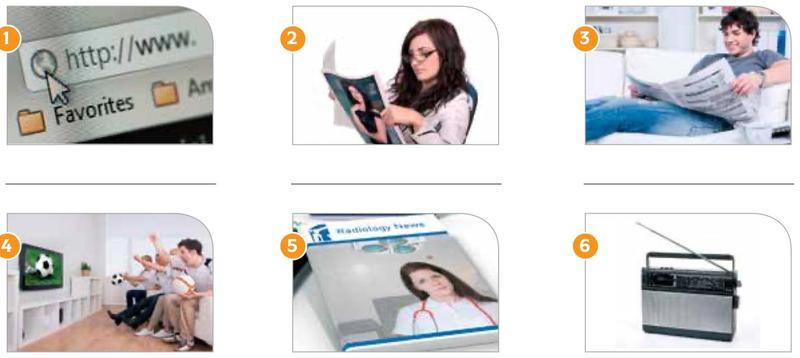
Picture row from English Download B1+ Form 5, p.86.
| Word | Meaning | Related words |
|---|---|---|
| newspaper | printed news, usually every day | front page, editorial, headline, review |
| magazine | printed or online publication with articles and photos, weekly or monthly | e-zine (online magazine), horoscope, problem page |
| journal | a serious publication for one subject, such as medicine or science | scientific articles |
| radio, television | programmes you listen to or watch | soap opera, commercials, interview, reception |
| the Internet | websites, blogs, social networking sites | website, hits, go viral |
Show answerHide answer
7.2People who work in the media
| Job | What the person does |
|---|---|
| editor | decides what a newspaper or magazine includes |
| columnist | writes a regular article giving an opinion, such as about fashion or sport |
| journalist | writes news articles for newspapers or magazines |
| correspondent | reports on news from a particular place or subject |
| newsreader | reads the news on television or radio |
| presenter | introduces and leads a programme |
| DJ | plays and talks about music on the radio |
| blogger | writes regularly on a personal webpage (a blog) |
7.3Reading: "Is print media doomed?"
The article in the textbook (pp.84-85) asks whether printed books and newspapers will die out as digital media become popular. Its main ideas are:
- The newspaper industry, like the music industry, has been hit by the Internet. News is free online, and a daily printed paper is no longer a practical way to get news as it happens.
- Most newspapers now have online versions. Some papers charge a subscription, and a digital membership is more affordable than buying a paper every day.
- Online readers get an interactive experience (they can post comments), and the newspaper saves money on ink, paper, warehouses and delivery vans.
- Print books have advantages over e-books: no headaches or eye strain, no battery to charge, no damage if you drop them in sand or water, and a physical pleasure of holding and collecting books. The writer believes print books are a long way from dying.
Show answerHide answer
7.4Grammar 1: the passive
We use the passive when the action is more important than the person who does it, when we do not know the agent, or when it is not important. Form: the right tense of be + past participle.
| Tense or form | Passive |
|---|---|
| present simple | The newspaper is published in the UK. |
| past simple | The website was set up in 2009. |
| present continuous | The sports star is being interviewed now. |
| present perfect | Many advertisements have been created. |
| past perfect | The magazine had been edited before it went to print. |
| future (will) | My article will be published tomorrow. |
| future perfect | She will have been asked many questions by then. |
| modal | An article must be written. Something should be done. |
| gerund | Being interviewed was fun. |
| bare infinitive | The article had better be written soon. |
| full infinitive | The story is supposed to be printed. |
- get can replace be for something unpleasant that happens by accident or unexpectedly: The correspondent got kidnapped.
- by + name or noun gives the agent: owned by a media group. with gives the tool: taken with a digital camera.
Passive: A lot of text messages are written (by teenagers) every day.
Steps: object becomes the subject; keep the tense of the verb in the form of be; add the past participle; put the old subject after by, or drop it.
Show answerHide answer
7.5Grammar 2: impersonal and personal passive
Verbs such as believe, consider, know, expect, say, report, suppose, think are often used in the passive to report what people say or think.
| Structure | Form | Example |
|---|---|---|
| Impersonal | It + passive verb + that + clause | It is believed that magazines should be cheaper. |
| Personal | Noun + passive verb + to + infinitive | Teenagers are said to spend too much time online. |
Impersonal: It is known that advertisements sell products.
Personal: Advertisements are known to sell products.
Show answerHide answer
7.6Vocabulary: prepositions, collocations, word formation
Nouns with prepositions (p.88)
| Noun | Preposition | Example |
|---|---|---|
| comment | on / about | comment on the strike |
| use | of | the use of commercials |
| comparison | between | no comparison between books and e-books |
| attitude | towards | an attitude towards the media |
| decrease | in | a decrease in sales |
| preference | for | a preference for short articles |
| information | on / about | information on careers |
| advantage | over | an advantage over e-zines |
Collocations
| Expression | Meaning |
|---|---|
| be in the public eye | be known and watched by many people |
| be on the big screen | appear in films |
| go viral | spread quickly and widely on the Internet |
| have a lot of hits | be visited or watched many times |
| make a name for yourself | become well known |
| make the headlines | be reported on the front page |
Verb to noun: publish - publication, subscribe - subscription, require - requirement, replace - replacement, receive - reception, involve - involvement.
Show answerHide answer
7.7Listening and speaking
For listening, you hear short conversations and choose a picture. Listen to the question that is actually asked, not the one you expected. In the conversation about a fire, for example, several news sources are mentioned, but each question asks about one of them only.
In a discussion, use phrases to agree, disagree or partly agree, and always give a reason.
| Function | Phrases |
|---|---|
| Agree | I agree with you. I think you're right about that. That's my opinion too. I feel exactly the same. |
| Disagree | I don't think that's the case, because ... I think you are wrong about that. I wouldn't say that because ... |
| Agree in part | You have a point, but ... I see what you mean, but ... |
7.8Writing: a report that makes suggestions
Reports use formal language to give information and make suggestions or recommendations. Using the passive makes suggestions sound formal: instead of "We could upload short news videos" write "Short news videos could be uploaded".
| Part | What to write |
|---|---|
| Title | Report on ... (the subject of the report) |
| Introduction | The aim of this report is to ... |
| Headings | One heading for each area, such as Information and Entertainment, with suggestions and reasons |
| Recommendation | I recommend that ... be + past participle / I recommend + gerund |
- Show the reason by describing the result: "Games and puzzles would be fun and enjoyable."
- Two ways to recommend: I recommend that a good mixture of articles be published (passive) or I recommend publishing a good mixture of articles (gerund).
- Length for the task in the book: 140-190 words.
Show answerHide answer
Summary
- Media forms: newspaper, magazine (e-zine), journal, radio, television, the Internet. Know the jobs: editor, columnist, correspondent, presenter, newsreader, DJ, blogger.
- Print vs digital: online papers are cheaper to produce and interactive; print books have physical and practical advantages.
- Passive = be + past participle in the tense you need; by for the agent, with for the tool, get for unpleasant surprises.
- Impersonal: It is believed that ... Personal: He is said to ...
- Collocations: go viral, make the headlines, be in the public eye, make a name for yourself.
- Reports: formal, headings, suggestions in the passive, reasons, a recommendation.