Textbook English Download B1+ Student's Book Form 5 (KSSM, Hamilton House / KPM 2020), pages 147-158
What this chapter covers
I can name social problems (homelessness, unemployment, poverty, addiction, racism, bullying) and the services and solutions that deal with them (Vocabulary 1)
I can read an article about young people who run charities and answer multiple-choice questions, including a question about the writer's purpose (Reading)
I can use question tags, reflexive pronouns and indefinite pronouns correctly (Grammar 1)
I can use phrasal verbs, word families and expressions with parts of the body (Vocabulary 2)
I can use not only ... but also with inversion, had better and it's (about/high) time + past tense (Grammar 2)
I can listen for exact details in a radio announcement and ask politely for clarification when I do not hear or understand (Listening, Speaking)
I can write a polite letter to a person in authority that suggests solutions and shows how each one would help (Writing)
This unit is about helping the community: social problems, charities and volunteers. You revise the language of the unit (question tags, pronouns, inversion, phrasal verbs), reading a magazine-style article, listening for exact details, asking for clarification, and writing a letter to someone in authority. Page numbers are from the Form 5 English Download student's book (pp. 147-158).
12.1Social problems, services and solutions (pp. 147, 150)
The unit opens with three situations (a person begging, a stray puppy, graffiti) and asks what you would do. Then it gives you the words to talk about problems in a community.
Social problem
Meaning
homelessness
not having a place to live
unemployment
not having a job
poverty
not having money or the basics of life
addiction
needing to do something without being able to stop
racism
unfair treatment because of colour or where a person comes from
physical disability
a condition that makes it hard to move or use part of the body
mental illness
a disease of the mind
bullying
frightening or hurting someone weaker than you
Service or solution
What it gives you
food bank
food (not money)
shelter
a temporary place to stay
halfway house
a home until you are ready to live on your own
retraining course
new skills, so you may get a better job
social welfare
money from the government
youth hostel
cheap beds for young travellers (they pay)
nursing home
care for old people who need help
charity
an organisation that asks for donations to help people in need
Common mistakes.
A shelter is temporary; a halfway house is a step to independent life; neither is "forever".
A youth hostel is not free, and a nursing home is for old people, not for people training to be nurses.
Which service would help (a) a man who has lost his job and wants new skills, (b) a family with nothing to eat tonight?
Show answerHide answer
(a) a retraining course (b) a food bank. A shelter would also help if they have no home.
12.2Reading: kids with a conscience (pp. 148-149)
The article tells how children turned a sad sight into action. Read it quickly first to decide which charities help people and which help nature.
Who
What they saw
What they did
Hannah Taylor (Canada)
a homeless man eating from a rubbish bin, when she was five
founded The Ladybug Foundation (the ladybug stands for good luck); began with painted baby-food jars collecting small change in local businesses; raised money for shelter and food
Janine and Aislin (Costa Rica)
the rainforest disappearing because of roads and buildings; Mono Titi monkeys dying from electric cables and cars
started Kids Saving The Rainforest; built "monkey bridges" (thick ropes), about 130 of them
Martha Payne (UK)
readers of her school-dinner blog pointed out that many children have no meal
raised money for Mary's Meals and asked her readers to donate
Mary's Meals gives free daily meals at school to encourage hungry children to attend. Education can lift them out of poverty, which helps the whole community.
Whole-text questions. Some multiple-choice questions ask about the purpose of the text (p. 149, question 6). The writer's intention here is to encourage others to get involved. Look at the first and last paragraphs: the opening asks "have you considered using your spare time?" and the ending says "why not use them to do something constructive?".
Common mistake. For "Which statement is true?", check every option against the text. Words such as only and the most are often traps; one example that does not fit makes the option wrong.
Name the problem that each charity tries to solve: The Ladybug Foundation, KSTR, Mary's Meals.
Show answerHide answer
Ladybug Foundation: homelessness (shelter and food). KSTR: the loss of rainforest and danger to wildlife. Mary's Meals: hunger, and children not going to school.
12.3Grammar 1: question tags and pronouns (p. 151)
Question tags
A tag is a short question at the end of a sentence to ask for agreement or to check. A positive sentence takes a negative tag, and a negative sentence takes a positive tag. The tag uses the same auxiliary as the sentence, or do/does/did if the sentence has none.
Sentence
Tag
They tried to help the poor,
didn't they?
You didn't give it to charity,
did you?
You've stayed at the hostel before,
haven't you?
Everyone donated to UNICEF,
didn't they? (everyone takes they)
I'm able to help,
aren't I? (special case)
Don't forget Grandma,
will you? (imperative)
Let's help out tonight,
shall we?
Reflexive pronouns
myself, yourself, himself, herself, itself, ourselves, yourselves, themselves. Use them (1) when subject and object are the same: She taught herself to read; (2) after some verbs: behave yourselves; (3) to stress that a person did it alone, often with by: Ben started the programme by himself.
Indefinite pronouns
Word
Use
Example
someone, anything, everywhere, nobody
unspecified person, thing or place
Nobody could answer.
another
one more
Could I ask another?
less / little, more / much
smaller or larger amount
Much has been done.
such
a type already mentioned
She was poor and was treated as such.
whoever, whatever, whichever, wherever
"any person / thing / place that"
Whoever wants to join, sign here.
Common mistakes.
"I'm being a bully, am not I?" is wrong. Use aren't I.
Do not use itself or himself for a plural subject: "We sold the tickets ourselves", not "themselves".
Add a tag: (a) "Julia didn't raise the most money, ____?" (b) "This is good news, ____?"
Show answerHide answer
(a) did she? (b) isn't it?
12.4Vocabulary 2: phrasal verbs, word formation and expressions (p. 152)
Phrasal verb
Meaning
act out
perform a situation as a role play
act up
behave badly
pass round
give to one person after another
pass by
go near a place without going in
speak up
speak more loudly
speak out
say your opinion publicly
cut off
separate from; stop a person getting to a place
cut back on
reduce the amount of something
point out
draw attention to a fact
point to
make something seem likely or true
take in
give a person a place to stay
take on
accept work or responsibility
Word formation
Verb
Noun
Adjective
disable
disability
disabled
inspire
inspiration
inspiring / inspired
represent
representative
representative
combine
combination
combined
assist
assistance
-
(addict)
addiction
addicted / addictive
Expressions with parts of the body
Expression
Meaning
dig in your heels
refuse to change your mind
my heart goes out to ...
I feel deep sympathy for ...
a pat on the back
praise for something done well
in one ear and out the other
heard but not remembered or heeded
drag your feet
act slowly because you do not want to
a weight off my shoulders
a relief after a worry
Learn the verb, noun and adjective together: a sentence often needs the noun (his addiction) where you may expect the verb.
Complete: (a) "The teacher asked the class to ____ an argument." (b) "We must ____ sweets to stay healthy."
Show answerHide answer
(a) act out (b) cut back on
12.5Grammar 2: not only ... but also, had better, it's time (p. 153)
Structure
Rule
Example
Not only ... but also
At the start of a sentence, the auxiliary comes before the subject (inversion)
Not only does Kevin help the mentally ill, but he also volunteers at the hostel.
had better + bare infinitive
advice; no to; negative: had better not
You had better apply this week.
It's time / about time / high time + past tense
complaint about the present; the verb is past
It's high time she got a job.
Common mistakes.
"Not only the man was an addict" is wrong: say "Not only was the man an addict, but he was also a thief."
"had better to speak" is wrong: had better speak.
"It's time they give" is wrong: it's time they gave.
Rewrite with inversion: "Clare helped at the food bank and also ran a charity shop."
Show answerHide answer
Not only did Clare help at the food bank, but she also ran a charity shop. (Past simple: did + base verb.)
12.6Listening and speaking (pp. 154-155)
The listening task is a short radio announcement about the volunteer group GoodGym with five four-option questions. Read all the questions first, and underline the small word that changes the meaning (for example as a group, all runners, last event). A common slip is to choose an answer that is true for the group but not for what the question asks.
In speaking, you plan how to keep a youth centre open. Discuss how effective each idea is, then choose two. If you did not hear or understand your partner, ask politely.
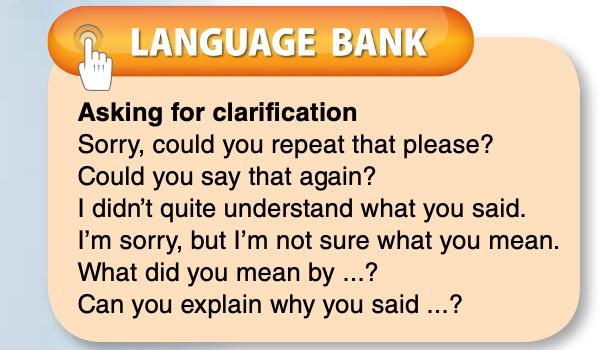
Language for asking for clarification.
Source: textbook Bahasa Inggeris Tingkatan 5, p. 155.
Problem
Say
You did not hear
Sorry, could you repeat that, please? / Could you say that again?
You did not understand
Can you explain why you said that? / I'm not sure what you mean by that.
Give your opinion, then a reason, then react to your partner's idea. Discuss both ideas in the task; do not only talk about your own.
12.7Writing: a letter to a person in authority (pp. 156-157)
You write to a mayor or chief of police because you want them to take action. So the tone must be personal and polite: say how you feel, suggest measures, and show how they would help.
Too rude
Polite and persuasive
Why didn't you have enough policemen? Make sure there are more next time!
I think we should have more officers on duty next time, if possible, to make life safer for ordinary citizens.
Plan (from the sample letter and task)
Part
What to do
Paragraph 1
Say what you read or saw, give your opinion and say why you are writing
Paragraphs 2-4
One suggestion each, with an example and the result (how it will help)
Last paragraph
Show you expect action: I look forward to seeing you put some ideas into action soon.
Start "Dear Mayor," and, because you do not know the person's name, end "Yours faithfully," with your name.
Useful vocabulary (p. 157)
Word
Meaning
incident
(noun) an event that happens
vulnerable
(adjective) unprotected
prevent
(verb) stop something happening
deter
(verb) discourage people from doing something
inadequate
(adjective) not enough
Also: install, supply, enable, arrange, authorise, take measures, I am sure you agree that ...
Common mistakes.
Blaming or ordering the reader ("Make sure ...!").
Listing ideas without saying how they would help.
Informal language such as kids, stuff or contractions in a formal letter.
Finish the sentence: "If coach trips were arranged for the elderly, it would ____ them to see the outside world again." Choose: enable / prevent.
Show answerHide answer
enable. The result of the suggestion is positive; prevent means to stop something.