Practice paper, not an official KPM paper
4551
Ujian Akhir Sesi AkademikEnd of Academic Session Test
BiologiBiology
Tingkatan 5, 2 jam / 2 hours, 100 marks
Nama / Name
Kelas / Class
Tarikh / Date
Markah / Marks: / 100
Instructions
- Kertas soalan ini mengandungi empat bahagian: Bahagian A, Bahagian B, Bahagian C dan Bahagian D.This question paper consists of four sections: Section A, Section B, Section C and Section D.
- Bahagian A: jawab semua soalan. Pilih satu jawapan bagi setiap soalan.Section A: answer all questions. Choose one answer for each question.
- Bahagian B: jawab semua soalan.Section B: answer all questions.
- Bahagian C: jawab satu soalan sahaja daripada dua soalan. Bahagian D: jawab satu soalan sahaja daripada dua soalan.Section C: answer one question only out of two. Section D: answer one question only out of two.
- Rajah yang mengiringi soalan tidak dilukis mengikut skala kecuali dinyatakan.The diagrams in this paper are not drawn to scale unless stated.
- Anda dibenarkan menggunakan kalkulator saintifik.You may use a scientific calculator.
Answer schemes are in English (DLP).
Practice shows answers as you go. Exam times you and hides answers until you submit.
Bahagian ASection A
20 marksJawab semua soalan. Setiap soalan diikuti oleh empat pilihan jawapan, A, B, C dan D. Pilih satu jawapan sahaja.Answer all questions. Each question is followed by four options, A, B, C and D. Choose one answer only.
1
Question 1
Lilitan batang sebatang pokok balak bertambah besar setiap tahun. Pembahagian sel yang manakah menyebabkan pertambahan ini?The girth of the trunk of a timber tree becomes larger every year. Which cell division causes this increase?
Show answerHide answer
B
The vascular cambium is a lateral meristem. Its cells divide to give secondary xylem and secondary phloem, which increases the girth (secondary growth). Apical meristems increase length only.
2
Question 2
Penanda dakwat dibuat pada jarak 1 mm di sepanjang hujung akar anak benih jagung. Dua hari kemudian, penanda yang paling dekat dengan hujung akar masih rapat tetapi penanda antara 3 mm dengan 9 mm dari hujung akar telah menjauh antara satu sama lain. Apakah yang berlaku di kawasan 3 mm hingga 9 mm itu?Ink marks are made 1 mm apart along the tip of the root of a corn seedling. Two days later the marks nearest the root tip are still close together but the marks between 3 mm and 9 mm from the tip have moved far apart. What happens in the region 3 mm to 9 mm from the tip?
Show answerHide answer
C
The zone behind the zone of cell division is the zone of cell elongation: the cells take in water, the vacuoles enlarge and the cells become longer, so the marks move apart.
3
Question 3
Antara berikut, yang manakah dihasilkan dalam tindak balas bersandarkan cahaya dan digunakan dalam tindak balas tidak bersandarkan cahaya?Which of the following is produced in the light-dependent reaction and used in the light-independent reaction?
Show answerHide answer
D
The light-dependent reaction makes ATP and NADPH, which supply energy and hydrogen for the light-independent reaction. Oxygen is released; glucose is made in the light-independent reaction.
4
Question 4
Pada suatu tengah hari yang cerah, suhu dalam sebuah rumah hijau ialah 30 °C. Kadar fotosintesis pokok tomato di dalamnya tidak meningkat walaupun keamatan cahaya ditambah. Perubahan yang manakah paling mungkin meningkatkan kadar fotosintesis?At midday on a bright day the temperature inside a greenhouse is 30 °C. The rate of photosynthesis of the tomato plants in it does not increase even when the light intensity is raised. Which change is most likely to increase the rate of photosynthesis?
Show answerHide answer
A
Light is no longer limiting, so another factor must be. Carbon dioxide concentration is the factor that can be raised to speed up the light-independent reaction. 50 °C would denature enzymes; less carbon dioxide or darkness would lower the rate.
5
Question 5
Garam mineral memasuki akar melalui rambut akar. Antara berikut, yang manakah menunjukkan urutan yang betul bagi lintasan garam mineral itu hingga ke xilem?Mineral salts enter the root through the root hairs. Which of the following shows the correct sequence of the pathway of the mineral salts to the xylem?
Show answerHide answer
A
From the outside inwards the root has epidermis (root hair), cortex, endodermis, pericycle and then the vascular tissue: xylem.
6
Question 6
Sebatang pokok diletakkan di tempat berangin kencang pada waktu siang yang panas. Apakah yang berlaku kepada kadar transpirasi dan mengapa?A plant is placed in a strong wind on a hot day. What happens to the rate of transpiration and why?
Show answerHide answer
C
Moving air carries away the water vapour near the stomata, so the difference in water vapour concentration between the leaf and the air stays large and more vapour diffuses out. Transpiration also rises with heat.
7
Question 7
Seekor afid mencucuk batang sebatang pokok dengan stiletnya. Cecair manis yang kaya dengan sukrosa mengalir keluar melalui stilet itu. Stilet itu telah menembusi struktur yang manakah?An aphid pierces the stem of a plant with its stylet. A sweet liquid rich in sucrose flows out through the stylet. Which structure has the stylet penetrated?
Show answerHide answer
B
Sucrose is carried in the phloem by the sieve tubes. Xylem and tracheids carry water and mineral salts.
8
Question 8
Fitohormon yang manakah merangsang percambahan biji benih dengan menggalakkan pemanjangan sel dan perkembangan embrio?Which phytohormone stimulates seed germination by promoting cell elongation and development of the embryo?
Show answerHide answer
D
Gibberellin promotes seed development and germination and stem elongation. Abscisic acid keeps seeds dormant; ethylene ripens fruits.
9
Question 9
Antara berikut, yang manakah menunjukkan bilangan set kromosom dalam nukleus gamet jantan, zigot dan nukleus endosperma?Which of the following shows the number of chromosome sets in the nucleus of a male gamete, a zygote and the endosperm nucleus?
Show answerHide answer
B
The male gamete is haploid (n). Male gamete + egg cell gives a diploid zygote (2n). Male gamete + two polar nuclei gives a triploid endosperm nucleus (3n).
10
Question 10
Sejenis bunga berwarna hijau pucat, tidak berbau dan tidak mempunyai nektar. Antera bunga itu tergantung di luar bunga dan stigmanya berbulu halus. Apakah agen pendebungaan bunga itu?A flower is pale green, has no scent and has no nectar. Its anthers hang outside the flower and its stigma is feathery. What is the pollinating agent of this flower?
Show answerHide answer
A
A dull flower without scent or nectar, with exposed anthers and a feathery stigma to catch light pollen, is adapted to wind pollination. Animal-pollinated flowers attract with colour, scent or nectar.
11
Question 11
Daun pokok kaktus telah berubah menjadi duri. Bagaimanakah ciri ini membantu kaktus hidup di kawasan gurun?The leaves of a cactus have changed into spines. How does this feature help the cactus to live in a desert?
Show answerHide answer
D
Spines have a very small surface area and few stomata, so little water vapour is lost by transpiration. Water is stored in the thick stem, not in the leaves, and photosynthesis is done by the green stem.
12
Question 12
Kumpulan taksonomi yang manakah terdiri daripada organisma yang boleh mengawan dan menghasilkan anak yang subur?Which taxonomic group consists of organisms that can mate and produce fertile offspring?
Show answerHide answer
C
A species is the smallest group in the Linnaeus hierarchy; its members interbreed to produce viable, fertile offspring.
13
Question 13
Nitrosomonas sp. dan Nitrobacter sp. ialah bakteria yang terlibat dalam kitar nitrogen. Apakah proses yang dijalankan oleh kedua-dua bakteria ini?Nitrosomonas sp. and Nitrobacter sp. are bacteria involved in the nitrogen cycle. What process do these two bacteria carry out?
Show answerHide answer
C
This is nitrification: Nitrosomonas changes ammonium to nitrite and Nitrobacter changes nitrite to nitrate. A is nitrogen fixation, B is denitrification and D is ammonification.
14
Question 14
Dalam suatu rantai makanan, rumput mengandungi 20 000 kJ tenaga, belalang mengandungi 2 000 kJ dan katak mengandungi 180 kJ. Berapakah peratusan tenaga yang dipindahkan daripada belalang kepada katak?In a food chain, grass contains 20 000 kJ of energy, the grasshopper contains 2 000 kJ and the frog contains 180 kJ. What percentage of the energy is transferred from the grasshopper to the frog?
Show answerHide answer
A
(180 ÷ 2 000) × 100 = 9%. 10% would be grass to grasshopper (2 000 ÷ 20 000). 0.9% is the energy from the grass to the frog (180 ÷ 20 000).
15
Question 15
Spesies P dan spesies Q hidup dalam habitat yang sama. Apabila semua individu spesies Q dikeluarkan, populasi spesies P meningkat dengan cepat. Apakah kesimpulan yang paling sesuai?Species P and species Q live in the same habitat. When all the individuals of species Q are removed, the population of species P increases quickly. What is the most suitable conclusion?
Show answerHide answer
D
If P does better when Q is absent, the two were using the same limited resources. They were in interspecific competition, which means their niches overlap. In mutualism P would decline without Q.
16
Question 16
Antara pasangan aktiviti manusia dan gas yang dibebaskan berikut, yang manakah betul?Which of the following pairs of a human activity and the gas released is correct?
Show answerHide answer
B
Cooling substances release CFC. Animal farming gives methane, burning fossil fuels gives carbon dioxide and nitrogen oxide, and nitrogen fertiliser gives nitrogen oxide.
17
Question 17
Dua pokok kacang yang heterozigot bagi kedua-dua gen, AaBb, dikacukkan. Gen A dan gen B terletak pada kromosom yang berlainan. Apakah pecahan anak yang mempunyai genotip aabb?Two bean plants that are heterozygous for both genes, AaBb, are crossed. Gene A and gene B are on different chromosomes. What fraction of the offspring has the genotype aabb?
Show answerHide answer
C
Each parent makes four kinds of gametes, so the Punnett square has 16 boxes. Only one box is aabb (ab × ab): 1/16, or 1/4 × 1/4. 9/16 is the fraction showing both dominant traits.
18
Question 18
Seorang wanita berkumpulan darah B yang heterozigot berkahwin dengan seorang lelaki berkumpulan darah AB. Berapakah kebarangkalian anak mereka berkumpulan darah A?A woman of blood group B who is heterozygous marries a man of blood group AB. What is the probability that their child is blood group A?
Show answerHide answer
D
IBIO × IAIB gives IAIB (AB), IBIB (B), IAIO (A) and IBIO (B) in equal numbers. Group A is 1 of 4 = 25%.
19
Question 19
Pasangan ciri yang manakah kedua-duanya menunjukkan variasi tak selanjar?Which pair of characteristics both show discontinuous variation?
Show answerHide answer
A
Blood group and tongue rolling have distinct categories with no in-between (discontinuous). Height, body mass and skin colour are measurable with a range of values (continuous).
20
Question 20
Sebatang pokok kentang diberi gen daripada Arabidopsis sp. supaya boleh bertahan pada suhu beku. Apakah nama organisma ini?A potato plant is given a gene from Arabidopsis sp. so that it can tolerate freezing temperatures. What is this organism called?
Show answerHide answer
B
An organism that carries a gene from another species through recombinant DNA technology is a genetically modified (transgenic) organism.
Bahagian BSection B
40 marksJawab semua soalan. Tulis jawapan anda di ruang yang disediakan.Answer all questions. Write your answers in the spaces provided.
21
Question 21
Rajah 1 menunjukkan keratan rentas satu berkas vaskular dalam batang sebatang pokok bunga raya.Diagram 1 shows a cross-section of a vascular bundle in the stem of a hibiscus plant.
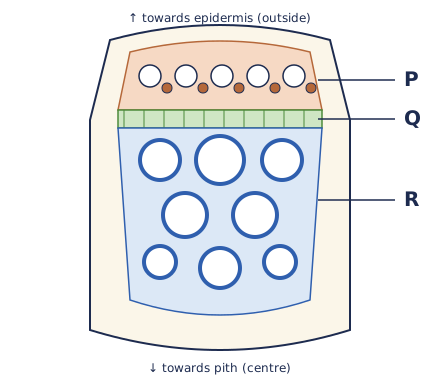
[3 marks]
(a)Namakan P, Q dan R.Name P, Q and R.
Show answerHide answer
Tick each point you got.
[2 marks]
(b)Nyatakan dua ciri R yang membolehkan ia mengangkut air dengan berkesan.State two features of R that enable it to transport water effectively.
Show answerHide answer
Any 2 points
Tick each point you got.
[1 mark]
(c)Nyatakan satu bahan yang diangkut dalam P.State one substance transported in P.
Show answerHide answer
Any 1 points
Tick each point you got.
[2 marks]
(d)Sel rakan di sebelah tiub tapis dalam P mengandungi banyak mitokondria. Terangkan mengapa.The companion cells beside the sieve tubes in P contain many mitochondria. Explain why.
Show answerHide answer
Tick each point you got.
[2 marks]
(e)Pada hari yang berangin dan panas, kadar pengangkutan air dalam R meningkat. Terangkan bagaimana transpirasi menyebabkan air bergerak ke atas dalam R.On a windy, hot day the rate of water transport in R increases. Explain how transpiration makes water move upwards in R.
Show answerHide answer
Tick each point you got.
22
Question 22
Jadual 1 menunjukkan tenaga yang terkandung pada setiap aras trofik dalam satu rantai makanan di sebuah kolam.
Jadual 1Table 1 shows the energy contained at each trophic level of a food chain in a pond.
Table 1
| Organisma | Tenaga (kJ m-2 setahun) |
|---|---|
| Fitoplankton | 15 000 |
| Zooplankton | 1 800 |
| Ikan puyu | 270 |
| Ikan keli | 27 |
| Organism | Energy (kJ m-2 per year) |
|---|---|
| Phytoplankton | 15 000 |
| Zooplankton | 1 800 |
| Climbing perch | 270 |
| Catfish | 27 |
[1 mark]
(a)Namakan pengeluar dalam rantai makanan ini.Name the producer in this food chain.
Show answerHide answer
Tick each point you got.
[1 mark]
(b)Nyatakan aras trofik ikan puyu.State the trophic level of the climbing perch.
Show answerHide answer
Tick each point you got.
[2 marks]
(c)Hitung peratusan tenaga yang dipindahkan daripada zooplankton kepada ikan puyu. Tunjukkan jalan kerja anda.Calculate the percentage of energy transferred from the zooplankton to the climbing perch. Show your working.
Show answerHide answer
Tick each point you got.
[2 marks]
(d)Tenaga yang dipindahkan antara aras trofik tidak 100%. Nyatakan dua cara tenaga hilang.The energy transferred between trophic levels is not 100%. State two ways in which energy is lost.
Show answerHide answer
Any 2 points
Tick each point you got.
[2 marks]
(e)Terangkan mengapa rantai makanan jarang mempunyai lebih daripada lima aras trofik.Explain why a food chain seldom has more than five trophic levels.
Show answerHide answer
Tick each point you got.
[1 mark]
(f)Bakteria menguraikan ikan keli yang mati. Namakan cara pemakanan bakteria itu.Bacteria break down a dead catfish. Name the mode of nutrition of the bacteria.
Show answerHide answer
Tick each point you got.
[1 mark]
(g)Apakah peranan bakteria penguraian dalam ekosistem kolam itu?What is the role of the decomposing bacteria in the pond ecosystem?
Show answerHide answer
Tick each point you got.
23
Question 23
Fibrosis sista dikawal oleh satu gen pada autosom. Alel biasa ialah A dan alel fibrosis sista ialah a. Rajah 2 menunjukkan salasilah satu keluarga bagi penyakit itu.Cystic fibrosis is controlled by one gene on an autosome. The normal allele is A and the cystic fibrosis allele is a. Diagram 2 shows the pedigree of a family for the disease.
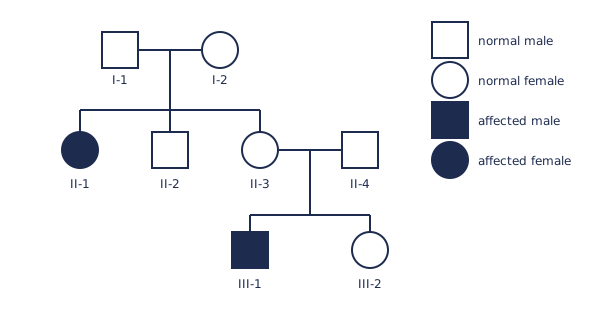
[1 mark]
(a)Alel fibrosis sista ialah alel __________.The cystic fibrosis allele is a __________ allele.
Show answerHide answer
recessive
I-1 and I-2 are normal but have an affected child, so the disease was hidden in the parents: it is recessive.
[1 mark]
(b)Berikan satu alasan bagi jawapan anda di (a).Give one reason for your answer in (a).
Show answerHide answer
Tick each point you got.
[2 marks]
(c)Nyatakan genotip I-1 dan I-2. Terangkan jawapan anda.State the genotypes of I-1 and I-2. Explain your answer.
Show answerHide answer
Tick each point you got.
[2 marks]
(d)Nyatakan genotip II-3. Berikan satu bukti daripada rajah.State the genotype of II-3. Give one piece of evidence from the diagram.
Show answerHide answer
Tick each point you got.
[2 marks]
(e)I-1 dan I-2 mempunyai anak yang keempat. Hitung kebarangkalian anak itu menghidap fibrosis sista. Tunjukkan Punnett square atau jalan kerja anda.I-1 and I-2 have a fourth child. Calculate the probability that the child has cystic fibrosis. Show a Punnett square or your working.
Show answerHide answer
Tick each point you got.
[2 marks]
(f)II-3 dan II-4 mempunyai anak ketiga. Berapakah kebarangkalian anak itu seorang lelaki yang menghidap fibrosis sista?II-3 and II-4 have a third child. What is the probability that the child is a boy with cystic fibrosis?
Show answerHide answer
Tick each point you got.
24
Question 24
Seorang murid menjalankan satu eksperimen untuk mengkaji kesan jarak lampu daripada tumbuhan Hydrilla sp. terhadap fotosintesis. Tumbuhan itu diletakkan di dalam sebuah bikar berisi air kolam. Bilangan gelembung gas yang dibebaskan dalam satu minit dicatat pada setiap jarak. Jadual 2 menunjukkan keputusan eksperimen itu.
Jadual 2A student carries out an experiment to study the effect of the distance of a lamp from a Hydrilla sp. plant on photosynthesis. The plant is placed in a beaker of pond water. The number of gas bubbles released in one minute is recorded at each distance. Table 2 shows the results of the experiment.
Table 2
| Jarak lampu (cm) | 10 | 20 | 30 | 40 | 50 |
|---|---|---|---|---|---|
| Bilangan gelembung seminit | 44 | 44 | 30 | 18 | 10 |
| Distance of lamp (cm) | 10 | 20 | 30 | 40 | 50 |
|---|---|---|---|---|---|
| Number of bubbles per minute | 44 | 44 | 30 | 18 | 10 |
[2 marks]
(a)Nyatakan pemboleh ubah dimanipulasikan dan pemboleh ubah bergerak balas dalam eksperimen ini.State the manipulated variable and the responding variable in this experiment.
Show answerHide answer
Tick each point you got.
[1 mark]
(b)Namakan gas dalam gelembung itu.Name the gas in the bubbles.
Show answerHide answer
Tick each point you got.
[2 marks]
(c)Terangkan keputusan eksperimen apabila jarak lampu bertambah daripada 20 cm kepada 50 cm.Explain the results of the experiment when the distance of the lamp increases from 20 cm to 50 cm.
Show answerHide answer
Tick each point you got.
[2 marks]
(d)Bilangan gelembung adalah sama pada 10 cm dan 20 cm. Terangkan mengapa.The number of bubbles is the same at 10 cm and 20 cm. Explain why.
Show answerHide answer
Tick each point you got.
[1 mark]
(e)Cadangkan satu cara untuk meningkatkan bilangan gelembung pada jarak 10 cm.Suggest one way to increase the number of bubbles at the distance of 10 cm.
Show answerHide answer
Any 1 points
Tick each point you got.
[2 marks]
(f)Lampu itu juga mengeluarkan haba. Terangkan bagaimana haba itu boleh menjejaskan ketepatan keputusan dan nyatakan cara untuk mengatasinya.The lamp also gives out heat. Explain how the heat can affect the accuracy of the results and state how to overcome it.
Show answerHide answer
Tick each point you got.
Bahagian CSection C
20 marksJawab satu soalan sahaja daripada dua soalan di bawah. Tulis jawapan anda di ruang yang disediakan.Answer one question only out of the two questions below. Write your answers in the spaces provided.
25Choose 1
Question 25
Sebuah ladang menanam pokok betik untuk dijual buahnya. Selepas pendebungaan, pokok betik membentuk buah yang mengandungi banyak biji benih.A farm grows papaya trees for their fruits. After pollination, the papaya flowers form fruits that contain many seeds.
[10 marks]
(a)Huraikan perkembangan butir debunga selepas mendarat pada stigma hingga berlakunya persenyawaan ganda dua.Describe what happens to a pollen grain after it lands on the stigma, up to double fertilisation.
Show answerHide answer
Tick each point you got.
[6 marks]
(b)Huraikan bagaimana ovul dan ovari berkembang menjadi biji benih dan buah selepas persenyawaan.Describe how the ovule and ovary develop into seeds and fruit after fertilisation.
Show answerHide answer
Tick each point you got.
[4 marks]
(c)Jelaskan bagaimana ciri-ciri biji benih membantu kemandirian spesies tumbuhan.Explain how the features of a seed help the survival of the plant species.
Show answerHide answer
Any 4 points
Tick each point you got.
26Choose 1
Question 26
Variasi wujud dalam populasi manusia dan haiwan. Sesetengah variasi diwarisi dan sesetengahnya disebabkan oleh mutasi.Variation exists in human and animal populations. Some variation is inherited and some is caused by mutation.
[6 marks]
(a)Bandingkan variasi selanjar dengan variasi tak selanjar.Compare continuous variation with discontinuous variation.
Show answerHide answer
Tick each point you got.
[6 marks]
(b)Terangkan bagaimana meiosis dan persenyawaan menghasilkan variasi genetik.Explain how meiosis and fertilisation produce genetic variation.
Show answerHide answer
Tick each point you got.
[4 marks]
(c)Dengan memberi contoh bagi setiap jenis, nyatakan dua jenis mutagen.State two types of mutagen, giving an example of each.
Show answerHide answer
Any 4 points
Tick each point you got.
[4 marks]
(d)Banding kesan penggantian satu bes dengan kesan penyisipan satu bes dalam gen terhadap polipeptida yang terbentuk.Compare the effect on the polypeptide of the substitution of one base with the insertion of one base in a gene.
Show answerHide answer
Tick each point you got.
Bahagian DSection D
20 marksJawab satu soalan sahaja daripada dua soalan di bawah. Tulis jawapan anda di ruang yang disediakan.Answer one question only out of the two questions below. Write your answers in the spaces provided.
27Choose 1
Question 27
Sebuah loji kumbahan melepaskan kumbahan yang tidak dirawat sepenuhnya ke dalam sebatang sungai pada jarak 2 km dari titik permulaan kajian. Sekumpulan murid mengukur kepekatan oksigen terlarut dan BOD air sungai itu pada beberapa jarak ke hilir. Rajah 3 menunjukkan keputusan kajian itu.A sewage plant releases sewage that is not fully treated into a river at a point 2 km from the starting point of a study. A group of students measure the concentration of dissolved oxygen and the BOD of the river water at several distances downstream. Diagram 3 shows the results of the study.
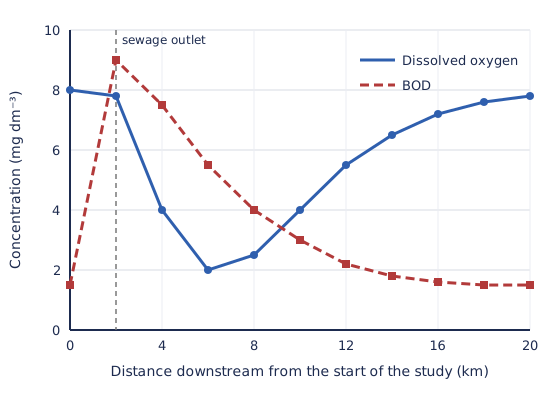
[2 marks]
(a)Berapakah kepekatan oksigen terlarut pada jarak 6 km? Hitung penurunan kepekatan oksigen terlarut dari 2 km ke 6 km.What is the concentration of dissolved oxygen at 6 km? Calculate the decrease in dissolved oxygen from 2 km to 6 km.
Show answerHide answer
Tick each point you got.
[4 marks]
(b)Terangkan mengapa BOD meningkat dengan mendadak pada 2 km dan oksigen terlarut menurun antara 2 km dengan 6 km.Explain why the BOD rises sharply at 2 km and the dissolved oxygen falls between 2 km and 6 km.
Show answerHide answer
Tick each point you got.
[4 marks]
(c)Terangkan mengapa oksigen terlarut meningkat semula selepas 6 km.Explain why the dissolved oxygen rises again after 6 km.
Show answerHide answer
Tick each point you got.
[2 marks]
(d)Pada jarak berapakah ikan paling berkemungkinan mati? Berikan satu sebab.At what distance are fish most likely to die? Give one reason.
Show answerHide answer
Tick each point you got.
[4 marks]
(e)Loji itu juga melepaskan air panas daripada sistem penyejukannya pada titik yang sama. Ramalkan kesan air panas itu terhadap graf oksigen terlarut dan terangkan.The plant also releases hot water from its cooling system at the same point. Predict the effect of the hot water on the dissolved oxygen curve and explain.
Show answerHide answer
Tick each point you got.
[4 marks]
(f)Cadangkan dan wajarkan dua langkah untuk mengurangkan pencemaran sungai itu.Suggest and justify two measures to reduce the pollution of the river.
Show answerHide answer
Any 4 points
Tick each point you got.
28Choose 1
Question 28
Sebuah syarikat benih ingin menghasilkan jagung transgenik yang tahan serangga perosak dengan memindahkan gen Bt daripada bakteria Bacillus thuringiensis ke dalam sel jagung. Alel untuk rintangan Bt, B, adalah dominan terhadap alel biasa, b.A seed company wants to produce transgenic corn that resists insect pests by transferring the Bt gene from the bacterium Bacillus thuringiensis into corn cells. The allele for Bt resistance, B, is dominant over the normal allele, b.
[5 marks]
(a)Terangkan bagaimana gen Bt dipindahkan ke dalam sel jagung menggunakan teknologi DNA rekombinan.Explain how the Bt gene is transferred into corn cells using recombinant DNA technology.
Show answerHide answer
Tick each point you got.
[3 marks]
(b)Sebatang pokok jagung transgenik heterozigot (Bb) didebungakan sendiri. Lukis Punnett square dan nyatakan nisbah fenotip anaknya.A heterozygous transgenic corn plant (Bb) is self-pollinated. Draw a Punnett square and state the phenotypic ratio of the offspring.
Show answerHide answer
Tick each point you got.
[2 marks]
(c)Syarikat itu mahu semua biji benih yang dijual tahan serangga. Genotip pokok induk yang manakah patut digunakan? Berikan sebab.The company wants all the seeds it sells to be insect resistant. Which genotype of parent plant should be used? Give a reason.
Show answerHide answer
Tick each point you got.
[6 marks]
(d)Sebuah koperasi petani mencadangkan supaya semua petani di kawasan itu menanam jagung transgenik ini. Nilaikan cadangan itu dengan menyatakan dua kelebihan dan dua kekurangan, kemudian buat keputusan anda.A farmers' cooperative proposes that all farmers in the area grow this transgenic corn. Evaluate the proposal by stating two advantages and two disadvantages, then give your decision.
Show answerHide answer
Tick each point you got.
[4 marks]
(e)Debunga jagung transgenik itu terbawa oleh angin ke ladang jagung biasa yang bersebelahan. Huraikan kesannya dan cadangkan satu cara mengawalnya.Pollen from the transgenic corn is blown by wind to a neighbouring farm that grows ordinary corn. Describe the possible effect and suggest one way to control it.
Show answerHide answer
Tick each point you got.
Test specification (JSU)
| Chapter | Remembering | Understanding | Applying | Analysing | Evaluating | Creating | Items | marks |
|---|---|---|---|---|---|---|---|---|
| 1. Organisation of Plant Tissues and Growth | 1 (1) | – | – | 1 (1) | – | – | 2 | 2 |
| 2. Leaf Structure and Function | 1 (1) | – | 1 (1) | 1 (10) | – | – | 3 | 12 |
| 3. Nutrition in Plants | – | 1 (1) | – | – | – | – | 1 | 1 |
| 4. Transport in Plants | 1 (1) | 2 (11) | – | – | – | – | 3 | 12 |
| 5. Response in Plants | 1 (1) | – | – | – | – | – | 1 | 1 |
| 6. Sexual Reproduction in Flowering Plants | – | 2 (21) | 1 (1) | – | – | – | 3 | 22 |
| 7. Adaptations of Plants in Different Habitats | – | 1 (1) | – | – | – | – | 1 | 1 |
| 8. Biodiversity | 1 (1) | 1 (1) | – | – | – | – | 2 | 2 |
| 9. Ecosystem | – | – | 2 (11) | 1 (1) | – | – | 3 | 12 |
| 10. Environmental Sustainability | 1 (1) | – | – | – | 1 (20) | – | 2 | 21 |
| 11. Inheritance | – | – | 3 (12) | – | – | – | 3 | 12 |
| 12. Variation | – | 2 (21) | – | – | – | – | 2 | 21 |
| 13. Genetic Technology | 1 (1) | – | – | – | 1 (20) | – | 2 | 21 |
| Total | 7 (7) | 9 (56) | 7 (25) | 3 (12) | 2 (40) | 0 (0) | 28 | 140 |
Each cell shows items (marks).