Practice paper, not an official KPM paper
4551
Peperiksaan Percubaan SPM (Model)SPM Trial Examination (Model)
BiologiBiology
Tingkatan 5, 2 jam / 2 hours, 100 marks
Nama / Name
Kelas / Class
Tarikh / Date
Markah / Marks: / 100
Instructions
- Kertas soalan ini mengandungi empat bahagian: Bahagian A, Bahagian B, Bahagian C dan Bahagian D.This question paper consists of four sections: Section A, Section B, Section C and Section D.
- Bahagian A: pilih satu jawapan bagi setiap soalan. Bahagian B: jawab semua soalan. Bahagian C: jawab satu soalan sahaja. Bahagian D: jawab satu soalan sahaja.Section A: choose one answer for each question. Section B: answer all questions. Section C: answer one question only. Section D: answer one question only.
- Tulis jawapan anda di ruang yang disediakan. Kerja mengira anda mesti ditunjukkan.Write your answers in the spaces provided. Your working must be shown.
- Rajah yang mengiringi soalan tidak dilukis mengikut skala kecuali dinyatakan.The diagrams are not drawn to scale unless stated.
- Jawapan boleh ditulis dalam Bahasa Melayu atau Bahasa Inggeris.Answers may be written in Bahasa Melayu or English.
- Kalkulator saintifik dibenarkan.A scientific calculator is allowed.
Answer schemes are in English (DLP).
Practice shows answers as you go. Exam times you and hides answers until you submit.
Bahagian ASection A
20 marksJawab semua soalan. Setiap soalan diikuti oleh empat pilihan jawapan, A, B, C dan D. Pilih satu jawapan sahaja.Answer all questions. Each question is followed by four options, A, B, C and D. Choose one answer only.
1
Question 1
Sel-sel yang manakah mati apabila matang, mempunyai dinding sel yang tebal dan berlignin, serta hanya memberikan sokongan mekanikal kepada tumbuhan?Which cells are dead when mature, have thick lignified walls and give only mechanical support to the plant?
Show answerHide answer
C
Sclerenchyma cells have walls thickened with lignin and are dead at maturity, so they only support. Parenchyma and collenchyma are living, and companion cells help sieve tubes.
2
Question 2
Hasil tindak balas bersandarkan cahaya yang manakah digunakan dalam tindak balas tidak bersandarkan cahaya?Which products of the light-dependent reaction are used in the light-independent reaction?
Show answerHide answer
A
The light-dependent reaction makes ATP, NADPH and oxygen. ATP and NADPH reduce carbon dioxide to glucose in the stroma. Oxygen is released and glucose is a product of the light-independent reaction.
3
Question 3
Daun muda pokok jambu batu menjadi kuning, manakala daun tuanya kekal hijau. Nutrien manakah yang kekurangan?The young leaves of a guava plant turn yellow while the older leaves stay green. Which nutrient is lacking?
Show answerHide answer
D
Iron is needed for chlorophyll synthesis and its shortage shows on the young leaves. Nitrogen and magnesium shortages show first on the mature leaves.
4
Question 4
Tumbuhan manakah ialah parasit yang tidak boleh berfotosintesis dan mendapat semua nutriennya daripada perumah?Which plant is a parasite that cannot photosynthesise and gets all its nutrients from its host?
Show answerHide answer
B
Rafflesia has no chlorophyll and lives on the roots of its host, so it is a parasite. Nepenthes is carnivorous, Platycerium (staghorn fern) is an epiphyte and Hydrilla is a free-living aquatic plant.
5
Question 5
Antara pernyataan berikut, yang manakah menerangkan laluan simplas dengan betul?Which statement describes the symplast pathway correctly?
Show answerHide answer
D
In the symplast pathway water moves through the cytoplasm of living cells, joined by plasmodesmata. A describes the apoplast pathway, C is movement inside the xylem and the Casparian strip blocks water.
6
Question 6
Fitohormon yang manakah disapu pada keratan batang pokok kembang sepatu supaya akar adventitius tumbuh?Which phytohormone is applied to the cut stem of a hibiscus cutting so that adventitious roots grow?
Show answerHide answer
A
Auxin stimulates the formation of adventitious roots on stem cuttings. Ethylene ripens fruits, abscisic acid inhibits growth and cytokinin stimulates cell division and lateral buds.
7
Question 7
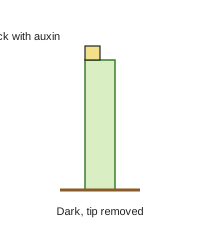
Hujung koleoptil dipotong dan dibuang. Seketul agar yang mengandungi auksin diletakkan pada separuh kiri permukaan terpotong itu seperti dalam Rajah 1. Koleoptil itu disimpan di dalam bilik gelap. Apakah yang diperhatikan selepas beberapa jam?The tip of a coleoptile is cut off and removed. A block of agar containing auxin is placed on the left half of the cut surface as in Diagram 1. The coleoptile is kept in a dark room. What is observed after a few hours?
Show answerHide answer
C
Auxin from the block moves down the left side only, so the cells on the left elongate more than those on the right. The longer left side pushes the coleoptile to curve towards the right. It does not need light.
8
Question 8
Bahagian ovul yang manakah berkembang menjadi testa biji benih?Which part of the ovule develops into the testa of a seed?
Show answerHide answer
B
The integument, the outer covering of the ovule, hardens into the testa (seed coat). The zygote becomes the embryo, and the funicle only attaches the ovule to the ovary wall.
9
Question 9
Sejenis bunga mempunyai kelopak kuning terang, bau yang harum, nektar dan butir debunga yang melekit. Apakah agen pendebungaannya yang paling mungkin?A flower has bright yellow petals, a sweet scent, nectar and sticky pollen grains. What is its most likely pollinating agent?
Show answerHide answer
D
Bright petals, scent and nectar attract insects, and sticky pollen sticks to their bodies. Wind-pollinated flowers are small and dull with light, dry pollen.
10
Question 10
Mengapakah petiol daun teratai panjang dan lentur?Why is the petiole of a water lily leaf long and flexible?
Show answerHide answer
A
A long, flexible petiole keeps the leaf at the water surface to receive light and bends with water movement. Storing water and reducing evaporation are xerophyte features.
11
Question 11
Pokok api-api (Avicennia sp.) tumbuh dalam lumpur paya bakau yang tepu air dan kurang oksigen. Ciri yang manakah membolehkan akarnya mendapat oksigen?The api-api tree (Avicennia sp.) grows in waterlogged mangrove mud that has little oxygen. Which feature allows its roots to obtain oxygen?
Show answerHide answer
C
Pneumatophores grow up above the mud and have lenticels through which air enters, so the submerged roots can respire. Salt glands remove salt, prop roots give support and waxy leaves reduce water loss.
12
Question 12
Jadual menunjukkan kunci dikotomi untuk mengenal pasti empat haiwan: burung pipit, ikan paus, jerung dan buaya.
Haiwan yang berikut manakah dicapai melalui 1b, 2b dan 3b?The table shows a dichotomous key to identify four animals: sparrow, whale, shark and crocodile.
Which animal is reached through 1b, 2b and 3b?
| Pasangan | Pernyataan | Pergi ke / jawapan |
|---|---|---|
| 1a | Badan berbulu | Burung pipit |
| 1b | Badan tidak berbulu | 2 |
| 2a | Bernafas dengan insang sepanjang hayat | Jerung |
| 2b | Bernafas dengan peparu | 3 |
| 3a | Melahirkan anak dan menyusukan anak | Ikan paus |
| 3b | Bertelur dan badan bersisik | Buaya |
| Couplet | Statement | Go to / answer |
|---|---|---|
| 1a | Body covered with feathers | Sparrow |
| 1b | Body without feathers | 2 |
| 2a | Breathes with gills all its life | Shark |
| 2b | Breathes with lungs | 3 |
| 3a | Gives birth and suckles its young | Whale |
| 3b | Lays eggs and has scaly skin | Crocodile |
Show answerHide answer
D
1b rules out the sparrow, 2b rules out the shark (it has gills) and 3b gives the animal that lays eggs and has scaly skin: the crocodile.
13
Question 13
Pasangan penyakit dan vektor yang manakah betul?Which pair of disease and vector is correct?
Show answerHide answer
A
Dengue is spread by the Aedes mosquito. Malaria is spread by the female Anopheles mosquito. Cholera spreads through contaminated food and water, and tuberculosis through droplets in the air.
14
Question 14
Seorang murid menggunakan tujuh kuadrat berukuran 0.5 m × 0.5 m untuk mengkaji rumput liar di padang sekolah. Jumlah bilangan rumput dalam semua kuadrat ialah 42. Berapakah ketumpatan populasi rumput itu?A student uses seven quadrats, each 0.5 m × 0.5 m, to study a weed on the school field. The total number of weeds in all the quadrats is 42. What is the population density of the weed?
Show answerHide answer
C
Total area sampled = 7 × (0.5 × 0.5) = 1.75 m². Density = 42 ÷ 1.75 = 24 per m². Option B uses 3.5 m², option A forgets that each quadrat is only 0.25 m², and D ignores the area.
15
Question 15
Sebuah kilang minyak sawit menangkap gas metana daripada kolam sisa cecairnya dan membakarnya untuk menjana elektrik. Apakah faedah utama alam sekitar daripada amalan ini?A palm oil mill traps the methane from its waste water ponds and burns it to generate electricity. What is the main environmental benefit of this practice?
Show answerHide answer
D
Methane is a greenhouse gas. Trapping and burning it as biogas stops it from reaching the atmosphere and saves fossil fuel, so it reduces global warming. The practice does not reduce noise or acid rain.
16
Question 16
Jadual menunjukkan kepekatan oksigen terlarut dalam sebatang sungai pada empat stesen. Stesen 2 ialah tempat sebuah ladang ayam melepaskan sisa.
Pernyataan yang manakah betul?The table shows the dissolved oxygen in a river at four stations. Station 2 is where a poultry farm discharges its waste.
Which statement is correct?
| Stesen | Kedudukan | Oksigen terlarut (mg dm⁻³) |
|---|---|---|
| 1 | Hulu, sebelum ladang | 7.8 |
| 2 | Tempat pelepasan sisa | 3.1 |
| 3 | 2 km hilir | 5.4 |
| 4 | 5 km hilir | 7.2 |
| Station | Position | Dissolved oxygen (mg dm⁻³) |
|---|---|---|
| 1 | Upstream, before the farm | 7.8 |
| 2 | Waste outlet | 3.1 |
| 3 | 2 km downstream | 5.4 |
| 4 | 5 km downstream | 7.2 |
Show answerHide answer
A
Low dissolved oxygen means high BOD: microorganisms decomposing the organic waste use up the oxygen at station 2. Oxygen rises again downstream as the waste is decomposed and diluted, so the river recovers. Upstream water is cleaner, not warmer.
17
Question 17
Seorang wanita bergolongan darah A (heterozigot) berkahwin dengan lelaki bergolongan darah AB. Berapakah kebarangkalian anak mereka bergolongan darah B?A woman of blood group A (heterozygous) marries a man of blood group AB. What is the probability that their child has blood group B?
Show answerHide answer
B
Woman IAIO × man IAIB gives IAIA, IAIB, IAIO and IBIO in equal numbers. Only IBIO is group B, so 1/4.
18
Question 18
Seorang wanita pembawa buta warna (XBXb) berkahwin dengan lelaki yang penglihatan warnanya normal. Berapakah kebarangkalian anak pertama mereka seorang anak lelaki yang buta warna?A woman who is a carrier of colour blindness (XBXb) marries a man with normal colour vision. What is the probability that their first child is a colour blind boy?
Show answerHide answer
B
Cross XBXb × XBY gives XBXB, XBXb, XBY and XbY. Only XbY is a colour blind boy, so 1/4 of all children. 1/2 is the chance that a son (not any child) is colour blind.
19
Question 19
Jujukan bes dalam sebahagian gen normal ialah TAC GGA CTT AAA. Dalam gen mutan, jujukan itu menjadi TAC GAC TTA AA. Apakah jenis mutasi gen ini dan apakah kesannya?The base sequence in part of a normal gene is TAC GGA CTT AAA. In a mutant gene, the sequence becomes TAC GAC TTA AA. What type of gene mutation is this and what is its effect?
Show answerHide answer
C
One G is missing (GGA becomes GA), so the sequence is shorter by one base: a deletion. Every codon after that point is shifted and many amino acids change. Substitution would keep the same length, and inversion is a chromosomal mutation.
20
Question 20
Antara berikut, yang manakah menunjukkan urutan langkah pemprofilan DNA yang betul?Which shows the correct order of the steps in DNA profiling?
Show answerHide answer
B
The DNA is extracted from the sample first, cut into fragments with restriction enzymes, separated by size by gel electrophoresis, then the bands are shown on X-ray film (textbook Figure 13.6). The fragments must be cut before they can be separated.
Bahagian BSection B
40 marksJawab semua soalan.Answer all questions.
21
Question 21
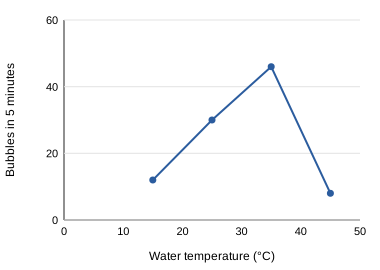
Seorang murid mengkaji kesan warna cahaya dan suhu air terhadap kadar fotosintesis Hydrilla sp. Bilangan gelembung oksigen yang dibebaskan dalam 5 minit dicatat. Dalam Jadual 1, lampu diletakkan 20 cm dari tumbuhan dan suhu air ialah 25 °C. Rajah 2 menunjukkan keputusan bagi cahaya putih pada empat suhu air.
A student investigates the effect of the colour of light and the water temperature on the rate of photosynthesis of Hydrilla sp. The number of oxygen bubbles released in 5 minutes is recorded. In Table 1 the lamp is 20 cm from the plant and the water is at 25 °C. Diagram 2 shows the results for white light at four water temperatures.
| Warna cahaya | Putih | Merah | Biru | Hijau |
|---|---|---|---|---|
| Bilangan gelembung dalam 5 minit | 30 | 27 | 24 | 4 |
| Colour of light | White | Red | Blue | Green |
|---|---|---|---|---|
| Number of bubbles in 5 minutes | 30 | 27 | 24 | 4 |
[2 marks]
(a)Nyatakan pemboleh ubah dimanipulasikan dan pemboleh ubah bergerak balas dalam eksperimen suhu air (Rajah 2).State the manipulated variable and the responding variable in the water temperature experiment (Diagram 2).
Show answerHide answer
Tick each point you got.
[1 mark]
(b)Mengapakah natrium hidrogen karbonat ditambah ke dalam air dalam eksperimen ini?Why is sodium hydrogen carbonate added to the water in this experiment?
Show answerHide answer
Tick each point you got.
[2 marks]
(c)Dalam Jadual 1, mengapakah cahaya hijau menghasilkan bilangan gelembung yang paling sedikit?In Table 1, why does green light give the fewest bubbles?
Show answerHide answer
Tick each point you got.
[2 marks]
(d)Huraikan perubahan bilangan gelembung apabila suhu air meningkat daripada 15 °C kepada 45 °C dalam Rajah 2 dan terangkan sebabnya.Describe how the number of bubbles changes as the water temperature rises from 15 °C to 45 °C in Diagram 2 and explain why.
Show answerHide answer
Tick each point you got.
[1 mark]
(e)Hitung kadar fotosintesis, dalam gelembung seminit, pada suhu 35 °C.Calculate the rate of photosynthesis, in bubbles per minute, at 35 °C.
Show answerHide answer
9.2 bubbles per minute
Tick each point you got.
[2 marks]
(f)Murid itu mendapati bahawa bilangan gelembung yang dikira lebih rendah daripada oksigen yang sebenarnya dihasilkan. Berikan satu sebab.The student finds that the number of bubbles counted is lower than the oxygen actually made. Give one reason.
Show answerHide answer
Tick each point you got.
22
Question 22
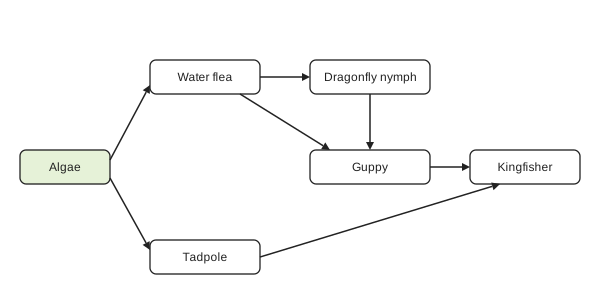
Rajah 3 menunjukkan siratan makanan dalam sebuah kolam. Anak panah menunjukkan arah pemindahan tenaga. Nimfa pepatung hanya memakan kutu air.Diagram 3 shows a food web in a pond. The arrows show the direction of energy transfer. The dragonfly nymph feeds only on water fleas.
[1 mark]
(a)Namakan pengeluar dalam siratan makanan ini.Name the producer in this food web.
Show answerHide answer
Tick each point you got.
[2 marks]
(b)Tuliskan rantai makanan yang paling panjang.Write the longest food chain.
Show answerHide answer
Tick each point you got.
[1 mark]
(c)Namakan pengguna tertier dalam rantai makanan di (b).Name the tertiary consumer in the food chain in (b).
Show answerHide answer
Tick each point you got.
[2 marks]
(d)Alga mengandungi 25 000 kJ tenaga. Hitung tenaga yang tersedia kepada ikan gupi dalam rantai makanan di (b) jika 10% tenaga dipindahkan pada setiap peringkat.The algae contain 25 000 kJ of energy. Calculate the energy available to the guppy in the food chain in (b) if 10% of the energy is transferred at each level.
Show answerHide answer
25 kJ
Tick each point you got.
[2 marks]
(e)Penyakit membunuh semua kutu air. Ramalkan kesan terhadap populasi nimfa pepatung dan berikan sebabnya.A disease kills all the water fleas. Predict the effect on the population of dragonfly nymphs and give a reason.
Show answerHide answer
Tick each point you got.
[2 marks]
(f)Terangkan mengapa bilangan burung pekaka dalam kolam itu jauh lebih sedikit daripada bilangan alga.Explain why the number of kingfishers in the pond is much smaller than the number of algae.
Show answerHide answer
Tick each point you got.
23
Question 23
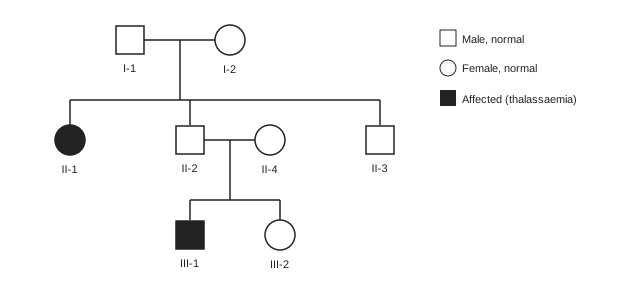
Talasemia disebabkan oleh alel resesif, t. Rajah 4 menunjukkan salasilah sebuah keluarga bagi penyakit ini.Thalassaemia is caused by a recessive allele, t. Diagram 4 shows the pedigree of a family for this disease.
[2 marks]
(a)Nyatakan genotip I-1 dan I-2. Berikan satu sebab.State the genotypes of I-1 and I-2. Give one reason.
Show answerHide answer
Tick each point you got.
[1 mark]
(b)Mengapakah talasemia tidak boleh disebabkan oleh alel dominan berdasarkan salasilah ini?Why can thalassaemia not be caused by a dominant allele, judging from this pedigree?
Show answerHide answer
Tick each point you got.
[3 marks]
(c)Lukis petak Punnett untuk persilangan antara I-1 dan I-2 dan nyatakan nisbah fenotip anak mereka.Draw a Punnett square for the cross between I-1 and I-2 and state the phenotypic ratio of their offspring.
Show answerHide answer
Tick each point you got.
[1 mark]
(d)Nyatakan genotip II-2 dan berikan sebabnya.State the genotype of II-2 and give a reason.
Show answerHide answer
Tick each point you got.
[2 marks]
(e)Berapakah kebarangkalian II-3 ialah pembawa? Tunjukkan jalan kerja anda.What is the probability that II-3 is a carrier? Show your working.
Show answerHide answer
2/3
Tick each point you got.
[1 mark]
(f)Berapakah kebarangkalian anak seterusnya II-2 dan II-4 menghidap talasemia?What is the probability that the next child of II-2 and II-4 has thalassaemia?
Show answerHide answer
1/4
Tick each point you got.
24
Question 24
Empat anak benih kacang yang sama saiz dirawat seperti yang berikut. Rajah 5 menunjukkan keputusan selepas dua minggu. P: dibiarkan utuh. Q: pucuk dipotong. R: pucuk dipotong dan lanolin yang bercampur auksin disapu pada bahagian yang terpotong. S: pucuk dipotong dan lanolin tanpa auksin disapu pada bahagian yang terpotong.Four bean seedlings of the same size are treated as follows. Diagram 5 shows the results after two weeks. P: left intact. Q: shoot tip cut off. R: shoot tip cut off and lanolin mixed with auxin smeared on the cut end. S: shoot tip cut off and plain lanolin smeared on the cut end.
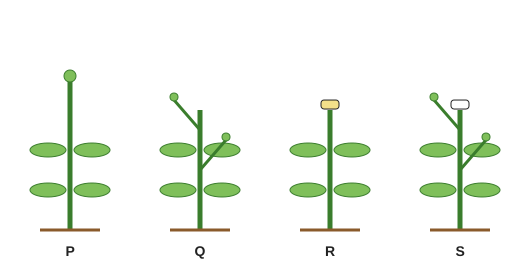
[1 mark]
(a)Namakan fenomena yang ditunjukkan oleh P.Name the phenomenon shown by P.
Show answerHide answer
Tick each point you got.
[1 mark]
(b)Namakan fitohormon yang dihasilkan oleh pucuk apeks yang menyebabkan fenomena ini.Name the phytohormone made in the shoot apex that causes this.
Show answerHide answer
Tick each point you got.
[1 mark]
(c)Mengapakah S disediakan?Why is S set up?
Show answerHide answer
Tick each point you got.
[2 marks]
(d)Bandingkan Q dengan R dan terangkan keputusan itu.Compare Q with R and explain the results.
Show answerHide answer
Tick each point you got.
[2 marks]
(e)Ramalkan apa yang berlaku jika sitokinin disapu pada tunas sisi P. Berikan sebab.Predict what happens if cytokinin is applied to the lateral buds of P. Give a reason.
Show answerHide answer
Tick each point you got.
[2 marks]
(f)Seorang tukang kebun memangkas pucuk pokok pagar bunga raya. Terangkan mengapa pokok itu menjadi lebih rimbun.A gardener trims the tips of a hibiscus hedge. Explain why the hedge becomes bushier.
Show answerHide answer
Tick each point you got.
[1 mark]
(g)Namakan fitohormon yang menutup stoma semasa kemarau.Name the phytohormone that closes the stomata during a drought.
Show answerHide answer
Tick each point you got.
Bahagian CSection C
20 marksJawab satu soalan sahaja.Answer one question only.
25Choose 1
Question 25
Sebatang pokok durian yang tinggi mengangkut air dan sukrosa ke seluruh bahagiannya.A tall durian tree transports water and sucrose to all its parts.
[4 marks]
(a)Huraikan bagaimana air dari tanah masuk ke dalam xilem akar.Describe how water from the soil enters the xylem of the root.
Show answerHide answer
Tick each point you got.
[6 marks]
(b)Terangkan bagaimana air bergerak ke atas hingga ke daun di puncak pokok yang tinggi itu.Explain how water moves up to the leaves at the top of the tall tree.
Show answerHide answer
Tick each point you got.
[4 marks]
(c)Huraikan bagaimana sukrosa dipindahkan dari daun ke buah durian.Describe how sucrose is transported from a leaf to the durian fruit.
Show answerHide answer
Tick each point you got.
[6 marks]
(d)Seorang peladang menabur terlalu banyak baja kimia pada pokok cili di dalam pasu. Pokok itu layu walaupun tanahnya basah. Terangkan mengapa, dan cadangkan dua cara untuk memulihkannya.A farmer applies too much chemical fertiliser to potted chilli plants. The plants wilt although the soil is wet. Explain why and suggest two ways to recover the plants.
Show answerHide answer
Tick each point you got.
26Choose 1
Question 26
Sebuah ladang orkid menjalankan pembiakbakaan untuk menghasilkan orkid kacukan yang baharu.An orchid farm carries out breeding to produce a new hybrid orchid.
[4 marks]
(a)Huraikan perkembangan pundi embrio daripada sel induk megaspora dalam ovul.Describe the development of the embryo sac from the megaspore mother cell in the ovule.
Show answerHide answer
Tick each point you got.
[5 marks]
(b)Huraikan pembentukan butir debunga matang dalam anter.Describe the formation of mature pollen grains in the anther.
Show answerHide answer
Tick each point you got.
[5 marks]
(c)Nyatakan perubahan yang berlaku pada ovul, ovari dan integumen selepas persenyawaan.State the changes that happen to the ovule, the ovary and the integument after fertilisation.
Show answerHide answer
Tick each point you got.
[6 marks]
(d)Seorang pembiak baka memindahkan debunga daripada pokok X (tinggi dan tahan penyakit) ke stigma pokok Y (rendah dan hasil tinggi) dengan tangan. Anther pokok Y dibuang dahulu dan bunga itu ditutup dengan beg selepas pendebungaan. Terangkan mengapa langkah-langkah ini perlu dan mengapa biji benih yang terhasil tidak serupa dengan induknya.A breeder moves pollen by hand from plant X (tall and disease resistant) to the stigma of plant Y (short with high yield). The anthers of plant Y are removed first and the flower is covered with a bag after pollination. Explain why these steps are needed and why the seeds formed are not identical to either parent.
Show answerHide answer
Tick each point you got.
Bahagian DSection D
20 marksSoalan ini menguji pemikiran aras tinggi. Jawab satu soalan sahaja.These questions test higher order thinking. Answer one question only.
27Choose 1
Question 27
Sebuah kampung nelayan memusnahkan sebahagian hutan paya bakau untuk membina kolam udang. Jadual 2 menunjukkan perubahan selama lima tahun.
A fishing village clears part of its mangrove forest to build shrimp ponds. Table 2 shows the changes over five years.
| Tahun 0 | Tahun 5 | |
|---|---|---|
| Luas hutan paya bakau (hektar) | 120 | 45 |
| Tangkapan ikan tahunan (tan) | 80 | 31 |
| Hakisan pantai (m dari garis asal) | 0 | 36 |
| Hasil udang tahunan (tan) | 0 | 40 |
| Year 0 | Year 5 | |
|---|---|---|
| Area of mangrove forest (hectares) | 120 | 45 |
| Annual fish catch (tonnes) | 80 | 31 |
| Shore erosion (m from the original line) | 0 | 36 |
| Annual shrimp harvest (tonnes) | 0 | 40 |
[3 marks]
(a)Hitung peratus kehilangan hutan paya bakau dan peratus penurunan tangkapan ikan.Calculate the percentage loss of mangrove forest and the percentage decrease in the fish catch.
Show answerHide answer
62.5% and 61.25%
Tick each point you got.
[4 marks]
(b)Terangkan dua kesan ekologi pemusnahan hutan paya bakau seperti yang ditunjukkan oleh jadual.Explain two ecological effects of clearing the mangrove forest, as shown by the table.
Show answerHide answer
Any of these points, up to 4 marks
Tick each point you got.
[5 marks]
(c)Air buangan kolam udang kaya dengan nitrat dan fosfat. Terangkan bagaimana eutrofikasi boleh berlaku dan menyebabkan ikan di muara mati.The waste water of the shrimp ponds is rich in nitrates and phosphates. Explain how eutrophication can happen and cause the fish in the estuary to die.
Show answerHide answer
Tick each point you got.
[4 marks]
(d)Cadangkan dua langkah yang mampan bagi memulihkan kampung itu dan berikan justifikasi.Suggest two sustainable measures to restore the village and give a justification for each.
Show answerHide answer
Tick each point you got.
[4 marks]
(e)Ketua kampung berkata kolam udang itu patut diteruskan kerana hasil udang meningkat. Nilaikan pendapat beliau.The village head says the shrimp ponds should continue because the shrimp harvest has increased. Evaluate his opinion.
Show answerHide answer
Tick each point you got.
28Choose 1
Question 28
Pihak kesihatan menggunakan racun serangga yang sama untuk membunuh nyamuk Aedes di sebuah bandar. Jadual 3 menunjukkan peratus nyamuk yang mati selepas disembur.
The health department uses the same insecticide to kill Aedes mosquitoes in a town. Table 3 shows the percentage of mosquitoes that die after spraying.
| Tahun | 1 | 3 | 5 |
|---|---|---|---|
| Peratus nyamuk yang mati | 98 | 71 | 22 |
| Year | 1 | 3 | 5 |
|---|---|---|---|
| Percentage of mosquitoes that die | 98 | 71 | 22 |
[5 marks]
(a)Terangkan, dengan menggunakan konsep variasi dan pemilihan semula jadi, mengapa peratus nyamuk yang mati menurun.Explain, using the ideas of variation and natural selection, why the percentage of mosquitoes that die falls.
Show answerHide answer
Tick each point you got.
[3 marks]
(b)Seorang murid berkata bahawa racun serangga itu menyebabkan nyamuk bermutasi dan menjadi kebal. Adakah beliau betul? Jelaskan.A student says that the insecticide caused the mosquitoes to mutate and become resistant. Is he correct? Explain.
Show answerHide answer
Tick each point you got.
[5 marks]
(c)Satu cadangan ialah melepaskan nyamuk jantan yang diubah suai secara genetik yang membawa gen yang menyebabkan anak mati sebelum dewasa. Huraikan langkah-langkah menghasilkan nyamuk jantan itu menggunakan teknologi DNA rekombinan.One proposal is to release genetically modified male mosquitoes that carry a gene which makes their offspring die before adulthood. Describe the steps to produce these mosquitoes using recombinant DNA technology.
Show answerHide answer
Tick each point you got.
[7 marks]
(d)Nilaikan sama ada pelepasan nyamuk jantan itu lebih baik daripada menggunakan racun serangga sahaja. Berikan dua kelebihan dan dua risiko serta satu keputusan yang jelas.Evaluate whether releasing these male mosquitoes is better than using insecticide alone. Give two advantages and two risks and a clear decision.
Show answerHide answer
Tick each point you got.
Test specification (JSU)
| Chapter | Remembering | Understanding | Applying | Analysing | Evaluating | Creating | Items | marks |
|---|---|---|---|---|---|---|---|---|
| 1. Organisation of Plant Tissues and Growth | 1 (1) | – | – | – | – | – | 1 | 1 |
| 2. Leaf Structure and Function | – | 1 (1) | – | 1 (10) | – | – | 2 | 11 |
| 3. Nutrition in Plants | 1 (1) | – | 1 (1) | – | – | – | 2 | 2 |
| 4. Transport in Plants | – | 1 (1) | – | – | 1 (20) | – | 2 | 21 |
| 5. Response in Plants | – | 1 (1) | 1 (1) | 1 (10) | – | – | 3 | 12 |
| 6. Sexual Reproduction in Flowering Plants | 1 (1) | – | 1 (1) | – | 1 (20) | – | 3 | 22 |
| 7. Adaptations of Plants in Different Habitats | – | 2 (2) | – | – | – | – | 2 | 2 |
| 8. Biodiversity | 1 (1) | – | 1 (1) | – | – | – | 2 | 2 |
| 9. Ecosystem | – | – | 2 (11) | – | – | – | 2 | 11 |
| 10. Environmental Sustainability | – | – | 1 (1) | 1 (1) | 1 (20) | – | 3 | 22 |
| 11. Inheritance | – | – | 2 (11) | 1 (1) | – | – | 3 | 12 |
| 12. Variation | – | – | – | 1 (1) | 1 (20) | – | 2 | 21 |
| 13. Genetic Technology | – | 1 (1) | – | – | – | – | 1 | 1 |
| Total | 4 (4) | 6 (6) | 9 (27) | 5 (23) | 4 (80) | 0 (0) | 28 | 140 |
Each cell shows items (marks).