Practice paper, not an official KPM paper
4551
Ujian Akhir Sesi AkademikEnd of Academic Session Test
BiologiBiology
Tingkatan 5, 2 jam / 2 hours, 100 marks
Nama / Name
Kelas / Class
Tarikh / Date
Markah / Marks: / 100
Instructions
- Kertas soalan ini mengandungi empat bahagian: Bahagian A, Bahagian B, Bahagian C dan Bahagian D.This question paper consists of four sections: Section A, Section B, Section C and Section D.
- Bahagian A: jawab semua soalan. Pilih satu jawapan bagi setiap soalan.Section A: answer all questions. Choose one answer for each question.
- Bahagian B: jawab semua soalan.Section B: answer all questions.
- Bahagian C: jawab satu soalan sahaja daripada dua soalan. Bahagian D: jawab satu soalan sahaja daripada dua soalan.Section C: answer one question only out of two. Section D: answer one question only out of two.
- Rajah yang mengiringi soalan tidak dilukis mengikut skala kecuali dinyatakan.The diagrams in this paper are not drawn to scale unless stated.
- Anda dibenarkan menggunakan kalkulator saintifik.You may use a scientific calculator.
Answer schemes are in English (DLP).
Practice shows answers as you go. Exam times you and hides answers until you submit.
Bahagian ASection A
20 marksJawab semua soalan. Setiap soalan diikuti oleh empat pilihan jawapan, A, B, C dan D. Pilih satu jawapan sahaja.Answer all questions. Each question is followed by four options, A, B, C and D. Choose one answer only.
1
Question 1
Tisu manakah yang terdiri daripada sel hidup berdinding nipis, sentiasa segah, menyimpan kanji dan boleh menjalankan fotosintesis?Which tissue is made of living cells with thin walls that are always turgid, store starch and can carry out photosynthesis?
Show answerHide answer
C
Parenchyma has the simplest, thinnest-walled living cells. They are always turgid and store starch and sugar and photosynthesise. Collenchyma has thicker, flexible walls; sclerenchyma and xylem are dead at maturity.
2
Question 2
Kambium gabus pada batang sebatang pokok berkayu membahagi secara aktif. Tisu manakah yang terbentuk hasil pembahagian ini?The cork cambium in the stem of a woody tree divides actively. Which tissues are formed by this division?
Show answerHide answer
A
The cork cambium under the epidermis forms cork cells on the outside and cortex on the inside. B describes the vascular cambium, not the cork cambium. D has the xylem and phloem the wrong way round.
3
Question 3
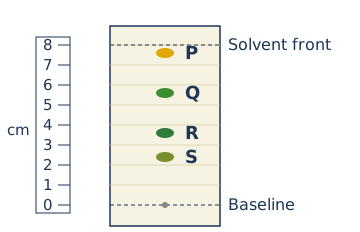
Rajah 1 menunjukkan kromatogram ekstrak daun bayam. Pembaris disusun supaya sifar berada pada garis dasar. Berapakah nilai Rf bagi pigmen R?Diagram 1 shows the chromatogram of a spinach leaf extract. The ruler is placed with zero at the baseline. What is the Rf value of pigment R?
Show answerHide answer
B
Rf = distance moved by the pigment ÷ distance moved by the solvent = 3.6 ÷ 8.0 = 0.45. 2.22 comes from dividing the two distances the wrong way round; an Rf is always less than 1.
4
Question 4
Jadual 1 menunjukkan pertukaran bersih karbon dioksida oleh sehelai daun pada lima keamatan cahaya. Tiada fotosintesis berlaku pada 0 unit cahaya.
Berapakah kadar fotosintesis pada keamatan cahaya 6 unit?Table 1 shows the net exchange of carbon dioxide by a leaf at five light intensities. There is no photosynthesis at 0 units of light.
What is the rate of photosynthesis at a light intensity of 6 units?
| Keamatan cahaya (unit) | Pertukaran bersih CO2 (unit) |
|---|---|
| 0 | dibebaskan 4 |
| 2 | dibebaskan 2 |
| 4 | 0 |
| 6 | diserap 3 |
| 8 | diserap 5 |
| Light intensity (units) | Net CO2 exchange (units) |
|---|---|
| 0 | released 4 |
| 2 | released 2 |
| 4 | 0 |
| 6 | taken in 3 |
| 8 | taken in 5 |
Show answerHide answer
D
The rate of respiration is 4 units (the CO2 released in the dark). At 6 units the leaf takes in a net 3 units, so photosynthesis = 3 + 4 = 7 units. The compensation point is at 4 units, where the net exchange is zero.
5
Question 5
Pada waktu malam, sukrosa dalam sel pengawal ditukarkan kepada kanji. Pernyataan yang manakah betul tentang sel pengawal pada waktu malam?At night, the sucrose in the guard cells is changed to starch. Which statement is correct about the guard cells at night?
Show answerHide answer
C
Less sucrose raises the water potential in the guard cells, so water leaves by osmosis, the guard cells become flaccid and the stoma closes. The reverse happens in the day (options A and D mix up the two directions).
6
Question 6
Seorang pekebun mendapati tepi daun pokok pinang merah menjadi kuning dan pokok itu mati sebelum waktunya. Nutrien manakah yang kekurangan?A gardener finds that the edges of the leaves of his red pinang palm turn yellow and the plant dies prematurely. Which nutrient is lacking?
Show answerHide answer
A
Potassium deficiency makes the leaf edges turn yellow and can kill the plant early. Nitrogen deficiency yellows mainly the mature leaves as a whole, magnesium deficiency yellows the parts between the veins of mature leaves, and calcium deficiency gives distorted, lobed leaves.
7
Question 7
Molekul air melekat pada dinding salur xilem yang sempit dan melekat sesama sendiri, lalu air naik melawan graviti. Apakah proses ini?Water molecules stick to the wall of narrow xylem vessels and to one another, so that water rises against gravity. What is this process?
Show answerHide answer
D
Adhesion (water sticking to the xylem wall) and cohesion (water sticking together) make up capillary action. Root pressure pushes from below, transpirational pull comes from the leaves and translocation is in the phloem.
8
Question 8
Air bergerak dari tanah melalui sel rambut akar, korteks dan xilem ke mesofil berspan sebuah daun. Susunan nilai keupayaan air (dalam kPa) yang manakah mungkin bagi laluan ini, mengikut urutan itu?Water moves from the soil through a root hair cell, the cortex and the xylem to the spongy mesophyll of a leaf. Which set of water potential values (in kPa) is possible for this route, in that order?
Show answerHide answer
B
Water moves by osmosis from a higher (less negative) to a lower (more negative) water potential, so the values must fall steadily along the route. Only B falls at every step; A rises, C goes up in the middle and D has the soil lower than the root hair cell.
9
Question 9
Seorang pekebun menyembur bunga cili yang belum didebungakan dengan satu fitohormon supaya buahnya tidak berbiji. Fitohormon yang manakah digunakan?A farmer sprays unpollinated chilli flowers with a phytohormone so that the fruits have no seeds. Which phytohormone is used?
Show answerHide answer
A
Auxin applied to unpollinated flowers produces fruit without fertilisation (parthenocarpy), so the fruit has no seeds. Abscisic acid inhibits growth, ethylene ripens fruit and cytokinin is used in tissue culture.
10
Question 10
Sebatang anak benih diletakkan secara mengufuk dalam gelap. Selepas beberapa jam, kepekatan auksin diukur pada bahagian atas dan bawah pucuk dan akar.
Pernyataan yang manakah betul?A seedling is placed horizontally in the dark. After a few hours the auxin concentration is measured on the upper and lower sides of the shoot and the root.
Which statement is correct?
| Bahagian | Kepekatan auksin pada sisi atas | Kepekatan auksin pada sisi bawah |
|---|---|---|
| Pucuk | 40 | 60 |
| Akar | 40 | 60 |
| Part | Auxin concentration, upper side | Auxin concentration, lower side |
|---|---|---|
| Shoot | 40 | 60 |
| Root | 40 | 60 |
Show answerHide answer
C
Auxin collects on the lower side. In the shoot this concentration stimulates elongation, so the shoot bends up (negative geotropism). In the root the same concentration inhibits elongation, so the upper side grows faster and the root bends down (positive geotropism).
11
Question 11
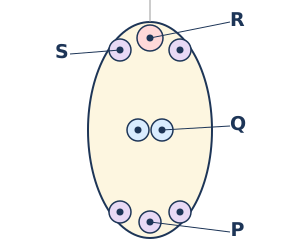
Rajah 2 menunjukkan pundi embrio sebiji ovul. Struktur manakah yang bergabung dengan satu gamet jantan untuk membentuk nukleus endosperma triploid?Diagram 2 shows the embryo sac of an ovule. Which structure fuses with one male gamete to form the triploid endosperm nucleus?
Show answerHide answer
B
Q is the pair of polar nuclei in the centre. A male gamete fuses with them to form the triploid (3n) endosperm nucleus. R is the egg cell, which fuses with the other male gamete to give the zygote; P (antipodal cells) and S (synergid) do not fuse.
12
Question 12
Elodea sp. hidup tenggelam di dalam air dan mempunyai batang yang kecil dan berongga. Apakah fungsi ciri ini?Elodea sp. lives submerged in water and has a small, hollow stem. What is the function of this feature?
Show answerHide answer
D
A small, hollow stem keeps a submerged plant floating upright and offers little resistance to water flow. Water storage is a xerophyte feature and broad leaves, not the stem, absorb sunlight in floating plants.
13
Question 13
Organisma P dan Q berada dalam famili yang sama tetapi genus yang berbeza. Organisma R dan S berada dalam genus yang sama. Pernyataan yang manakah betul?Organisms P and Q are in the same family but in different genera. Organisms R and S are in the same genus. Which statement is correct?
Show answerHide answer
C
Going down the hierarchy (family, then genus, then species) the groups are smaller and the members are more closely related. Organisms in the same genus therefore share more characteristics than organisms that only share a family. A genus can contain several species, and P and Q are in different genera.
14
Question 14
Situasi manakah yang menunjukkan persaingan antara spesies?Which situation shows interspecific competition?
Show answerHide answer
A
Interspecific competition is between different species for the same resource. B and C are intraspecific (same species); D is predation, not competition.
15
Question 15
Dalam sebuah rantai makanan di paya, tenaga dalam pengguna tertier ialah 650 kJ. Rantai itu mempunyai pengeluar, pengguna primer, pengguna sekunder dan pengguna tertier. Jika 10% tenaga dipindahkan pada setiap peringkat trofik, berapakah tenaga dalam pengeluar?In a swamp food chain, the energy in the tertiary consumers is 650 kJ. The chain has producers, primary consumers, secondary consumers and tertiary consumers. If 10% of the energy is transferred at each trophic level, how much energy is in the producers?
Show answerHide answer
D
There are three transfers, each 10%. Going back up the chain, multiply by 10 three times: 650 × 10 = 6 500 (secondary consumers), × 10 = 65 000 (primary consumers), × 10 = 650 000 kJ (producers).
16
Question 16
Sekumpulan murid menjahit beg plastik terpakai menjadi beg tangan fesyen yang baharu dan berguna tanpa melebur bahan itu. Amalan ini ialahA group of pupils sew used plastic bags into new and useful fashionable handbags without melting the material. This practice is
Show answerHide answer
B
Upcycling turns old materials into new, useful things of higher value. Recycling would break the plastic down and process it into new raw material; repair mends the original item.
17
Question 17
Sepasang suami isteri ialah pembawa talasemia (Tt). Apakah kebarangkalian anak mereka menjadi pembawa seperti mereka?A husband and wife are both carriers of thalassemia (Tt). What is the probability that their child is a carrier like them?
Show answerHide answer
C
Tt × Tt gives TT : Tt : Tt : tt = 1 : 2 : 1. Two of the four combinations are Tt, so the chance of a carrier child is 2/4 = 1/2. (1/4 is the chance of a child with thalassemia major.)
18
Question 18
Seorang lelaki yang menghidap hemofilia (XhY) berkahwin dengan seorang wanita normal yang homozigot (XHXH). Pernyataan yang manakah menerangkan anak-anak mereka?A man with haemophilia (XhY) marries a woman who is homozygous normal (XHXH). Which statement describes their children?
Show answerHide answer
A
Sons receive the Y from the father and an XH from the mother, so they are XHY (normal). Daughters receive Xh from the father and XH from the mother, so they are XHXh (carriers).
19
Question 19
Mutasi manakah yang paling mungkin diwarisi oleh anak?Which mutation is most likely to be inherited by a child?
Show answerHide answer
B
Only a mutation in a gamete (germ cell) can be passed to the next generation. The other three are mutations in somatic cells, which affect only the individual (for example cancer).
20
Question 20
Pernyataan berikut menerangkan langkah-langkah menghasilkan insulin manusia menggunakan bakteria.
I. Gen insulin dicantumkan ke dalam plasmid dengan ligase DNA.
II. Gen insulin dan plasmid dipotong dengan enzim penghad yang sama.
III. Plasmid rekombinan dimasukkan ke dalam bakteria.
IV. Bakteria membiak dan menghasilkan insulin.
Urutan yang betul ialahThe following statements describe the steps in making human insulin using bacteria.
I. The insulin gene is joined into the plasmid with DNA ligase.
II. The insulin gene and the plasmid are cut with the same restriction enzyme.
III. The recombinant plasmid is put into a bacterium.
IV. The bacterium multiplies and makes insulin.
The correct sequence is
I. Gen insulin dicantumkan ke dalam plasmid dengan ligase DNA.
II. Gen insulin dan plasmid dipotong dengan enzim penghad yang sama.
III. Plasmid rekombinan dimasukkan ke dalam bakteria.
IV. Bakteria membiak dan menghasilkan insulin.
Urutan yang betul ialahThe following statements describe the steps in making human insulin using bacteria.
I. The insulin gene is joined into the plasmid with DNA ligase.
II. The insulin gene and the plasmid are cut with the same restriction enzyme.
III. The recombinant plasmid is put into a bacterium.
IV. The bacterium multiplies and makes insulin.
The correct sequence is
Show answerHide answer
D
The gene and plasmid are first cut with the same restriction enzyme (II); the gene is then joined into the plasmid with DNA ligase (I); the recombinant plasmid is put into the bacterium (III); the bacterium multiplies and makes insulin (IV).
Bahagian BSection B
40 marksJawab semua soalan dalam bahagian ini.Answer all questions in this section.
21
Question 21
Puan Rosnah menanam tiga kumpulan pokok kailan dalam larutan kultur. Setiap kumpulan kekurangan satu mineral. Jadual 2 menunjukkan gejala yang dilihat.
Puan Rosnah grows three groups of kailan plants in culture solutions. Each group lacks one mineral. Table 2 shows the symptoms seen.
| Kumpulan | Gejala |
|---|---|
| L | Daun tua menjadi kuning, daun bawah gugur dan pertumbuhan terbantut |
| M | Pertumbuhan akar lemah; bintik merah atau ungu pada daun tua |
| N | Daun muda menjadi kuning |
| Group | Symptoms |
|---|---|
| L | Old leaves turn yellow, lower leaves fall off and growth is stunted |
| M | Poor root growth; red or purple spots on old leaves |
| N | Young leaves turn yellow |
[1 mark]
(a)Pilih mineral yang kurang bagi kumpulan L.Choose the mineral that is lacking in group L.
Show answerHide answer
Nitrogen
Yellowing of older leaves with stunted growth is the sign of nitrogen deficiency.
[1 mark]
(b)Pilih mineral yang kurang bagi kumpulan M.Choose the mineral that is lacking in group M.
Show answerHide answer
Phosphorus
Poor roots with red or purple spots on old leaves show phosphorus deficiency.
[1 mark]
(c)Pilih mineral yang kurang bagi kumpulan N.Choose the mineral that is lacking in group N.
Show answerHide answer
Iron
Iron deficiency shows on the young leaves, which turn yellow.
[2 marks]
(d)Terangkan mengapa daun kumpulan L menjadi kuning.Explain why the leaves of group L turn yellow.
Show answerHide answer
Tick each point you got.
[2 marks]
(e)Nyatakan dua fungsi fosforus dalam tumbuhan.State two functions of phosphorus in plants.
Show answerHide answer
Any 2 points
Tick each point you got.
[1 mark]
(f)Ferum ialah mikronutrien. Apakah yang dimaksudkan dengan mikronutrien?Iron is a micronutrient. What is meant by a micronutrient?
Show answerHide answer
Tick each point you got.
[2 marks]
(g)Tumbuhan periuk kera boleh membuat makanan sendiri tetapi hidup di tanah yang kurang nitrogen. Terangkan bagaimana tumbuhan itu mendapat nitrogen.A pitcher plant can make its own food but grows in soil that lacks nitrogen. Explain how it obtains nitrogen.
Show answerHide answer
Tick each point you got.
22
Question 22
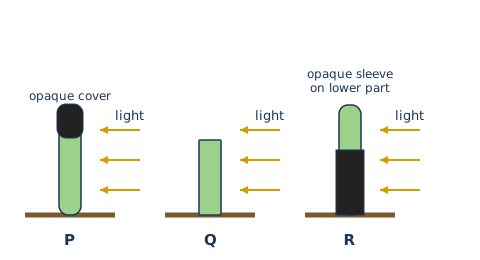
Rajah 3 menunjukkan tiga set eksperimen P, Q dan R pada koleoptil anak benih oat. Set P mempunyai penutup legap pada hujungnya, set Q dipotong hujungnya dan set R mempunyai sarung legap pada bahagian bawahnya manakala hujungnya terdedah. Ketiga-tiga set didedahkan kepada cahaya dari sebelah kanan.Diagram 3 shows three experimental set-ups P, Q and R on oat seedling coleoptiles. Set-up P has an opaque cover over its tip, set-up Q has its tip cut off and set-up R has an opaque sleeve over its lower part with the tip left uncovered. All three set-ups are exposed to light from the right.
[1 mark]
(a)Pilih fitohormon yang dihasilkan di hujung koleoptil.Choose the phytohormone made at the tip of a coleoptile.
Show answerHide answer
Auxin
Auxin is made at the coleoptile tip and diffuses down to the elongation zone.
[2 marks]
(b)Ramalkan pertumbuhan koleoptil P dan terangkan jawapan anda.Predict the growth of coleoptile P and explain your answer.
Show answerHide answer
Tick each point you got.
[2 marks]
(c)Koleoptil Q tidak tumbuh. Terangkan mengapa.Coleoptile Q does not grow. Explain why.
Show answerHide answer
Tick each point you got.
[3 marks]
(d)Ramalkan arah pertumbuhan koleoptil R dan terangkan jawapan anda.Predict the direction of growth of coleoptile R and explain your answer.
Show answerHide answer
Tick each point you got.
[1 mark]
(e)Pilih fitohormon yang merangsang percambahan biji benih dengan mematahkan dorman.Choose the phytohormone that stimulates seed germination by breaking dormancy.
Show answerHide answer
Gibberellin
Gibberellin breaks the dormancy of seeds and stimulates germination; abscisic acid maintains dormancy.
[1 mark]
(f)Nyatakan proses dalam sel yang dirangsang oleh auksin supaya koleoptil memanjang.State the process in the cells that auxin stimulates so that the coleoptile grows longer.
Show answerHide answer
Tick each point you got.
23
Question 23
Jadual 3 menunjukkan urutan bes pada suatu segmen gen normal dan tiga alel mutan P, Q dan R. Urutan dibaca dalam kumpulan tiga bes dari kiri ke kanan.
Table 3 shows the base sequence of a segment of a normal gene and of three mutant alleles P, Q and R. The sequences are read in groups of three bases from left to right.
| Alel | Urutan bes |
|---|---|
| Normal | ATG CCA GTT CAG CGT TAC |
| P | ATG CCA GAT CAG CGT TAC |
| Q | ATG CCA TGT TCA GCG TTA C |
| R | ATG CAG TTC AGC GTT AC |
| Allele | Base sequence |
|---|---|
| Normal | ATG CCA GTT CAG CGT TAC |
| P | ATG CCA GAT CAG CGT TAC |
| Q | ATG CCA TGT TCA GCG TTA C |
| R | ATG CAG TTC AGC GTT AC |
[1 mark]
(a)Pilih jenis mutasi gen bagi alel P.Choose the type of gene mutation in allele P.
Show answerHide answer
Base substitution
One base (T) is replaced by another (A) in the third triplet; the number of bases is unchanged.
[1 mark]
(b)Pilih jenis mutasi gen bagi alel Q.Choose the type of gene mutation in allele Q.
Show answerHide answer
Base insertion
An extra base (T) has been added after the second triplet, so the gene is one base longer.
[1 mark]
(c)Pilih jenis mutasi gen bagi alel R.Choose the type of gene mutation in allele R.
Show answerHide answer
Base deletion
A base (C) has been lost from the second triplet, so the gene is one base shorter.
[1 mark]
(d)Berapakah bilangan kumpulan tiga bes dalam alel P yang berbeza daripada gen normal?How many groups of three bases in allele P are different from the normal gene?
Show answerHide answer
Tick each point you got.
[2 marks]
(e)Alel Q dan R biasanya menyebabkan kesan yang lebih serius daripada alel P. Terangkan mengapa.Alleles Q and R usually have a more serious effect than allele P. Explain why.
Show answerHide answer
Tick each point you got.
[2 marks]
(f)Seorang petani menghidap kanser kulit selepas bertahun-tahun terdedah kepada sinar UV matahari. Adakah anaknya akan mewarisi kanser itu? Terangkan.A farmer develops skin cancer after many years of exposure to ultraviolet rays from the sun. Will his child inherit the cancer? Explain.
Show answerHide answer
Tick each point you got.
[2 marks]
(g)Namakan satu mutagen fizik dan satu mutagen kimia.Name one physical mutagen and one chemical mutagen.
Show answerHide answer
Tick each point you got.
24
Question 24
Cikgu Anis dan murid-muridnya mengkaji populasi pokok semalu (tumbuhan Y) dan katak pokok di padang sekolah yang bersebelahan dengan sebatang parit. Mereka meletakkan lapan kuadrat 1 m × 1 m secara rawak. Bilangan pokok Y dalam setiap kuadrat ialah 4, 0, 6, 2, 0, 3, 5 dan 0.Cikgu Anis and her pupils study the population of a sensitive plant (plant Y) and tree frogs in the school field beside a drain. They place eight quadrats of 1 m × 1 m at random. The numbers of plant Y in the quadrats are 4, 0, 6, 2, 0, 3, 5 and 0.
[2 marks]
(a)Hitung kekerapan tumbuhan Y.Calculate the frequency of plant Y.
Show answerHide answer
Tick each point you got.
[2 marks]
(b)Hitung ketumpatan tumbuhan Y dalam unit bilangan per m2.Calculate the density of plant Y in plants per m2.
Show answerHide answer
Tick each point you got.
[2 marks]
(c)Kebanyakan tumbuhan Y tumbuh di tempat lembap berhampiran parit. Namakan corak taburan populasi ini dan nyatakan puncanya.Most plants of Y grow in damp places near the drain. Name this pattern of population distribution and state its cause.
Show answerHide answer
Tick each point you got.
[2 marks]
(d)Murid-murid menangkap 30 ekor katak pokok, menandakannya dengan cat dan melepaskannya. Seminggu kemudian, 36 ekor katak ditangkap dan 4 ekor daripadanya bertanda. Anggarkan saiz populasi katak.The pupils catch 30 tree frogs, mark them with paint and release them. A week later 36 frogs are caught and 4 of them are marked. Estimate the size of the frog population.
Show answerHide answer
Tick each point you got.
[2 marks]
(e)Cat yang digunakan sangat terang dan banyak katak bertanda dimakan oleh burung bangau sebelum tangkapan kedua. Terangkan kesan terhadap anggaran saiz populasi.The paint is very bright and many marked frogs are eaten by herons before the second catch. Explain the effect on the estimated population size.
Show answerHide answer
Tick each point you got.
Bahagian CSection C
20 marksJawab satu soalan sahaja daripada dua soalan dalam bahagian ini.Answer one question only out of the two questions in this section.
25Choose 1
Question 25
Pak Jusoh mempunyai sebatang pokok jambu batu di kebunnya. Pokok ini mempunyai sistem pengangkutan yang memindahkan air, mineral dan bahan organik ke seluruh bahagiannya.Pak Jusoh has a guava tree in his orchard. The tree has a transport system that carries water, minerals and organic substances to all its parts.
[4 marks]
(a)Bandingkan xilem dengan floem dari segi bahan yang diangkut, arah pengangkutan dan daya yang menggerakkannya.Compare xylem with phloem in terms of the substances transported, the direction of transport and the force that moves them.
Show answerHide answer
Tick each point you got.
[6 marks]
(b)Pada tengah hari yang panas dan berangin, daun pokok jambu batu itu layu, tetapi pulih semula pada waktu petang. Terangkan mengapa.At midday on a hot, windy day the leaves of the guava tree wilt, but they recover in the evening. Explain why.
Show answerHide answer
Tick each point you got.
[3 marks]
(c)Puan Salmah menanggalkan satu gelang kulit kayu, termasuk floem, daripada sebatang dahan pokok jambu batunya. Selepas lima minggu, kulit kayu di atas gelang itu bengkak.Puan Salmah removes a ring of bark, including the phloem, from one branch of her guava tree. After five weeks the bark just above the ring is swollen.
Show answerHide answer
Tick each point you got.
[2 marks]
(d)Seterusnya, jika gelang kulit kayu dibuang pada keseluruhan batang pokok itu, ramalkan apa yang berlaku kepada akar dan terangkan.Next, if a ring of bark is removed all round the whole trunk of the tree, predict what happens to the roots and explain.
Show answerHide answer
Tick each point you got.
[5 marks]
(e)Terangkan bagaimana struktur sel xilem dan sel floem sesuai dengan fungsi masing-masing.Explain how the structure of xylem cells and phloem cells suits their functions.
Show answerHide answer
Tick each point you got.
26Choose 1
Question 26
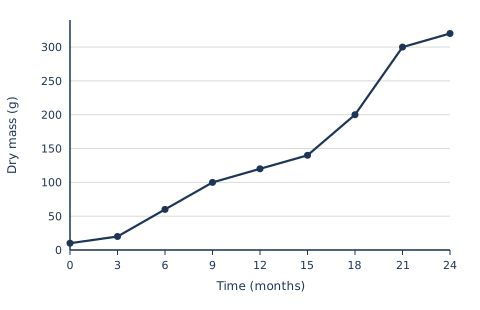
Sebuah koperasi tani menanam lobak merah di tanah tinggi. Seorang murid mengukur jisim kering sebatang pokok lobak merah selama 24 bulan dan menunjukkan keputusannya dalam Rajah 4.A farmers' cooperative grows carrots in the highlands. A pupil measures the dry mass of a carrot plant for 24 months and shows the results in Diagram 4.
[3 marks]
(a)Lobak merah mempunyai kitar hidup biennial. Berdasarkan Rajah 4, nyatakan satu bukti dan hitung pertambahan jisim kering dari bulan ke-15 hingga bulan ke-21.The carrot has a biennial life cycle. Based on Diagram 4, state one piece of evidence for this and calculate the increase in dry mass from month 15 to month 21.
Show answerHide answer
Tick each point you got.
[4 marks]
(b)Terangkan bentuk lengkung dari bulan ke-6 hingga bulan ke-12 dan perubahan yang berlaku pada bulan ke-12 hingga bulan ke-18.Explain the shape of the curve from month 6 to month 12 and the changes that occur from month 12 to month 18.
Show answerHide answer
Tick each point you got.
[5 marks]
(c)Bandingkan pertumbuhan primer dengan pertumbuhan sekunder dalam eudikot.Compare primary growth with secondary growth in eudicots.
Show answerHide answer
Tick each point you got.
[5 marks]
(d)Terangkan bagaimana batang sebatang pokok berkayu bertambah tebal dari tahun ke tahun.Explain how the stem of a woody tree becomes thicker from year to year.
Show answerHide answer
Any 5 points
Tick each point you got.
[3 marks]
(e)Nyatakan tiga kepentingan ekonomi pertumbuhan sekunder.State three economic importances of secondary growth.
Show answerHide answer
Any 3 points
Tick each point you got.
Bahagian DSection D
20 marksJawab satu soalan sahaja daripada dua soalan dalam bahagian ini. Jawapan hendaklah jelas dan berasas.Answer one question only out of the two questions in this section. Your answers must be clear and reasoned.
27Choose 1
Question 27
Sebuah pemaju merancang Bandar Hijau, sebuah perbandaran di atas tanah hutan yang telah dibersihkan, dengan 400 buah rumah. Di sebelah tapak itu terdapat sebuah tanah bencah yang menjadi kawasan tadahan air dan habitat burung. Setiap rumah yang menggunakan elektrik grid melepaskan 1.8 tan karbon dioksida setahun. Panel solar di atas bumbung boleh membekalkan 55% daripada keperluan elektrik setiap rumah.A developer plans Bandar Hijau, a township on cleared forest land, with 400 houses. Next to the site is a wetland that is a water catchment area and a bird habitat. Each house that uses grid electricity releases 1.8 tonnes of carbon dioxide a year. Solar panels on the roof can supply 55% of the electricity needs of each house.
[3 marks]
(a)Terangkan bagaimana pembersihan hutan menyumbang kepada pemanasan global.Explain how clearing the forest contributes to global warming.
Show answerHide answer
Tick each point you got.
[4 marks]
(b)Hitung jumlah karbon dioksida (tan setahun) yang dilepaskan oleh 400 buah rumah (i) jika semuanya menggunakan elektrik grid sahaja, dan (ii) jika semua rumah memasang panel solar. Hitung juga jumlah yang dijimatkan.Calculate the total carbon dioxide (tonnes a year) released by the 400 houses (i) if all use grid electricity only, and (ii) if all the houses install the solar panels. Also calculate the amount saved.
Show answerHide answer
Tick each point you got.
[3 marks]
(c)Nyatakan tiga amalan 5R yang boleh diamalkan oleh penduduk Bandar Hijau dan beri satu contoh bagi setiap amalan.State three of the 5R practices that the residents of Bandar Hijau can follow and give one example of each.
Show answerHide answer
Any 3 points
Tick each point you got.
[4 marks]
(d)Pemaju mencadangkan supaya tanah bencah itu ditambak untuk membina jalan raya. Nilaikan cadangan ini dan beri keputusan anda.The developer proposes to fill in the wetland to build a road. Evaluate this proposal and give your decision.
Show answerHide answer
Tick each point you got.
[6 marks]
(e)Cadangkan satu rancangan teknologi hijau untuk Bandar Hijau dengan memilih tiga daripada empat tonggak Dasar Teknologi Hijau Negara. Beri satu cadangan dan satu justifikasi bagi setiap tonggak yang dipilih.Suggest a green technology plan for Bandar Hijau by choosing three of the four pillars of the National Green Technology Policy. Give one suggestion and one justification for each pillar chosen.
Show answerHide answer
Any 6 points
Tick each point you got.
28Choose 1
Question 28
Selepas banjir, wabak kolera berlaku di tiga buah kampung P, Q dan R yang sama saiz. Penyakit ini disebabkan oleh bakteria Vibrio cholerae yang disebarkan oleh lalat kepada makanan. Di kampung P, penduduk menutup makanan, memasang perangkap lalat dan mengklorinkan air perigi. Di kampung Q, hanya pesakit diberi antibiotik. Kampung R tidak dikenakan sebarang tindakan. Jadual 4 menunjukkan bilangan kes kolera bagi setiap 1 000 penduduk pada minggu pertama dan selepas empat minggu.
After a flood, a cholera outbreak occurs in three villages P, Q and R of the same size. The disease is caused by the bacterium Vibrio cholerae, which flies spread to food. In village P, the residents cover their food, set fly traps and chlorinate the well water. In village Q, only the patients are given antibiotics. Village R receives no action. Table 4 shows the number of cholera cases per 1 000 residents in the first week and after four weeks.
| Kampung | Minggu pertama | Selepas empat minggu |
|---|---|---|
| P (kebersihan dan perangkap) | 40 | 6 |
| Q (antibiotik sahaja) | 38 | 25 |
| R (tiada tindakan) | 42 | 40 |
| Village | First week | After four weeks |
|---|---|---|
| P (hygiene and traps) | 40 | 6 |
| Q (antibiotics only) | 38 | 25 |
| R (no action) | 42 | 40 |
[3 marks]
(a)Namakan patogen dan vektor bagi kolera, dan terangkan bagaimana patogen itu sampai kepada manusia.Name the pathogen and the vector of cholera, and explain how the pathogen reaches humans.
Show answerHide answer
Tick each point you got.
[4 marks]
(b)Hitung peratus penurunan kes kolera dalam kampung P, Q dan R, betul kepada satu tempat perpuluhan. Kemudian nyatakan mengapa kampung R disertakan dalam kajian ini.Calculate the percentage decrease in cholera cases in villages P, Q and R, correct to one decimal place. Then state why village R is included in the study.
Show answerHide answer
Tick each point you got.
[4 marks]
(c)Doktor bimbang bahawa jika antibiotik yang sama digunakan secara berlebihan dan tidak dihabiskan, rawatan akan menjadi kurang berkesan. Terangkan mengapa, dengan menggunakan konsep variasi dan pemilihan semula jadi.A doctor worries that if the same antibiotic is overused and the course is not finished, the treatment will become less effective. Explain why, using the ideas of variation and natural selection.
Show answerHide answer
Tick each point you got.
[4 marks]
(d)Nilaikan kaedah di kampung P berbanding kaedah di kampung Q sebagai cara mengawal kolera.Evaluate the method in village P compared with the method in village Q as a way of controlling cholera.
Show answerHide answer
Any 4 points
Tick each point you got.
[5 marks]
(e)Cadangkan satu pelan bersepadu untuk mencegah kolera berulang di kampung itu. Berikan sebab bagi setiap cadangan.Suggest an integrated plan to prevent cholera from returning to the villages. Give a reason for each suggestion.
Show answerHide answer
Tick each point you got.
Test specification (JSU)
| Chapter | Remembering | Understanding | Applying | Analysing | Evaluating | Creating | Items | marks |
|---|---|---|---|---|---|---|---|---|
| 1. Organisation of Plant Tissues and Growth | 2 (21) | 1 (1) | – | – | – | – | 3 | 22 |
| 2. Leaf Structure and Function | – | 1 (1) | 1 (1) | 1 (1) | – | – | 3 | 3 |
| 3. Nutrition in Plants | – | 1 (10) | 1 (1) | – | – | – | 2 | 11 |
| 4. Transport in Plants | 1 (1) | 1 (20) | – | 1 (1) | – | – | 3 | 22 |
| 5. Response in Plants | 1 (1) | – | 1 (10) | 1 (1) | – | – | 3 | 12 |
| 6. Sexual Reproduction in Flowering Plants | 1 (1) | – | – | – | – | – | 1 | 1 |
| 7. Adaptations of Plants in Different Habitats | 1 (1) | – | – | – | – | – | 1 | 1 |
| 8. Biodiversity | – | – | – | 1 (1) | 1 (20) | – | 2 | 21 |
| 9. Ecosystem | – | 1 (1) | 2 (11) | – | – | – | 3 | 12 |
| 10. Environmental Sustainability | – | 1 (1) | – | – | 1 (20) | – | 2 | 21 |
| 11. Inheritance | – | – | 1 (1) | 1 (1) | – | – | 2 | 2 |
| 12. Variation | – | – | 1 (1) | 1 (10) | – | – | 2 | 11 |
| 13. Genetic Technology | – | 1 (1) | – | – | – | – | 1 | 1 |
| Total | 6 (25) | 7 (35) | 7 (25) | 6 (15) | 2 (40) | 0 (0) | 28 | 140 |
Each cell shows items (marks).