Redox equilibrium
What this chapter covers
- Describe redox reactions as gain or loss of oxygen or hydrogen, transfer of electrons and change in oxidation number (1.1)
- Determine oxidation numbers, name compounds using IUPAC names and write half equations and ionic equations (1.1)
- Explain displacement of metals and halogens as redox reactions (1.1)
- Use standard electrode potentials to identify oxidising and reducing agents and predict reactions (1.2)
- Describe voltaic cells, write cell notation and calculate cell voltage (1.3)
- Describe electrolysis of molten compounds and aqueous solutions, and the factors that decide which ions are discharged (1.4)
- Compare voltaic and electrolytic cells and describe electroplating and purification of metals (1.4)
- Explain extraction of metals by electrolysis and by carbon reduction (1.5)
- Explain rusting as a redox reaction and the ways to prevent it (1.6)
1.1Oxidation and reduction
| Concept | Oxidation | Reduction |
|---|---|---|
| Oxygen | Gains oxygen | Loses oxygen |
| Hydrogen | Loses hydrogen | Gains hydrogen |
| Electrons | Loses electrons | Gains electrons |
| Oxidation number | Increases | Decreases |
Half equations and ionic equations
For electron transfer, write each half equation, balance the charge with electrons, then multiply so the electrons are equal and add them. Cancel the electrons.
Reduction: MnO₄⁻ + 8H⁺ + 5e⁻ → Mn²⁺ + 4H₂O (purple to colourless)
Multiply the first by 5: 5Fe²⁺ + MnO₄⁻ + 8H⁺ → 5Fe³⁺ + Mn²⁺ + 4H₂O
In a U-tube set-up, electrons flow through the wire from the reducing agent (negative terminal) to the oxidising agent (positive terminal). Sulphuric acid is the electrolyte that completes the circuit.
| Common oxidising agents | Common reducing agents |
|---|---|
| Acidified KMnO₄, acidified K₂Cr₂O₇, Cl₂, Br₂, Fe³⁺, H₂O₂ | KI, KBr, Fe²⁺, reactive metals (e.g. Zn), SO₂ |
Oxidation number
| Rule | Example |
|---|---|
| Element = 0 | Na, O₂, S₈, Cl₂ |
| Monoatomic ion = its charge | Al³⁺ = +3, O²⁻ = -2 |
| Compound: sum = 0; polyatomic ion: sum = charge | CO₃²⁻: x + 3(-2) = -2, so C = +4 |
| Hydrogen +1 (metal hydrides -1) | HCl: H = +1; NaH: H = -1 |
| Oxygen -2 (peroxides -1) | MgO: O = -2; H₂O₂: O = -1 |
| Group 1, 2, 13 compounds +1, +2, +3; halogens usually -1 | AlCl₃: Al = +3, Cl = -1 Exception: in KClO, Cl = +1 (halogen bonded to oxygen) |
A roman numeral in an IUPAC name gives the oxidation number of a metal that can have more than one: Fe(NO₃)₂ is iron(II) nitrate, Fe(NO₃)₃ is iron(III) nitrate, KMnO₄ is potassium manganate(VII), MnO₂ is manganese(IV) oxide.
Show answerHide answer
Displacement reactions
A more electropositive metal displaces a less electropositive metal from its salt solution. A more reactive halogen (higher in Group 17) displaces a less reactive halogen from its halide solution.
| Reaction | Observation | Equations |
|---|---|---|
| Zn into Cu(NO₃)₂ | Blue solution paler, brown solid, zinc thinner | Zn → Zn²⁺ + 2e⁻; Cu²⁺ + 2e⁻ → Cu |
| Cl₂ into KBr | Colourless to brown | 2Br⁻ → Br₂ + 2e⁻; Cl₂ + 2e⁻ → 2Cl⁻ |
Halogens are identified in 1,1,1-trichloroethane: chlorine is colourless, bromine is brown and iodine is purple in the organic layer.
Show answerHide answer
1.2Standard electrode potential
- All half-equations are written as reductions: oxidising agent + e⁻ ⇌ reducing agent.
- More positive E°: stronger oxidising agent (the species on the left).
- More negative E°: stronger reducing agent (the species on the right).
| Half-cell | E° / V |
|---|---|
| Mg²⁺ + 2e⁻ ⇌ Mg | -2.38 |
| Zn²⁺ + 2e⁻ ⇌ Zn | -0.76 |
| Fe²⁺ + 2e⁻ ⇌ Fe | -0.44 |
| 2H⁺ + 2e⁻ ⇌ H₂ | 0.00 |
| Cu²⁺ + 2e⁻ ⇌ Cu | +0.34 |
| Ag⁺ + e⁻ ⇌ Ag | +0.80 |
1.3Voltaic cell
A voltaic (galvanic) cell changes chemical energy to electrical energy. The metal with the more negative E° is the negative terminal (anode, oxidation); the other is the positive terminal (cathode, reduction). Electrons flow from negative to positive through the wire. The salt bridge or porous pot completes the circuit by letting ions move.
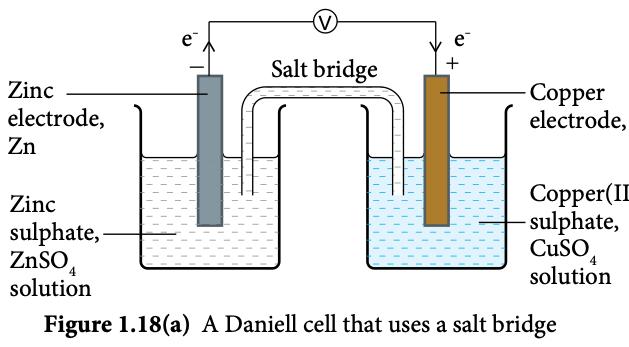
Daniell cell: Chemistry Form 5 (DLP) textbook, Figure 1.18(a), p. 28.
E°cell = E°(cathode) - E°(anode) = (+0.34) - (-0.76) = +1.10 V
Show answerHide answer
1.4Electrolytic cell
Anions go to the anode (oxidation); cations go to the cathode (reduction). Molten PbBr₂: anode 2Br⁻ → Br₂ + 2e⁻ (brown gas); cathode Pb²⁺ + 2e⁻ → Pb (grey solid).
Factors deciding which ion is discharged (aqueous solution)
| Factor | Effect |
|---|---|
| Position in E° series | Cations: more positive E° discharged at cathode. Anions: less positive E° discharged at anode. |
| Concentration | A halide ion at high concentration is discharged at the anode even if its E° is higher (1.0 mol dm⁻³ HCl gives Cl₂; 0.0001 mol dm⁻³ gives O₂) |
| Type of electrode | Active electrode (Cu, Ag) as anode: the metal itself dissolves; no anion is discharged |
Anode: 4OH⁻ → O₂ + 2H₂O + 4e⁻ (colourless gas), because OH⁻ has a less positive E° than SO₄²⁻.
Voltaic cell and electrolytic cell
| Voltaic cell | Electrolytic cell | |
|---|---|---|
| Energy change | Chemical to electrical | Electrical to chemical |
| Electrodes | Two different metals | Usually the same metal or carbon |
| Anode | Negative terminal | Connected to the positive terminal of the battery |
| Cathode | Positive terminal | Connected to the negative terminal of the battery |
Electroplating and purification
- Electroplating: object = cathode, plating metal = anode, electrolyte = solution of the plating metal's ions. Anode: Cu → Cu²⁺ + 2e⁻; cathode: Cu²⁺ + 2e⁻ → Cu. The blue colour stays because ions leave and enter at the same rate.
- Purification: impure metal = anode (it gets thinner, impurities fall below it), pure metal = cathode (it gets thicker).
1.5Extraction of metal from its ore
- Very reactive metals (more reactive than carbon, e.g. Al): electrolysis of the molten ore.
- Moderately reactive metals (e.g. Fe, Zn, Pb): reduction by carbon.
- Unreactive metals such as gold exist as elements.
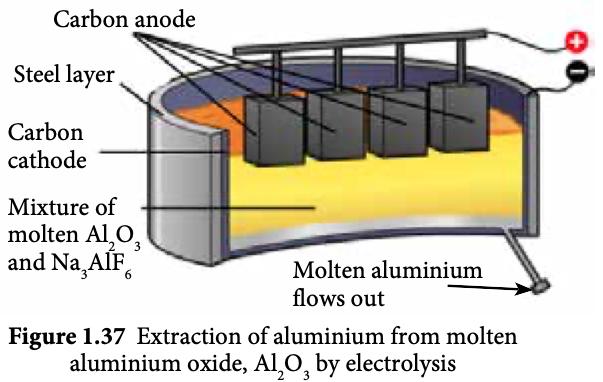
Aluminium cell: Chemistry Form 5 (DLP) textbook, Figure 1.37, p. 49.
Aluminium: molten Al₂O₃ mixed with cryolite, Na₃AlF₆ (lowers the melting point from 2000 °C). Anode: 2O²⁻ → O₂ + 4e⁻. Cathode: Al³⁺ + 3e⁻ → Al. The carbon anode burns in the oxygen, so CO₂ is released.
Iron (blast furnace): C + O₂ → CO₂; CO₂ + C → 2CO; Fe₂O₃ + 3CO → 2Fe + 3CO₂. Limestone decomposes to CaO, which reacts with SiO₂ to form slag, CaSiO₃. Thermite reaction: Fe₂O₃ + 2Al → Al₂O₃ + 2Fe (more reactive metal reduces the oxide).
Show answerHide answer
1.6Rusting
Rusting needs water and oxygen. A tiny cell forms in a water droplet: the iron where oxygen is low is the anode (Fe → Fe²⁺ + 2e⁻); where oxygen is high it is the cathode (O₂ + 2H₂O + 4e⁻ → 4OH⁻). Fe²⁺ + 2OH⁻ → Fe(OH)₂, which is oxidised to brown hydrated iron(III) oxide, Fe₂O₃·xH₂O (rust). Rust is brittle and porous, so rusting continues. Acid or salt speeds it up by making a better electrolyte.
| Metal in contact with iron | Effect | Reason |
|---|---|---|
| Mg, Al, Zn (more electropositive) | Rusting slows down | They corrode instead (sacrificial protection) |
| Sn, Pb, Cu (less electropositive) | Rusting speeds up | Iron releases electrons more easily |
Ways to prevent rusting: protective surface (paint, grease, plastic; galvanising with zinc; tin or chrome plating), sacrificial protection (zinc or magnesium blocks on ship hulls and pipes) and alloying (stainless steel with chromium and nickel).