Practice paper, not an official KPM paper
4541
Peperiksaan Percubaan SPM (Model)SPM Trial Examination (Model)
KimiaChemistry
Tingkatan 5, 2 jam / 2 hours, 100 marks
Nama / Name
Kelas / Class
Tarikh / Date
Markah / Marks: / 100
Instructions
- Kertas soalan ini mengandungi empat bahagian: Bahagian A, Bahagian B, Bahagian C dan Bahagian D.This question paper consists of four sections: Section A, Section B, Section C and Section D.
- Bahagian A: pilih satu jawapan bagi setiap soalan. Bahagian B: jawab semua soalan. Bahagian C: jawab satu soalan sahaja. Bahagian D: soalan mesti dijawab.Section A: choose one answer for each question. Section B: answer all questions. Section C: answer one question only. Section D: this question must be answered.
- Kerja mengira anda mesti ditunjukkan.Your working must be shown.
- Rajah yang mengiringi soalan tidak dilukis mengikut skala kecuali dinyatakan.The diagrams are not drawn to scale unless stated.
- Jawapan boleh ditulis dalam Bahasa Melayu atau Bahasa Inggeris.Answers may be written in Bahasa Melayu or English.
- Jadual Berkala Unsur dan kalkulator saintifik dibenarkan.The Periodic Table and a scientific calculator are allowed.
Answer schemes are in English (DLP).
Practice shows answers as you go. Exam times you and hides answers until you submit.
Bahagian ASection A
20 marksJawab semua soalan. Setiap soalan diikuti oleh empat pilihan jawapan, A, B, C dan D. Pilih satu jawapan sahaja.Answer all questions. Each question is followed by four options, A, B, C and D. Choose one answer only.
1
Question 1
Apakah nombor pengoksidaan klorin dalam kalium klorat(V), KClO₃?What is the oxidation number of chlorine in potassium chlorate(V), KClO₃?
Show answerHide answer
C
K = +1 and O = -2, so (+1) + x + 3(-2) = 0 and x = +5. The roman numeral (V) in the name also gives +5.
2
Question 2
Sebuah sel kimia dibina daripada separuh sel Sn²⁺/Sn (E° = -0.14 V) dan separuh sel Ag⁺/Ag (E° = +0.80 V). Apakah voltan sel dan terminal negatifnya?A voltaic cell is made from a Sn²⁺/Sn half-cell (E° = -0.14 V) and an Ag⁺/Ag half-cell (E° = +0.80 V). What are the cell voltage and the negative terminal?
Show answerHide answer
A
E°cell = (+0.80) - (-0.14) = +0.94 V. Tin has the more negative E°, so it releases electrons and is the negative terminal. +0.66 V comes from adding the signs wrongly.
3
Question 3
Larutan natrium klorida pekat, 1.0 mol dm⁻³, dielektrolisiskan menggunakan elektrod karbon. Apakah hasil di katod dan di anod?Concentrated sodium chloride solution, 1.0 mol dm⁻³, is electrolysed using carbon electrodes. What are the products at the cathode and at the anode?
Show answerHide answer
B
At the cathode H⁺ (higher E° than Na⁺) is discharged to give hydrogen. At the anode the Cl⁻ concentration is high, so chloride is discharged ahead of OH⁻ to give chlorine.
4
Question 4
Jadual 1 menunjukkan nilai E° bagi empat logam, W, X, Y dan Z, serta besi. Dua logam yang manakah, apabila masing-masing dililitkan pada paku besi, akan menyebabkan paku besi berkarat dengan lebih cepat?
Jadual 1Table 1 shows the E° values of four metals, W, X, Y and Z, and of iron. Which two metals, when each is coiled round an iron nail, will make the nail rust faster?
Table 1
| Logam / Metal | Fe | W | X | Y | Z |
|---|---|---|---|---|---|
| E° (V) | -0.44 | -0.76 | -0.14 | +0.34 | -2.38 |
| Metal | Fe | W | X | Y | Z |
|---|---|---|---|---|---|
| E° (V) | -0.44 | -0.76 | -0.14 | +0.34 | -2.38 |
Show answerHide answer
D
Iron rusts faster when it is in contact with a metal that is less electropositive (more positive E°) than iron: X (-0.14 V) and Y (+0.34 V). W and Z are more electropositive and protect the iron by sacrificial protection.
5
Question 5
Antara berikut, yang manakah formula molekul bagi alkuna yang mempunyai empat atom karbon?Which of the following is the molecular formula of the alkyne with four carbon atoms?
Show answerHide answer
A
Alkynes have the general formula CₙH₂ₙ₋₂. For n = 4, the formula is C₄H₆ (butyne). C₄H₈ is an alkene and C₄H₁₀ an alkane.
6
Question 6
Apakah nama IUPAC bagi sebatian dengan formula struktur CH₃CH(CH₃)CH₂CH₂OH?What is the IUPAC name of the compound with the structural formula CH₃CH(CH₃)CH₂CH₂OH?
Show answerHide answer
B
The longest chain containing -OH has 4 carbons (butanol). Number from the end nearest -OH, so OH is on C1 and the methyl branch is on C3: 3-methylbutan-1-ol. Numbering from the other end would give OH the number 4, which breaks the rule.
7
Question 7
Ester butil metanoat boleh disediakan melalui tindak balas antara pasangan bahan yang manakah?Which pair of substances reacts to form the ester butyl methanoate?
Show answerHide answer
D
The first part of an ester name comes from the alcohol (butyl from butanol) and the second part from the acid (methanoate from methanoic acid). Butanoic acid with methanol would give methyl butanoate.
8
Question 8
0.01 mol suatu alkena menghasilkan 1.32 g karbon dioksida apabila terbakar lengkap dalam oksigen berlebihan. Apakah alkena itu? [Jisim atom relatif: C = 12, O = 16]0.01 mol of an alkene produces 1.32 g of carbon dioxide when it burns completely in excess oxygen. What is the alkene? [Relative atomic mass: C = 12, O = 16]
Show answerHide answer
C
Moles of CO₂ = 1.32 ÷ 44 = 0.03 mol. 0.01 mol of alkene gives 0.03 mol CO₂, so each molecule contains 3 carbon atoms: C₃H₆, propene.
9
Question 9
Rajah 1 menunjukkan gambar rajah aras tenaga bagi penguraian ammonia. Pernyataan yang manakah betul?Diagram 1 shows the energy level diagram for the decomposition of ammonia. Which statement is correct?
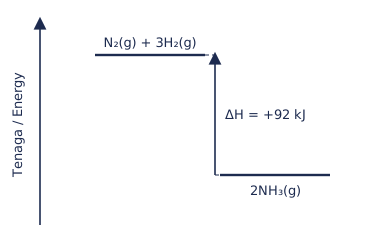
Show answerHide answer
C
The products are on the higher level and ΔH is positive, so the reaction is endothermic: heat is absorbed from the surroundings and the temperature falls. A, B and D describe an exothermic reaction.
10
Question 10
Persamaan bagi pembentukan ammonia ialah N₂ + 3H₂ → 2NH₃. Tenaga ikatan: N≡N = 945, H–H = 436, N–H = 391 kJ mol⁻¹. Hitung perubahan haba bagi tindak balas ini sebagaimana yang ditulis.The equation for the formation of ammonia is N₂ + 3H₂ → 2NH₃. Bond energies: N≡N = 945, H–H = 436, N–H = 391 kJ mol⁻¹. Calculate the heat change for the reaction as written.
Show answerHide answer
A
Bonds broken: 945 + 3(436) = 2 253 kJ. Bonds formed: 6 N–H = 6 × 391 = 2 346 kJ. ΔH = 2 253 - 2 346 = -93 kJ (exothermic). +4 599 is the two totals added.
11
Question 11
40 cm³ asid hidroklorik 1.0 mol dm⁻³ dicampurkan dengan 60 cm³ larutan natrium hidroksida 1.0 mol dm⁻³ dalam cawan polistirena. Suhu campuran naik sebanyak 5.0 °C. Apakah haba peneutralan? [Muatan haba tentu larutan = 4.2 J g⁻¹ °C⁻¹; ketumpatan larutan = 1 g cm⁻³]40 cm³ of 1.0 mol dm⁻³ hydrochloric acid is mixed with 60 cm³ of 1.0 mol dm⁻³ sodium hydroxide solution in a polystyrene cup. The temperature of the mixture rises by 5.0 °C. What is the heat of neutralisation? [Specific heat capacity of the solution = 4.2 J g⁻¹ °C⁻¹; density of the solution = 1 g cm⁻³]
Show answerHide answer
D
Q = 100 × 4.2 × 5.0 = 2 100 J = 2.1 kJ. HCl is the limiting reactant: n = 1.0 × 40/1000 = 0.04 mol, so 0.04 mol of water forms. ΔH = -2.1 ÷ 0.04 = -52.5 kJ mol⁻¹. Using 0.1 mol gives -21.0 and 0.06 mol gives -35.0.
12
Question 12
Jadual 2 menunjukkan haba pembakaran dan jisim molar bagi empat bahan api, P, Q, R dan S. Bahan api yang manakah mempunyai nilai bahan api yang paling tinggi?
Jadual 2Table 2 shows the heat of combustion and molar mass of four fuels, P, Q, R and S. Which fuel has the highest fuel value?
Table 2
| Bahan api | P | Q | R | S |
|---|---|---|---|---|
| Haba pembakaran (kJ mol⁻¹) | -1 560 | -890 | -2 220 | -3 509 |
| Jisim molar (g mol⁻¹) | 30 | 16 | 44 | 72 |
| Fuel | P | Q | R | S |
|---|---|---|---|---|
| Heat of combustion (kJ mol⁻¹) | -1 560 | -890 | -2 220 | -3 509 |
| Molar mass (g mol⁻¹) | 30 | 16 | 44 | 72 |
Show answerHide answer
B
Fuel value = heat of combustion ÷ molar mass: P = 52.0, Q = 55.6, R = 50.5, S = 48.7 kJ g⁻¹. Q has the highest fuel value even though its heat of combustion per mole is the smallest.
13
Question 13
Antara berikut, yang manakah ialah aplikasi tindak balas endotermik dalam kehidupan harian?Which of the following is an application of an endothermic reaction in daily life?
Show answerHide answer
C
A cold pack absorbs heat from the injured part (endothermic) so it feels cold. A, B and D release heat (exothermic).
14
Question 14
Pasangan polimer asli dan monomernya yang manakah betul?Which pair of natural polymer and its monomer is correct?
Show answerHide answer
A
Protein is made of amino acids. Starch and cellulose are made of glucose, and natural rubber is made of isoprene.
15
Question 15
Pasangan monomer yang manakah bertindak balas untuk menghasilkan Terilena (poliester)?Which pair of monomers reacts to form Terylene (polyester)?
Show answerHide answer
B
Terylene is formed by condensation polymerisation of 1,2-ethanediol and terephthalic acid, with water as the by-product. Option A forms nylon, and C is addition polymerisation.
16
Question 16
Beberapa titik asid metanoik ditambahkan kepada lateks segar. Pernyataan yang manakah menerangkan mengapa lateks itu menggumpal?A few drops of methanoic acid are added to fresh latex. Which statement explains why the latex coagulates?
Show answerHide answer
D
The protein membranes are negatively charged and keep the particles apart. H⁺ ions from the acid neutralise the charge, the membranes break and the rubber particles join together. OH⁻ (from ammonia) would keep latex liquid.
17
Question 17
Jadual 3 menunjukkan keputusan ujian ke atas dua sampel getah, X dan Y, yang sama saiz. Pernyataan yang manakah menerangkan keputusan itu?
Jadual 3Table 3 shows the results of tests on two rubber samples, X and Y, of the same size. Which statement explains the results?
Table 3
| Ujian | X | Y |
|---|---|---|
| Pertambahan panjang di bawah beban 500 g (cm) | 12.0 | 6.0 |
| Suhu apabila melembut (°C) | 60 | 120 |
| Air bromin (masa untuk luntur warna) | 5 minit | 25 minit |
| Test | X | Y |
|---|---|---|
| Extension under a 500 g load (cm) | 12.0 | 6.0 |
| Temperature at which it softens (°C) | 60 | 120 |
| Bromine water (time to decolourise) | 5 minutes | 25 minutes |
Show answerHide answer
B
Y stretches less, softens at a higher temperature and reacts slowly with bromine water: all signs of vulcanised rubber, whose sulphur cross-links hold the chains and remove some C=C bonds. X is the unvulcanised rubber.
18
Question 18
Natrium benzoat ditambahkan ke dalam sos cili dalam botol. Apakah fungsi natrium benzoat?Sodium benzoate is added to bottled chilli sauce. What is the function of sodium benzoate?
Show answerHide answer
A
Sodium benzoate is a preservative: it prevents or delays the growth of bacteria and fungi. B is the function of an antioxidant, C of a dye and D of a thickener.
19
Question 19
Sabun tidak berkesan apabila digunakan untuk membasuh pakaian dalam air sungai yang berasid. Apakah sebabnya?Soap is not effective when used to wash clothes in acidic river water. What is the reason?
Show answerHide answer
C
In acidic water the soap anion RCOO⁻ combines with H⁺ to form the fatty acid RCOOH, which is insoluble, so there are no anions left to remove grease. Scum (A) forms in hard water, not acidic water.
20
Question 20
Skrin sentuh yang boleh dilenturkan dihasilkan menggunakan grafin. Antara sifat grafin berikut, yang manakah menjadikannya sesuai untuk kegunaan ini?A bendable touch screen is made using graphene. Which property of graphene makes it suitable for this use?
Show answerHide answer
D
Graphene is a single sheet of carbon atoms that is transparent, strong, elastic and conducts electricity well. It burns at a lower (not higher) temperature than graphite and is an element, not a compound.
Bahagian BSection B
40 marksJawab semua soalan dalam bahagian ini.Answer all questions in this section.
21
Question 21
Serbuk zink berlebihan ditambahkan ke dalam 50 cm³ larutan kuprum(II) sulfat 0.20 mol dm⁻³ dalam cawan polistirena. Suhu naik daripada 29.0 °C kepada 39.0 °C. Rajah 2 menunjukkan gambar rajah aras tenaga bagi tindak balas ini. [Muatan haba tentu larutan = 4.2 J g⁻¹ °C⁻¹; ketumpatan larutan = 1 g cm⁻³]Excess zinc powder is added to 50 cm³ of 0.20 mol dm⁻³ copper(II) sulphate solution in a polystyrene cup. The temperature rises from 29.0 °C to 39.0 °C. Diagram 2 shows the energy level diagram for this reaction. [Specific heat capacity of the solution = 4.2 J g⁻¹ °C⁻¹; density of the solution = 1 g cm⁻³]
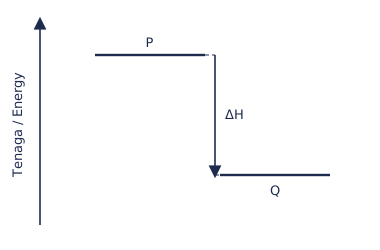
[1 mark]
(a)Apakah yang dimaksudkan dengan haba penyesaran?What is meant by heat of displacement?
Show answerHide answer
Tick each point you got.
[1 mark]
(b)Mengapakah serbuk zink digunakan secara berlebihan?Why is the zinc powder used in excess?
Show answerHide answer
Tick each point you got.
[1 mark]
(c)Hitung bilangan mol kuprum yang disesarkan.Calculate the number of moles of copper displaced.
Show answerHide answer
Tick each point you got.
[1 mark]
(d)Hitung haba yang dibebaskan dalam eksperimen ini.Calculate the heat released in this experiment.
Show answerHide answer
Tick each point you got.
[2 marks]
(e)Hitung haba penyesaran kuprum oleh zink. Tulis nilainya dengan tanda dan unit.Calculate the heat of displacement of copper by zinc. Write the value with its sign and unit.
Show answerHide answer
Tick each point you got.
[1 mark]
(f)Dalam Rajah 2, Zn(s) + Cu²⁺(aq) berada pada aras __________.In Diagram 2, Zn(s) + Cu²⁺(aq) is at level __________.
Show answerHide answer
P
The reaction is exothermic, so the reactants are on the higher level P and the products on the lower level Q.
[1 mark]
(g)Nilai haba penyesaran yang diperoleh daripada eksperimen ini biasanya lebih kecil daripada nilai teori. Berikan satu sebab.The heat of displacement found in this experiment is usually smaller than the theoretical value. Give one reason.
Show answerHide answer
Tick each point you got.
[2 marks]
(h)Eksperimen diulang menggunakan 50 cm³ larutan kuprum(II) sulfat 0.40 mol dm⁻³ dengan serbuk zink berlebihan. Ramalkan kenaikan suhu.The experiment is repeated using 50 cm³ of 0.40 mol dm⁻³ copper(II) sulphate solution with excess zinc powder. Predict the temperature rise.
Show answerHide answer
Twice the moles give twice the heat in the same volume, so the rise doubles from 10.0 °C to 20.0 °C.
Tick each point you got.
22
Question 22
Pak Samad menoreh pokok getah di dusunnya di Kedah. Latek yang dikutip ditambah sedikit larutan ammonia sebelum dibawa pulang. Latek itu kemudiannya digumpalkan untuk menghasilkan lembaran getah.Pak Samad taps rubber trees on his smallholding in Kedah. The latex he collects is mixed with a little ammonia solution before it is taken home. The latex is then coagulated to make rubber sheets.
[1 mark]
(a)Namakan monomer bagi getah asli.Name the monomer of natural rubber.
Show answerHide answer
Tick each point you got.
[1 mark]
(b)Mengapakah ammonia ditambahkan kepada latek yang dikutip?Why is ammonia added to the collected latex?
Show answerHide answer
Tick each point you got.
[2 marks]
(c)Terangkan bagaimana asid metanoik menyebabkan latek menggumpal.Explain how methanoic acid makes latex coagulate.
Show answerHide answer
Tick each point you got.
[1 mark]
(d)Pemvulkanan getah dilakukan dengan sulfur. Apakah yang dimaksudkan dengan pemvulkanan?Rubber is vulcanised using sulphur. What is meant by vulcanisation?
Show answerHide answer
Tick each point you got.
[2 marks]
(e)Nyatakan dua perbezaan sifat antara getah tervulkan dengan getah tak tervulkan.State two differences in property between vulcanised and unvulcanised rubber.
Show answerHide answer
Tick each point you got.
[1 mark]
(f)Tayar kereta diperbuat daripada getah stirena-butadiena (SBR) dan bukannya getah asli. Berikan satu sebab.Car tyres are made from styrene-butadiene rubber (SBR) instead of natural rubber. Give one reason.
Show answerHide answer
Any 1 points
Tick each point you got.
[1 mark]
(g)Nyatakan satu kesan buruk pembuangan tayar terpakai kepada alam sekitar.State one harmful effect of dumping used tyres on the environment.
Show answerHide answer
Any 1 points
Tick each point you got.
23
Question 23
Rajah 3 menunjukkan carta alir tindak balas bagi sebatian P, butan-1-ol, C₄H₉OH.Diagram 3 shows a reaction flow chart for compound P, butan-1-ol, C₄H₉OH.
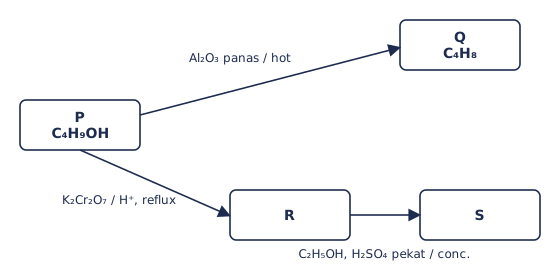
[1 mark]
(a)Namakan sebatian Q.Name compound Q.
Show answerHide answer
Tick each point you got.
[1 mark]
(b)Nyatakan perubahan warna larutan kalium dikromat(VI) berasid apabila P bertukar kepada R.State the colour change of the acidified potassium dichromate(VI) solution when P changes to R.
Show answerHide answer
Tick each point you got.
[1 mark]
(c)Namakan sebatian R.Name compound R.
Show answerHide answer
Tick each point you got.
[2 marks]
(d)Namakan S dan nyatakan satu sifat fizikalnya.Name S and state one physical property of it.
Show answerHide answer
Tick each point you got.
[1 mark]
(e)Tulis persamaan kimia bagi tindak balas P kepada Q.Write the chemical equation for the reaction of P to Q.
Show answerHide answer
Tick each point you got.
[2 marks]
(f)Huraikan satu ujian kimia untuk membezakan Q daripada butana.Describe one chemical test to distinguish Q from butane.
Show answerHide answer
Tick each point you got.
24
Question 24
Sebuah sel kimia disediakan menggunakan plumbum dalam larutan plumbum(II) nitrat dan kuprum dalam larutan kuprum(II) sulfat, dihubungkan oleh titian garam. E°: Pb²⁺/Pb = -0.13 V; Cu²⁺/Cu = +0.34 V.A voltaic cell is set up using lead in lead(II) nitrate solution and copper in copper(II) sulphate solution, joined by a salt bridge. E°: Pb²⁺/Pb = -0.13 V; Cu²⁺/Cu = +0.34 V.
[1 mark]
(a)Nyatakan terminal negatif sel itu.State the negative terminal of the cell.
Show answerHide answer
Tick each point you got.
[1 mark]
(b)Tulis setengah persamaan di terminal positif.Write the half equation at the positive terminal.
Show answerHide answer
Tick each point you got.
[1 mark]
(c)Hitung voltan sel.Calculate the cell voltage.
Show answerHide answer
Tick each point you got.
[1 mark]
(d)Nyatakan fungsi titian garam.State the function of the salt bridge.
Show answerHide answer
Tick each point you got.
[1 mark]
(e)Nyatakan satu pemerhatian pada elektrod kuprum.State one observation at the copper electrode.
Show answerHide answer
Tick each point you got.
[2 marks]
(f)Plumbum digantikan dengan zink (E° = -0.76 V). Apakah yang berlaku kepada voltan sel? Beri satu sebab.The lead is replaced with zinc (E° = -0.76 V). What happens to the cell voltage? Give a reason.
Show answerHide answer
Tick each point you got.
25
Question 25
Label pada sebungkus keropok ikan menyenaraikan: tepung, ikan, gula, natrium benzoat, monosodium glutamat (MSG) dan tartrazina.The label on a packet of fish crackers lists: flour, fish, sugar, sodium benzoate, monosodium glutamate (MSG) and tartrazine.
[1 mark]
(a)Nyatakan jenis bahan tambah makanan bagi MSG.State the type of food additive that MSG is.
Show answerHide answer
Tick each point you got.
[1 mark]
(b)Tartrazina ialah sebatian azo. Nyatakan fungsinya.Tartrazine is an azo compound. State its function.
Show answerHide answer
Tick each point you got.
[1 mark]
(c)Nyatakan satu kesan buruk pengambilan bahan tambah makanan secara berlebihan.State one harmful effect of taking food additives in excess.
Show answerHide answer
Tick each point you got.
[2 marks]
(d)Aini diberi antibiotik selama 7 hari oleh doktor. Dia berhenti mengambilnya pada hari ketiga kerana berasa sihat. Terangkan akibatnya.Aini is prescribed an antibiotic for 7 days by a doctor. She stops taking it on the third day because she feels well. Explain the consequence.
Show answerHide answer
A full antibiotic course must be completed so that all the bacteria are killed.
Tick each point you got.
[1 mark]
(e)Nyatakan satu langkah berjaga-jaga apabila membeli kosmetik.State one precaution to take when buying a cosmetic product.
Show answerHide answer
Tick each point you got.
Bahagian CSection C
20 marksJawab satu soalan sahaja.Answer one question only.
26Choose 1
Question 26
Syarikat peralatan perkhemahan memilih bahan api untuk dapur mudah alih yang digunakan oleh pendaki gunung. Jadual 4 menunjukkan data bagi dua bahan api.
Jadual 4A camping equipment company is choosing the fuel for a portable stove used by mountain climbers. Table 4 shows data for two fuels.
Table 4
| Bahan api | Haba pembakaran (kJ mol⁻¹) | Jisim molar (g mol⁻¹) |
|---|---|---|
| Butana, C₄H₁₀ | -2 877 | 58 |
| Metanol, CH₃OH | -726 | 32 |
| Fuel | Heat of combustion (kJ mol⁻¹) | Molar mass (g mol⁻¹) |
|---|---|---|
| Butane, C₄H₁₀ | -2 877 | 58 |
| Methanol, CH₃OH | -726 | 32 |
[4 marks]
(a)Bandingkan tindak balas eksotermik dengan tindak balas endotermik berdasarkan (i) perubahan suhu persekitaran dan (ii) tanda ΔH. Berikan satu contoh bagi setiap jenis tindak balas.Compare exothermic and endothermic reactions in terms of (i) the temperature change of the surroundings and (ii) the sign of ΔH. Give one example of each type of reaction.
Show answerHide answer
Tick each point you got.
[6 marks]
(b)Etena bertindak balas dengan hidrogen untuk membentuk etana: C₂H₄ + H₂ → C₂H₆. Tenaga ikatan: C=C = 614, H–H = 436, C–C = 348, C–H = 413 kJ mol⁻¹. (i) Hitung jumlah haba yang diserap untuk memecahkan ikatan dalam bahan tindak balas. (ii) Hitung jumlah haba yang dibebaskan apabila ikatan baharu terbentuk. (iii) Hitung ΔH dan nyatakan sama ada tindak balas itu eksotermik atau endotermik. (iv) Terangkan mengapa ΔH bernilai negatif dengan merujuk kepada tenaga ikatan.Ethene reacts with hydrogen to form ethane: C₂H₄ + H₂ → C₂H₆. Bond energies: C=C = 614, H–H = 436, C–C = 348, C–H = 413 kJ mol⁻¹. (i) Calculate the total heat absorbed to break the bonds in the reactants. (ii) Calculate the total heat released when the new bonds form. (iii) Calculate ΔH and state whether the reaction is exothermic or endothermic. (iv) Explain why ΔH is negative in terms of bond energy.
Show answerHide answer
Tick each point you got.
[10 marks]
(c)(i) Hitung nilai bahan api bagi butana dan metanol. (ii) Hitung jisim butana yang diperlukan untuk memanaskan 500 g air sebanyak 40 °C. [Muatan haba tentu air = 4.2 J g⁻¹ °C⁻¹; anggap semua haba diserap oleh air] (iii) Pada pendapat anda, bahan api yang manakah lebih sesuai untuk pendaki gunung? Wajarkan jawapan anda dengan dua sebab. (iv) Nyatakan satu kelemahan membakar bahan api fosil dan cadangkan satu cara untuk mengurangkan kesannya.(i) Calculate the fuel value of butane and of methanol. (ii) Calculate the mass of butane needed to heat 500 g of water by 40 °C. [Specific heat capacity of water = 4.2 J g⁻¹ °C⁻¹; assume all the heat is absorbed by the water] (iii) In your opinion, which fuel is more suitable for the mountain climbers? Justify your answer with two reasons. (iv) State one disadvantage of burning fossil fuels and suggest one way to reduce its effect.
Show answerHide answer
Tick each point you got.
27Choose 1
Question 27
Polimer digunakan secara meluas dalam kehidupan harian, tetapi pelupusan sisa polimer menimbulkan masalah alam sekitar.Polymers are used widely in daily life, but the disposal of polymer waste causes environmental problems.
[6 marks]
(a)Bandingkan pempolimeran penambahan dengan pempolimeran kondensasi berdasarkan (i) jenis monomer dan (ii) hasil yang terbentuk. Berikan satu contoh polimer bagi setiap jenis.Compare addition polymerisation and condensation polymerisation in terms of (i) the type of monomers and (ii) the products formed. Give one example of a polymer for each type.
Show answerHide answer
Tick each point you got.
[6 marks]
(b)Dua jalur getah yang sama saiz, X dan Y, mempunyai panjang asal 5.0 cm. Salah satu daripadanya ialah getah tervulkan. Apabila beban 200 g digantung, panjang X menjadi 9.2 cm dan panjang Y menjadi 6.8 cm. Selepas beban dialihkan, panjang X ialah 6.0 cm dan panjang Y ialah 5.1 cm. (i) Hitung pertambahan panjang X dan Y. (ii) Kenal pasti jalur getah tervulkan. (iii) Terangkan jawapan anda dalam (ii) berdasarkan struktur getah itu. (iv) Nyatakan pemboleh ubah dimanipulasikan dalam eksperimen ini.Two rubber strips of the same size, X and Y, each have an original length of 5.0 cm. One of them is vulcanised rubber. When a 200 g load is hung on them, the length of X becomes 9.2 cm and the length of Y becomes 6.8 cm. After the load is removed, the length of X is 6.0 cm and the length of Y is 5.1 cm. (i) Calculate the extension of X and of Y. (ii) Identify the vulcanised rubber strip. (iii) Explain your answer in (ii) in terms of the structure of the rubber. (iv) State the manipulated variable in this experiment.
Show answerHide answer
Tick each point you got.
[8 marks]
(c)(i) Sarung tangan perubatan sekali guna dibuat daripada getah nitril dan bukannya getah asli untuk sesetengah pesakit. Cadangkan satu sebab. (ii) Sebuah bandar menjana banyak sisa plastik yang dibuang ke tapak pelupusan. Huraikan tiga langkah untuk mengurangkan pencemaran plastik itu dan wajarkan setiap langkah.(i) Single-use medical gloves are made from nitrile rubber instead of natural rubber for some patients. Suggest one reason. (ii) A town produces a lot of plastic waste that is dumped in landfills. Describe three steps to reduce the plastic pollution and justify each step.
Show answerHide answer
(i) 2 marks; (ii) any 3 steps, 2 marks each (step 1 mark, justification 1 mark). Total 8 marks.
Tick each point you got.
Bahagian DSection D
20 marksSoalan ini mesti dijawab.This question must be answered.
28
Question 28
Seorang murid menyediakan ester dalam makmal. Dia memanaskan 4.4 g pentan-1-ol, C₅H₁₁OH, dengan asid etanoik berlebihan dan beberapa titis asid sulfurik pekat dalam tabung didih yang direndam dalam kukus air, seperti dalam Rajah 4. Selepas pemanasan, campuran itu dituang ke dalam air dan lapisan ester dipisahkan. Jisim ester yang diperoleh ialah 4.55 g. [Jisim atom relatif: H = 1, C = 12, O = 16]A pupil prepares an ester in the laboratory. She heats 4.4 g of pentan-1-ol, C₅H₁₁OH, with excess ethanoic acid and a few drops of concentrated sulphuric acid in a boiling tube placed in a water bath, as shown in Diagram 4. After heating, the mixture is poured into water and the layer of ester is separated. The mass of ester obtained is 4.55 g. [Relative atomic mass: H = 1, C = 12, O = 16]
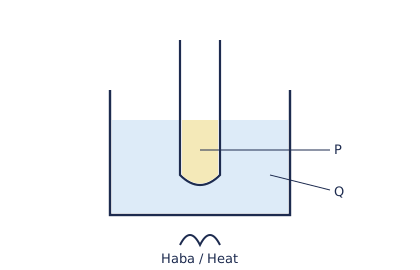
[2 marks]
(a)(i) Namakan jenis tindak balas ini. (ii) Nyatakan fungsi asid sulfurik pekat.(i) Name the type of this reaction. (ii) State the function of the concentrated sulphuric acid.
Show answerHide answer
Tick each point you got.
[2 marks]
(b)Tulis persamaan kimia bagi tindak balas ini menggunakan formula molekul atau formula struktur ringkas.Write the chemical equation for this reaction using molecular or condensed structural formulae.
Show answerHide answer
Tick each point you got.
[3 marks]
(c)Namakan ester yang terbentuk dan nyatakan dua sifat fizikalnya.Name the ester formed and state two of its physical properties.
Show answerHide answer
Tick each point you got.
[5 marks]
(d)Hitung (i) bilangan mol pentan-1-ol yang digunakan, (ii) jisim teori ester yang boleh terbentuk, dan (iii) peratus hasil ester itu.Calculate (i) the number of moles of pentan-1-ol used, (ii) the theoretical mass of ester that can be formed, and (iii) the percentage yield of the ester.
Show answerHide answer
Tick each point you got.
[2 marks]
(e)Mengapakah ester itu terapung di atas air apabila campuran dituang ke dalam air?Why does the ester float on top of the water when the mixture is poured into water?
Show answerHide answer
Tick each point you got.
[3 marks]
(f)Huraikan satu ujian kimia untuk membezakan asid etanoik daripada ester yang terbentuk.Describe one chemical test to distinguish ethanoic acid from the ester formed.
Show answerHide answer
Tick each point you got.
[3 marks]
(g)Seorang murid lain mencadangkan memanaskan campuran itu terus di atas api Bunsen tanpa kukus air. Nilai cadangan itu dan berikan pendapat anda.Another pupil suggests heating the mixture directly over a Bunsen flame without a water bath. Evaluate this suggestion and give your opinion.
Show answerHide answer
Tick each point you got.
Test specification (JSU)
| Chapter | Remembering | Understanding | Applying | Analysing | Evaluating | Creating | Items | marks |
|---|---|---|---|---|---|---|---|---|
| 1. Redox equilibrium | 1 (1) | – | 3 (9) | 1 (1) | – | – | 5 | 11 |
| 2. Carbon compound | 1 (1) | 1 (1) | 2 (9) | 1 (1) | 1 (20) | – | 6 | 32 |
| 3. Thermochemistry | – | 2 (2) | 3 (12) | 1 (1) | 1 (20) | – | 7 | 35 |
| 4. Polymer | 2 (2) | 2 (10) | – | 1 (1) | 1 (20) | – | 6 | 33 |
| 5. Consumer and industrial chemistry | – | 4 (9) | – | – | – | – | 4 | 9 |
| Total | 4 (4) | 9 (22) | 8 (30) | 4 (4) | 3 (60) | 0 (0) | 28 | 120 |
Each cell shows items (marks).