Mathematics notes, chapter 1
Variation
Textbook Mathematics Form 5 (DLP), pages 1–33
What this chapter covers
- Explain direct variation, determine the relation between two variables, write y ∝ xⁿ and y = kxⁿ, and solve problems (1.1)
- Determine the relation between three or more variables for a joint variation and solve problems (1.1)
- Explain inverse variation, determine y ∝ 1/xⁿ and y = k/xⁿ from tables, graphs and values, and solve problems (1.2)
- Express a combined variation (direct and inverse together) as a relation and an equation, and solve problems (1.3)
1.1Direct variation
Direct variation: when one quantity increases, the other increases at the same rate, and when one decreases, the other decreases at the same rate. We say y varies directly as x and write y ∝ x.
Everyday examples: the fare for a taxi ride and the distance travelled, or the wage of a part-time worker and the hours worked. If the hours are doubled, the wage is doubled. If the hours fall by 40%, the wage falls by 40%.
The constant of proportionality
When y varies directly as x, the ratio y/x never changes. This fixed number is the constant of proportionality, k.
| Form | Written as |
|---|---|
| Variation relation | y ∝ xn |
| Equation | y = kxn |
| Constant | k = y ÷ xn |
| Graph | y against xn is a straight line through the origin, with gradient k |
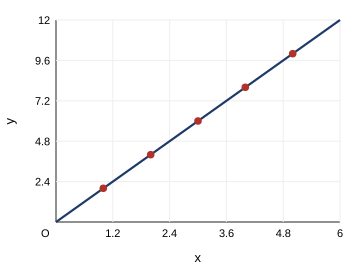
The power n can be 1, 2, 3, ½ or ⅓. "y varies directly as the square root of x" is y ∝ √x, which gives y = k√x. A graph of y against x is a straight line through O only when n = 1; for y ∝ x² draw y against x².
A straight line that does not pass through the origin is not a direct variation. For example y = 3x + 1 is a straight line, but y/x is not constant.
Testing for direct variation
Example (textbook p. 6): does y vary as t or t²?
t: 2, 4, 6, 8; y: 14, 28, 42, 56.y/t = 7, 7, 7, 7 (constant). y/t² = 3.5, 1.75, 1.17, 0.88 (not constant).
So y ∝ t.
Finding the equation and unknown values
- Write the relation, for example m ∝ √n.
- Write the equation with k: m = k√n.
- Substitute the given pair of values to find k.
- Write the equation with the value of k, then substitute to find what is asked.
Example (textbook p. 8): extension of a spring
The extension x cm of a spring varies directly as the load w g. When w = 200, x = 3.x = kw, so 3 = k(200) and k = 0.015. Hence x = 0.015w.
Example: y ∝ x²
y = 18 when x = 3. Find y when x = 5.y = kx², 18 = k(9), k = 2. So y = 2x².
When x = 5: y = 2(25) = 50.
Alternative method using proportion: y₁/x₁n = y₂/x₂n. For y ∝ x² this gives 18/3² = y₂/5², so y₂ = 2 × 25 = 50.
y varies directly as the square root of x. y = 12 when x = 16. Find y when x = 49.
Show answerHide answer
y = k√x, 12 = k(4), k = 3.
y = 3√49 = 3 × 7 = 21
y = 3√49 = 3 × 7 = 21
Joint variation
Joint variation is a direct variation in which one quantity varies as the product of two or more quantities. "y varies jointly as x and z" is y ∝ xz, and y = kxz.
Simple interest I = Prt is a joint variation: I varies jointly as P, r and t. In general y ∝ xmzn, so y = kxmzn.
| Statement | Relation | Equation |
|---|---|---|
| p varies jointly as q and r | p ∝ qr | p = kqr |
| y varies jointly as the square of w and the cube of x | y ∝ w²x³ | y = kw²x³ |
| Volume of a prism V and area A and height h | V ∝ Ah | V = kAh |
Example (textbook p. 12): x ∝ y²z
x = 6 when y = 3 and z = 5.6 = k(3²)(5) = 45k, so k = 2/15.
x = (2/15) y²z
Square only the variable that carries the power. In y ∝ w²x, only w is squared. Do not square the product.
A varies jointly as x and y. A = 14 when x = 7 and y = 4. If x rises by 20% and y falls by 10%, what is the percentage change in A?
Show answerHide answer
A = kxy, so A = 0.5xy.
New A = 0.5(1.2x)(0.9y) = 1.08 × 0.5xy.
A increases by 8%.
New A = 0.5(1.2x)(0.9y) = 1.08 × 0.5xy.
A increases by 8%.
1.2Inverse variation
Inverse variation: when one quantity increases, the other decreases at the same rate, and vice versa. We say y varies inversely as x and write y ∝ 1/x.
Examples: the more doors open in a hall, the less time it takes to empty; the more workers, the fewer days needed. If the number of workers is doubled, the days are halved.
| Form | Written as |
|---|---|
| Variation relation | y ∝ 1/xn |
| Equation | y = k/xn |
| Constant | k = xny (the product stays the same) |
| Graphs | y against x is a curve (hyperbola). y against 1/xn is a straight line through the origin |
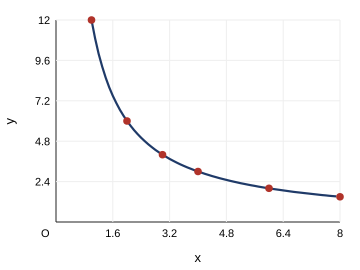
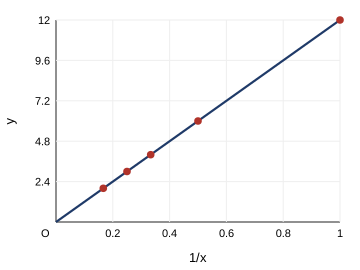
Example (textbook p. 22): test by multiplying
Workers x: 2, 3, 4, 5, 6; time t: 180, 120, 90, 72, 60.xt = 360 each time (constant). x²t = 720, 1 080, 1 440 … (not constant).
So t ∝ 1/x.
Example (textbook p. 23): y ∝ 1/√x
y = 3 when x = 0.25. Find y in terms of x.y = k/√x, 3 = k/0.5, k = 1.5. y = 1.5/√x
Example: finding a value
p varies inversely as q. p = 2 when q = 7. Find p when q = 1.6.pq = k = 14. So p = 14 ÷ 1.6 = 8.75.
For inverse variation you can use p₁q₁ = p₂q₂ directly. For y ∝ 1/x² use x₁²y₁ = x₂²y₂.
Do not mix up the two. In direct variation the ratio y/xn is constant. In inverse variation the product xny is constant.
g varies inversely as the cube of h. g = 0.5 when h = 2. Find h when g = 0.032.
Show answerHide answer
g = k/h³, 0.5 = k/8, k = 4.
0.032 = 4/h³, h³ = 125, h = 5
0.032 = 4/h³, h³ = 125, h = 5
Problems: Boyle's law
Example (textbook p. 25): gas in a cylinder
At a fixed temperature the pressure p of a gas varies inversely as its volume V. p = 190.25 kPa when V = 80 cm³.k = pV = 190.25 × 80 = 15 220. When p = 121.76, V = 15 220 ÷ 121.76 = 125 cm³.
1.3Combined variation
Combined variation mixes direct (or joint) variation with inverse variation. "y varies directly as x and inversely as z" is y ∝ x/z, so y = kx/z.
| Statement | Relation |
|---|---|
| w varies directly as the cube of x and inversely as the cube root of z | w ∝ x³/∛z |
| A varies directly as distance s and inversely as the square of time t | A ∝ s/t², A = ks/t² |
Example (textbook p. 27): y ∝ x²/√z
y = 8 when x = 4 and z = 36. Express y in terms of x and z.8 = k(16)/6, so k = 48/16 = 3.
y = 3x²/√z
Example: finding two missing values
T varies directly as x² and inversely as y. T = 12 when x = 3 and y = 6.12 = k(9)/6, k = 8, so T = 8x²/y.
When x = 5, y = 4: T = 8(25)/4 = 50.
Keep the steps the same: relation, equation with k, substitute to find k, rewrite, substitute again. The values for "find k" and "find the answer" are always two different pairs.
y ∝ x/z². y = 4 when x = 6 and z = 3. Find y when x = 10 and z = 5.
Show answerHide answer
4 = k(6)/9, k = 6. y = 6x/z².
y = 6(10)/25 = 2.4
y = 6(10)/25 = 2.4
Summary
| Type | Relation | Equation | Constant |
|---|---|---|---|
| Direct | y ∝ xn | y = kxn | k = y/xn |
| Joint | y ∝ xmzn | y = kxmzn | k = y/(xmzn) |
| Inverse | y ∝ 1/xn | y = k/xn | k = xny |
| Combined | y ∝ xm/zn | y = kxm/zn | k = yzn/xm |