Consumer Mathematics: Insurance
What this chapter covers
- Explain the meaning of risk and the importance of insurance coverage, and name the types of life insurance and general insurance that protect different risks (3.1.1)
- Investigate, interpret and calculate insurance rates and premiums for life insurance and motor insurance, including No Claim Discount (3.1.2)
- Solve problems involving insurance, including deductible and co-insurance in property and health insurance (3.1.3)
3.1Risk and insurance coverage
Careful living cannot remove every risk: a road accident, a fire at home, a costly hospital bill. Insurance does not stop the loss from happening. It transfers the financial risk from the individual to an insurance company, so the family does not carry the whole burden alone.
Who does what
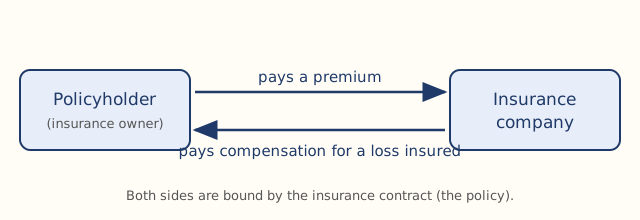
| Term | Meaning |
|---|---|
| Insurance company | The party that agrees to pay compensation for a loss covered in the policy |
| Policyholder | The insurance owner who pays the premium and claims compensation |
| Policy (contract) | The written agreement between the two parties |
| Premium | The money the policyholder pays to the insurance company |
Life insurance and general insurance
| Type | What it covers |
|---|---|
| Life insurance | Death, critical illness, and loss of ability (total and permanent disability). It protects the family who depend on the policyholder. |
| General insurance | Any loss or damage apart from the risks of life insurance. Coverage is usually for one year or less, and the premium is paid for each period of cover. |
| General insurance | Protects against |
|---|---|
| Motor | Loss or damage related to the use of a motor vehicle (compulsory for every vehicle in Malaysia) |
| Fire | Damage by fire, lightning and explosion at home or business premises; flood or riot can be added for an extra premium |
| Medical and health | Hospital and surgery costs, critical illness, disability or hospital income |
| Personal accident | Bodily injury, disability or death resulting directly from an accident |
| Travel | Losses while travelling: medical costs, lost luggage, passport or money, death |
Group insurance covers a group, such as employees of a company or pupils in school (for example the TPSM scheme for government school pupils).
Motor insurance policies
| Coverage | Act | Third party | Third party, fire and theft | Comprehensive |
|---|---|---|---|---|
| Injury or death of a third party | Yes | Yes | Yes | Yes |
| Loss of a third party's property | No | Yes | Yes | Yes |
| Own vehicle: fire or theft | No | No | Yes | Yes |
| Own vehicle: accident damage | No | No | No | Yes |
Show answer
3.2Insurance rates and premiums
Life insurance premium
The premium depends on the face value, age, gender and smoking status. The rate is given per RMx of face value.
The rate rises with age (life expectancy falls) and for smokers (higher chance of illness).
Premium = 100 000 ÷ 1 000 × 2.49 = RM249.00
Madam Shapuva, 36, non-smoker, buys RM250 000 (rate RM1.50) and adds critical illness cover of 30% of the face value (rate RM1.77).
Critical illness cover = 30% × 250 000 = RM75 000
Premium = 250 × 1.50 + 75 × 1.77 = 375 + 132.75 = RM507.75
Show answer
Motor insurance premium
Motor premiums follow the Motor Tariff, which sets the minimum premium by engine capacity, region, type of policy and (for comprehensive) the sum insured. Use the row whose engine capacity is the first one not less than the car's.
| Engine not exceeding (cc) | Comprehensive (RM) | Third party (RM) |
|---|---|---|
| 1 400 | 273.80 | 120.60 |
| 1 650 | 305.50 | 135.00 |
| 2 200 | 339.10 | 151.20 |
| 3 050 | 372.60 | 167.40 |
Peninsular Malaysia, extract from Schedule of Motor Tariff 2015 (textbook p. 83). Comprehensive rate is for the first RM1 000 of the sum insured.
- Comprehensive basic premium (Peninsular) = rate for the first RM1 000 + RM26 for each further RM1 000 (or part of it). For Sabah and Sarawak the extra is RM20.30.
- Third party, fire and theft basic premium = 75% of the comprehensive basic premium.
- Third party premium = the tariff figure for that engine size.
- Gross premium = basic premium − No Claim Discount (NCD). The NCD is a discount given when no claim was made during the policy period; it is lost when a claim is made.
Comprehensive: 305.50 + 26 × 59 = 305.50 + 1 534 = RM1 839.50. NCD = 0.25 × 1 839.50 = 459.88. Gross = RM1 379.62.
Third party, fire and theft: 0.75 × 1 839.50 = RM1 379.63; less NCD 344.91 = RM1 034.72.
Third party: 135.00 less NCD 33.75 = RM101.25.
Show answer
3.3Deductible and co-insurance
Some policies pay less than the actual loss. Two common provisions are deductible and co-insurance.
Deductible
| Loss (RM) | Claim? | Compensation (RM) |
|---|---|---|
| 2 800 | Yes | 2 800 − 300 = 2 500 |
| 250 | No (loss < deductible) | 0 |
| 400 | Yes | 400 − 300 = 100 |
Deductible is found in property, medical and motor insurance, but not in life or personal liability insurance. In motor insurance, a compulsory deductible of RM400 applies when the car is driven by an unnamed driver, a named driver under 21, or a holder of an L licence or a full licence of under 2 years.
Co-insurance in property insurance
| Situation | Compensation |
|---|---|
| Insured amount = required amount (partial loss) | loss − deductible |
| Insured amount < required amount (partial loss) | (insured ÷ required) × loss − deductible |
| Total loss | amount of insurance purchased − deductible |
The part of the loss you carry because you did not insure enough is the co-insurance penalty. The company never pays more than the actual loss or more than the sum insured.
Required = 0.80 × 350 000 = RM280 000.
Loss RM25 000, insured at RM150 000: (150 000 ÷ 280 000) × 25 000 − 2 000 = 13 392.86 − 2 000 = RM11 392.86. Penalty = 25 000 − 13 392.86 = RM11 607.14.
Total loss, insured at RM200 000: 200 000 − 2 000 = RM198 000.
Co-insurance in health insurance
A percentage participation clause such as 80/20 means the company pays 80% and the policyholder 20% of the covered cost after the deductible. There is no penalty in health insurance.
Company pays 0.75 × 20 100 = RM15 075.
Madam Chen pays 0.25 × 20 100 + 500 = RM5 525.
| Deductible | Co-insurance |
|---|---|
| A fixed amount paid first, whatever the benefit | A percentage share of the loss between you and the company |
Show answer
Choosing a policy
- Work out the total cover you need and avoid cover you do not need.
- Compare premiums and benefits (limits, days covered) from different companies.
- Read the terms and conditions before you agree.
Summary
| Remember | Key fact |
|---|---|
| Indemnity | Paid only up to the loss and the sum insured, never a profit |
| Life premium | (face value ÷ RMx) × rate |
| Comprehensive basic | First RM1 000 rate + RM26 per further RM1 000 (Sabah/Sarawak RM20.30) |
| TPFT basic | 75% of comprehensive basic |
| Gross premium | Basic − NCD |
| Deductible | Compensation = loss − deductible |
| Required insurance | Co-insurance % × insurable value |
| Under-insured | (insured ÷ required) × loss − deductible |
| Health co-insurance | (cost − deductible) shared, e.g. 80/20 |