Practice paper, not an official KPM paper
4531
Peperiksaan Percubaan SPM (Model)SPM Trial Examination (Model)
FizikPhysics
Tingkatan 5, 2 jam / 2 hours, 100 marks
Nama / Name
Kelas / Class
Tarikh / Date
Markah / Marks: / 100
Instructions
- Kertas soalan ini mengandungi empat bahagian: Bahagian A, Bahagian B, Bahagian C dan Bahagian D.This question paper consists of four sections: Section A, Section B, Section C and Section D.
- Bahagian A: pilih satu jawapan bagi setiap soalan. Bahagian B: jawab semua soalan. Bahagian C: jawab satu soalan sahaja. Bahagian D: jawab satu soalan sahaja.Section A: choose one answer for each question. Section B: answer all questions. Section C: answer one question only. Section D: answer one question only.
- Tunjukkan kerja mengira anda dan berikan jawapan numerik dengan unit yang betul. Rajah tidak dilukis mengikut skala kecuali dinyatakan.Show your working and give numerical answers with the correct units. Diagrams are not drawn to scale unless stated.
- Gunakan g = 9.81 m s⁻² kecuali dinyatakan. Jawapan boleh ditulis dalam Bahasa Melayu atau Bahasa Inggeris.Use g = 9.81 m s⁻² unless stated. Answers may be written in Bahasa Melayu or English.
- Anda dibenarkan menggunakan kalkulator saintifik.You may use a scientific calculator.
Answer schemes are in English (DLP).
Practice shows answers as you go. Exam times you and hides answers until you submit.
Bahagian ASection A
20 marksJawab semua soalan. Setiap soalan diikuti oleh empat pilihan jawapan, A, B, C dan D. Pilih satu jawapan sahaja.Answer all questions. Each question is followed by four options, A, B, C and D. Choose one answer only.
1
Question 1
Seorang penerjun payung terjun dan payung terjunnya mempunyai jisim 70 kg bersama-sama. Dia menurun dengan halaju malar. Apakah daya rintangan udara yang bertindak ke atasnya?A parachutist and parachute have a combined mass of 70 kg. The parachutist descends with a constant velocity. What is the air resistance acting on the parachutist?
Show answerHide answer
A
Constant velocity means zero resultant force, so air resistance equals the weight: 70 × 9.81 = 687 N, acting upwards against the weight.
2
Question 2
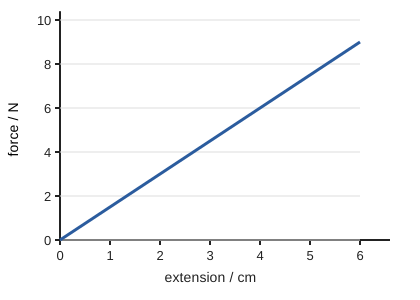
Rajah 1 menunjukkan graf daya F melawan pemanjangan x bagi sebuah spring. Berapakah kerja yang dilakukan untuk meregangkan spring itu daripada pemanjangan 2.0 cm kepada 6.0 cm?Diagram 1 shows the graph of force F against extension x for a spring. How much work is done to stretch the spring from an extension of 2.0 cm to 6.0 cm?
Show answerHide answer
B
Work done = area under the graph between 2.0 cm and 6.0 cm = ½ × (3 + 9) N × 0.04 m = 0.24 J. 0.27 J is the whole area from 0 to 6 cm.
3
Question 3
Spring X (pemalar spring 300 N m⁻¹) dan spring Y (pemalar spring 600 N m⁻¹) disambung secara siri dan menggantung beban 12 N. Berapakah jumlah pemanjangan kedua-dua spring itu?Spring X (spring constant 300 N m⁻¹) and spring Y (spring constant 600 N m⁻¹) are joined in series and support a load of 12 N. What is the total extension of the two springs?
Show answerHide answer
D
In series each spring carries the full 12 N: x = 12/300 + 12/600 = 0.040 + 0.020 = 0.060 m = 6.0 cm. 1.3 cm is the answer for parallel (12/900); 2.0 and 4.0 cm count only one spring.
4
Question 4
Apakah prinsip Pascal?What is Pascal's principle?
Show answerHide answer
C
Pascal's principle: pressure applied to an enclosed fluid is transmitted equally (uniformly) in all directions to every part of the fluid (textbook 2.4).
5
Question 5
Sebuah belon mempunyai isi padu 40 m³ dan diisi dengan helium berketumpatan 0.18 kg m⁻³. Jisim kain belon itu ialah 20 kg. Ketumpatan udara ialah 1.2 kg m⁻³. Apakah jisim beban maksimum tambahan yang boleh diangkat oleh belon itu?A balloon has a volume of 40 m³ and is filled with helium of density 0.18 kg m⁻³. The fabric of the balloon has a mass of 20 kg. The density of air is 1.2 kg m⁻³. What is the maximum extra load that the balloon can lift?
Show answerHide answer
A
Mass of air displaced = 1.2 × 40 = 48.0 kg (this is the lifting force in kg). Helium = 0.18 × 40 = 7.2 kg and fabric 20 kg. Load = 48.0 − 7.2 − 20 = 20.8 kg.
6
Question 6
Air mengalir secara mantap dalam sebuah paip mengufuk yang mempunyai bahagian lebar P dan bahagian sempit Q. Pernyataan manakah yang betul?Water flows steadily through a horizontal pipe that has a wide section P and a narrow section Q. Which statement is correct?
Show answerHide answer
D
Water must move faster through the narrow section to keep the flow rate the same; by Bernoulli's principle the pressure is lower where the speed is higher.
7
Question 7
Apakah d.g.e. bagi sebuah sel?What is the e.m.f. of a cell?
Show answerHide answer
B
E.m.f. is the energy transferred per unit charge by the source in driving the charge round a complete circuit, including the internal resistance (textbook 3.3.1).
8
Question 8
Sebuah pemanas berintangan 24 Ω disambung kepada bekalan 240 V. Berapakah tenaga elektrik yang digunakan oleh pemanas itu dalam masa 5.0 minit?A heater of resistance 24 Ω is connected to a 240 V supply. How much electrical energy does the heater use in 5.0 minutes?
Show answerHide answer
C
P = V²/R = 240²/24 = 2 400 W. E = Pt = 2 400 × 300 = 720 000 J = 720 kJ. 3.0 kJ comes from 10 A × 300 s = 3 000, which is the charge in coulombs, not energy.
9
Question 9
Sebuah bateri berd.g.e. 9.0 V memberikan beza keupayaan terminal 8.4 V apabila arus 2.0 A mengalir. Berapakah rintangan dalam bateri itu?A battery of e.m.f. 9.0 V gives a terminal potential difference of 8.4 V when a current of 2.0 A flows. What is the internal resistance of the battery?
Show answerHide answer
A
Lost volts = 9.0 − 8.4 = 0.6 V = Ir, so r = 0.6/2.0 = 0.30 Ω. 0.60 Ω forgets to divide by the current; 4.2 Ω is the external resistance.
10
Question 10
Sebuah mentol berlabel 12 V, 6 W dan sebuah mentol berlabel 12 V, 24 W disambung secara siri kepada bekalan 12 V. Apakah yang diperhatikan?A bulb labelled 12 V, 6 W and a bulb labelled 12 V, 24 W are connected in series to a 12 V supply. What is observed?
Show answerHide answer
C
R = V²/P: the 6 W bulb has 24 Ω and the 24 W bulb has 6 Ω. In series the current is the same (0.40 A) and P = I²R, so the 6 W bulb dissipates 3.84 W and the 24 W bulb only 0.96 W.
11
Question 11
Apakah hukum Lenz?What is Lenz's law?
Show answerHide answer
D
Lenz's law: the induced current flows in a direction that opposes the change producing it (a consequence of conservation of energy).
12
Question 12
Sebuah transformer unggul mempunyai 2 000 lilitan gegelung primer dan 100 lilitan gegelung sekunder. Voltan primer ialah 240 V. Sebuah lampu 36 W beroperasi dengan normal pada gegelung sekunder. Berapakah arus dalam gegelung primer?An ideal transformer has 2 000 turns in its primary coil and 100 turns in its secondary coil. The primary voltage is 240 V. A 36 W lamp works normally from the secondary coil. What is the current in the primary coil?
Show answerHide answer
B
For an ideal transformer, input power = output power: I_p = 36 ÷ 240 = 0.15 A. (The secondary voltage is 12 V and the secondary current is 3.0 A.)
13
Question 13
Gegelung sebuah penjana a.u. diputarkan dengan laju dua kali ganda berbanding sebelumnya. Bagaimanakah nilai puncak d.g.e. dan frekuensi keluaran berubah?The coil of an a.c. generator is turned at twice its previous speed. How do the peak e.m.f. and the frequency of the output change?
Show answerHide answer
A
A faster rotation cuts the magnetic field lines at a faster rate, so the induced e.m.f. doubles, and the coil completes twice as many revolutions each second, so the frequency doubles.
14
Question 14
Satu alur elektron bergerak ke kanan secara mengufuk di antara dua plat selari mengufuk. Plat atas ialah plat positif dan plat bawah ialah plat negatif. Bagaimanakah alur elektron itu bergerak?A beam of electrons travels horizontally to the right between two horizontal parallel plates. The upper plate is positive and the lower plate is negative. How does the beam move?
Show answerHide answer
C
Cathode rays are streams of negatively charged electrons, so they are attracted towards the positive plate and bend upwards.
15
Question 15
Sebutir elektron dipecutkan dari keadaan rehat melalui beza keupayaan 1 500 V dalam vakum. Berapakah tenaga kinetik yang diperoleh elektron itu? [Cas elektron = 1.60 × 10⁻¹⁹ C]An electron is accelerated from rest through a potential difference of 1 500 V in a vacuum. What kinetic energy does the electron gain? [Charge of an electron = 1.60 × 10⁻¹⁹ C]
Show answerHide answer
D
Kinetic energy = eV = 1.60 × 10⁻¹⁹ × 1 500 = 2.4 × 10⁻¹⁶ J.
16
Question 16
Dalam sebuah transistor npn yang berfungsi sebagai amplifier arus, arus tapak ialah 40 μA dan arus pengumpul ialah 2.0 mA. Apakah faktor penggandaan amplifier dan arus pengeluar?In an npn transistor working as a current amplifier, the base current is 40 μA and the collector current is 2.0 mA. What are the current amplification factor and the emitter current?
Show answerHide answer
B
Amplification factor = I_C/I_B = 2.0 mA ÷ 0.040 mA = 50. Emitter current I_E = I_B + I_C = 0.04 + 2.0 = 2.04 mA.
17
Question 17
Satu nukleus berenombor nukleon 232 dan nombor proton 90 mengalami dua reputan alfa dan satu reputan beta. Apakah nombor nukleon dan nombor proton nukleus yang terhasil?A nucleus with nucleon number 232 and proton number 90 undergoes two alpha decays and one beta decay. What are the nucleon number and proton number of the resulting nucleus?
Show answerHide answer
A
Each alpha decay lowers the nucleon number by 4 and the proton number by 2: 232 − 8 = 224, 90 − 4 = 86. A beta decay raises the proton number by 1 and leaves the nucleon number unchanged: 224 and 87.
18
Question 18
Dalam suatu tindak balas pelakuran, jumlah jisim bahan tindak balas ialah 5.03015 u dan jumlah jisim hasil ialah 5.01127 u. Berapakah tenaga yang dibebaskan? [1 u = 1.66 × 10⁻²⁷ kg; c = 3.00 × 10⁸ m s⁻¹]In a fusion reaction the total mass of the reactants is 5.03015 u and the total mass of the products is 5.01127 u. How much energy is released? [1 u = 1.66 × 10⁻²⁷ kg; c = 3.00 × 10⁸ m s⁻¹]
Show answerHide answer
C
Mass defect = 5.03015 − 5.01127 = 0.01888 u = 0.01888 × 1.66 × 10⁻²⁷ = 3.13 × 10⁻²⁹ kg. E = mc² = 3.13 × 10⁻²⁹ × (3.00 × 10⁸)² = 2.82 × 10⁻¹² J.
19
Question 19
Elektron yang dipecutkan melalui beza keupayaan V mempunyai panjang gelombang de Broglie λ. Apakah panjang gelombang de Broglie jika beza keupayaan pemecut dijadikan 4V?Electrons accelerated through a potential difference V have a de Broglie wavelength λ. What is the de Broglie wavelength if the accelerating potential difference is changed to 4V?
Show answerHide answer
B
eV = ½mv² gives p = mv = √(2meV), and λ = h/p, so λ ∝ 1/√V. When V becomes 4V, λ becomes λ/√4 = λ/2.
20
Question 20
Cahaya berpanjang gelombang 400 nm menyinari satu logam yang fungsi kerjanya 2.0 eV. Berapakah tenaga kinetik maksimum fotoelektron? [hc = 1 240 eV nm]Light of wavelength 400 nm shines on a metal whose work function is 2.0 eV. What is the maximum kinetic energy of the photoelectrons? [hc = 1 240 eV nm]
Show answerHide answer
D
Photon energy = hc/λ = 1 240 ÷ 400 = 3.10 eV. K_max = hf − W = 3.10 − 2.0 = 1.10 eV.
Bahagian BSection B
40 marksJawab semua soalan. Tunjukkan kerja mengira anda.Answer all questions. Show your working.
21
Question 21
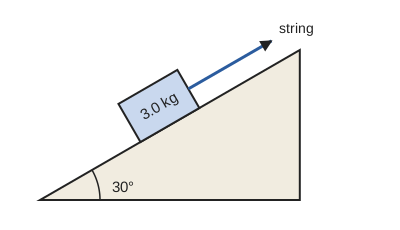
Rajah 2 menunjukkan sebuah blok berjisim 3.0 kg ditarik ke atas sepanjang satah condong licin yang condong 30° kepada mengufuk oleh seutas tali yang selari dengan satah itu. Blok itu bergerak dengan halaju malar.Diagram 2 shows a block of mass 3.0 kg being pulled up a smooth plane inclined at 30° to the horizontal by a string parallel to the plane. The block moves with a constant velocity.
[1 mark]
(a)Hitung berat blok itu.Calculate the weight of the block.
Show answerHide answer
Tick each point you got.
[2 marks]
(b)Hitung komponen berat blok yang selari dengan satah condong.Calculate the component of the weight of the block parallel to the inclined plane.
Show answerHide answer
Tick each point you got.
[2 marks]
(c)Nyatakan tegangan tali dan beri satu sebab bagi jawapan anda.State the tension in the string and give one reason for your answer.
Show answerHide answer
Tick each point you got.
[2 marks]
(d)Hitung tindak balas normal yang bertindak ke atas blok itu.Calculate the normal reaction acting on the block.
Show answerHide answer
Tick each point you got.
[2 marks]
(e)Tali itu tiba-tiba terputus. Hitung pecutan blok itu.The string suddenly breaks. Calculate the acceleration of the block.
Show answerHide answer
Tick each point you got.
[1 mark]
(f)Satah itu digantikan dengan satah kasar. Tegangan tali yang diperlukan untuk menarik blok itu dengan halaju malar ialah __________ berbanding sebelum ini.The plane is replaced with a rough plane. The tension needed to pull the block at a constant velocity is __________ compared with before.
Show answerHide answer
greater
Friction acts down the slope as well, so the tension must balance both the component of the weight and the friction.
22
Question 22
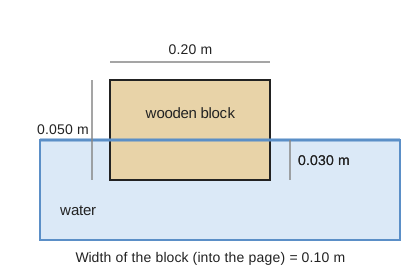
Rajah 3 menunjukkan sebuah blok kayu berbentuk kuboid terapung dalam air. Blok itu mempunyai panjang 0.20 m, lebar 0.10 m dan tinggi 0.050 m. Tinggi blok di bawah permukaan air ialah 0.030 m. [Ketumpatan air = 1 000 kg m⁻³]Diagram 3 shows a cuboid wooden block floating in water. The block has a length of 0.20 m, a width of 0.10 m and a height of 0.050 m. The height of the block below the water surface is 0.030 m. [Density of water = 1 000 kg m⁻³]
[1 mark]
(a)Nyatakan prinsip Archimedes.State Archimedes' principle.
Show answerHide answer
Tick each point you got.
[2 marks]
(b)Hitung isi padu air yang disesarkan oleh blok itu.Calculate the volume of water displaced by the block.
Show answerHide answer
Tick each point you got.
[2 marks]
(c)Hitung daya apung yang bertindak ke atas blok itu.Calculate the buoyant force acting on the block.
Show answerHide answer
Tick each point you got.
[2 marks]
(d)Tentukan berat dan jisim blok kayu itu.Determine the weight and the mass of the wooden block.
Show answerHide answer
Tick each point you got.
[1 mark]
(e)Hitung ketumpatan kayu itu.Calculate the density of the wood.
Show answerHide answer
Tick each point you got.
[2 marks]
(f)Blok yang sama diapungkan dalam cecair X dan tinggi 0.040 m berada di bawah permukaan cecair. Hitung ketumpatan cecair X.The same block is floated in liquid X and a height of 0.040 m is below the surface of the liquid. Calculate the density of liquid X.
Show answerHide answer
Tick each point you got.
23
Question 23
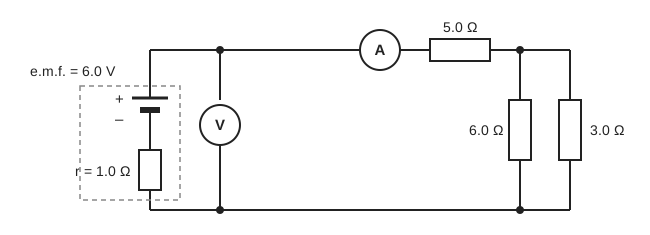
Rajah 4 menunjukkan satu litar yang mengandungi sel berd.g.e. 6.0 V dan rintangan dalam 1.0 Ω, sebuah ammeter, sebuah voltmeter dan tiga perintang.Diagram 4 shows a circuit containing a cell of e.m.f. 6.0 V and internal resistance 1.0 Ω, an ammeter, a voltmeter and three resistors.
[2 marks]
(a)Hitung rintangan berkesan bagi perintang 6.0 Ω dan 3.0 Ω yang disambung selari.Calculate the effective resistance of the 6.0 Ω and 3.0 Ω resistors connected in parallel.
Show answerHide answer
Tick each point you got.
[3 marks]
(b)Hitung bacaan ammeter.Calculate the reading of the ammeter.
Show answerHide answer
Tick each point you got.
[2 marks]
(c)Hitung bacaan voltmeter.Calculate the reading of the voltmeter.
Show answerHide answer
Tick each point you got.
[2 marks]
(d)Hitung arus yang mengalir melalui perintang 3.0 Ω.Calculate the current through the 3.0 Ω resistor.
Show answerHide answer
Tick each point you got.
[1 mark]
(e)Mengapakah bacaan voltmeter kurang daripada d.g.e. sel itu?Why is the reading of the voltmeter less than the e.m.f. of the cell?
Show answerHide answer
Tick each point you got.
24
Question 24
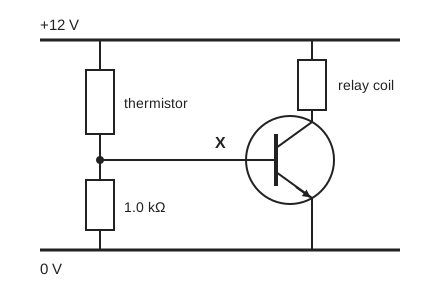
Rajah 5 menunjukkan satu litar suis automatik yang menghidupkan kipas penyejuk dalam sebuah bilik pelayan apabila suhu naik. Termistor ialah jenis yang rintangannya berkurang apabila suhu meningkat. Transistor silikon itu hidup apabila beza keupayaan tapak-pengeluar mencapai 0.7 V.Diagram 5 shows an automatic switch circuit that turns on a cooling fan in a server room when the temperature rises. The thermistor is the type whose resistance decreases when its temperature rises. The silicon transistor turns on when the base-emitter potential difference reaches 0.7 V.
[1 mark]
(a)Apakah jenis transistor dalam Rajah 5?What type of transistor is shown in Diagram 5?
Show answerHide answer
npn
The arrow on the emitter points outwards (away from the base), which is the symbol of an npn transistor.
[1 mark]
(b)Namakan terminal X.Name terminal X.
Show answerHide answer
Base
X is joined to the middle of the potential divider and controls the transistor: it is the base.
[1 mark]
(c)Apabila suhu bilik meningkat, rintangan termistor __________ dan beza keupayaan merentasi perintang 1.0 kΩ __________.When the room temperature rises, the resistance of the thermistor __________ and the potential difference across the 1.0 kΩ resistor __________.
Show answerHide answer
decreases, increases
A lower thermistor resistance leaves a larger share of the 12 V across the 1.0 kΩ resistor.
[3 marks]
(d)Pada suhu bilik yang sejuk, rintangan termistor ialah 30 kΩ. Hitung beza keupayaan di X dan nyatakan sama ada kipas berfungsi.When the room is cool, the resistance of the thermistor is 30 kΩ. Calculate the potential difference at X and state whether the fan works.
Show answerHide answer
Tick each point you got.
[2 marks]
(e)Pada suhu tinggi, rintangan termistor ialah 5.0 kΩ. Terangkan bagaimana kipas dihidupkan.At a high temperature the resistance of the thermistor is 5.0 kΩ. Explain how the fan is turned on.
Show answerHide answer
Tick each point you got.
[2 marks]
(f)Hitung rintangan maksimum termistor supaya transistor dapat hidup.Calculate the maximum resistance of the thermistor at which the transistor turns on.
Show answerHide answer
Tick each point you got.
Bahagian CSection C
20 marksJawab satu soalan sahaja daripada Soalan 25 dan Soalan 26. Setiap soalan bernilai 20 markah.Answer one question only from Question 25 and Question 26. Each question carries 20 marks.
25Choose 1
Question 25
Soalan 25. Sebuah pengecas telefon pintar mengandungi transformer yang menurunkan voltan 240 V a.u. kepada 9.0 V a.u. Pengubah itu mempunyai 2 400 lilitan pada gegelung primer.Question 25. A smartphone charger contains a transformer that steps down 240 V a.c. to 9.0 V a.c. The transformer has 2 400 turns in its primary coil.
[3 marks]
(a)Terangkan bagaimana transformer menghasilkan voltan dalam gegelung sekunder.Explain how the transformer produces a voltage in the secondary coil.
Show answerHide answer
Tick each point you got.
[4 marks]
(b)Anggap transformer itu unggul dan memberi keluaran 1.5 A pada 9.0 V. Hitung (i) bilangan lilitan pada gegelung sekunder, (ii) arus dalam gegelung primer.Assume the transformer is ideal and gives an output of 1.5 A at 9.0 V. Calculate (i) the number of turns in the secondary coil, (ii) the current in the primary coil.
Show answerHide answer
Tick each point you got.
[6 marks]
(c)Dalam transformer sebenar, kuasa input ialah 16.2 W dan kuasa output ialah 13.5 W. Hitung kecekapan transformer itu dan nyatakan dua sebab kehilangan tenaga serta cara mengurangkan setiap satu.In the real transformer the input power is 16.2 W and the output power is 13.5 W. Calculate the efficiency of the transformer and state two causes of energy loss, with a way to reduce each.
Show answerHide answer
Any of these points, up to 6 marks
Tick each point you got.
[4 marks]
(d)Stesen janakuasa menghantar 100 kW kuasa melalui kabel yang rintangan keseluruhannya 2.0 Ω. Hitung arus dalam kabel dan kuasa yang hilang sebagai haba apabila kuasa dihantar pada (i) 5 000 V, (ii) 500 V.A power station sends 100 kW of power through cables whose total resistance is 2.0 Ω. Calculate the current in the cables and the power lost as heat when the power is transmitted at (i) 5 000 V, (ii) 500 V.
Show answerHide answer
Tick each point you got.
[3 marks]
(e)Seorang murid berkata, "Lebih baik menggunakan kabel kuprum yang sangat tebal pada 240 V daripada menggunakan transformer injak naik." Nilaikan pernyataan itu.A student says, "It is better to use very thick copper cables at 240 V than to use step-up transformers." Evaluate the statement.
Show answerHide answer
Tick each point you got.
26Choose 1
Question 26
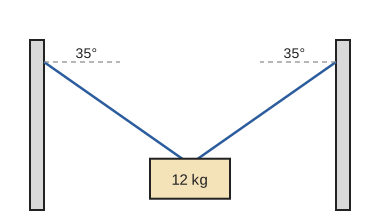
Soalan 26. Rajah 6 menunjukkan sebuah papan tanda berjisim 12 kg yang digantung dalam keadaan pegun oleh dua kabel yang sama pada dua tiang yang sama tinggi. Setiap kabel membuat sudut 35° dengan garis mengufuk.Question 26. Diagram 6 shows a sign of mass 12 kg hung at rest by two identical cables from two poles of the same height. Each cable makes an angle of 35° with the horizontal.
[2 marks]
(a)Nyatakan syarat supaya papan tanda itu berada dalam keseimbangan dan namakan daya-daya yang bertindak ke atasnya.State the condition for the sign to be in equilibrium and name the forces acting on it.
Show answerHide answer
Tick each point you got.
[4 marks]
(b)Hitung tegangan dalam setiap kabel.Calculate the tension in each cable.
Show answerHide answer
Tick each point you got.
[4 marks]
(c)Kabel dikencangkan supaya setiap kabel membuat sudut 20° dengan garis mengufuk. Terangkan perubahan tegangan itu dan hitung tegangan baharu.The cables are tightened so that each makes an angle of 20° with the horizontal. Explain how the tension changes and calculate the new tension.
Show answerHide answer
Tick each point you got.
[3 marks]
(d)Sebuah spring penyerap hentak sebuah kenderaan mempunyai pemalar spring 2.0 × 10⁴ N m⁻¹ dan dimampatkan sebanyak 0.050 m. Hitung daya mampatan dan tenaga keupayaan kenyal yang tersimpan.A shock absorber spring of a vehicle has a spring constant of 2.0 × 10⁴ N m⁻¹ and is compressed by 0.050 m. Calculate the compressing force and the elastic potential energy stored.
Show answerHide answer
Tick each point you got.
[3 marks]
(e)Seorang murid berjisim 60 kg berdiri di atas penimbang dalam sebuah lif yang memecut ke atas dengan pecutan 1.5 m s⁻². Hitung bacaan penimbang itu dalam newton.A student of mass 60 kg stands on a weighing scale in a lift that accelerates upwards at 1.5 m s⁻². Calculate the reading of the scale in newtons.
Show answerHide answer
Tick each point you got.
[4 marks]
(f)Sebuah van berat 8 000 N disokong oleh empat spring yang sama. Reka bentuk X menggunakan spring berpemalar 2.0 × 10⁴ N m⁻¹ dan reka bentuk Y menggunakan spring berpemalar 8.0 × 10⁴ N m⁻¹. Ruang yang ada hanya membenarkan setiap spring termampat sebanyak 0.060 m. Hitung mampatan setiap spring dan nilaikan reka bentuk yang sesuai.A van of weight 8 000 N is supported by four identical springs. Design X uses springs of spring constant 2.0 × 10⁴ N m⁻¹ and design Y uses springs of spring constant 8.0 × 10⁴ N m⁻¹. The space available allows each spring to compress by 0.060 m at most. Calculate the compression of each spring and evaluate which design is suitable.
Show answerHide answer
Tick each point you got.
Bahagian DSection D
20 marksJawab satu soalan sahaja daripada Soalan 27 dan Soalan 28. Setiap soalan bernilai 20 markah.Answer one question only from Question 27 and Question 28. Each question carries 20 marks.
27Choose 1
Question 27
Soalan 27. Iodin-131 (13153I) ialah bahan radioaktif yang digunakan dalam perubatan. Jadual 1 menunjukkan keaktifan satu sampel iodin-131 pada masa yang berbeza.
Jadual 1 / Table 1Question 27. Iodine-131 (13153I) is a radioactive substance used in medicine. Table 1 shows the activity of a sample of iodine-131 at different times.
| Masa / Time (hari / days) | 0 | 4 | 8 | 12 | 16 |
|---|---|---|---|---|---|
| Keaktifan / Activity (Bq) | 1 600 | 1 131 | 800 | 566 | 400 |
[1 mark]
(a)Apakah maksud separuh hayat?What is meant by half-life?
Show answerHide answer
Tick each point you got.
[2 marks]
(b)Reputan radioaktif ialah proses rawak dan spontan. Terangkan maksud rawak dan spontan.Radioactive decay is a random and spontaneous process. Explain the meaning of random and spontaneous.
Show answerHide answer
Tick each point you got.
[2 marks]
(c)Iodin-131 mereput melalui pemancaran zarah beta kepada xenon (Xe). Tulis persamaan reputan itu.Iodine-131 decays by emitting a beta particle to form xenon (Xe). Write the decay equation.
Show answerHide answer
Tick each point you got.
[2 marks]
(d)Tentukan separuh hayat iodin-131 daripada Jadual 1.Determine the half-life of iodine-131 from Table 1.
Show answerHide answer
Tick each point you got.
[2 marks]
(e)Hitung keaktifan sampel itu selepas 40 hari.Calculate the activity of the sample after 40 days.
Show answerHide answer
Tick each point you got.
[2 marks]
(f)Sampel itu pada mulanya mengandungi 64 μg iodin-131. Berapakah jisim iodin-131 yang belum mereput selepas 32 hari?The sample first contained 64 μg of iodine-131. What mass of iodine-131 has not decayed after 32 days?
Show answerHide answer
Tick each point you got.
[4 marks]
(g)Dalam sebuah reaktor, satu nukleus uranium-235 menyerap neutron dan membelah: ²³⁵U + n → ¹⁴⁴Ba + ⁸⁹Kr + 3n. Jisim bahan tindak balas ialah 236.0526 u dan jisim hasil ialah 235.8668 u. Hitung cacat jisim dan tenaga yang dibebaskan dalam joule. [1 u = 1.66 × 10⁻²⁷ kg; c = 3.00 × 10⁸ m s⁻¹]In a reactor a uranium-235 nucleus absorbs a neutron and splits: ²³⁵U + n → ¹⁴⁴Ba + ⁸⁹Kr + 3n. The mass of the reactants is 236.0526 u and the mass of the products is 235.8668 u. Calculate the mass defect and the energy released in joules. [1 u = 1.66 × 10⁻²⁷ kg; c = 3.00 × 10⁸ m s⁻¹]
Show answerHide answer
Tick each point you got.
[5 marks]
(h)Nyatakan fungsi rod kawalan dalam reaktor nuklear. Seterusnya, nilaikan sama ada tenaga nuklear lebih baik daripada arang batu sebagai sumber tenaga elektrik.State the function of the control rods in a nuclear reactor. Then evaluate whether nuclear energy is better than coal as a source of electrical energy.
Show answerHide answer
Tick each point you got.
28Choose 1
Question 28
Soalan 28. Satu eksperimen fotoelektrik menggunakan cahaya monokromatik berfrekuensi berlainan pada permukaan satu logam. Jadual 2 menunjukkan tenaga kinetik maksimum Kmaks fotoelektron.
Jadual 2 / Table 2
[h = 6.63 × 10⁻³⁴ J s; c = 3.00 × 10⁸ m s⁻¹; jisim elektron / mass of an electron = 9.11 × 10⁻³¹ kg]Question 28. A photoelectric experiment uses monochromatic light of different frequencies on the surface of a metal. Table 2 shows the maximum kinetic energy Kmax of the photoelectrons.
| f / 10¹⁴ Hz | 6.0 | 7.0 | 8.0 | 9.0 |
|---|---|---|---|---|
| Kmaks (Kmax) / 10⁻¹⁹ J | 0.68 | 1.34 | 2.00 | 2.67 |
[h = 6.63 × 10⁻³⁴ J s; c = 3.00 × 10⁸ m s⁻¹; jisim elektron / mass of an electron = 9.11 × 10⁻³¹ kg]Question 28. A photoelectric experiment uses monochromatic light of different frequencies on the surface of a metal. Table 2 shows the maximum kinetic energy Kmax of the photoelectrons.
[2 marks]
(a)Takrifkan fungsi kerja dan frekuensi ambang.Define work function and threshold frequency.
Show answerHide answer
Tick each point you got.
[2 marks]
(b)Cahaya sangat terang berfrekuensi 4.0 × 10¹⁴ Hz tidak menyebabkan pancaran fotoelektron daripada logam itu. Terangkan mengapa.A very bright light of frequency 4.0 × 10¹⁴ Hz does not cause emission of photoelectrons from the metal. Explain why.
Show answerHide answer
Tick each point you got.
[3 marks]
(c)Gunakan Jadual 2 untuk menentukan nilai pemalar Planck.Use Table 2 to determine the value of Planck's constant.
Show answerHide answer
Tick each point you got.
[3 marks]
(d)Tentukan fungsi kerja logam itu dalam joule dan frekuensi ambangnya.Determine the work function of the metal in joules and its threshold frequency.
Show answerHide answer
Tick each point you got.
[3 marks]
(e)Cahaya berpanjang gelombang 400 nm disinarkan pada logam itu. Hitung tenaga kinetik maksimum fotoelektron.Light of wavelength 400 nm is shone on the metal. Calculate the maximum kinetic energy of the photoelectrons.
Show answerHide answer
Tick each point you got.
[2 marks]
(f)Hitung laju maksimum fotoelektron dalam (e).Calculate the maximum speed of the photoelectrons in (e).
Show answerHide answer
Tick each point you got.
[2 marks]
(g)Hitung panjang gelombang de Broglie bagi elektron yang bergerak pada laju maksimum itu.Calculate the de Broglie wavelength of an electron moving at that maximum speed.
Show answerHide answer
Tick each point you got.
[3 marks]
(h)Seorang murid berkata, "Jika cahaya ungu yang lebih terang digunakan, fotoelektron akan bergerak lebih laju." Nilaikan pernyataan itu.A student says, "If a brighter violet light is used, the photoelectrons will move faster." Evaluate the statement.
Show answerHide answer
Tick each point you got.
Test specification (JSU)
| Chapter | Remembering | Understanding | Applying | Analysing | Evaluating | Creating | Items | marks |
|---|---|---|---|---|---|---|---|---|
| 1. Force and Motion II | – | 1 (1) | 3 (31) | 1 (1) | – | – | 5 | 33 |
| 2. Pressure | 1 (1) | 1 (1) | 2 (11) | – | – | – | 4 | 13 |
| 3. Electricity | 1 (1) | – | 3 (12) | 1 (1) | – | – | 5 | 14 |
| 4. Electromagnetism | 1 (1) | 1 (1) | 1 (1) | – | 1 (20) | – | 4 | 23 |
| 5. Electronics | – | 1 (1) | 2 (2) | 1 (10) | – | – | 4 | 13 |
| 6. Nuclear Physics | – | – | 2 (2) | – | 1 (20) | – | 3 | 22 |
| 7. Quantum Physics | – | – | 1 (1) | 1 (1) | 1 (20) | – | 3 | 22 |
| Total | 3 (3) | 4 (4) | 14 (60) | 4 (13) | 3 (60) | 0 (0) | 28 | 140 |
Each cell shows items (marks).